Modern Management of Case Sleep Disorders 58 yr. old WF with - - PowerPoint PPT Presentation

modern management of case sleep disorders
SMART_READER_LITE
LIVE PREVIEW

Modern Management of Case Sleep Disorders 58 yr. old WF with - - PowerPoint PPT Presentation

Modern Management of Case Sleep Disorders 58 yr. old WF with >4 yr. of poor sleep Douglas C. Bauer, MD Sound asleep by 9-10 PM, but difficulty with University of California, maintenance of sleep, often awake at 3 AM. San


slide-1
SLIDE 1

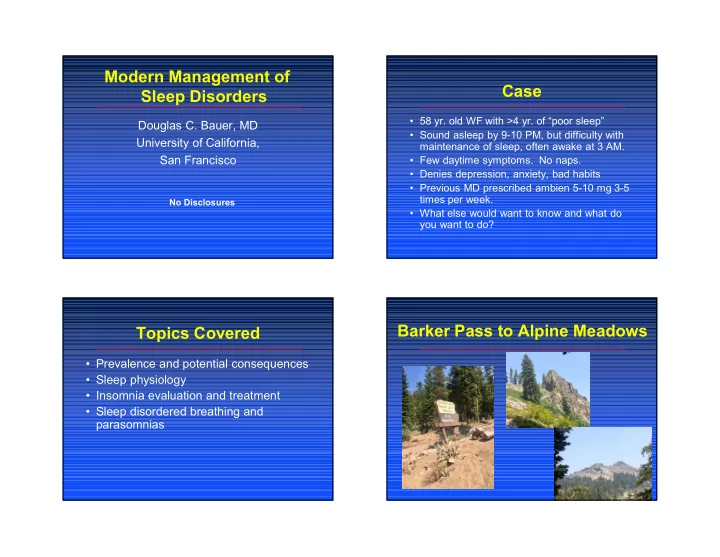
Modern Management of Sleep Disorders

Douglas C. Bauer, MD University of California, San Francisco

No Disclosures

Case

  • 58 yr. old WF with >4 yr. of “poor sleep”
  • Sound asleep by 9-10 PM, but difficulty with

maintenance of sleep, often awake at 3 AM.

  • Few daytime symptoms. No naps.
  • Denies depression, anxiety, bad habits
  • Previous MD prescribed ambien 5-10 mg 3-5

times per week.

  • What else would want to know and what do

you want to do?

Topics Covered

  • Prevalence and potential consequences
  • Sleep physiology
  • Insomnia evaluation and treatment
  • Sleep disordered breathing and

parasomnias

Barker Pass to Alpine Meadows

slide-2
SLIDE 2

Sleep Disorders

  • Sleep per night: 9 hr in 1910, 6.9 hr now
  • 40 million in US suffer from sleep disorders
  • 95% are undiagnosed and untreated
  • Prevalence of sleep disorders higher in

women and increases with age

  • Frequent complaint in primary care…

Percent Reporting Symptoms

  • f Insomnia

0% 5% 10% 15% 20% 25% 30% 35% Almost Every Night Few times/week Few times/month Rarely/Never

2002 ‘Sleep in America’ poll, National Sleep Foundation

Definitions

  • Insomnia (insufficient or poor quality sleep)

– Latency (time to fall asleep) – Efficiency (proportion of time in bed asleep)

  • Hypersomnia (excessive daytime sleepiness)
  • Sleep disordered breathing/sleep apnea
  • Narcolepsy
  • Parasomnia (coordinated motor activity)
  • Restless leg syndrome

Sleep Architecture

  • REM (Rapid Eye Movement)
  • Characteristic eye movement
  • EEG resembles wakefulness
  • Non REM
  • 75% of sleep
  • Four stages: correlate with depth of sleep
  • Progressive cortical inactivity
  • Sleep architecture changes over age 65
  • Reduced stage 3 and 4, phase advancement
  •  total time,  latency,  efficiency
slide-3
SLIDE 3

Special Populations: Insomnia in the Elderly and in Women

  • Elderly

– High prevalence (> 50%) – Secondary sleep disorder more common – Commonly associated with psychiatric disorders or depression

  • Women

– 50% more common than in men – Increases dramatically after menopause

Special Populations: Perimenopausal Women

  • Prospective study of >3000 women 42-52

followed for 7 yr (SWAN)

  • Sleep complaints worse in peri and

postmenopausal women (40% vs. 22%)

– Both initiation and maintenance of sleep impaired – Partly attributable to hot flushes – Improved but not fully reversed with HRT – Other neurocognitive effects? Kravitz et al, Sleep, 2008

Presentation and Screening for Insomnia

  • Typical presentation

– Difficulty initiating or maintaining sleep – Wake after sleep onset – Early morning awakening – Awakening not rested

  • Recommended screening question: “Do you

have trouble falling asleep or staying asleep?”

  • If positive, consider full sleep questionnaire

Name Date

Sleep Quality Assessment (PSQI)

What is PSQI, and what is it measuring?

The Pittsburgh Sleep Quality Index (PSQI) is an effective instrument used to measure the quality and patterns of sleep in adults. It differentiates “poor” from “good” sleep quality by measuring seven areas (components): subjective sleep quality, sleep latency, slee duration, habitual sleep efficiency, sleep disturbances, use of sleeping medications, and daytime dysfunction over the last month.

INSTRUCTIONS:

The following questions relate to your usual sleep habits during the past month only. Your answers should indicate the most accurate reply for the majority of days and nights in the past month. Please answer all questions.

During the past month,

1. When have you usually gone to bed? 2. How long (in minutes) has it taken you to fall asleep each night? 3. What time have you usually gotten up in the morning? 4.

  • A. How many hours of actual sleep did you get at night?
  • B. How many hours were you in bed?
  • 5. During the past month, how often have you had trouble sleeping because you

Not during the past month (0) Less than once a week (1) Once or twice a week (2) Three or more times a week (3)

  • A. Cannot get to sleep within 30 minutes
  • B. Wake up in the middle of the night or early morning
  • C. Have to get up to use the bathroom
  • D. Cannot breathe comfortably
  • E. Cough or snore loudly
  • F. Feel too cold
  • G. Feel too hot
  • H. Have bad dreams
  • I. Have pain
  • J. Other reason (s), please describe, including how often you have had trouble sleeping because of this reason (s):
  • 6. During the past month, how often have you taken medicine (prescribed or “over the counter”) to help you sleep?
  • 7. During the past month, how often have you had trouble staying awake while driving, eating meals, or engaging in social activity?
  • 8. During the past month, how much of a problem has it been for you to keep up enthusiasm to get things done?
  • 9. During the past month, how would you rate your sleep quality overall?

Very good (0) Fairly good (1) Fairly bad (2) Very bad (3)
slide-4
SLIDE 4

Medical Conditions That Cause Insomnia

  • Hyperthyroidism
  • Arthritis
  • Chronic renal failure
  • Chronic lung disease
  • Heart failure
  • Neurological disorders
  • Dementia/AD
  • Parkinson’s disease

Drugs That Cause Insomnia

  • Alcohol
  • CNS stimulants
  • Beta-blockers
  • Bronchodilators
  • Calcium channel

blockers

  • Corticosteroids
  • Decongestants
  • Stimulating

antidepressants

  • Thyroid hormones
  • Nicotine

Evaluation of Insomnia: History, Exam and Labs

  • General history and exam
  • Sleep pattern (patient and bedroom partner)
  • Insufficient sleep time
  • Delayed onset vs. frequent/early awakening
  • Associated nocturnal symptoms and

daytime symptoms

  • Lab testing: thyroid function, glucose, UA
  • Formal sleep study rarely indicated

Insomnia Therapies

Which of following is known to be superior to benzodiazepine receptor agonists for primary insomnia?

  • A. sleep hygiene instruction
  • B. cognitive behavioral therapy
  • C. anti-histamines
  • D. anti-depressants (TCA, SSRI,

and trazadone)

s l e e p h y g i e n e i n s t r u c t i

  • n

c

  • g

n i t i v e b e h a v i

  • r

a l t h . . . a n t i

  • h

i s t a m i n e s a n t i

  • d

e p r e s s a n t s ( T C A , S S . . .

54% 12% 4% 30%

slide-5
SLIDE 5

Treatment of Insomnia: Non-Pharmacologic

  • Treat underlying disorders
  • Document sleep patterns with Sleep Diary
  • Begin with non-pharmacologic treatment
  • Sleep education (changes with aging)
  • Sleep hygiene: diet, exercise, habits,

environment (e.g. computer screens)

  • Establish optimal sleep pattern

Cognitive Behavioral Therapy for Insomnia (CBTi)

  • Cognitive therapy

– Change maladaptive thought processes

  • Behavioral therapy

– Stimulus control, sleep restriction, relaxation, good sleep hygiene

  • RCT of 46 adults with chronic insomnia

– Superior short and long-term (6 mo)

  • utcomes with CBT compared to zopiclone
  • r placebo

Buysse et al, Arch Intern Med, 2011 Trauer et al, Annal Int Med, 2015

CBTi: Face-to-face Vs. Internet-based

  • Insufficient CBTi-trained therapists and may

not be covered by insurance

  • Internet-base CBTi

– More convenient, less expensive – Multiple vendors/programs – SHUTi Self Help extensively studied

  • 6 weekly 40 minute sessions, sleep diary feedback,

Fitbit integration ($150 for 26 wk access)

  • Not easy but if motivated…

SHUTi vs. Face-to-face CBT

slide-6
SLIDE 6

Treatment of Insomnia: Pharmacologic

  • Depression (use PHQ9)
  • TCA, trazadone, SSRI, combinations
  • Not recommended if not depressed
  • Anxiety, panic (use GAD-7)
  • Benzodiazepines, SRRI
  • Not recommended if not anxious
  • Primary insomnia: what to use?

Treatment of Insomnia: Pharmacologic

  • Problems with anti-histamines: anti-

cholinergic, sedation, cognitive dysfunction

  • Problems with benzodiazepines: habit

forming, tachyphylaxis, suppression of REM sleep, cognitive dysfunction, falls

  • Short-term benzodiazepine use (<2 wk) may

be helpful in some patients

  • Alternatives to benzodiazepines?
slide-7
SLIDE 7

Benzodiazepine Receptor Agonists

  • Zolpidem (generic), zaleplon (Sonata), eszopiclone

(Lunesta)

  • Activate 1 of 3 benzodiazepine receptors
  • No anxiolytic or muscle relaxing effects
  • Preserves REM, less tolerance and withdrawal
  • Rapid onset, half life 2-3 hours
  • Zolpidem dosing: limit to 3-4 times per wk, use 5 mg

in women and >65

– CR zolpidem if awakens too early with generic – Sublingual zolpidem (Intermezzo) for middle of the night

  • awakening. Note women 1.75 mg, men 3.5 mg

An unexpected side effect…

Other Drugs

  • Melatonin (OTC)
  • From pineal gland, receptors in hypothalamus
  • Poor evidence for insomnia, maybe for jet lag
  • r phase delay. Not regulated
  • Ramelteon (Rozerem)

– Melatonin receptor agonist for sleep onset – FDA approved but no long-term safety data

  • Suvorexant (Belsomra)

– Orexin receptor antagonist for sleep maintenance Buysse Jama 2017

Suggested Approach to Insomnia In Primary Care

Insomnia Acute <4 wks Chronic >4 wks Assess trigger Consider brief tx Secondary cause? Treat and reassess Primary? Hypersomia or parasomnia? Sleep hygiene CBTi Refer if persists Evaluate and treat

slide-8
SLIDE 8

Hypersominas: Sleep Apnea

  • Obstructive more common than central
  • Apnic episodes, loud snoring, choking, gasping

during sleep

  • Key feature: insomnia not common but usually

associated with daytime sleepiness

  • Risk factors include:
  • Older age
  • Male sex
  • Obesity
  • Craniofacial structure

Sleep Study Definition

  • f Sleep Apnea
  • Apnea = complete cessation of respiration
  • Hypopnea = partial decrease (>50%) of

respiration

  • Duration 10 seconds

 Respiratory Disturbance Index (RDI): – # apneas + hypopneas / hour while asleep – Normal RDI < 5, severe apnea  15

Prevalence of Sleep Disordered Breathing

  • Heavily dependent on definition used
  • 2-4% in younger adults (20-60 yrs)
  • > 10% in elderly

Consequences of Sleep Disordered Breathing

  • Impaired QOL
  • Increased risk of accidents & injuries
  • Mild cognitive impairment/dementia

– 85% increased risk if RDI>15 in older women

  • Increased risk of hypertension and

cardiovascular events

– Sleep Heart Study

Yaffe et al Jama, 2011

slide-9
SLIDE 9

Evaluation of Sleep Disorders: Sleep Studies

  • Polysomnography (oximetry, EEG, EKG, EMG,
  • bservation)
  • Home monitoring (oximetry + 1-2 others) if not

medically complicated

  • Indications
  • Unexplained hypersomnia (esp. with snoring)
  • Unexplained sleep-related CV abn (pulm HTN)
  • Abnormal complex sleep behavior
  • Unremitting chronic insomnia that

does not respond to therapy

ACP Guidelines, 2016

Other Causes of Hypersomnia: Narcolepsy

  • Extreme daytime sleepiness,

frequent brief naps, cataplexy

  • Rare, familial, presents in 20s and 30s
  • Requires sleep study and daytime

Multiple Sleep Latency Test (MSLT)

  • Treatment: stimulants, anticholinergics

Parasomnias: Restless Leg Syndrome

  • Intense dysesthesias, repetitive jerking
  • Worse at bedtime, frequently awakens patient
  • Often familial, progresses with age
  • Etiology unknown, associated with iron deficiency
  • Treatment

– Iron 325 mg/d if ferritin <75 mcg/L – Sinemet 25/100 qhs (70% respond) – Clonazepam 0.5-2 mg qhs – Dopamine agonists (rotingotine, pergolide, etc) effective but intolerance common Scholz et al, Cochrane Database, 2011

Conclusions

  • Sleep disorders common, particularly in women
  • Associated with significant morbidity
  • Primary care providers can diagnose and treat

most patients with insomnia

  • Drugs treatment over-utilized, non-pharmacologic

treatment often successful

  • CBTi is treatment of choice for insomnia
  • Specialty referral (sleep study) for selected

patients with unexplained hypersomnia or severe insomnia