Modern Electronic Structure: Modern Electronic Structure: many- - - PowerPoint PPT Presentation

modern electronic structure modern electronic structure
SMART_READER_LITE
LIVE PREVIEW

Modern Electronic Structure: Modern Electronic Structure: many- - - PowerPoint PPT Presentation

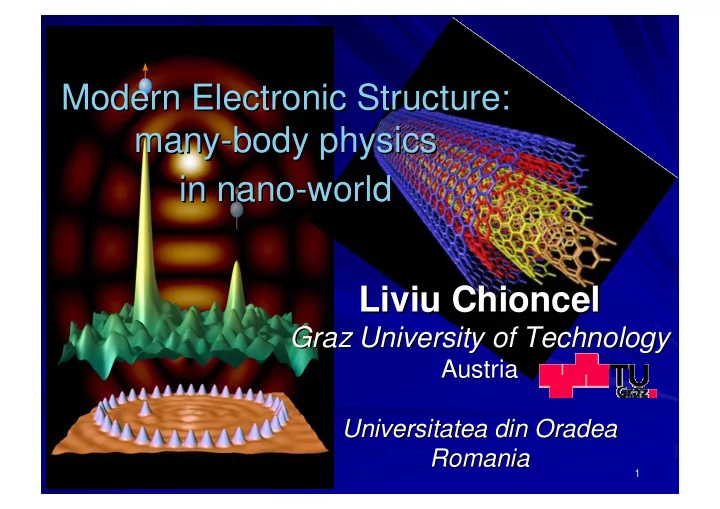
Modern Electronic Structure: Modern Electronic Structure: many- -body physics body physics many in nano nano- -world world in Liviu Chioncel Chioncel Liviu Graz University of Technology Graz University of Technology Austria Austria


slide-1
SLIDE 1

1 1

Liviu Liviu Chioncel Chioncel

Graz University of Technology Graz University of Technology

Austria Austria Universitatea din Oradea Universitatea din Oradea Romania Romania

Modern Electronic Structure: Modern Electronic Structure: many many-

  • body physics

body physics in in nano nano-

  • world

world

slide-2
SLIDE 2

2 2

Content Content

NANO scale NANO scale

– – More than just length and size More than just length and size

Electronic structure, Electronic structure,

– – Density Functional Theory, implementations Density Functional Theory, implementations

Many Many-

  • body physics and electronic structure

body physics and electronic structure

– – Dynamical Mean Field Theory (DMFT) Dynamical Mean Field Theory (DMFT)

Magnetism in nanosystems Magnetism in nanosystems

– – Molecular magnets Molecular magnets – – Surface states vs. Kondo effect Surface states vs. Kondo effect – – Correlated adatom on a metal surface Correlated adatom on a metal surface

slide-3
SLIDE 3

3 3

Nano Nano-

  • scales in every day life

scales in every day life

1 m 1 mm 1 µm 1 nm Humans Butterfly Laptop Visible Light Micromachines Microelectronic chips Size of an atom Proteins Width of DNA Biological cell Nucleus of a cell Car Boeing 747 Aircraft Carrier Microprocessor

  • Nanostr. & Quantum Devices

Resolving power of the eye ~ 0.2 mm

electron neutron proton

slide-4
SLIDE 4

4 4

Nano Nano-

  • scale in numbers

scale in numbers

Carbon nanotube Protein molecule Molecule

  • f DNA

Water molecules – 3 atoms thousands milions

H H O

slide-5
SLIDE 5

5 5

Development of Nanotechnology Development of Nanotechnology

Fundamental Understanding Characterization and Experimentation Modeling and Simulation Synthesis and Integration

Nano to Macro Inorganic and Organic Optical with Mechanical with Electrical with Magnetic with …

slide-6
SLIDE 6

6 6

Nanostructures Nanostructures ( (At least one dimension is between 1 At least one dimension is between 1 -

  • 100 nm)

100 nm)

2 2-

  • D structures (1

D structures (1-

  • D confinement):

D confinement):

– – Thin films Thin films – – Planar quantum wells Planar quantum wells – – Superlattices Superlattices

1 1-

  • D structures (2

D structures (2-

  • D confinement):

D confinement):

– – Nanowires Nanowires – – Quantum wires Quantum wires – – Nanorods Nanorods – – Nanotubes Nanotubes

0-

  • D structures (3

D structures (3-

  • D confinement):

D confinement):

– – Nanoparticles Nanoparticles – – Quantum dots Quantum dots Si0.76Ge0.24 / Si0.84Ge0.16 superlattice

2 µ µ µ µm

Si Nanowire Array Multi-wall carbon nanotube

slide-7
SLIDE 7

7 7

NaNo.... NaNo....

“ “The art of understanding / developing The art of understanding / developing materials on an atomic or molecular scale materials on an atomic or molecular scale with the aim of building devices. with the aim of building devices.” ”

slide-8
SLIDE 8

8 8

1900 2007 ‘64 DFT ’85 Car-Parrinello 1900 Planck ‘26 Schrodinger ‘28 Dirac ’75 LMTO, LAPW 1998 Nobel Prize Kohn ‘59 Pseudopotential ‘96 DMFT ’72 LSDA ’86 GGA ’91 LDA+U ’30 Hartree ‘51 Slater X ’37 APW ’27 Fermi

Condensed matter physics Condensed matter physics

Quantum theory & Electronic structure Quantum theory & Electronic structure

slide-9
SLIDE 9

9 9

Behaviour at different dimensions

  • Effective potential
  • Bloch states
  • Pauli principle

1964

Density Functional Theory (DFT) Density Functional Theory (DFT)

  • Effective one

Effective one-

  • particle states

particle states

  • Local Density Approximation (LDA)

Local Density Approximation (LDA)

Electrons in solids

?

Atom

Solid

FERMI sea

slide-10
SLIDE 10

10 10

Density Functional Theory (DFT) Density Functional Theory (DFT)

many many-

  • particle interacting system

particle interacting system -----

  • ---- non

non-

  • interacting reference system

interacting reference system

[ ] [ ] [ ] [ ] [ ] [ ]

∫ ∫ ∫

− −

= = + =

1

' , , ' 2 1 ) ( ) ' ( ) ( ' 2 1 ) ( ) ( ) ( ) ( r r g d V drdr r F r V r drdr r F r F r F r F

e e xc e e H xc H

ρ α ρ ρ ρ ρ ρ ρ ρ

α

Local density approximation Local density approximation

[ ] [ ] [ ]

)] ( [ ) ( 2 1 ) ( ' ' , , )) ' ( ) ' ( ))( ( ) ( ( ' , ,

'

r r dr r F F r r g r r n r r n r r g

LDA

xc LDA xc rr

ρ ε ρ ρ δρδρ δ ρ ρ ρ ρ

α α α

=       = − − =

Hohenberg Hohenberg-

  • Kohn theorems:

Kohn theorems:

1. 1.Existence

Existence of the single particle

  • f the single particle

density of a non density of a non-

  • degenerate

degenerate ground state of an interacting ground state of an interacting electron system electron system 2. 2.Variational principle

Variational principle The total

The total energy of the N energy of the N-

  • electron system is

electron system is minimized by the ground state minimized by the ground state electron density electron density
slide-11
SLIDE 11

11 11

DFT implementations: choices of the methods DFT implementations: choices of the methods

k i k i k i xc r

V r V Ψ = Ψ       + + ∇ − ε ) ( ) ( 2 1

2

Beyond LDA GGA(generalized gradient) LDA(local density)

GW LDA+U SIC Atomic orbitals (Gaussian, Slater, numerical) Plane waves Augmentation (FLAPW, LMTO,ASW) Numerical Spin-polarized Non-spin-polarized Periodic Non-periodic All-electron full potential All-electron muffin-tin All-electron PAW Pseudopotential Fully-relativistic Semi-relativistic Non-relativistic

DMFT

slide-12
SLIDE 12

12 12

∑ ∑

+ =

' , , ' , ' ' , ,

) ' ( ) ( ) ' , ( 2 1 ) ( ) (

k k k

k n k n k k f k k n E

σ σ σ σ σ σ σ σ

ε

The Fermi Liquid Theory (1957 The Fermi Liquid Theory (1957-

  • 59):

59):

– – Quasiparticles Quasiparticles -

  • weak interactions

weak interactions – – Interactions Interactions -

  • slowly switched on

slowly switched on – – Energy levels Energy levels -

  • modified

modified – – Eigenstate Eigenstate -

  • given by occupation number

given by occupation number

Lev Landau

How well performs the DFT How well performs the DFT-

  • LSDA

LSDA

DFT DFT-

  • LSDA

LSDA -

  • fails for correlated electrons

fails for correlated electrons… …

– – Mott insulators (long range order) V2O3 Mott insulators (long range order) V2O3 – – High High Tc Tc superconductors (quasi 2D) superconductors (quasi 2D) – – Organic conductors (quasi 1D) Organic conductors (quasi 1D) – – Quantumdots (0D) Quantumdots (0D)

slide-13
SLIDE 13

13 13

U/t U/t Chemical potential Chemical potential

U

t

( )

∑ ∑

↓ ↑ +

+ ⋅ + =

i i i j i ij ij ij

n n U c c t H

σ σ

µδ

Correlated electrons on lattices Correlated electrons on lattices

John Hubbard

slide-14
SLIDE 14

14 14

Solving the correlated electrons problem Solving the correlated electrons problem

  • P. Weiss

Mean Field Theory U τ τ’ Impurity embedded in a fermionic bath Dynamical Mean Field Theory Local quantum fluctuations = dynamics

P.W.Anderson G.Kotliar

slide-15
SLIDE 15

15 15

Dynamical Mean Dynamical Mean-

  • Field: Cavity construction

Field: Cavity construction

U τ τ’

Single impurity in the effective medium: Effective medium characterized by the action: SCF condition connect the impurity solution with the effective medium W.Metzner, D. Vollhardt, PRL 62, ….(1989) A.Georges et.al. Rev. Mod. Phys 68,13 (1996)

( ) ( ) ( ) ( ) ( )

τ τ τ τ τ τ τ τ τ

β σ σ σ β β ↓ ↑ − +

∫ ∫ ∫

+ − − = n n d U c G c d d S

bath eff 1 ,

' ' '

( ) ( ) ( )

eff

S

c c T G ' ' τ τ τ τ

σ σ τ σ +

− = −

H G t i Gbath σ µ ω

σ σ

− − + =

− 2 1 ,

slide-16
SLIDE 16

16 16

Analogy with conventional MF Analogy with conventional MF

slide-17
SLIDE 17

17 17

DMFT solution for the Hubbard model DMFT solution for the Hubbard model

METAL INSULATOR ~U Lower HB Upper HB Quasi-particle peak Hans Bethe

U t

( )

∑ ∑

↓ ↑ +

+ ⋅ + =

i i i j i ij ij ij

n n U c c t H

σ σ

µδ

slide-18
SLIDE 18

18 18

Diagrammatic: Iterated Perturbation Theory Diagrammatic: Iterated Perturbation Theory

) 2 / 1 )( 2 / 1 ( − − =

↓ ↑

n n U HI

( )

Σ − − = → = Σ → ) ( 2 / ) ( ) ( ) ( ) (

3 2

ω ω ε ε ρ τ ω ω U i d G G U FT G

Σ + =

− − 1 1

G G

Compute Self-energy in the second

  • rder perturbation theory

U U

G0 G0 G0

= Σ )

2 (

Yoshida & Yamada

  • Prog. Theor. Phys. 46, 244, 1970
slide-19
SLIDE 19

19 19

Metal to Insulator transition Metal to Insulator transition IPT IPT-

  • solution

solution

Georges & Kotliar PRB 45, 6479, 1992 Zhang, Rozemberg, Kotliar PRL 70, 1666, 1993

slide-20
SLIDE 20

20 20

Exact Exact Diagonalization Diagonalization

↓ ↑ + +

+ + + =

∑ ∑

f f k k k k k k k AM

n Un hc c f V c c H . ε

∑ ∫

= − −

− − + = − ∆ − + =

s s

n p p n p n n n n n n

i V i i G i d i i G

2 2 1 1

) ( ' ) ' ( ' ) ( ε ω µ ω ω ω ω ω ω µ ω ω

G t i G G n Un V H H

D E f f 2 1 .

) , ( − =  →  + =

− ↓ ↑

ω ε

{ }

ε , V

Mapping to the Anderson impurity model Solution corresponding the Anderson Hamiltonian for a finite number orbitals ns

Get new set

  • f parameters

Modified Lanczos (Dagotto & Moreo ’85) Recursion Method

slide-21
SLIDE 21

21 21

Algorithm: Algorithm:

p

G t i G

2 1

− =

ω

Parameterization (2N parameters, ai, bi, i=1,N)

=

− − =

N i i i

a i b t i G

1 2 2

1 ω ω

... 1

3 2 3 2 2 2 2 2 1 2 1 2

− − − − − − − = a i b t a i b t a i b t i G ω ω ω ω

G G p ≅

G n Un b a H H

D E i i

 →  + =

↓ ↑ .

) , (

New set of parameters

a1 a2 a3 aN tb1 tb2 tb3 tbN tb1 tb2 tbN a1 a2 aN

slide-22
SLIDE 22

22 22

Metal Metal-

  • Insulator transition

Insulator transition

Self-energy (QMC QMC-

  • ED

ED-

  • IPT)

IPT) Spectral function DOS (ED-IPT)

U=1 1.5 2.0 2.5 3.0 3.5

U=3.5 U=2.0

U=1 1.5 2.0 2.5 3.0 3.5

slide-23
SLIDE 23

23 23

Realistic description of correlations in solids Realistic description of correlations in solids DFT(LDA+U) = LDA + on DFT(LDA+U) = LDA + on-

  • site Coulomb

site Coulomb interaction between localized electrons on the interaction between localized electrons on the same ion; mean field approach for strongly same ion; mean field approach for strongly correlated materials; no dynamics correlated materials; no dynamics DFT(LDA+DMFT) = Treats Hubbard band and DFT(LDA+DMFT) = Treats Hubbard band and QP QP’ ’s s on the same footing; many energy

  • n the same footing; many energy

scales=many competing forms of interactions scales=many competing forms of interactions

slide-24
SLIDE 24

24 24

Flow diagram for the LDA+DMFT approach Flow diagram for the LDA+DMFT approach

Σ

[ ]

loc LDA

G G = Σ −

− − κ 1 1

1 1 − −

= ∑ +

bath loc

G G

Correlation problem Band problem (LDA)

[ ]

bath

G ∑

DMFT self-consistency

slide-25
SLIDE 25

25 25

SCF scheme SCF scheme-

  • LDA+DMFT

LDA+DMFT

( )

ω ∑

( )

ω G

( ) ( )

[ ]

( )

z G z z G

loc

= Σ −

− − κ

κ

1 1

,

( )

z Gloc

LDA(EMTO): L.Vitos et al. Comp. Mater. Sci. 18, 24 (2000) DMFT(SPT-FLEX): M.I.Katsnelson et al. J.Phys.Cond.Matter. 11, 1037 (1999) A.I.Lichtenstein et al. PRB 57, 6884 (1998) LDA+DMFT: L. C., L.Vitos, I.Abrikosov, J.Kollar, M.I. Katsnelson and A.I. Lichtenstein, PRB 67, 235106 (2003) Pade analytical continuation

slide-26
SLIDE 26

26 26

Applications: Magnetism in nano Applications: Magnetism in nano-

  • systems

systems

Molecular magnetism Molecular magnetism -

  • Nano

Nano-

  • magnets

magnets Correlated surface magnetism Correlated surface magnetism

– – Surface states and the Kondo effect Surface states and the Kondo effect

Dimensional crossover Dimensional crossover -

  • 1D systems

1D systems

– – From Fermi to Luttinger liquid From Fermi to Luttinger liquid

Correlated adatom trimer on a metal Correlated adatom trimer on a metal surface surface

slide-27
SLIDE 27

27 27

Molecular architecture: new nanomagnets

Mn12 Fe8 Cr8 V15

  • B. Barbara,
  • J. Friedman,
  • D. Gatteschi,
  • R. Sessoli,
  • W. Wernsdorfer

1994

Computing properties:

  • Exchange Interactions

(LDA,LDA+U, LDA+DMFT)

  • Excitation energies
  • anisotropy
slide-28
SLIDE 28

28 28

Magnetic Co Magnetic Co-

  • nanoparticles

nanoparticles at Pt at Pt-

  • surface

surface

Magnetism vs. Kondo screening: Huge magnetic anisotropy for Co on Pt

  • S. Rusponi, et. al., Nature 2003
  • P. Gambardella, et al Science 2003
  • P. Gambardella, et al Science 2003
slide-29
SLIDE 29

29 29

Scanning Tunneling Microscopy and Spectroscopy

Allows to Obtain information about the surface topography via I ~ V LDOS exp(-2kz) Investigate the surface electronic structure on the atomic scale via dI/dV ~ LDOS exp(-2kz)

STM/STS

slide-30
SLIDE 30

30 30

H.C. Manoharan et.al., Nature 403, 512, 2000

STM and Kondo

slide-31
SLIDE 31

31 31

J s JK k ε ε ε εF ε ε ε ε − − − − ε ε ε ε f

N (ε) ε) ε) ε)

Τ Τ Τ ΤΚ

Κ Κ Κ

4f (local) moments screening by conduction electrons spins “Kondo screening”

Kondo resonance

Kondo temperature

The magnetic moment of the “4f ”electron is screened by the conduction electrons spins (Kondo effect). As a consequence, a replica of the local orbital arises at the Fermi level called Kondo- Suhl resonance.

U− − − − ε ε ε ε f

1933- van den Berg: exp. 1964- J.Kondo: theory

slide-32
SLIDE 32

32 32

STS investigations of the Cr(001) electronic structure

  • 0 .5

0 .0 0 .5

d I / d V

  • 560 mV

400 mV 30 mV

E F

b ia s v o lta g e , (V )

  • O. Kolesnychenko et. al. Nature (2002)
slide-33
SLIDE 33

33 33

Orbital Kondo resonance on Cr(001)

Cr(001) has not only dz2 , but also two degenerated dxz, dyz surface states The interaction of these states with the conduction electrons can lead to the formation of a many-body Kondo resonance near the Fermi level

sp YZ Cr(001) XZ

slide-34
SLIDE 34

34 34

Dimensional crossover: Chain-DMFT

Crossover between the Luttinger-liquid and coherent Fermi liquid, difficulty: breakdown of perturbation expansion in

t

  • E. Arrigoni, PRL 83, 128 (1999); PRB 61, 7909 (2000)

Generalization of DMFT = limit of infinite transverse dimensionality

( )

[ ]

⊥ ⊥ ⊥ ⊥ ⊥ ⊥ ⊥

− = = ∞ →

k

k D z t t z ε ε δ ε ) ( ~

) , ( ) , ( ω κ i k k k ∑ = ∑ =

Self-energy independent of transverse momentum

slide-35
SLIDE 35

35 35

Quasi Quasi-

  • one
  • ne-
  • dimensional organic

dimensional organic conductor: weakly coupled chains conductor: weakly coupled chains

Effective 1d-problem in the bath (QMC) with self-consistency condition

TMTTF2(X)

slide-36
SLIDE 36

36 36

Chain-DMFT for quasi-1D system

[ ]

∫ ∫ ∑ ∫

+ − +

+ − − =

β σ σ β σ σ σ β

τ τ τ τ τ τ τ

1 int , , 1

} , { ) ' ( ) ' , ( ) ( '

i i D j i j bath i eff

c c H d c j i G c d d S

⊥ ⊥ ⊥

− ∑ − − + = ε ω ε µ ω ε ε ω ) , ( ) ( ) , ( i k i D d i k G

k

eff j i

c c T j i G > < − = − −

+

) ' ( ) ' ( ) ' , ( τ τ τ τ

τ

∑ ∑ ∑

> < + ⊥

+ − =

' , , ' 1

.) . (

m m i im im m m D

c h c c t H H

σ σ σ

  • A. Georges et al.

PRB, 61,16393 (2000)

Effective one-dimensional problem:

1 1 − −

+ ∑ = G Gbath

slide-37
SLIDE 37

37 37

Luttinger Luttinger to Fermi Liquid crossover to Fermi Liquid crossover

LL T FL T*

π

≈ t T 5 .

*

  • S. Biermann et. al

PRL, 87, 276405 (2001)

⊥ ⊥ ⊥ ⊥ ↓ ↑ + +

− = + + − =

∑ ∑

k t k n n U c h c c t H

i i i i i i D

cos 2 ) ( .) . (

, ' 1 1

ε

σ σ σ

Fermi surface Quasiparticle residue

k n F

i k k ε ω µ ε − ∑ − =

= ⊥ ⊥

) , ( Re ) (

1

) (

F

k Z Z

=

On-chain spin/charge response function

( )

) 1 ( ,

/ sin ) 2 / ( ) ( ) , ( ) , ( ) , ( ) (

ρ

β πτ β χ τ χ τ χ τ τ χ

K s s k k s z z s

k k j S j S

+ − ⊥

= = =

slide-38
SLIDE 38

38 38

Magnetic nanoclusters on surface

Trimer state #1 Trimer state #2

Experiment:STM: dI/dV spectra

A single antiferromagnetic chromium trimer on gold surface:

  • M. Crommie Phys. Rev. Lett. 87, 256804 (2001)

Kondo resonance is

  • bserved for isosceles

trimer (state #2)

Interplay between single-impurity Kondo effect and RKKY exchange Complicated phase diagram Quantum critical points Heavy fermions Non-Fermi-liquid behavior Uncontrollable approximations: Replacement of Heisenberg exchange by Ising one

slide-39
SLIDE 39

39 39

Correlated adatom on surface Correlated adatom on surface

Questions: Questions:

– – Is the difference between Is the difference between the Heisemberg and Ising the Heisemberg and Ising types of exchange types of exchange interaction essential? interaction essential? – – How does the geometry of How does the geometry of the problem affect the the problem affect the Kondo effect Kondo effect

slide-40
SLIDE 40

40 40

Heisenberg vs.Ising exchange Heisenberg vs.Ising exchange

  • 4
  • 2

2 4 0,0 0,2 0,4 0,6

1 2 3 4

  • 1,2
  • 1,0
  • 0,8
  • 0,6
  • 0,4
  • 0,2

SS SzSz J=0

AFM

Energy

DOS

Im(G(iω))

SS SzSz J=0

  • 4
  • 2

2 4 0,0 0,2 0,4 0,6

1 2 3 4

  • 1,2
  • 1,0
  • 0,8
  • 0,6
  • 0,4
  • 0,2

DOS Energy

FM

SS SzSz J=0

Im(G(iω))

SS SzSz J=0

Intersite exchange term can have Heisenberg (SS) or Ising (SzSz) form Exchange integral J antiferromagnetic (AFM, J>0) or ferromagnetic (FM, J<0)

One can see drastic difference between Heisenberg and Ising types of interaction for antiferromagnetic case

slide-41
SLIDE 41

41 41

Equilateral and Isoscel Trimers Equilateral and Isoscel Trimers

AFM FM

Density of states at geometry modification of the trimer Equilateral (ET) and isosceles (IT) trimers One can see a reconstruction of the Kondo resonance for isosceles trimer at antiferromagnetic exchange interaction J23=J, J12=J13=J/3

  • 4
  • 3
  • 2
  • 1

1 2 3 4 0,0 0,1 0,2 0,3 0,4 0,5 0,6 0,7

ET 1-2-3 IT 1 IT 2-3

DOS Energy ET

3 2 1

IT

3 2 1

  • 4
  • 3
  • 2
  • 1

1 2 3 4 0,0 0,1 0,2 0,3 0,4 0,5 0,6 0,7

3 2 ET 1-2-3 IT 1 IT 2-3

DOS Energy

1

ET

3 2 1

slide-42
SLIDE 42

42 42

Conclusions and perspectives Conclusions and perspectives

Summary for applications Summary for applications Molecular magnets: Molecular magnets: Surface states vs. Kondo physics Surface states vs. Kondo physics

– – STS measurements on Cr(001) surface reveal a very narrow resonan STS measurements on Cr(001) surface reveal a very narrow resonance near the ce near the Fermi level and visualized its orbital character Fermi level and visualized its orbital character – – Within Dynamical Mean Within Dynamical Mean-

  • Field Theory, the observed peak is explained as an

Field Theory, the observed peak is explained as an Orbital Kondo resonance from the two Orbital Kondo resonance from the two dxz dxz and and dyz dyz degenerated surface states degenerated surface states – – This is a first evidence that the surface orbital degrees of fre This is a first evidence that the surface orbital degrees of freedom can lead to edom can lead to the Kondo effect the Kondo effect

Correlated adatom Correlated adatom

– – Study of multi Study of multi-

  • center Kondo systems (Cr

center Kondo systems (Cr-

  • trimer

trimer on Au) can open a new research

  • n Au) can open a new research

field of quantum coherence effects in field of quantum coherence effects in nanosystems nanosystems

Reducing dimensionality Reducing dimensionality -

  • > Nanoscopy

> Nanoscopy

– – Correlated electron materials Correlated electron materials – – Explore more and higher quality materilas Explore more and higher quality materilas – – Dynamics Dynamics – – Potential correlated elctrons devices Potential correlated elctrons devices

slide-43
SLIDE 43

43 43

Quantum dots Quantum dots -

  • 0 dimensions

0 dimensions

“ “artificial atoms artificial atoms” ” “ “A A mesoscopic mesoscopic island island containing conduction electrons containing conduction electrons” ” microscopic < mesoscopic <macroscopic

  • electrons move coherently (QM at work) and

experience system-specific properties

  • correlation effects are important
  • large compared to atomic physics ~
  • fluctuations are important…

isolated regime, droplet,…

slide-44
SLIDE 44

44 44

energy of adding an energy of adding an electron electron wavelength wavelength electrons electrons Fermi energy Fermi energy Level spacing Level spacing K a e d a d e EC 10 ~ 13 1 ~ ~

2 2

ε

nm

F

10 ~ λ

( )

100 ~ /

2 F

d N λ = K m E

F F

100 ~ ) /( ~

* 2 2

λ h K N EF 1 ~ / ~ ∆