Modern Block Cipher Standards (DES) Debdeep Mukhopadhyay Assistant - - PDF document

modern block cipher standards des
SMART_READER_LITE
LIVE PREVIEW

Modern Block Cipher Standards (DES) Debdeep Mukhopadhyay Assistant - - PDF document

Modern Block Cipher Standards (DES) Debdeep Mukhopadhyay Assistant Professor Department of Computer Science and Engineering Indian Institute of Technology Kharagpur INDIA -721302 Data Encryption Standard DES developed in 1970s


slide-1
SLIDE 1

Low Power Ajit Pal IIT Kharagpur 1

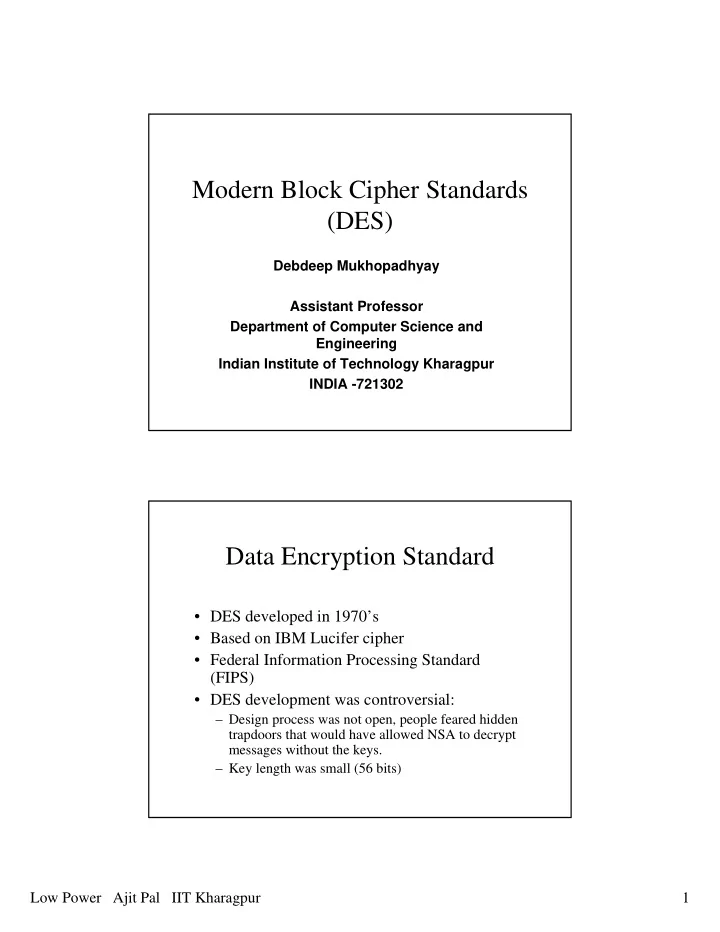
Modern Block Cipher Standards (DES)

Debdeep Mukhopadhyay Assistant Professor Department of Computer Science and Engineering Indian Institute of Technology Kharagpur INDIA -721302

Data Encryption Standard

  • DES developed in 1970’s
  • Based on IBM Lucifer cipher
  • Federal Information Processing Standard

(FIPS)

  • DES development was controversial:

– Design process was not open, people feared hidden trapdoors that would have allowed NSA to decrypt messages without the keys. – Key length was small (56 bits)

slide-2
SLIDE 2

Low Power Ajit Pal IIT Kharagpur 2

DES Numerology

  • DES is a Feistel cipher
  • 64 bit block length
  • 56 bit key length
  • 16 rounds
  • 48 bits of key used each round (subkey)
  • Each round is simple (for a block cipher)
  • Security depends primarily on “S-boxes”
  • Each S-boxes maps 6 bits to 4 bits

Initial Permutations

  • DES has an initial permutation and a final

permutation after 16 rounds.

  • These permutations are inverses of each
  • ther and operate on 64 bits.
  • They have no cryptographic significance.
  • The designers did not disclose their

purpose.

slide-3
SLIDE 3

Low Power Ajit Pal IIT Kharagpur 3

L R

expand shift shift

key key

S-boxes

compress

L R

28 28 28 28 28 28 48 32 48 32 32 32 32

One Round

  • f

DES

48 32

Ki

P box

 

Function f

DES Expansion

  • Input 32 bits

1 2 3 4 5 6 7 8 9 10 11 12 13 14 15 16 17 18 19 20 21 22 23 24 25 26 27 28 29 30 31

  • Output 48 bits

31 1 2 3 4 3 4 5 6 7 8 7 8 9 10 11 12 11 12 13 14 15 16 15 16 17 18 19 20 19 20 21 22 23 24 23 24 25 26 27 28 27 28 29 30 31

slide-4
SLIDE 4

Low Power Ajit Pal IIT Kharagpur 4

DES S-box (Substitution Box)

  • 8 “substitution boxes” or S-boxes
  • Each S-box maps 6 bits to 4 bits
  • S-box number 1

input bits (0,5)  input bits (1,2,3,4)

| 0000 0001 0010 0011 0100 0101 0110 0111 1000 1001 1010 1011 1100 1101 1110 1111

  • 00

| 1110 0100 1101 0001 0010 1111 1011 1000 0011 1010 0110 1100 0101 1001 0000 0111 01 | 0000 1111 0111 0100 1110 0010 1101 0001 1010 0110 1100 1011 1001 0101 0011 1000 10 | 0100 0001 1110 1000 1101 0110 0010 1011 1111 1100 1001 0111 0011 1010 0101 0000 11 | 1111 1100 1000 0010 0100 1001 0001 0111 0101 1011 0011 1110 1010 0000 0110 1101

For other tables refer to Stinson’s Book

S-Box with Table entries in decimal

What is the output if input is 101000?

Row=10=2 Column=0100=4 Output=13

slide-5
SLIDE 5

Low Power Ajit Pal IIT Kharagpur 5

Properties of the S-Box

  • There are several properties
  • We highlight some:

– The rows are permutations – The inputs are a non-linear combination of the inputs – Change one bit of the input, and half of the

  • utput bits change (Avalanche Effect)

– Each output bit is dependent on all the input bits

DES P-box (Permutation Box)

  • Input 32 bits

1 2 3 4 5 6 7 8 9 10 11 12 13 14 15 16 17 18 19 20 21 22 23 24 25 26 27 28 29 30 31

  • Output 32 bits

15 6 19 20 28 11 27 16 14 22 25 4 17 30 9 1 7 23 13 31 26 2 8 18 12 29 5 21 10 3 24

slide-6
SLIDE 6

Low Power Ajit Pal IIT Kharagpur 6

DES Subkey

  • Input key size: 64 bits, of which 8 are parity

bits.

  • 56 bit DES key, 0,1,2,…,55
  • Left half key bits, LK

49 42 35 28 21 14 7 50 43 36 29 22 15 8 1 51 44 37 30 23 16 9 2 52 45 38 31

  • Right half key bits, RK

55 48 41 34 27 20 13 6 54 47 40 33 26 19 12 5 53 46 39 32 25 18 11 4 24 17 10 3

DES Subkey

  • For rounds

i=1 ,2 , . . . . , n

– Let LK = (LK circular shift left by ri) – Let RK = (RK circular shift left by ri) – Left half of subkey Ki is of 24 bits

13 16 10 23 4 2 27 14 5 20 9 22 18 11 3 25 7 15 6 26 19 12 1

– Right half of subkey Ki is 24 bits

12 23 2 8 18 26 1 11 22 16 4 19 15 20 10 27 5 24 17 13 21 7 3

slide-7
SLIDE 7

Low Power Ajit Pal IIT Kharagpur 7

DES Subkey

  • For rounds 1, 2, 9 and 16 the shift ri is 1, and in

all other rounds ri is 2

  • Bits 8,17,21,24 of LK omitted each round
  • Bits 6,9,14,25 of RK omitted each round
  • Compression permutation yields 48 bit subkey

Ki from 56 bits of LK and RK

  • Key schedule generates subkey

DES Some Points to Ponder

  • An initial perm P before round 1, and its

inverse at the end.

  • Halves are swapped after last round.
  • A final permutation (inverse of P) is

applied to (R16,L16) to yield ciphertext.

slide-8
SLIDE 8

Low Power Ajit Pal IIT Kharagpur 8

Exercise

Prove that decryption in DES can be done by applying the encryption algorithm to the ciphertext, with the key schedule reversed.

Weak keys

  • A weak key is the one which after parity

drop operation, consists either of all 0’s, all 1’s or half 0’s and half 1’s.

  • Four out of the 256 keys are weak keys.
slide-9
SLIDE 9

Low Power Ajit Pal IIT Kharagpur 9

Examples of weak keys

FFFFFFF FFFFFFF FEFE FEFE FEFE FEFE FFFFFFF 0000000 E0E0 E0E0 F1F1 F1F1 0000000 FFFFFFF 1F1F 1F1F 0E0E 0E0E 0000000 0000000 0101 0101 0101 0101 Actual key (56 bits) Keys before parity drop (64 bits)

Consequence of weak keys

  • The round keys created from any of these

weak keys are the same.

– For example, for the first weak key, all the round keys are 0. – The second key leads to half 0s, and half 1s.

  • If we encrypt a block with a weak key and

subsequently encrypt the result with the same weak key, we get the original block.

slide-10
SLIDE 10

Low Power Ajit Pal IIT Kharagpur 10

Semi Weak Keys

  • A semi weak key creates only two different

round keys and each of them is repeated eight times.

  • There are six key pairs that are called semi-

weak keys.

  • The round keys created from each pair are

the same in different order.

Semi weak keys

FEE0 FEE0 FEF1 FEF1 E0FE E0FE F1FE F1FE 1F01 1F01 0E01 0E01 011F 011F 010E 010E FE1F FE1F FE0E FE0E 1FFE 1FFE 0EFE 0EFE E001 E001 F101 F101 01E0 01E0 01F1 01F1 E01F E01F F10E F10E 1FE0 1FE0 0EF1 0EF1 FE01 FE01 FE01 FE01 01FE 01FE 01FE 01FE Second key in the pair First key in the pair

slide-11
SLIDE 11

Low Power Ajit Pal IIT Kharagpur 11

A Sample round key generation

9153E54319BD 6EAC1ABCE642 16 6EAC1ABCE642 9153E54319BD 15 6EAC1ABCE642 9153E54319BD 14 6EAC1ABCE642 9153E54319BD 13 6EAC1ABCE642 9153E54319BD 12 6EAC1ABCE642 9153E54319BD 11 6EAC1ABCE642 9153E54319BD 10 6EAC1ABCE642 9153E54319BD 9 9153E54319BD 6EAC1ABCE642 8 9153E54319BD 6EAC1ABCE642 7 9153E54319BD 6EAC1ABCE642 6 9153E54319BD 6EAC1ABCE642 5 9153E54319BD 6EAC1ABCE642 4 9153E54319BD 6EAC1ABCE642 3 9153E54319BD 6EAC1ABCE642 2 6EAC1ABCE642 9153E54319BD 1

There are 8 equal round keys in each semi-weak keys. Also, the round key in the first set is the same as the 16th key in the second set. This means that the keys are inverses

  • f each other.

Thus, Ek2 (Ek1(P))=P

Multiple DES

  • The major criticism against DES is the key

length.

  • So, we may try cascading several DES

applications.

  • Luckily, DES does not form a group under

the composition operation. Thus, it is highly improbable that we can obtain k3 st.

– Ek2(Ek1(P))=Ek3(P)

slide-12
SLIDE 12

Low Power Ajit Pal IIT Kharagpur 12

2DES

  • Uses two applications of the DES cipher.
  • The total key size is 56x2=112 bits.
  • However 2DES is vulnerable to a known

plaintext attack.

Meet in the middle attack

64 bit plaintext

DES cipher M=EK2(P) and M=Dk2(C)

middle text

DES cipher

64 bit ciphertext Attacker performs a known plaintext attack. He collects (P,C) pairs. Using 1st relation, he encrypts P using all possible 256 keys, and records all values for M. Using 2nd relation, he decrypts C using all possible 256 keys, and records all values for M.

slide-13
SLIDE 13

Low Power Ajit Pal IIT Kharagpur 13

Security of 2 DES

  • Then the attacker checks for a match in the table

in the value of M. He notes the key pair (K1,K2)

  • If there are more than one keys, he takes another

(P,C) pair.

  • The attacker continues until there is only key left.
  • Thus attack complexity is around 257.
  • What does this say about the security of 2DES?

Triple DES

  • Since 2DES was a bad design, people

consider 3 applications of DES.

  • The first and third stages use K1 as key.
  • The second stage use K2 as the key.
  • Also, the middle stage uses decryption.
  • Thus, setting K1=K2 we have simple DES.
slide-14
SLIDE 14

Low Power Ajit Pal IIT Kharagpur 14

Further Reading

  • B. A Forouzan, Cryptography & Network

Security, Tata Mc Graw Hills, Chapter 5

  • Douglas Stinson, Cryptography Theory and

Practice, 2nd Edition, Chapman & Hall/CRC