Modelling word perception and comprehension across modalities - - PDF document

modelling word perception and comprehension across
SMART_READER_LITE
LIVE PREVIEW

Modelling word perception and comprehension across modalities - - PDF document

15/09/2017 Modelling word perception and comprehension across modalities Psychology in Big Question 1 PhD student : Danny Merkx Supervisors : Stefan Frank (CLS) Mirjam Ernestus (CLS) Raquel Fernandez (ILLC) Louis ten Bosch (CLS) Research


slide-1
SLIDE 1

15/09/2017 1 PhD student: Danny Merkx Supervisors: Stefan Frank (CLS) Mirjam Ernestus (CLS) Raquel Fernandez (ILLC) Louis ten Bosch (CLS)

Modelling word perception and comprehension across modalities

Psychology in Big Question 1

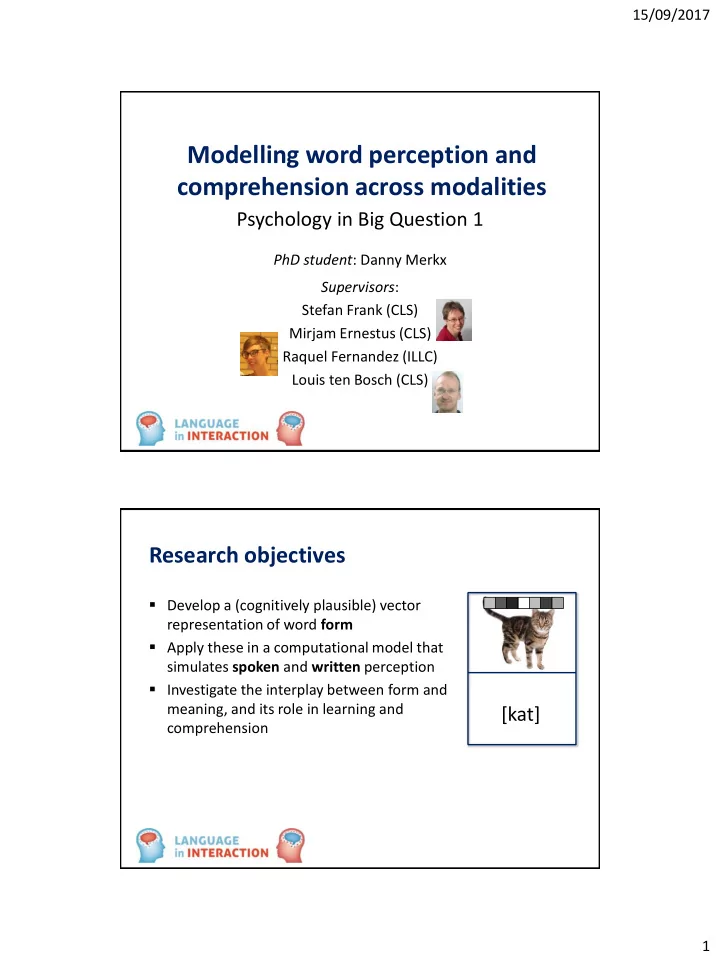
Research objectives

  • Develop a (cognitively plausible) vector

representation of word form

  • Apply these in a computational model that

simulates spoken and written perception

  • Investigate the interplay between form and

meaning, and its role in learning and comprehension

[kat]

slide-2
SLIDE 2

15/09/2017 2

Written: Interactive Activation

(McClelland & Rumelhart, 1981)

Spoken: TRACE (McClelland & Elman, 1986)

Challenge #1

Different modalities in a single model

  • Current DSMs are amodal
  • Word-perception models lack semantics and deal with one

modality

  • Reading is not independent from speech perception
  • How to capture the unique perceptual constraints posed by

different modalities in a vector model?

Challenge #2

Complex relations between form, identity, and meaning

data data

Meanings Identities Forms

Data dates [de:ts] dates2 dates3 [da:ta:] [deɪts] dates

17 dec 1903 20 jul 1969 14 sep 2017

[deɪtə] [datə]

slide-3
SLIDE 3

15/09/2017 3

  • Simply running a DSM on a bilingual corpus would result in

clustering by language → vectors do not reflect semantics

  • (Most?) current work in bilingual DSMs:

− Get two monolingual vector spaces − Combine such that translation equivalents receive similar vectors

  • No way to tell the languages apart

− Not evaluated against human processing data

Challenge #2

Models of the bilingual lexicon

Artetxe, Labaka, & Agirre (ACL, 2017)

  • The bilingual mental lexicon: Languages are integrated but can

still be told apart

  • Psycholinguistic models of the bilingual mental lexicon:

‒ Account for response/naming times, cognate/homograph effects, interlingual priming, etc. ‒ But: small vocabularies, not trainable, no realistic semantics

Costa et al. (Cognitive Science, 2017)

Challenge #2

Models of the bilingual lexicon

slide-4
SLIDE 4

15/09/2017 4

Challenge #3

Psycholinguistic evaluation

  • How to measure the psychological accuracy of word vectors?
  • How to evaluate representations on human data from

sentence/discourse comprehension?

  • Evaluation of statistical language models based on word

surprisal:

‒ Correlate to measure of processing difficulty

  • n naturalistic materials

Reading times from eye-tracking study

Frank & Thompson (Proc. CogSci, 2012)

N400 size (content words only)

Frank, Otten, Galli, & Vigliocco (Brain & Language, 2015)

Average surprisal Fit to RT (±χ2) Average surprisal Fit to N400 amplitude (±χ2)

Challenge #3

Psycholinguistic evaluation

slide-5
SLIDE 5

15/09/2017 5

Challenge #3

Psycholinguistic evaluation

  • How to measure the psychological accuracy of word vectors?
  • How to evaluate representations on human data from

sentence/discourse comprehension?

  • Evaluating statistical language models based on word

surprisal:

‒ Correlate to measure of processing difficulty

  • n naturalistic materials

‒ Independent measure of linguistic accuracy is helpful for model comparison ‒ Model variants are cognitively intepretable

Not (so much) for DSMs

  • Mandera, Keuleers, & Brysbaert (2017):

– Compared state-of-the-art DSMs (Skipgram, CBOW) and traditional count-based DSM, on wide range of parameter values

Psycholinguistic evaluation of DSMs

Recent work

slide-6
SLIDE 6

15/09/2017 6

  • Mandera, Keuleers, & Brysbaert (2017):

– Compared state-of-the-art DSMs (Skipgram, CBOW) and traditional count-based DSM, on wide range of parameter values – Implicit measures (response times in semantic priming): fairly small difference between model types – Explicit norms (association, semantic relatedness): CBOW is best

  • Rotaru, Vigliocco, & Frank (submitted):

– Markov chain over semantic distance matrix (from CBOW, GloVe, LSA) simulates dynamics in semantic network

Psycholinguistic evaluation of DSMs

Recent work

slide-7
SLIDE 7

15/09/2017 7

  • Mandera, Keuleers, & Brysbaert (2017):

– Compared state-of-the-art DSMs (Skipgram, CBOW) and traditional count-based DSM, on wide range of parameter values – Implicit measures (response times in semantic priming): fairly small difference between model types – Explicit norms (association, semantic relatedness): CBOW is best

  • Rotaru, Vigliocco, & Frank (submitted):

– Markov chain over semantic distance matrix (from CBOW, GloVe, LSA) simulates dynamics in semantic network – This improves fit to human data (association/relatedness norms, lexical/semantic decision times and accuracies) – CBOW outperformed GloVe and LSA in almost all tests

Psycholinguistic evaluation of DSMs

Recent work

slide-8
SLIDE 8

15/09/2017 8

  • Frank & Willems (2017):

– Naturalistic materials: UCL corpus sentences (written) and excerpts from Dutch audiobooks (spoken) – Cosine distance (using Skipgram) between each content word and sum

  • f previous content words

Psycholinguistic evaluation of DSMs

Recent work

Unique effects of suprisal and semantic distance

Frank & Willems (Language, Cognition and Neuroscience, in press)

slide-9
SLIDE 9

15/09/2017 9

  • Frank & Willems (2017):

– Naturalistic materials: UCL corpus sentences (written) and excerpts from Dutch audiobooks (spoken) – Cosine distance (using Skipgram) between each content word and sum

  • f previous content words

– Explained variance in N400 and BOLD responses offers possibilities for comparing DSMs

  • But reading times appear to be insensitive to semantic

distance

Psycholinguistic evaluation of DSMs

Recent work

Current semantic distance Previous semantic distance UCL corpus Dundee corpus

FF FP RB GP

  • 0.01

0.01 0.02

reading time measure coefficient

FF FP RB GP

  • 0.02

0.02 0.04

  • 0.02

0.02 0.04

coefficient

FF FP RB GP FF FP RB GP

  • 0.01

0.01 0.02

reading time measure

no surprisal 2-gram 3-gram 4-gram 5-gram

Reading times from two eye-tracking corpora: (no) effect of semantic distance

Frank (Proc. CogSci, 2017)

slide-10
SLIDE 10

15/09/2017 10

Potential pitfalls

for BQ1 collaboration

  • Different opinions about the meaning and importance of

cognitively plausibility

  • Different opinions about model evaluation: task performance

versus human performance

  • BQ1’s goal to link between neurobiology and cognition does

not mean that psychology must be reduced to neuroscience

  • Behavioural data is relevant too: Not all questions are about

the brain and model comparison may be more difficult on high-dimensional (neural) data