Modeling project requirements with Objectiver - - PDF document

modeling project requirements with objectiver
SMART_READER_LITE
LIVE PREVIEW

Modeling project requirements with Objectiver - - PDF document

Modeling project requirements with Objectiver Denis.Ballant@cediti.be Cediti SA www. cediti .be www. objectiver .com Requirements Engineering Why ? Project completed on time, on budget, success Project cancelled and with all functions


slide-1
SLIDE 1

Modeling project requirements with Objectiver

www.cediti.be www.objectiver.com Denis.Ballant@cediti.be Cediti SA

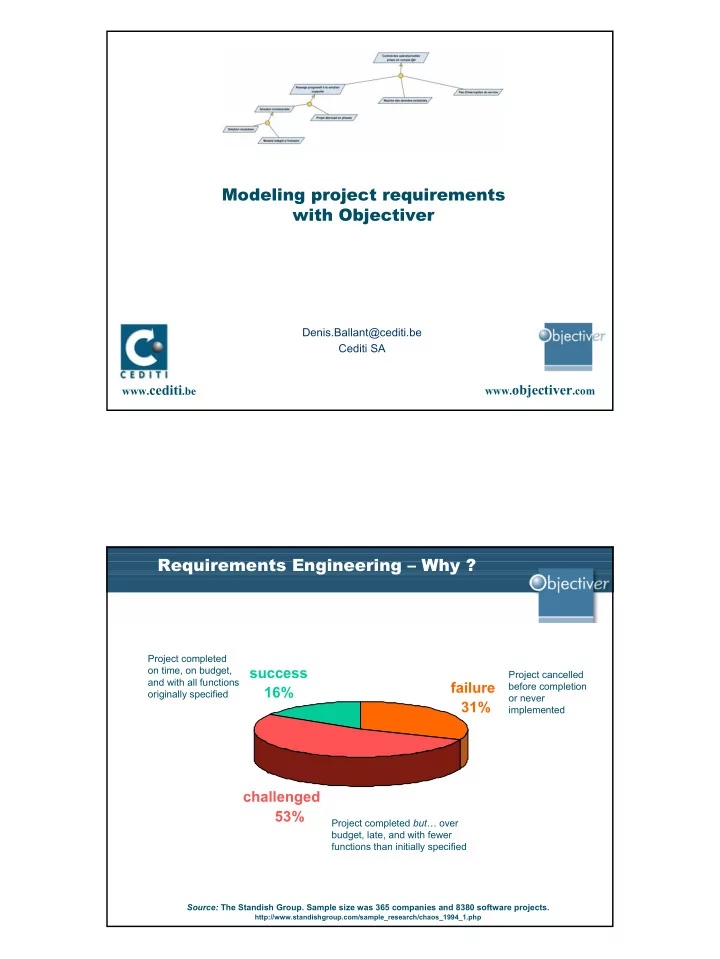
Requirements Engineering – Why ?

failure 31% challenged 53% success 16%

Source: The Standish Group. Sample size was 365 companies and 8380 software projects.

http://www.standishgroup.com/sample_research/chaos_1994_1.php

Project completed

  • n time, on budget,

and with all functions

  • riginally specified

Project completed but… over budget, late, and with fewer functions than initially specified Project cancelled before completion

  • r never

implemented

slide-2
SLIDE 2

Lack of User Input 13 % Incomplete Reqs & Specs 12 % Changing Reqs & Specs 11 %

Lack of Executive Support 8 % Technology Incompetence 7 % Lack of Resources 6 %

Unrealistic Expectations 6 % Unclear Objectives 5 %

Unrealistic Time Frames 4 % New Technology 3 %

Reasons for Project Failures

Req Eng’s Domain

The KAOS approach A goal-driven approach to requirements engineering – Elicitation – Structuring – Specification – Analysis – Negotiation – Communication – Documentation – Evolution

KAOS Notation Method Tool Objectiver

slide-3
SLIDE 3

Involved organizations

Research University of Louvain (B)

Market

Private company:

  • Consulting services
  • Objectiver vendor

Non-profit applied research organization:

  • formal tools (FAUST)
slide-4
SLIDE 4

Main Views

Model editor Generated web documentation Generated requirements document

Web documentation

Process

Modeling Interviews Documents Requirements document

KAOS model

Existing systems Validation Analysis Queries Verifications & Checks

slide-5
SLIDE 5

IOP Rewrite Project 1> Interviews 2> Identify Goals

slide-6
SLIDE 6

3> Specify Goal Properties 4> Build Goal Model

+ responsibility, object, and

  • peration models
slide-7
SLIDE 7

5> Generate Reqs Document 6> Amend Reqs Document

slide-8
SLIDE 8

7> Publish Reqs Document

Output formats:

  • RTF (MS-Word, …)
  • PDF (Acrobat)

Support for Model Checking & Validation

  • Automatic Model Validation
  • Extensible manually-triggered OQL queries
  • Report & Diagram generation
  • Validation based on the generated Web

documentation

slide-9
SLIDE 9

Automatic Model Checking Conformance to KAOS syntax verified on the fly OQL-Supported Model Checking

  • Query Language (OQL extension)
  • Model completeness checking

– goals not refined (wishful thinking) – requirements without a responsible agent – requirements not “operationalized” – unresolved obstacles – …

  • Model quality checking

– concepts not used in any document – incomplete concept specification – concepts with unresolved Issues – …

slide-10
SLIDE 10

Report generation

Diagram generation Responsibility model generated based on the goal model

Validation with experts : model browser

Text viewer Concept references are hyperlinks Diagram viewer Property viewer Indexes

slide-11
SLIDE 11

Should I use Objectiver ?

  • Elicit and specify requirements in a systematic way
  • Produce structured, motivated, easy to understand

requirements documents

  • Facilitate communication
  • Simplify validation process
  • Provide traceability from:

– Requirements to goals – Operations to requirements

cetic

FAUST Project

Model Checking Animator Kaos Formal Editing Acceptance Test Case Generator Pattern reuse Obstacle Generator / Resolver Consistency / Completeness Analyser

slide-12
SLIDE 12

Cediti References

Requirements analyses & Reengineering Requirements documents Strategical plans & IT plans

Get your free trial version now ! www.objectiver.com