Mobile Treatment Unit for septage emptying and safe disposal in - - PowerPoint PPT Presentation

mobile treatment unit for
SMART_READER_LITE
LIVE PREVIEW

Mobile Treatment Unit for septage emptying and safe disposal in - - PowerPoint PPT Presentation

Mobile Treatment Unit for septage emptying and safe disposal in Dindigul, India Aaron Forbis-Stokes 1,2 Arumugam Kalimuthu 3 , L. Peter 3 , Marc Deshusses 1 1 Duke University, Dept. of Civil & Environmental Engineering, Durham, NC, USA 2


slide-1
SLIDE 1

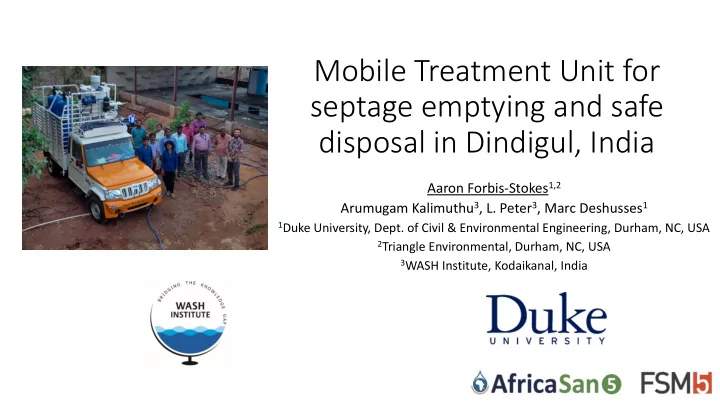
Mobile Treatment Unit for septage emptying and safe disposal in Dindigul, India

Aaron Forbis-Stokes1,2 Arumugam Kalimuthu3, L. Peter3, Marc Deshusses1

1Duke University, Dept. of Civil & Environmental Engineering, Durham, NC, USA 2Triangle Environmental, Durham, NC, USA 3WASH Institute, Kodaikanal, India

slide-2
SLIDE 2

Background

2

Urban septage treatment solutions are needed at decentralized level 38% of urban households in India 62% of households in cities <1 million

slide-3
SLIDE 3

Background

3

Treat and discharge septage onsite. Save time, fuel, and money.

slide-4
SLIDE 4

Mobile Treatment Unit – Technology overview

4

MTU uses off-the-shelf separation technologies to produce a clean effluent quickly and cost-effectively Septic Tank Centrifuge Holding Tank

(58 µm mesh)

Dual-Media

(Pebbles & Sand)

GAC

(#4x8 mesh)

MF (x2)

(10 & 5 µm)

UF

(0.02 µm)

Discharge Solids collection

(Compost/Disposal Partial UF return

slide-5
SLIDE 5

Methods

  • Phase I – 1 unit
  • No backwash
  • Operational: Pressure, flow & power

every 15 minutes

  • Treatment: First pass & final pass

sample each location

  • Phase II – 4 units (3 new)
  • Reverse flow backwash every 30

minutes

  • Operational: Pressure, flow & power

every 15 minutes

  • Treatment: Final pass septage & UF

effluent

5

Target flow: 3,000 L/hr Pressures: membrane life and fouling Effluent quality: Meet Indian discharge standards

slide-6
SLIDE 6

Operational performance – Phase I

200 400 600 800 1.000 1.200 1.400 1.600 1.800 2.000 20 40 60 80 100 120 140 160 Flow rate (L/h) Time (h)

6

Initial flow-rates decreased and did not fully recover.

slide-7
SLIDE 7

20.000 40.000 60.000 80.000 100.000 0,00 0,50 1,00 1,50 2,00 2,50 3,00 0,00 0,50 1,00 1,50 2,00 2,50 3,00 20 40 60 80 100 120 140 160 Volume treated (L) TMP (bar) Time (h) MF UF

Operational performance – Phase I

7

Rapid increase of Transmembrane Pressure for MF

slide-8
SLIDE 8

Treatment performance – Phase I

8

Total Coliform (CFU / 100 mL)

10 100 1,000 10,000 100,000 1,000,000 Effluent meets Indian discharge limits 1

COD (mg / L)

slide-9
SLIDE 9

Phase I Conclusions

9

Phase I Challenge Phase II Improvement Maintain high target flow rates Routine backwashing during run Rapid MF fouling Increase MF surface area Occasional high solids tanks Additional low-cost pre-screening Standard India CPCB WASHi Effluent pH 6.5-9.0 7.7 ✔ COD (mg/L) [old, not in new] 100 66 ✔ BOD (mg/L) 30 24 ✔ TSS (mg/L) 100 103 ✘ Total Coliform (CFU/100 mL) 1,000 83 ✔

slide-10
SLIDE 10

500 1.000 1.500 2.000 2.500 3.000 3.500 4.000 4.500 5 10 15 20 25 Flow rate (L/h) Time (h) 500 1.000 1.500 2.000 2.500 3.000 3.500 4.000 4.500 10 20 30 40 Flow rate (L/h) Time (h) 500 1.000 1.500 2.000 2.500 3.000 3.500 4.000 4.500 5 10 15 20 25 30 35 Flow rate (L/h) Time (h) 500 1.000 1.500 2.000 2.500 3.000 3.500 4.000 4.500 50 100 150 Flow rate (L/h) Time (h)

Operational performance – Phase II

10

MTU-1 MTU-3 MTU-4 MTU-2

Flow rates maintained, TMP decreased

slide-11
SLIDE 11

Treatment performance – Phase II

11

slide-12
SLIDE 12

Expenses

$9.317 $3.617 $132 $2.620 $0 $5.000 $10.000 $15.000 $20.000 $25.000 $30.000 $35.000 Traditional septic MTU

CapEx

Hardware Monitoring Filtration Vehicle

12

$0 $2 $4 $6 $8 $10 $12 $14 $16 $18 MTU

OpEx ($ / 3,000 L Septic tank)

Cleaning Power Diesel Filtration Vehicle

$46 typical fee for 3,000 L septic tank

slide-13
SLIDE 13

Case Study: MTU in Kerala

13

  • 4 MTUs sent to Kerala in response to severe

flooding, August 2018

  • First 9 days:
  • 330,000 L septage treated
  • 34,965 beneficiaries
  • Aug. 25th – Dec. 14th 2018:
  • 156 septic tanks emptied
  • 918,222 L treated
  • ~200,000 beneficiaries
  • Effluent samples met all discharge

standards

slide-14
SLIDE 14

Next steps

  • Patent:
  • Filed and awaiting finalization
  • Commercialization
  • In discussion with partners
  • Interested customers: relief agencies, small-scale entrepreneurs
  • Automation:
  • Improve operation efficiency, decrease operator requirements

14

slide-15
SLIDE 15

Thank you!

15

Arumugam Kalimuthu Marc Deshusses Aaron Forbis-Stokes akalimuthu@washinstitute.org marc.deshusses@duke.edu aaron@triangle-environmental.com Program Director Professor Sanitation Technology Consultant WASH Institute Duke University Triangle Environmental www.washinstitute.org www.sanitation.pratt.duke.edu www.triangle-environmental.com

slide-16
SLIDE 16

Additional slides

16

slide-17
SLIDE 17

20.000 40.000 60.000 0,00 0,50 1,00 1,50 2,00 2,50 3,00 3,50 5 10 15 20 Volume treated (L) TMP (bar) Time (h) MF UF 10.000 20.000 30.000 0,00 0,50 1,00 1,50 2,00 2,50 3,00 3,50 10 20 30 Volume treated (L) TMP (bar) Time (h) MF UF

Operational performance – Phase II

17

MTU-2 MTU-4 MF no longer fouling Low TMP, likely undersized pump