Mixed-Use Multifamily Design Competition 2019
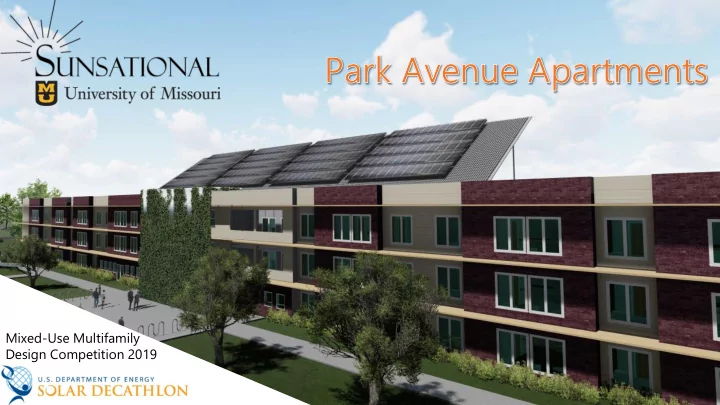
Mixed-Use Multifamily Design Competition 2019 Academic Institution - - PowerPoint PPT Presentation
Mixed-Use Multifamily Design Competition 2019 Academic Institution Department of Architectural Studies & College of Engineering 4-year undergraduate program in architecture and interior design (CIDA) Faculty Advisor Michael Goldschmidt,
Faculty Advisor Michael Goldschmidt, AIA LEED AP BD+C
Associate Teaching Professor in the Department of Architectural Studies at the University of Missouri and a State Housing and Environmental Design Specialist with University of Missouri Extension.
Department of Architectural Studies & College of Engineering
4-year undergraduate program in architecture and interior design (CIDA)
Academic Institution
Project Team
Megan Wahlquist
Team Leader
Junior
Janee Thompson
Financial Analysis
Senior
Jessica Blankinship
Architecture
Senior
Margaret Jordan
Interior Design
Senior
Brandon Smeets
Engineering
Senior
- 10 engineering capstone students (Fall 2018)
- 14 architecture and interior design students (ArchSt 4323, Sustainable Technologies)
- Faculty Lead Advisor Michael Goldschmidt
- Engineering Faculty Advisor Dr. John Bowders
- Two Additional Faculty Advisors (energy modeling & sustainable design)
University of Missouri –Extension, Housing and Environmental Design Midwest Energy Efficiency Research Consortium (MEERC) The National Healthy Homes Partnership City of Columbia Missouri- Office of Sustainability and Office of Water and Light Malicoat & Winslow Engineering
Industry Partners
Columbia Housing Authority (CHA) Net Zero Structural Insulated Panels Quaker Windows Missouri Solar Apps CM Engineering
Climate Summary
Climate Zone: 4A Mixed-humid Cool to cold winters
- 4800 heating degree days
Long, hot, and humid summers
- 1550 cooling degree days
Location: 507 Park Avenue, Columbia, Missouri Neighborhood: North-Central Lot Size: 1.62 acres Building Size: 56,650 square feet [48 Apartments, common space, small retail space] Building Cost: $5,525,082 ($115,106 per unit)
Project Summary
Boone County Missouri
Design Constraints
Design Constraints
Neighborhood Context (Park Avenue)
Current Public Housing on Park Avenue Downtown Student Housing
Design Constraints
Columbia Housing Authority (CHA) Properties
McBaine Townhomes Bear Creek Townhomes Providence Family Townhomes Stuart Parker Townhomes McBaine Kitchen Park Avenue Paquin Tower
Design Constraints
Design Standards
Columbia Housing Authority regulations ADAAG 2010 Uniform Federal Accessibility Standards (UFAS)
Design Mission
Design Goals
To create an affordable, energy-efficient, resilient, and environmentally friendly apartment design within the urban context of the North-Central Neighborhood in Columbia, Missouri to accommodate low-income families.
Design Goals
1. Design apartment plans that can be used by CHA as a model for efficient, resilient, affordable, and flexible housing.
- 2. Create a resource efficient and net-zero energy design,
reduce construction costs and follow appraised value precedent
- f nearby neighborhood and public housing .
- 3. Create a design with a friendly relationship with the street and
reconcile public and private relationships between the apartments and neighbors.
- 4. Create a flexible interior that utilizes universal design principles.
- 5. Utilize building materials that consider embodied energy,
rapidly renewable and/or recycled content, distance to the project site, and reduction of construction waste.
- 6. Create a design that allows options to use manual systems for
ventilation, lighting, heating, and cooling, versus automatic systems.
- 7. Use appropriate, affordable, and researched-based industry
standard strategies.
- 8. Design the apartments to provide ultra-affordable home rental
and ownership to low income Columbia residents.
Proposal
3-story building
- Approximately 19,000 square feet per floor
- 27 one-bed one-bath apartments, 21 two-bed two-bath apartments
- 1,600 square feet retail store
- Commons area (meeting space for entire neighborhood and resilient core)
- Net zero with 160 kW photovoltaic array
- Construction cost approximately $115,000 per unit (with PV)
Construction
- Walls: R-40 SIPS with drainage plane between skin and SIPS
- High performance flashings and air/moisture/vapor control
- Roofs: R-50 SIPS with concrete topping and EPDM membrane; wood trusses
- Floors: Concrete floor topping on sub-floor over wood trusses
- Sound insulation (control) between apartment walls and ceilings
- Followed Energy Pyramid
- BeOpt to optimize energy efficient strategies
(3155 MMbtu/yr Source and Site)
- REMRate analysis to determine:
- HERS Rating:
- 40 without PV (one apartment)
- 0 with PV (one apartment)
- Compliance with IECC, ASHRAE 90.1, EnergyStar Homes
- DOE Net-Zero Ready Home requirements
- OpenStudio analysis to determine:
- EUI Rating: 49 kBtuh/ft2/yr (37.5 kBtuh/ft2/yr source)
Energy Performance
Energy Performance
Photovoltaic array:
- Four arrays (180 panels total)
- Expandable to 8 arrays (360 panels total)
- 160kW array
- SunPower X21-470
○
Micro-inverters versus String or DC Optimizers
○
470 W per panel
○
17.2 SF per panel
- Per PVWatt:
○
233,360 kWh per year
○
31 degrees tilt (roof slope)
- Micro-inverters used for NEC/ISEP
Compliance:
○
Rapid Shutdown
○
Anti-Islanding
○
Better performance under shading
○
Missouri PV Installers prefer micro- inverter systems PV cost (equipment and installation): $3.18 per Watt
- Federal 30% tax credit
- City of Columbia rebate ($500 per kW)
$508,800 - $152,640 - $80,000 = $276,160
Energy Performance
Enphase iQ6+ Micro Inverter: IQ6PLUS-72-2-US SunPower Photovoltaic Panel: model X21-470
Energy Performance
Lighting Controls:
Hubbell DLCPCI (indoor) DLCPCO (outdoor) DCLPCA/S (atrium/skylight) Design Illumination Levels (FC): Kitchen 50 Living Room 30 Bathroom 40 Bedroom 20 Hallways/Stairways 5 Commons/Atrium 30 Commercial 50 Lighting Load: maximum 125 Watts per unit
Plug & Appliance Loads:
Reducing Plug Loads: Legrand Plug Load Reducer Appliances: Energy Star - lowest available energy use
Engineering
Overall Approach:
Fall Semester 2018, engineering students produced report evaluating preliminary site and building, structural, site utilities, control, mechanical and electrical systems (see supplemental report)
HVAC System
Process: HeatCAD evaluation review by engineer (CM) review by additional engineer (MW)
- 1.5 ton geothermal heat pump system (each apartment)
- Bosch Greensource CDi SM-024 Split-System with attached Bosch
DX025-1VTX Compact Air Handler and Fan Coil
- Interfaces with passive solar heating and cooling strategies
- Provides primary water heating
- 300 foot vertical loop wells
- 4 and 6 ton units for commons area and retail
- MERV 13 air filters
- Thermostat: Honeywell Lyric T5
Engineering
Plumbing System Layout Rainwater collection for irrigation (22,886 Gal/Week) HVAC System Layout
Cost Estimation:
- RSMeans Online (1Q 2019)
- Adjusted for known materials cost
- CHA pays no sales tax
- Full cost estimate in supplemental report
- $5,525,082 ( $115,106 per unit)
- Average unit cost for CHA properties: $145,000 per unit
- Average unit cost for Columbia: $65,000 to $85,000 per unit
Rent-to-Own Possibility:
- Invest utility dollars savings for equity
- Floor plan configured for future condominiums
Repair & Maintenance:
- Rental Income: $765 per month/unit
- Rental Income: $535 per month/unit with housing assistance
- Total Rental Income: $440,640
- Per CHA maintenance = 9% rental income
- $39,658 in maintenance
Optional Purchase Power Agreement
Financial Feasibility & Affordability
Rebates, Incentives, and More
- CHA (client) is Non-for-Profit Organization
- Sales Tax 7% savings
- No compensation or fees for marketing or sales commission
- Job Point of Columbia (Youth Build)
- Lower contractor’s overhead and profit (not-for-profit agency)
- No sales tax on materials
- Solar Property Tax Exemption (Missouri)
- Residential Renewable Energy Tax Credit (30% Geothermal Heat
Pumps)
- Renewable Electricity Production Tax Credit (PTC) ($0.023/kWh)
- Columbia Water & Light - Home Performance with ENERGY STAR
Rebates (Multiple incentives)
- Columbia Water & Light - Solar Rebates ($500/kW)
- Columbia Water & Light - HVAC and Lighting Efficiency Rebates
- HVAC: $570 - $3,770, Lighting: 50% of invoiced cost up to
$22,500)
Financial Feasibility & Affordability
Summary & Cost of Living
Rent
Resilience
Joplin, MO May 2011
Resilience
Compartmentalization
- Resilient Core & Apartments
- SIPS walls and roofs; core surrounded by Insulated Concrete Forms (ICF construction)
- Commons Area Mezzanine-Steel Construction; windows with rolling steel shutters
- Concrete topping on roof SIPS reinforced with steel channels
- Fire separation: two-hour from commons to residences; one-hour between hallways and residences;
- ne-hour between residences
- Backup Power (Tesla Batteries), water supply within core
- Areas of refuge/shelter for apartments and entire neighborhood
- Hurricane ties and straps on trusses and SIPS
Resilience
Building Enclosure Design Details
Architecture
Site & Roof Plan
Buffalo Grass Bluestem Yellow Wild Indigo Coneflower Green Roof
- Xeriscaping (native plants)
limits the need for additional irrigation and fertilizers
- Modular green roof
blocks (optional)
- Rainwater collection from
roof and parking lot
- Permeable paving in
some areas
Long central axis maximizes solar (passive and active) exposure Separation of public/private/services spaces Resilient core (red lines): ICF walls and two-hour fire separation Exterior material and form of building inspired by surrounding street and neighborhood
- Brick and fiber cement siding
- High-performance vinyl windows and doors
Architecture
1st Floorplan
PUBLIC PRIVATE SERVICE
Air lock vestibules at entries 27 one-bed, one-bath; 21 two-bed, two bath apartments 3-story, 32 feet tall building
Architecture
Second Floor Third Floor
Wind Roses
Architecture
Sun Diagram Breeze Diagram
The commons area is designed for passive solar heating, cooling (natural ventilation), and daylighting.
- Reduces loads for mechanical and electrical systems
- Allow for heating, cooling and lighting during
disaster recovery or refuge Quaker Window Manchester Series U-Value SHGC Vinyl Casement .23 .18 Vinyl Double Hung .25 .21 Vinyl Picture Window .22 .22
Architecture
Indoor and Outdoor Vertical Green Wall
These walls include a variety of plants to give the building texture and life.
- The interior wall will be planted on a Florafelt Vertical Garden
Planter.
- The exterior wall cools summer breezes entering the building
and protects windows
Ecologically Sensitive Interior Materials
- Rapidly renewable, recycled content, and/or local materials
- No VOCs or Formaldehyde
- Concrete floor in public areas and South apartments for
thermal mass
- Linoleum flooring in bathrooms: 98% bio-based; 78%
recycled content; biodegradable
- Paperstone counter surfaces: 100% recyclable and durable
- Engineered bamboo hardwood: 50-year warranty
- 100% LED lighting, with photocell
LED GE Morgan Ceiling Fan with remote Frigidair Electric Stovetop and Oven Energy Star Frididaire Refrigerator Energy Star Recessed Green LED lighting Energy Star Bellacore LED table pendants GE combination washer and dryer Bar pendants lightology freejack LED lights Panasonic whisper recessed LED lights vent fan Vanity DweLED Bathroom Lighting Philips Vetro LED PW series wall sconce
Operations
Insignia Microwave
Market Potential
Target Occupant:
2-3 family members, low-income Target Family Income: $45,221 (2-3 family members) Cost of Living (Columbia, MO): 92.9%
- Renters on public housing assistance (30% of
adjusted monthly income)
- Most renters on LIHEAP and other government
assistance
- Most families are food insecure
CHA Criteria:
- 1,200 applications for housing assistance per year
- 1,900 units currently in CHA ownership
- 2 year wait list
- Income limits
- $26,750 one-occupant
- $30,600 two-occupants
- $34,400 three-occupants
- Renters Assistance
- Livability and convenience
- Better benefits for less money
https://www.columbiamissourian.com
Sun space South side apartments (bedrooms, living, dining, and kitchens) and atrium/mezzanines with thermal mass for solar heating Universal design principles:
- 3 foot doors
- 5 foot turning diameter
- Clearances for approach
- One level
- Clear lines of sight
Heat spaces (kitchen, laundry, mechanical) located in central axis
- f building, near hallways
Open floor plan (flexibility)
- No hallways in apartments
Market Potential
Market Potential
Amenities
REM Rate – Heating and Cooling loads
HVAC Design Criteria:
- Systems that fit into the limited area
- Maximizes human comfort
- Maximizes energy-efficiency
- Assists in reducing indoor humidity to below 50%
- Affordable for simple homes that are market ready
- Easy distribution of conditioned, filtered, and fresh
air to all rooms for good indoor air quality
- Quiet system performance
- Reliable quality and low maintenance
- Simple and intuitive to use by homeowners
- Water heating through geothermal heat pump
Manual J Assumptions
Comfort & Environmental Quality
Honeywell VNT5070 E 1000 Energy Recovery Ventilator
- Radon Reduction: Passive system in each residential wing
- Whole House Ventilation: Honeywell VNT5070 E 1000
Energy Recovery Ventilator (ERV)
- 60 to 65 CFM
- ASHRAE 62.2 compliance
- Filtration: MERV 10 (Winter and Summer), MERV 13
(Spring and Autumn)
- Source Exhaust (ducted to outside):
- Bathrooms: 50 CFM
- Kitchen: 100-135 CFM
Comfort & Environmental Quality
Noise Control:
- Double-stud walls with insulation
- Between units
- Between hallways and units
- STC value:
- 50 to 59 (loud sounds can barely be heard)
Contaminant Control:
- No VOCs or Formaldehyde
- MERV 10 to 13 filtration
- Indoor plant wall to naturally remove contaminants, and
naturally control humidity
- Units are separated from each other thermally, acoustically,
and for fresh air flow
- Independent exhaust for kitchens and bathrooms