Mitigating high energy anomalous signals in the CMS barrel - - PowerPoint PPT Presentation

mitigating high energy anomalous signals in the cms
SMART_READER_LITE
LIVE PREVIEW

Mitigating high energy anomalous signals in the CMS barrel - - PowerPoint PPT Presentation

Mitigating high energy anomalous signals in the CMS barrel Electromagnetic Calorimeter Summary report Ali Farzanehfar University of Southampton University of Southampton Spike mitigation May 28, 2015 1 / 33 May 28, 2015 Introduction


slide-1
SLIDE 1

Mitigating high energy anomalous signals in the CMS barrel Electromagnetic Calorimeter

Summary report Ali Farzanehfar

University of Southampton

May 28, 2015

University of Southampton Spike mitigation May 28, 2015 1 / 33
slide-2
SLIDE 2

Introduction

Introduction

University of Southampton Spike mitigation May 28, 2015 2 / 33

slide-3
SLIDE 3

Introduction

Introduction

CMS is one of the two general purpose detectors at CERN The Electromagnetic Calorimeter (ECAL) is responsible for electron/photon (eγ) measurements in CMS At the start of LHC run 1 in 2009, anomalous isolated high energy signals (spikes) were observed in the ECAL These signals put at risk the acquisition of proper physics data and may affect accurate reconstruction of CMS events The aim of this project was to understand the nature of spikes and develop spike rejection methods needed for the future LHC running at higher luminosities

University of Southampton Spike mitigation May 28, 2015 3 / 33

slide-4
SLIDE 4

Introduction

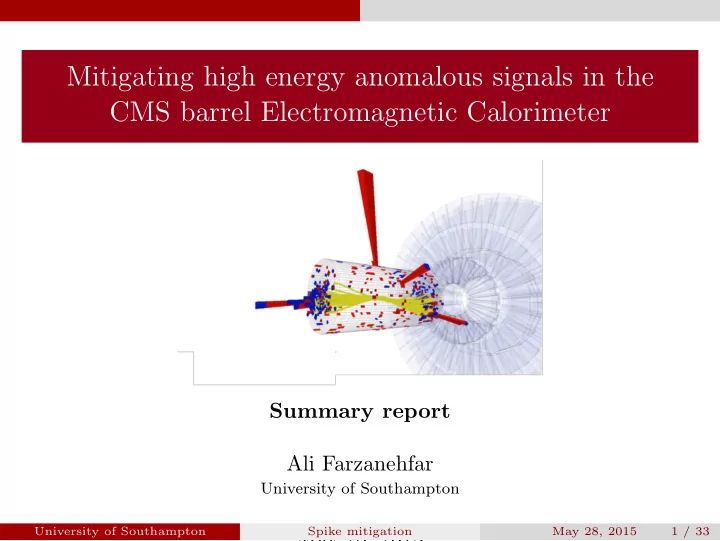
Example of a spike signal. It originates from just a single channel

A cross section of CMS is visible. The spike represents 690 GeV of energy. This was recorded during √s = 2.36 TeV runs.

University of Southampton Spike mitigation May 28, 2015 4 / 33

slide-5
SLIDE 5

Introduction

Outline

The CMS experiment and ECAL Origin and properties of spikes Pulse shape analysis of 2012 data Development of a pulse shape Monte Carlo Results of optimising the Monte Carlo Summary and future studies

University of Southampton Spike mitigation May 28, 2015 5 / 33

slide-6
SLIDE 6

The CMS experiment

The CMS experiment

University of Southampton Spike mitigation May 28, 2015 6 / 33

slide-7
SLIDE 7

The CMS experiment

An overview of the CMS detector

14,000 Tonnes 3.8 T magnetic field 100 m under ground

University of Southampton Spike mitigation May 28, 2015 7 / 33

slide-8
SLIDE 8

The CMS experiment The electromagnetic calorimeter (ECAL)

eγ are detected via a scintillation process

Electromagnetic showers result from eγ interactions in the scintillators The scintillators are made of Lead Tungstate crystals Avalanche Photo Diodes (APDs) measure the scintillation light

Lead Tungstate crystals with the APDs are displayed[1].

University of Southampton Spike mitigation May 28, 2015 8 / 33

slide-9
SLIDE 9

The CMS experiment The electromagnetic calorimeter (ECAL)

The CMS ECAL layout

University of Southampton Spike mitigation May 28, 2015 9 / 33

slide-10
SLIDE 10

The CMS experiment The event selection system (Trigger)

Localised nature of eγ in ECAL are used to trigger

The trigger reduces event rate in steps from 40 MHz to 100 KHz to 1 KHz Electrons and photons are selected based on their pattern

  • f energy deposition in

ECAL[2] They deposit most (>90%) of their energy in two strips [red] They deposit very little of their energy (<5%) outside ECAL

University of Southampton Spike mitigation May 28, 2015 10 / 33

slide-11
SLIDE 11

The CMS experiment The event selection system (Trigger)

Spikes dominate eγ trigger rate if unmitigated

Spikes pass eγ trigger requirements:

Spikes are high energy Spikes are highly localised (occur in a single crystal channel) Spikes only exist in ECAL

The spike rate increases with energy and luminosity[3] If there were no mitigation:

More than 60% of the trigger rate would be due to spikes (2012 data)[2] Even with current mitigation efforts there would be more spikes than the trigger could cope with in the future1 This means a dramatic loss of eγ events (such as H → γγ)

1This is the case for the High Luminosity LHC (HL-LHC) which begins running

in 2025.

University of Southampton Spike mitigation May 28, 2015 11 / 33

slide-12
SLIDE 12

Origin and properties of spikes

Origin and properties of spikes

University of Southampton Spike mitigation May 28, 2015 12 / 33

slide-13
SLIDE 13

Origin and properties of spikes Origin of spikes

Spikes originate within the APDs

APDs are covered with a protective epoxy ≈ 400µm thick Epoxy is a hydrocarbon polymer Neutrons (produced in calorimeters) undergo n − p scattering within this epoxy coating Resulting proton heavily ionises APD active layer

Left: Normal operation of APD. Right: Spike being produced.

University of Southampton Spike mitigation May 28, 2015 13 / 33

slide-14
SLIDE 14

Origin and properties of spikes Properties of spikes

Spikes occur in isolation

Spike signals are produced within an individual APD Spikes are not associated with electromagnetic showers (unlike eγ) eγ spread their energy across several channels (Left) unlike spikes (Right) This is currently being used to distinguish between spikes and eγ signals.

University of Southampton Spike mitigation May 28, 2015 14 / 33

slide-15
SLIDE 15

Origin and properties of spikes Properties of spikes

Spike pulses rise faster than eγ pulses

Spike pulses [red] are not associated with the scintillation process Scintillation decay time of crystals is 10 ns on average[4] The peak time of pulses is currently being used in spike mitigation after the trigger.

University of Southampton Spike mitigation May 28, 2015 15 / 33

slide-16
SLIDE 16

Origin and properties of spikes Properties of spikes

The pulse shape has not been directly used in spike mitigation

The combination of energy topology and time based selections have allowed ECAL to perform to design requirements thus far They are not 100% efficient In higher luminosity conditions the spike rate will increase The trigger will become less efficient by 2025 We looked into using the pulse shape directly in spike mitigation

University of Southampton Spike mitigation May 28, 2015 16 / 33

slide-17
SLIDE 17

Pulse shape analysis of 2012 CMS data

Pulse shape analysis of 2012 CMS data

University of Southampton Spike mitigation May 28, 2015 17 / 33

slide-18
SLIDE 18

Pulse shape analysis of 2012 CMS data A χ2 test

A goodness of fit test for digitised pulses is used in CMS

xi are values from a sampled pulse σi are the statistical errors

  • f sampled values

ti are samples from an eγ template shape N=10 is the total number

  • f samples

Agreement means

  • χ2

= 1 χ2 = 1 N

N

  • i=1

(xi − ti)2 σ2

i

University of Southampton Spike mitigation May 28, 2015 18 / 33

slide-19
SLIDE 19

Pulse shape analysis of 2012 CMS data The χ2

CMS behaviour

eγ and spike χ2

CMS distributions mix non-negligibly

CMS use χ2

CMS where:

χ2

CMS = 7(3 + ln

  • χ2

) eγ and spike signals have separate peaks There is some overlap

Efficient separation is not possible This inefficiency needs investigation

University of Southampton Spike mitigation May 28, 2015 19 / 33

slide-20
SLIDE 20

Pulse shape analysis of 2012 CMS data CMS χ2 blind spot

The χ2

CMS distribution has periodic blind spots

χ2

CMS plotted as a function of time

CMS pulses are sampled every 25 ns In this dataset collisions took place every 50 ns (grey bands) Some eγ and spike digitised pulses have similar χ2

CMS for the same

reconstructed time Adjusting the time of digitisation may move the blind spot. A simulation is necessary to confirm this as well as investigate other features of digitisation process

University of Southampton Spike mitigation May 28, 2015 20 / 33

slide-21
SLIDE 21

Pulse shape analysis of 2012 CMS data CMS χ2 blind spot

Spike and eγ pulses are identical at the blind spots

University of Southampton Spike mitigation May 28, 2015 21 / 33

slide-22
SLIDE 22

Monte Carlo simulation of CMS pulse shapes

Monte Carlo simulation of CMS pulse shapes

University of Southampton Spike mitigation May 28, 2015 22 / 33

slide-23
SLIDE 23

Monte Carlo simulation of CMS pulse shapes Pulse digitisation process

3 main steps exist in the CMS digitisation process

APD eγ signals are extended via convolution with the shaping function with shaping time τe Digitisation start time of the pulse is adjusted Finally the pulse is digitised with a set number of samples CMS will be upgraded in 2023 for HL-LHC. This is our chance to optimise the ECAL electronics for spike mitigation.

University of Southampton Spike mitigation May 28, 2015 23 / 33

slide-24
SLIDE 24

Monte Carlo simulation of CMS pulse shapes Calculation of χ2 of simulated pulses

The Monte Carlo reproduces the blind spot behaviour in CMS data

The simulation generates eγ and spike pulses to mimic CMS data Convoluted pulse shapes are digitised Convoluted eγ is used as χ2 reference Noise is added to each digitised value by sampling a Gaussian with σ = 60 MeV

University of Southampton Spike mitigation May 28, 2015 24 / 33

slide-25
SLIDE 25

Improving χ2 discrimination using the Monte Carlo

Improving χ2 discrimination using the Monte Carlo

University of Southampton Spike mitigation May 28, 2015 25 / 33

slide-26
SLIDE 26

Improving χ2 discrimination using the Monte Carlo Tuning the electronic shaping time

Shorter shaping time results in better spike rejection

Shorter shaping time increases spike-eγ pulse shape differences APD noise depends on shaping time τe and dark current Id

University of Southampton Spike mitigation May 28, 2015 26 / 33

slide-27
SLIDE 27

Improving χ2 discrimination using the Monte Carlo Tuning the electronic shaping time

This takes the following form: στe =

  • A

τe + B(τe)(Id) Id is due to APD irradiation (∝ L) During HL-LHC conditions Id will be large and στe ∝ √τe eγ acceptance efficiency is 98% for all data points Based on this study CMS should consider reducing the shaping time to τe = 20 ns during the HL-LHC upgrade.

University of Southampton Spike mitigation May 28, 2015 27 / 33

slide-28
SLIDE 28

Improving χ2 discrimination using the Monte Carlo Adjusting the digitisation start time

Adjusting the moment of digitisation removes the blind spot

This study has found for any shaping time, blind spots can be removed by adjusting the digitisation moment. For shaping times 43 and 20 ns, the adjustment necessary is -9 ns and

  • 7 ns respectively. This can be

implemented before 2023 and should be considered.

University of Southampton Spike mitigation May 28, 2015 28 / 33

slide-29
SLIDE 29

Improving χ2 discrimination using the Monte Carlo Increasing the number of digitised samples

Doubling the number of samples also removes the blind spots

Increase the number of samples from 10 to 20 eγ [blue] and spike [red] distributions are separated Blind spots are removed Increasing the number of samples from 10 to 20 is most effective and should be considered for the HL-LHC upgrade.

University of Southampton Spike mitigation May 28, 2015 29 / 33

slide-30
SLIDE 30

Summary and proposals for future studies

Summary and proposals for future studies

University of Southampton Spike mitigation May 28, 2015 30 / 33

slide-31
SLIDE 31

Summary and proposals for future studies

There is still work to be done

If doubling the bandwidth (number of samples) is not practical a spike bit should be developed Spike bit will effectively use the analogue shape in a goodness of fit test This could compare pulse widths at half maximum to discriminate between pulses The current simulation contains the flexibility to be used for such a study Study is required to find a compromise digitisation time adjustment for spike rejection and trigger efficiency

University of Southampton Spike mitigation May 28, 2015 31 / 33

slide-32
SLIDE 32

Summary and proposals for future studies

Summary

Spikes in the CMS ECAL have the potential to dominate the trigger rate Previous mitigation methods have allowed ECAL to perform to design requirements thus far Situation will get progressively worse for higher energies and luminosities Viable solutions to be implemented in the HL-LHC were presented By using the properties of spikes in energy topology, pulse shape and time, the CMS trigger can be used to mitigate spikes to the required level

University of Southampton Spike mitigation May 28, 2015 32 / 33

slide-33
SLIDE 33

Summary and proposals for future studies

References

[1] D. A. Petyt, Nuclear Instruments and Methods in Physics Research Section A: Accelerators, Spectrometers, Detectors and Associated Equipment 695, 293 (2012), ISSN 01689002, URL http://www. sciencedirect.com/science/article/pii/S0168900211019553. [2] A. Zabi, EPJ Web of Conferences 28, 12036 (2012), ISSN 21016275, arXiv:1202.0594v1. [3] T. F. of Anomalous Signals in Calorimeters (Presented at a CMS Wednesday General Meeting on May 26, 2010), URL https://indico.cern.ch/event/81386/contribution/1/ material/slides/1.pdf. [4] The CMS Collaboration, Journal of Instrumentation 3, S08004 (2008), ISSN 1748-0221, URL http://stacks.iop.org/1748-0221/3/i=08/a=S08004. [5] The CMS Collaboration, Journal of Instrumentation 5, T03011 (2010), ISSN 1748-0221, URL http://cds.cern.ch/record/1223866/usage. [6] P. Gras, Journal of Physics: Conference Series 587, 012016 (2015),

University of Southampton Spike mitigation May 28, 2015 33 / 33

slide-34
SLIDE 34

Current spike mitigation efforts

Current spike mitigation efforts

University of Southampton Spike mitigation May 28, 2015 34 / 33

slide-35
SLIDE 35

Current spike mitigation efforts Topological and time based discrimination

>98.5% of spikes are rejected using energy topology and reconstructed time

The Swiss-Cross variable is used to distinguish spikes from eγ Spike reconstructed time is early due to their faster pulse shape[5]

University of Southampton Spike mitigation May 28, 2015 35 / 33

slide-36
SLIDE 36

Current spike mitigation efforts Unaffected spikes

Spikes in-time with LHC collisions are unmitigated

Swiss-Cross[red] and time[blue] are the only properties used thus far Spikes within red boxes are not removed Time reconstruction is not available at trigger (Only Swiss-Cross) In future high luminosity conditions[6], the overlap of spikes and electromagnetic showers will increase Detailed pulse shape information has not been used in spike mitigation as of yet

University of Southampton Spike mitigation May 28, 2015 36 / 33

slide-37
SLIDE 37

Efficiency curves

Efficiency curves

University of Southampton Spike mitigation May 28, 2015 37 / 33

slide-38
SLIDE 38

Efficiency curves Shaping time efficiency curves

Left: Spike rejection efficiency of a sliding χ2 cut is plotted against eγ acceptance efficiency for signals within the collision time windows for τe = 43 ns as was the case in 2012. Right: The same as the plot on the left with a shaping time of τe = 20 ns.

University of Southampton Spike mitigation May 28, 2015 38 / 33

slide-39
SLIDE 39

Efficiency curves Digitisation time efficiency curves and example

Left: Spike rejection efficiency of a sliding χ2 cut is plotted against eγ acceptance efficiency for signals within the collision time windows for pulses as was the case in CMS in 2012. Right: The same as on the left with

  • ptimised digitisation.

University of Southampton Spike mitigation May 28, 2015 39 / 33

slide-40
SLIDE 40

Efficiency curves Digitisation time effect on pulses

Left: The blind spot with simulated pulses. Right: The digitisation time is

  • ptimised here.

University of Southampton Spike mitigation May 28, 2015 40 / 33

slide-41
SLIDE 41

The data based energy and time PDFs

The data based energy and time PDFs

University of Southampton Spike mitigation May 28, 2015 41 / 33

slide-42
SLIDE 42

The data based energy and time PDFs Time probability distributions

Left: Time probability distribution for spike signals extracted from CMS. Right: The same as the left for eγ signals.

University of Southampton Spike mitigation May 28, 2015 42 / 33

slide-43
SLIDE 43

The data based energy and time PDFs Energy probability distributions

Left: Energy probability distribution for spike signals extracted from CMS. Right: The same as the left for eγ signals.

University of Southampton Spike mitigation May 28, 2015 43 / 33