Mississippi United To End Homelessness Coalition Balance of State - - PDF document

mississippi united to end homelessness coalition balance
SMART_READER_LITE
LIVE PREVIEW

Mississippi United To End Homelessness Coalition Balance of State - - PDF document

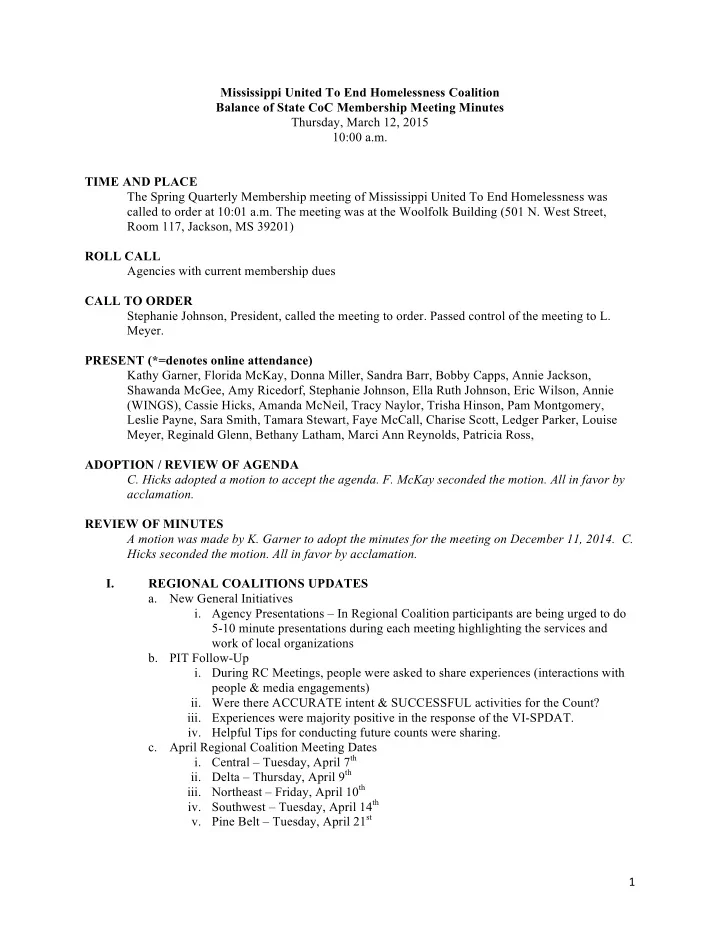
Mississippi United To End Homelessness Coalition Balance of State CoC Membership Meeting Minutes Thursday, March 12, 2015 10:00 a.m. TIME AND PLACE The Spring Quarterly Membership meeting of Mississippi United To End Homelessness was called to


slide-1
SLIDE 1

¡ 1 ¡ Mississippi United To End Homelessness Coalition Balance of State CoC Membership Meeting Minutes Thursday, March 12, 2015 10:00 a.m. TIME AND PLACE The Spring Quarterly Membership meeting of Mississippi United To End Homelessness was called to order at 10:01 a.m. The meeting was at the Woolfolk Building (501 N. West Street, Room 117, Jackson, MS 39201) ROLL CALL Agencies with current membership dues CALL TO ORDER Stephanie Johnson, President, called the meeting to order. Passed control of the meeting to L. Meyer. PRESENT (*=denotes online attendance) Kathy Garner, Florida McKay, Donna Miller, Sandra Barr, Bobby Capps, Annie Jackson, Shawanda McGee, Amy Ricedorf, Stephanie Johnson, Ella Ruth Johnson, Eric Wilson, Annie (WINGS), Cassie Hicks, Amanda McNeil, Tracy Naylor, Trisha Hinson, Pam Montgomery, Leslie Payne, Sara Smith, Tamara Stewart, Faye McCall, Charise Scott, Ledger Parker, Louise Meyer, Reginald Glenn, Bethany Latham, Marci Ann Reynolds, Patricia Ross, ADOPTION / REVIEW OF AGENDA

  • C. Hicks adopted a motion to accept the agenda. F. McKay seconded the motion. All in favor by

acclamation. REVIEW OF MINUTES A motion was made by K. Garner to adopt the minutes for the meeting on December 11, 2014. C. Hicks seconded the motion. All in favor by acclamation. I. REGIONAL COALITIONS UPDATES

  • a. New General Initiatives
  • i. Agency Presentations – In Regional Coalition participants are being urged to do

5-10 minute presentations during each meeting highlighting the services and work of local organizations

  • b. PIT Follow-Up
  • i. During RC Meetings, people were asked to share experiences (interactions with

people & media engagements)

  • ii. Were there ACCURATE intent & SUCCESSFUL activities for the Count?
  • iii. Experiences were majority positive in the response of the VI-SPDAT.
  • iv. Helpful Tips for conducting future counts were sharing.
  • c. April Regional Coalition Meeting Dates
  • i. Central – Tuesday, April 7th
  • ii. Delta – Thursday, April 9th
  • iii. Northeast – Friday, April 10th
  • iv. Southwest – Tuesday, April 14th
  • v. Pine Belt – Tuesday, April 21st
slide-2
SLIDE 2

¡ 2 ¡

  • d. For more information about Coalition Dates and Locations, LINK:

http://muteh.org/#/calendar/regional-meetings

  • e. 2015 PIT Count
  • i. Thanks to everyone who participated!
  • ii. All anticipated forms (PIT & HIC) have been submitted to the BoS and are now

processed in HMIS de-duplication and reporting.

  • iii. We’ve received approx. 500 VI-SPDATs!
  • iv. Results to be reported via Regional Coalition & next Membership Meeting
  • v. Sample media coverage of the PIT can be viewed at

https://muteh.wordpress.com/

  • vi. Questions:
  • 1. K. Garner was concerned that the PB Count would be low. She asked if

all PB organizations had submitted forms vs. who did not submit forms.

  • R. Glenn noted that all usual PB orgs submitted form except one. He also

noted that counts in the PB as well as around the state were lower than usual.

  • 2. B. Capps was concerned about those who were counted in past counts vs.

those who were counted in this year’s Count. R. Glenn noted that the population that he was concerned about would not greatly affect the NE numbers or the overall Count.

  • 3. M. Reynolds expressed the need to connect with the City of Meridian to

better bolster their Count number. R. Glenn wholeheartedly agreed. II. HMIS UPDATES

  • a. HMIS Stats
  • i. Agencies Implemented: 24
  • ii. Agency Programs: 105
  • iii. Active Users: 118
  • b. Upcoming Events
  • i. The Department of Mental Health’s CABHI Implementation is beginning to take

shape in HMIS. There will be training for the CABHI implementation on Friday, March 20, 2015.

  • ii. This month’s “Training Tuesdays” has been rescheduled for March 24th. If you

have a training request, please make it known the HMIS Staff (L. Parker, B. Latham). III. TRANSITION COMMITTEE: GOVERNANCE CHARTER REVIEW

  • a. The CoC is moving forward with the adoption of several documents in accordance with

HUD regulations:

  • i. MS Balance of State Governance Charter
  • 1. LINK:

http://storage.cloversites.com/mississippiunitedtoendhomelessness/docu ments/Governance_Charter_for_MS_BoS_Draft_2.pdf

  • ii. Collaborative Applicant Agreement
  • 1. LINK:

http://storage.cloversites.com/mississippiunitedtoendhomelessness/docu ments/Collaborative_Applicant_Agreement_2014_2015.pdf

  • iii. HMIS Lead Agency Agreement
  • 1. LINK:

http://storage.cloversites.com/mississippiunitedtoendhomelessness/docu ments/HMIS_CoC_Agreement.pdf

slide-3
SLIDE 3

¡ 3 ¡

  • iv. All aforementioned documents will be posted under the BoS CoC tab here:

http://muteh.org/#/bos-coc/coc-membership

  • b. The MS BoS Governing Council (15 Members) will include:
  • i. Representatives of each of the 6 regional coalitions (non-funded agencies

preferred)

  • ii. 1 Formerly Homeless Person
  • iii. ESG Representative
  • iv. Community Liaison (MS Municipal League)
  • v. Representative from the MS Permanent Supportive Housing Council

(Interagency Council)

  • vi. Veterans Affairs Representative
  • vii. Philanthropic/Foundation Rep.
  • viii. Dept. of Mental Health Rep.
  • ix. Exec. Director of Collaborative Applicant
  • x. 1 At-Large Representative
  • c. MS BoS Governing Council Officers: Executive Committee
  • i. The Executive Committee will recuse themselves from the ranking committee.

The Executive Committee serves as the Appeal Board for any disputes on actions taken by committees and/or CoC membership. The decision of the Executive Committee shall be final in all matters.

  • ii. The Committee will consist of:
  • 1. Chair
  • 2. Vice Chair
  • 3. Secretary/Treasurer
  • iii. Ballots to be sent off next week.
  • d. New Committee Structures
  • i. Ranking Committee – will be made up of by the 15 member GC (funding

agencies will recuse themselves

  • ii. HMIS/Technology Committee – potential new name
  • iii. Resource Development/Membership/Awareness Committee – formerly the

membership committee

  • iv. Funding & Strategy Committee
  • v. Quality and Performance Evaluation/Monitoring Committee – makes

recommendations for non-funded of ESG and CoC projects

  • vi. Ad-Hoc committees
  • vii. Coordinated Assessment Committee
  • e. Regional Coalitions
  • i. The Governing Council will include representation from the 6 Regional
  • Coalitions. The Governing Council will identify and address membership gaps in

essential sectors, from key providers or other vital stakeholders (see below). Regional Coalition representation on the Governing Council is specifically intended to bring broad representation from multiple service delivery systems and areas of expertise throughout the state.

  • ii. Regional Coalitions meeting once a month.
  • iii. As of July 1st, 2015, fees for membership will be $10.
  • iv. Regional Coalition membership on the Governing Council should include

representation from all of the sectors or stakeholders listed below. Individual board members may represent multiple sectors or stakeholders:

  • 1. Non-Profit homeless assistance providers
  • 2. Domestic violence victim service providers
  • 3. Culturally-specific service providers
slide-4
SLIDE 4

¡ 4 ¡

  • 4. Faith-based organizations
  • 5. Governments
  • 6. Businesses and workforce development organizations
  • 7. Advocates
  • 8. Public housing agencies
  • 9. School districts
  • 10. Social service providers
  • 11. Behavioral health
  • 12. Hospitals and primary health care providers
  • 13. Coordinated Care Organizations
  • 14. Universities
  • 15. Affordable housing developers
  • 16. Law enforcement and criminal justice
  • 17. Organizations that serve veterans
  • 18. Homeless and formerly homeless individuals
  • 19. Department of Human Services self-sufficiency and foster care programs
  • 20. Other relevant organizations within community as determined by the

Governing Council

  • v. The Regional Coalitions shall support the principles of the Continuum of Care

through shared agendas and participation in the Governing Council, committees and work groups, and CoC meetings. The members of the Regional Coalition shall elect a Chair and Vice Chair every 2 years. There is no limit to the number of terms that an individual can be elected

  • r appointed to serve. The Chair will serve as the appointment to the Governing
  • Council. Regional Coalition meetings will be conducted in accordance with

Mississippi’s Public Meetings Laws and directed by the Regional Coalition

  • Chair. The Regional Coalitions Vice Chair will direct Regional Coalitions

meetings if required due to Regional Coalitions Chairs’ absence. Regular meetings will be held at least once per quarter, but generally on a monthly basis. The Regional Coalitions Chair may call additional meetings. At a duly called meeting of the Regional Coalitions, a majority of the Regional Coalitions or greater than 50% shall constitute a quorum. All business of the Regional Coalitions will be transacted at a duly called meeting of the Regional Coalitions. Meeting dates, locations and agendas will be made public at least one week in advance of the meeting. Notes from the meeting will be submitted to the CoC Coordinator and posted publicly within seven business days of the meeting. The Regional Coalitions will make decisions by a vote of the majority of Regional Coalitions members present.

  • vi. Terms of Service - The Regional Coalition appointment to the Governing

Council shall serve as long as they hold the office of Regional Coalition Chair. There is no limit to the number of terms that an individual can be elected or appointed to serve. If a Regional Coalition Chair is unable to routinely conduct Regional Coalitions business, the Governing Council should seek to assign Regional Coalitions representation to another appointed individual. Regional Coalitions members appointed to the Governing Council might have their appointments revoked at any time and at the sole discretion of the

slide-5
SLIDE 5

¡ 5 ¡ Governing Council.

  • vii. A new position, CoC Coordinator, will provided to help the CoC conduct daily
  • business. They will be paid 3% of admin. Budget from the CoC-funded agencies.
  • f. Coordinated Entry Process Development
  • i. An effective coordinated entry process is a critical component to any

community’s efforts to meet the goals of Opening Doors: Federal Strategic Plan to Prevent and End Homelessness. HUD’s primary goals for coordinated entry processes are that assistance be allocated as effectively as possible and that it be easily accessible no matter where or how people present.

  • ii. Last week, HUD posted the Coordinated Entry Policy Brief. Please click the link

to download and review the policy brief. IV. UNFINISHED BUSINESS

  • a. None

V. NEW BUSINESS

  • a. Trisha Hinson (DMH) shared information about CABHI, PATH, and Mental Health

Centers.

  • i. CABHI includes $1.5M for homeless services. Planning to submit an expansion

grant to get to $1.8M. Community Mental Health agencies to provide case management for CABHI participants.

  • ii. CABHI started 10/2014, but sub grantees were just awarded monies for

programs.

  • iii. CABHI wants to use the VI-SPDAT to determine program entry. Will work

with the BoS CoC to accomplish collaboration

  • iv. SOAR is a part of the CABHI grant. Hinson hopes to utilize and get SOAR

staff for each MH Hospital in the state.

  • v. T. Hinson is looking to hire 2 more staff persons: 1) SOAR Staff Person 2)

Peer Support Specialist.

  • vi. If you would like to know more her organization, work, or CABHI opportunities,

email trisha.hinson@dmh.state.ms.us VI. ANNOUNCEMENTS

  • a. CoC Funding Announcement(s): FY2014
  • i. MS Awards LINK: https://www.hudexchange.info/onecpd/assets/File/2014-

mississippi-coc-grants.pdf

  • b. Next Membership Meeting
  • i. Our next Quarterly Membership Meeting will be March 12th, 2015 10am in

Jackson, MS. VII. ADJOURNMENT The meeting adjourned at 12:00 p.m.

slide-6
SLIDE 6

M U T E H M E M B E R S H I P M E E T I N G

M A R C H 1 2 , 2 0 1 5

A G E N D A

  • Welcome
  • Call to Order
  • Adoption/Review of Agenda
  • Review of Minutes
  • Regional Coalition Updates
  • PIT Count Update
  • HMIS Update
  • Transition Committee Report
  • Coordinated Entry Process Development
  • Unfinished Business
  • New Business
  • Announcements
  • Adjournment
  • General Initiative
  • Agency Presentations - 5-10 min

presentations during each meeting highlighting the services and work of local

  • rganization
  • PIT Follow-Up Debriefing
  • Experiences (Interactions w/ people & media
  • Were there ACCURATE intent &

SUCCESSFUL activities for the Count?

  • VI-SPDAT
  • Helpful Tips

R E G I O N A L C O A L I T I O N M E E T I N G D AT E S

  • Central - April 7th
  • Delta - April 9th
  • Northeast - April 10th
  • Southwest - April 14th
  • Pine Belt - April 21st
slide-7
SLIDE 7
  • Thanks to everyone who participated!
  • All anticipated forms (PIT & HIC) have been submitted to the BoS

and are now processed in HMIS de-duplication and reporting.

  • We’ve received approx. 500 VI-SPDATs!
  • Results to be reported via Regional Coalition & next Membership

Meeting

  • Sample Media coverage of the PIT can be viewed at

mute.wordpress.com

H M I S U P D AT E S

  • Agencies Implemented: 24
  • Agency Programs: 105
  • Active Users: 118
  • Upcoming Events:
  • DMH CABHI Implementation
  • Training Tuesday rescheduled for March 24th

G O V E R N A N C E C H A R T E R R E V I E W

T R A N S I T I O N C O M M I T T E E

A D O P T E D D O C U M E N T S

  • MS Balance of State Governance Charter
  • Collaborative Applicant Agreement
  • HMIS Lead Agency Agreement

Documents will be posted under the BoS CoC tab of muteh.org

slide-8
SLIDE 8

M S B A L A N C E O F S TAT E G O V E R N I N G ( 1 5 M E M B E R S )

  • Representatives of each of the 6 regional coalitions (prefer non-funded)
  • Formerly Homeless Person
  • ESG Representative
  • Community Liaison (MS Municipal League)
  • Representative from the MS Permanent Supportive Housing Council

(Interagency Council)

  • VA Representative
  • Philanthropic/Foundation Rep
  • Dept of Mental Health Rep
  • Exec Director of Collaborative Applicant
  • 1 At Large

M S B O S G O V E R N I N G C O U N C I L O F F I C E R S : E X E C U T I V E C O M M I T T E E

  • Chair
  • Vice Chair
  • Secretary / Treasurer

The Executive Committee will recuse themselves from the ranking committee. The Executive Committee serves as the Appeal Board for any disputes on actions taken by committees and/or CoC membership. The decision of the Executive Committee shall be final in all matters.

N E W C O M M I T T E E S T R U C T U R E

  • Ranking Committee – will be made up by the 15 member

Governing Council (funded agencies will recuse themselves)

  • HMIS/Technology Committee – potential new name
  • Resource Development/Membership/Awareness Committee –

formerly the membership committee

  • Funding & Strategy Committee
  • Quality and Performance Evaluation/Monitoring Committee –

makes recommendations for non-funded of ESG and CoC projects

  • Ad Hoc committees
  • Coordinated Assessment Committee

R E G I O N A L C O A L I T I O N S

  • The Governing Council will include representation from the 6

Regional Coalitions. The Governing Council will identify and address membership gaps in essential sectors, from key providers or other vital stakeholders (see below). Regional Coalition representation on the Governing Council is specifically intended to bring broad representation from multiple service delivery systems and areas of expertise throughout the state. Regional Coalition membership on the Governing Council should include representation from all of the sectors or stakeholders listed below. Individual board members may represent multiple sectors or stakeholders.

slide-9
SLIDE 9

R E G I O N A L C O A L I T I O N S

  • Nonprofit homeless assistance

providers

  • Domestic violence victim service

providers

  • Culturally-specific service providers
  • Faith-based organizations
  • Governments
  • Businesses and workforce

development organizations

  • Advocates
  • Public housing agencies
  • School districts
  • Social service providers
  • Behavioral health providers
  • Hospitals and primary health care

providers

  • Coordinated Care Organizations
  • Universities
  • Affordable housing developers
  • Law enforcement and criminal

justice

  • Organizations that serve veterans
  • Homeless and formerly homeless

individuals

  • Department of Human Services self-

sufficiency and foster care programs

  • Other relevant organizations within

community as determined by the Governing Council

R E G I O N A L C O A L I T I O N S

  • The Regional Coalitions shall support the principles of the Continuum of Care through

shared agendas and participation in the Governing Council, committees and work groups, and CoC meetings.

  • The members of the Regional Coalition shall elect a Chair and Vice Chair every 2 years.

There is no limit to the number of terms that an individual can be elected or appointed to

  • serve. The Chair will serve as the appointment to the Governing Council. Regional

Coalition meetings will be conducted in accordance with Mississippi’s Public Meetings Laws and directed by the Regional Coalition Chair. The Regional Coalitions Vice Chair will direct Regional Coalitions meetings if required due to Regional Coalitions Chairs’

  • absence. Regular meetings will be held at least once per quarter, but generally on a

monthly basis. Additional meetings may be called by the Regional Coalitions Chair. At a duly called meeting of the Regional Coalitions, a majority of the Regional Coalitions or greater than 50% shall constitute a quorum. All business of the Regional Coalitions will be transacted at a duly called meeting of the Regional Coalitions. Meeting dates, locations and agendas will be made public at least one week in advance of the meeting. Notes from the meeting will be submitted to the CoC Coordinator and posted publicly within seven business days of the meeting.

  • The Regional Coalitions will make decisions by a vote of the majority of Regional

Coalitions members present.

T E R M S O F S E R V I C E

  • The Regional Coalition appointment to the Governing

Council shall serve as long as they hold the office of Regional Coalition Chair. There is no limit to the number

  • f terms that an individual can be elected or appointed to
  • serve. If a Regional Coalition Chair is unable to routinely

conduct Regional Coalitions business, the Governing Council should seek to assign Regional Coalitions representation to another appointed individual.

  • Regional Coalitions members appointed to the

Governing Council may have their appointments revoked at any time and at the sole discretion of the Governing Council.

C O O R D I N AT E D E N T RY P R O C E S S D E V E L O P M E N T

slide-10
SLIDE 10

E F F E C T I V E C O O R D I N AT E D E N T RY

  • An effective coordinated entry process is a critical

component to any community’s efforts to meet the goals of Opening Doors: Federal Strategic Plan to Prevent and End Homelessness.

  • HUD’s primary goals for coordinated entry

processes are that assistance be allocated as effectively as possible and that it be easily accessible no matter where or how people present. Q U A L I T I E S O F E F F E C T I V E C O O R D I N AT E D E N T RY

An effective coordinated entry process has the following qualities:

  • Prioritization. HUD has determined that an effective coordinated entry process ensures that

people with the greatest needs receive priority for any type of housing and homeless assistance available in the CoC, including PSH, Rapid Rehousing (RRH), and other interventions.

  • Low Barrier. The coordinated entry process does not screen people out for assistance because
  • f perceived barriers to housing or services, including, but not limited to, lack of employment or

income, drug or alcohol use, or having a criminal record. In addition, housing and homelessness programs lower their screening barriers in partnership with the coordinated entry process.

  • Housing First orientation. The coordinated entry process is Housing First oriented, such that

people are housed quickly without preconditions or service participation requirements.

  • Person-Centered. The coordinated entry process incorporates participant choice, which may

be facilitated by questions in the assessment tool or through other methods. Choice can include location and type of housing, level of services, and other options about which households can participate in decisions.

Fair and Equal Access. All people in the CoC’s geographic area have fair and equal access to the coordinated entry process, regardless of where or how they present for services. Fair and equal access means that people can easily access the coordinated entry process, whether in person, by phone, or some other method, and that the process for accessing help is well known. Marketing strategies may include direct outreach to people on the street and other service sites, informational flyers left at service sites and public locations, announcements during CoC or other coalition meetings, and educating mainstream service providers. If the entry point includes

  • ne or more physical locations, they are accessible to people with disabilities, and easily accessible by public

transportation, or there is another method, e.g., toll-free or 211 phone number, by which people can easily access them. The coordinated entry process is able to serve people who speak languages commonly spoken in the community. Emergency services. The coordinated entry process does not delay access to emergency services such as

  • shelter. The process includes a manner for people to access emergency services at all hours independent of the
  • perating hours of the coordinated entry intake and assessment processes. For example, people who need

emergency shelter at night are able to access shelter, to the extent that shelter is available, and then receive an assessment in the days that follow, even if the shelter is the access point to the coordinated entry process. Standardized Access and Assessment. All coordinated entry locations and methods (phone, in-person,

  • nline, etc.) offer the same assessment approach and referrals using uniform decision-making processes. A

person presenting at a particular coordinated entry location is not steered towards any particular program or provider simply because they presented at that location.

Q U A L I T I E S O F E F F E C T I V E C O O R D I N AT E D E N T RY Q U A L I T I E S O F E F F E C T I V E C O O R D I N AT E D E N T RY

  • Inclusive. A coordinated entry process includes all subpopulations, including people experiencing

chronic homelessness, Veterans, families, youth, and survivors of domestic violence. However, CoCs may have different processes for accessing coordinated entry, including different access points and assessment tools for the following different populations: (1) adults without children, (2) adults accompanied by children, (3) unaccompanied youth, or (4) households fleeing domestic violence. These are the only groups for which different access points are used. For example, there is not a separate coordinated entry process for people with mental illness or addictions, although the systems addressing those disabilities may serve as referral sources into the process. The CoC continuously evaluates and improves the process ensuring that all subpopulations are well served.

  • Referral to projects. The coordinated entry process makes referrals to all projects receiving

Emergency Solutions Grants (ESG) and CoC Program funds, including emergency shelter, RRH, PSH, and transitional housing (TH), as well as other housing and homelessness projects. Projects in the community that are dedicated to serving people experiencing homelessness fill all vacancies through referrals, while other housing and services projects determine the extent to which they rely on referrals from the coordinated entry process.

  • Referral protocols. Programs that participate in the CoC’s coordinated entry process accept all

eligible referrals unless the CoC has a documented protocol for rejecting referrals that ensures that such rejections are justified and rare and that participants are able to identify and access another suitable project.

slide-11
SLIDE 11

Q U A L I T I E S O F E F F E C T I V E C O O R D I N AT E D E N T RY

  • Outreach. The coordinated entry process is linked to street outreach efforts so that people

sleeping on the streets are prioritized for assistance in the same manner as any other person assessed through the coordinated entry process.

  • Ongoing planning and stakeholder consultation. The CoC engages in ongoing planning with all

stakeholders participating in the coordinated entry process. This planning includes evaluating and updating the coordinated entry process at least annually. Feedback from individuals and families experiencing homelessness or recently connected to housing through the coordinated entry process is regularly gathered through surveys, focus groups, and other means and is used to improve the process.

  • Informing local planning. Information gathered through the coordinated entry process is used to

guide homeless assistance planning and system change efforts in the community.

  • Leverage local attributes and capacity. The physical and political geography, including the

capacity of partners in a community, and the opportunities unique to the community’s context, inform local coordinated entry implementation.

  • Safety planning. The coordinated entry process has protocols in place to ensure the safety of the

individuals seeking assistance. These protocols ensure that people fleeing domestic violence have safe and confidential access to the coordinated entry process and domestic violence services, and that any data collection adheres to the Violence Against Women Act (VAWA).

Q U A L I T I E S O F E F F E C T I V E C O O R D I N AT E D E N T RY

  • Using HMIS and other systems for coordinated entry. The CoC may use HMIS

to collect and manage data associated with assessments and referrals or they may use another data system or process, particularly in instances where there is an existing system in place into which the coordinated entry process can be easily

  • incorporated. For example, a coordinated entry process that serves households

with children may use a system from a state or local department of family services to collect and analyze coordinated entry data. Communities may use CoC Program

  • r ESG program funding for HMIS to pay for costs associated with coordinated

entry to the extent that coordinated entry is integrated into the CoCs HMIS. A forthcoming paper on Coordinated Entry and HMIS will provide more information.

  • Full coverage. A coordinated entry process covers the CoC’s entire geographic
  • area. In CoCs covering large geographic areas (including statewide, Balance of

State, or large regional CoCs) the CoC might use several separate coordinated entry processes that each cover a portion of the CoC but in total cover the entire

  • CoC. This might be helpful in CoCs where it is impractical for a person who is

assessed in one part of the CoC to access assistance in other parts of the CoC.

P R I O R I T I Z I N G P E O P L E F O R H O U S I N G

  • One of the main purposes of coordinated entry is to ensure

that people with the most severe service needs and levels of vulnerability are prioritized for housing and homeless assistance.

  • HUD’s policy is that people experiencing chronic

homelessness should be prioritized for permanent supportive housing. In some cases PSH projects are required to serve people experiencing chronic homelessness and in

  • ther cases, HUD provides incentives for projects to do so.
  • HUD is strongly encouraging communities to fully implement

the prioritization process included in Notice CPD-014-12.

P R I O R I T I Z I N G P E O P L E F O R H O U S I N G

  • When prioritizing people housing and assistance, consider the following:
  • Significant health or behavioral health challenges or functional impairments which

require a significant level of support in order to maintain permanent housing;

  • High utilization of crisis or emergency services, including emergency rooms, jails,

and psychiatric facilities, to meet basic needs

  • The extent to which people, especially youth and children, are unsheltered
  • Vulnerability to illness or death
  • Risk of continued homelessness
  • Vulnerability to victimization, including physical assault or engaging in trafficking
  • r sex work
slide-12
SLIDE 12

A D D R E S S I N G WA I T T I M E S

Long wait times make homeless assistance less effective and reduce the overall performance of a community’s homeless assistance system. When a community faces a scarcity of needed resources, they should use the coordinated entry process to prioritize which people will receive housing assistance rather than continuing to add people to a long waiting list.

  • For example: If a community has enough permanent supportive housing to serve 10 new

households per month, but 30 households are assessed as needing PSH every month, the coordinated entry process should be adjusted to prioritize approximately 10 households for PSH each month. The other 20 households should be prioritized for other resources available in the community, such as RRH, TH (taking care to consider the impact of placement in TH on an individual’s chronically homeless status or future eligibility in other programs), housing subsidies, or other mainstream resources.

Short waiting times of a few days or weeks might be necessary to properly manage utilization, but waiting times for homeless assistance of several months or years should be eliminated whenever possible

A D D R E S S I N G WA I T T I M E S

Although PSH is almost always the most effective resource for people with high levels of vulnerability and high service needs, including those experiencing chronic homelessness, the lack of available PSH should not result in people languishing in shelters or on the streets without further assistance. Most communities face a gap between need and availability based on limited resources. Communities should be proactively taking steps to close these gaps that are identified through the coordinated entry process.

I M P L E M E N T I N G E F F E C T I V E A S S E S S M E N T T O O L S A N D P R O C E S S E S

HUD does not endorse any specific assessment tool or approach, but there are universal qualities that any tool or criteria used by a CoC for their coordinated entry process should include. At its core, the assessment process is not a one-time event to gather as much information about a person as possible. Instead, assessments are performed only when needed and only assess for information necessary to help an individual or family at that

  • moment. Initial assessments happen as quickly as possible

regardless of where households are residing–streets or in shelter, and the assessment process uses tools as a guide to start the conversation, not as a final decision-maker.

P R I N C I P L E S F O R A N E F F E C T I V E A S S E S S M E N T

Phased Assessment - The assessment tools are employed as a series of situational assessments that allow the assessment process to occur over time and only as necessary

  • For example, an assessment process may have separate tools that assess for

each of the following:

  • Screening for diversion or prevention
  • Assessing shelter and other emergency needs
  • Identifying housing resources and barriers
  • Evaluating vulnerability to prioritize for assistance
  • Screening for program eligibility
  • Facilitating connections to mainstream resources
slide-13
SLIDE 13

P R I N C I P L E S F O R A N E F F E C T I V E A S S E S S M E N T

Necessary Information - The assessment process only seeks information necessary to determine the severity of need and eligibility for housing and services and is based on evidence of the risk of becoming or remaining homeless.

  • For example, a coordinated assessment process would only assess

for a particular disability to determine if that household could be referred to a program that requires a particular disability as part of its eligibility criteria. Participant autonomy - The protocol for filling out assessment tools provides the opportunity for people receiving the assessment to freely refuse to answer questions without retribution or limiting their access to assistance.

P R I N C I P L E S F O R A N E F F E C T I V E A S S E S S M E N T

  • Person-Centered - The assessment process provides options and

recommendations that guide and inform client choices, as opposed to rigid decisions about what individuals or families need. The process also incorporates participants’ strengths, goals, and protective factors to recommend options that best meet the needs and goals of the people being assessed.

  • Cultural competence - Staff administering assessments use culturally

competent practices, and tools contain culturally competent

  • questions. For example, questions are worded to reflect an

understanding of LGBTQ issues and needs, and staff administering assessments are trained to ask appropriately worded questions and

  • ffer options and recommendations that reflect this population’s

specific needs.

P R I N C I P L E S F O R A N E F F E C T I V E A S S E S S M E N T

  • User-friendly - Tools are brief, easily administered by non-clinical staff

including outreach workers, minimize the time required to utilize, and easy for those being assessed to understand.

  • Privacy protections - Privacy protections are in place to ensure proper

consent and use of client information.

  • Meaningful recommendations - Tools are designed to collect the

information necessary to make meaningful recommendations and referrals to available housing and services. Participants being assessed should know exactly what program they are being referred, what will be expected of them, and what they should expect from the program. The coordinated entry process should avoid placing people on long waiting lists.

P R I N C I P L E S F O R A N E F F E C T I V E A S S E S S M E N T

  • Written standards and policies and procedures - The CoC has written

standards describing who is prioritized for assistance and how much assistance they might receive, and the policies and procedures governing the coordinated assessment process are approved by the CoC and easily accessible to stakeholders in the community.

  • Sensitive to lived experiences - Providers recognize that assessment, both the

kinds of questions asked and the context in which the assessment is administered, can cause harm and risk to individuals or families, especially if they require people to relive difficult experiences. The tool’s questions are worded and asked in a manner that is sensitive to the lived and sometimes traumatic experiences of people experiencing homelessness.

slide-14
SLIDE 14

I N T E G R AT I N G Y O U T H I N T O T H E C E P R O C E S S

CoCs with a network of youth serving programs should consider whether they would better serve youth by creating coordinated entry access points dedicated to underage and transition aged youth. These access points can be located in areas where homeless youth feel comfortable and safe. They can be staffed with people who specialize in working with youth. CoCs should take care to ensure that if they use separate coordinated entry points for youth, that those youth can still access assistance from other parts of the homeless assistance system and that youth who access other coordinated entry points can access assistance from youth serving programs. Regardless of whether a CoC uses youth dedicated access points, the coordinated entry process must ensure that youth are treated respectfully and with attention to their developmental needs.

S E R V E P E O P L E F L E E I N G D O M E S T I C V I O L E N C E

CoCs must work with domestic violence programs in their communities to ensure that the coordinated entry process addresses the safety needs of people fleeing domestic violence. This includes providing a safe location or process for conducting assessments, a process for providing confidential referrals, and a data collection process consistent with the Violence Against Women Act. If the CoC’s coordinated entry process uses separate access points for people fleeing domestic violence, CoCs should take care to ensure that people who use the DV coordinated entry process can access homeless assistance resources available from the non-DV portion of the coordinated entry process and vice versa.

D E F I N I N G C O O R D I N AT E D E N T RY R O L E S I N H O M E L E S S A S S I S TA N C E S Y S T E M

Diverse stakeholders have different roles in a coordinated entry process. In some cases, these roles are clearly defined. Often, the roles are challenging to define and can change

  • ver time:

Homeless Assistance Organizations - All homeless assistance organizations should be involved in the coordinated entry process by helping people access the system and receiving referrals. Homeless assistance organizations may also provide assessments or provide space for assessments to be conducted. Emergency shelter, transitional housing, rapid re-housing, and permanent supportive housing programs should only receive referrals through the coordinated entry process. Mainstreaming Housing & Services - Affordable housing and mainstream services are crucial tools for ending homelessness and should be involved in the coordinated entry

  • process. As a CoC’s coordinated entry process is developed, mainstream providers can

act as a source or receiver of referrals.

  • Examples: Mental Health Centers, Substance Abuse Services, VA, Jails, & ERs

D E F I N I N G C O O R D I N AT E D E N T RY R O L E S I N H O M E L E S S A S S I S TA N C E S Y S T E M

  • Prevention and Diversion - There are many more

people who qualify for homelessness prevention assistance than homeless assistance. In developing coordinated entry processes, CoCs should consider how much capacity they have to manage prevention

  • assistance. At a minimum, ESG funded prevention

assistance should be incorporated into the coordinated entry process. Communities should decide to what extent they include additional non- prevention programs and how they are incorporated.

slide-15
SLIDE 15

A N O T E O N F U T U R E G U I D A N C E

  • In the coming months, HUD anticipates releasing the

following materials related to coordinated entry:

  • Summer 2015 - Notice on the requirements for

development and implementation of a CoC’s coordinated entry process. This notice will establish requirements for coordinated entry and timelines for implementation.

A N O T E O N F U T U R E G U I D A N C E

In the coming months, HUD anticipates releasing the following materials related to coordinated entry: Ongoing: Technical Assistance products

  • Meeting HUD expectations and requirements
  • Special considerations for youth
  • Special considerations for people fleeing domestic violence
  • Compliance and monitoring
  • Options for funding coordinated entry
  • Advanced approaches for coordinated entry processes and

systems o Deciding on community-specific assessment tools

  • Planning and implementation
  • Data sharing
  • CoC written standards
  • Using progressive engagement

A N O T E O N F U T U R E G U I D A N C E

Additionally, HUD intends to release the Emergency Solutions Grant (ESG) and CoC Program interim rules for public comment in 2015. During this time, HUD encourages CoCs, ESG recipients and sub-recipients, and CoC Program recipients to submit comments on the requirements contained in the interim rules related to coordinated entry.

R E S O U R C E S & R E F E R E N C E S

  • HUD’s Office of Policy Development & Research February 2015 Summary Report: Assessment

Tools for Allocating Homelessness Assistance: State of the Evidence

  • HUD’s requirements for a Centralized or Coordinated Assessment System in CoC Program

Interim Rule (24 CFR 578.7(a)(8)).

  • HUD’s Office of Special Needs Assistance Programs (SNAPS) July 2013 Weekly Focus on

Coordinated Assessment

  • HUD’s Overview of Coordinated Assessment Systems Prezi and Video
  • Community Solutions’ recorded one hour conference call with slide deck: Overview of

Coordinated Assessment and Housing Placement System. Community’s Solutions’ CAHP System Overview - Zero: 2016

  • Corporation for Supportive Housing’s January 2015 Report: Improving Community-wide

Targeting of Supportive Housing to End Chronic Homelessness: The Promise of Coordinated Assessment

  • National Alliance to End Homelessness Coordinated Assessment Toolkit
  • United States Interagency Council on Homelessness Coordinated Assessment: Putting the Key

Pieces in Place

slide-16
SLIDE 16

A N N O U N C E M E N T S ?

  • CoC Funding Announcement(s)
  • Next Membership Meeting:
  • Annual Membership Meeting: (Tentatively) June 11,

2015