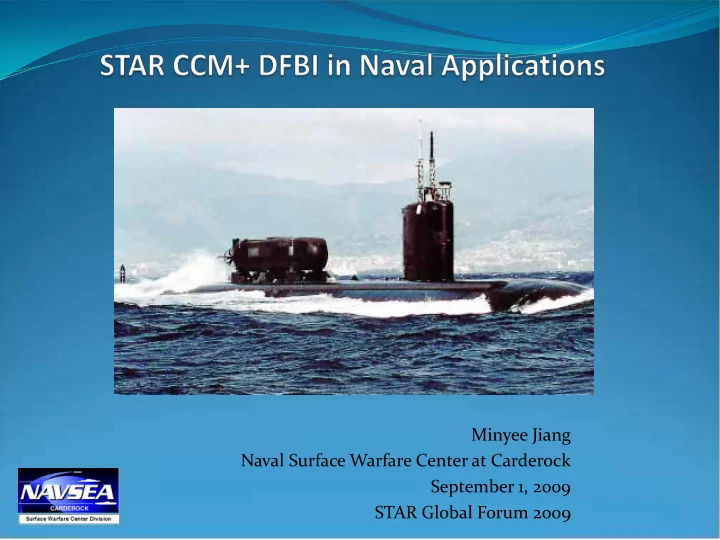
SLIDE 1
Minyee Jiang Naval Surface Warfare Center at Carderock September 1, 2009 STAR Global Forum 2009
SLIDE 2 STAR-CCM+ in NSWCCD CFD Applications
Hull Resistance prediction CFD Validations Internal flow plus ship-wave interaction Wave slap prediction
SLIDE 3 Background
Traditional Submarine Mission: Prior to the end of the Cold
War conflict between two super powers, anti-submarine warfare and the delivery of massive nuclear fire power were the major roles for U.S.
- submarines. The “Silent Service” was the major concern for submarine
- perations. Opportunities for submarine to encounter waves were very
rare .
New Missions: . Now dealing with multiple small conflicts
through out the world, U.S. submarines are more multi-mission
- riented, including assisting Special Operating Forces. Submarine
- peration is no longer completely silent in deep sea. More often
submarines encounter waves.
New configurations: Dry Deck Shelter (DDS) and Advanced Seal
Delivery System (ASDS) mounted on host submarines.
SLIDE 4 ASDS Wave Slap Simulation
Task Title:
Initial Investigation of Wave Impact Loading Trends on the ASDS
Objective:
Simulate forces on ASDS under various wave height, wavelength, and wave
heading to identify trends where ASDS systems may experience significant forces.
Results could lead to identification of potential problem areas with high
loading
Approach:
Computational Fluid Dynamics approach for pressure loading by
simulation of the interaction of the wave field with the ASDS mated to the host ship
SLIDE 5
Numerical Tool and Method
STAR-CCM+
A Reynolds Averaged Navier-Stokes (RANS) code, developed by CD- Adapco, was designed to solve wave interaction problems and is applicable to surface ships and submarines.
VOF
Volume of fluid (VOF) is one of the approaches for accurately
computing free surface flows and breaking waves. Grid cells near the free surface are filled partially with air and water and computed appropriately based on VOF.
SLIDE 6
Volume of Fluid Free Surface Capturing
water air
SLIDE 7
Geometries for the Numerical Model ASDS on a submarine
The propellers of ASDS and submarine are not included in the numerical model Still water line
ASDS Wave Slap Simulation
SLIDE 8
Close up View on ASDS
ASDS was raised few inches for grid generation purpose Control surfaces ASDS Hull Pylons and Matting trunk
SLIDE 9 Computational Domain and Grid
Local Grid Refinement
Cell Zones Region of interest Cells near ASDS Inlet Interest Damping
SLIDE 10 Grid Topology I
(Single region with stretched wave damping zone)
Velocity Inlet Pressure
velocity inlet Velocity inlet
SLIDE 11 Grid Topology II
(Embedded mesh with stretched wave damping zone)
Velocity Inlet Pressure
velocity inlet Interface
SLIDE 12
Grid Topology III
(Single region without stretched wave damping zone)
Velocity Inlet Pressure outlet Velocity Inlet Velocity inlet
SLIDE 13
Grid Topology I (Single region)
Because the outlet boundary is located far downstream, free surface is outside the fine grid region even for small pitch angle d =20L
SLIDE 14
Grid Topology I (Single region)
Free surface enters coarse grid region
SLIDE 15
Grid Topology II (Embedded Grid)
Interface for grid rotation Free surface stays in fine grid region
SLIDE 16
Grid Information
2 - 6 M cells Evenly distributed cells in the inlet region Stretched grid size in the damping zone
SLIDE 17
Wave Conditions
Averaged Wave Height (H=20 feet) Averaged Wave Length (λ=262 feet) Wave Heading: (Beam Sea) Positions : broach Forward speeds : 0 knot
SLIDE 18
Submarine and ASDS at Broach Condition
Free Surface
Wave direction
SLIDE 19
Sample of the Surface Pressure
Areas with High impact load Pressure Animation
SLIDE 20
Wave Slap Peak Pressure on ASDS
Large peak pressure with small duration More sustain load
SLIDE 21
Wave Slap Peak Pressure on ASDS Elements
More vulnerable element
SLIDE 22
Conclusions
STAR-CCM+ has been successfully applied to several Navy
vessels for resistance prediction and wave impact analysis.
More wave slap/slam validations and simulations are in
progress.
Simulation of LCS-2 requires modeling of interaction of
ship with wave as well as internal flow
We are gradually increasing our usage at DoD-HPC. We are
expecting to have more allocation available at several computing centers next year.
Fluid-Structure Interaction (FSI): We are currently waiting
for the release of STAR-CCM+ coupled with ABAQUS for accurately prediction of wave impact load.