1. Background & story In August 2015 the owner (state - - PDF document

1 background story
SMART_READER_LITE
LIVE PREVIEW

1. Background & story In August 2015 the owner (state - - PDF document

1. Background & story In August 2015 the owner (state administration) of the road removed (at the request of the Police) all pedestrian crossings from Hodolanska street in the Czech city of Olomouc. All together 5 marked unsignalised


slide-1
SLIDE 1

Three Crossings Study

Matus Sucha, Department of Psychology, Palacky University in Olomouc, Czech Republic

  • 1. Background & story

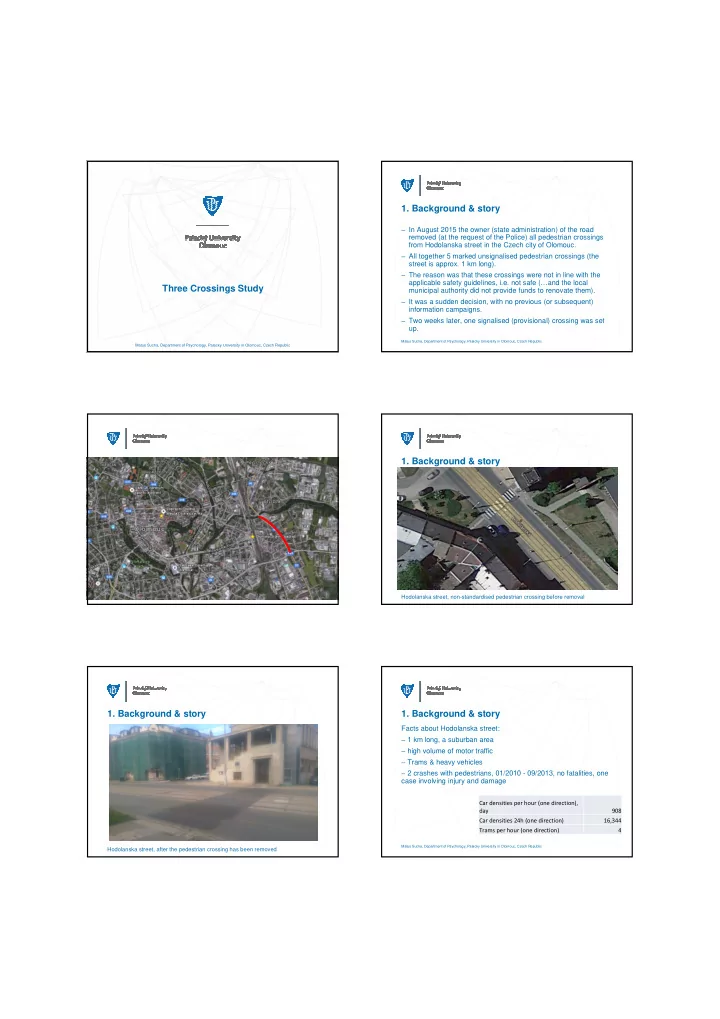
− In August 2015 the owner (state administration) of the road removed (at the request of the Police) all pedestrian crossings from Hodolanska street in the Czech city of Olomouc. − All together 5 marked unsignalised pedestrian crossings (the street is approx. 1 km long). − The reason was that these crossings were not in line with the applicable safety guidelines, i.e. not safe (…and the local municipal authority did not provide funds to renovate them). − It was a sudden decision, with no previous (or subsequent) information campaigns. − Two weeks later, one signalised (provisional) crossing was set up.

Matus Sucha, Department of Psychology, Palacky University in Olomouc, Czech Republic

  • 1. Background & story

Matus Sucha, Department of Psychology, Palacky University in Olomouc, Czech Republic

  • 1. Background & story

Hodolanska street, non-standardised pedestrian crossing before removal

  • 1. Background & story

Hodolanska street, after the pedestrian crossing has been removed

  • 1. Background & story

Facts about Hodolanska street: − 1 km long, a suburban area − high volume of motor traffic − Trams & heavy vehicles − 2 crashes with pedestrians, 01/2010 - 09/2013, no fatalities, one case involving injury and damage

Matus Sucha, Department of Psychology, Palacky University in Olomouc, Czech Republic

Car densities per hour (one direction), day 908 Car densities 24h (one direction) 16,344 Trams per hour (one direction) 4

slide-2
SLIDE 2
  • 2. Problem & questions

Authorities: When considering that it is not possible to renovate non- standardised crossings within a year or so, is it safer to keep the current non-standardised crossings or remove them? We were not able to answer this. So, we reformulated the question:

  • 1. What are the needs and preferences of pedestrians in this area?

2.How will this change affect their behaviour?

Matus Sucha, Department of Psychology, Palacky University in Olomouc, Czech Republic

  • 3. Theory
  • Theory of human needs & maximum gain (e.g. Freud, Maslow,

McClelland)

  • Theory of habits and its influence on behaviour and behaviour

change (e. g. Lally et al., 2010)

  • Pedestrians’ needs and preferences – safety (subjective),

comfort, easiness (flow), aesthetics, social environment (Hakamies-Blomqvist & Jutila, 1997)

  • Pedestrians prefer the shortest way (e.g. Broach, 2015)
  • Perception of safety – subjective safety vs. objective safety (e.g.

Vlakveld, 2008)

  • Risk homeostasis theory & awareness (e.g. Wilde, 2000)
  • Driver‘s yielding behaviour & waiting times & pedestrians

comfort (e.g. Schroeder & Rouphail, 2011)

Matus Sucha, Department of Psychology, Palacky University in Olomouc, Czech Republic

  • 4. Data collection, analysis & sample

Time: one month after the change, 7.00-9.00, 13.00-14.00, 16.00- 18.00, 3 days (Tue, Wed, Thu), together 15 hours Place: the former crossing and its surroundings (≈ 50m in both directions), the new signalised crossing 200m away, tram stop Methods: Rapid on-site interviews (needs, motives, perceived safety), video recording analysis – manual/human (behaviour & scene: where crossed, gap/ yielding, waiting time, no. of cars passed, disturbances – running, braking, etc). Sample: Interviews N=325 (all peds willing to answer during

  • bservation time and space ≈ 1/3 of all), video analysis N=829 (all

peds captured during observation times)

Matus Sucha, Department of Psychology, Palacky University in Olomouc, Czech Republic

  • 4. Data collection, analysis & sample

Time: one month after the change, 7.00-9.00, 13.00-14.00, 16.00- 18.00, 3 days (Tue, Wed, Thu), together 15 hours Place: the former crossing and its surroundings (≈ 50m in both directions), the new signalised crossing 200m away, tram stop Methods: Rapid on-site interviews (needs, motives, perceived safety), video recording analysis – manual/human (behaviour & scene: where crossed, gap/ yielding, waiting time, no. of cars passed, disturbances – running, braking, etc). Sample: Interviews N=325 (all peds willing to answer during

  • bservation time and space ≈ 1/3 of all), video analysis N=829 (all

peds captured during observation times) Video recording sample

  • 4. Sample description

Matus Sucha, Department of Psychology, Palacky University in Olomouc, Czech Republic

  • 5. Results - Scene

Where are you going? % Work 26.19% School 42.46% Leisure/ walk 6.75% Other 24.21%

Matus Sucha, Department of Psychology, Palacky University in Olomouc, Czech Republic

Do you cross here regularly (more than once a week)? % Yes 87.96% No 11.42% Speed Mean speed (km/h) 28.09 STD 8.65

  • Max. speed

76

  • Min. speed

8 N 10,114

slide-3
SLIDE 3
  • 5. Results – Waiting time

Matus Sucha, Department of Psychology, Palacky University in Olomouc, Czech Republic

No of cars passing (mean) SD Seconds waiting (mean) SD N Adult 2.01 2.25 3.28 8.86 316 Child 3.07 2.91 6.17 8.94 252 Older person 1.85 2.24 2.86 9.32 120 Mother with a child/pram 1.47 1.09 1.76 3.83 102 Cyclist 2.02 2.7 4.37 12.49 37

  • 5. Results – Crossing behaviour

Matus Sucha, Department of Psychology, Palacky University in Olomouc, Czech Republic N Adult 316 Child 252 Older person 120 Mother with a child/pram 102 Cyclist 37

  • 5. Results - Behaviour

Matus Sucha, Department of Psychology, Palacky University in Olomouc, Czech Republic

  • 5. Potential conflict situations

Matus Sucha, Department of Psychology, Palacky University in Olomouc, Czech Republic

Potential conflict situations % No conflict 774 93.70% Potential conflict 52 6.30% Total 826 100.00%

  • 5. Results – Needs and preferences

Matus Sucha, Department of Psychology, Palacky University in Olomouc, Czech Republic

Do you feel safe when crossing here? Frequencies % Yes 18 5.54% No 303 93.23% Why not?

  • Too many cars…
  • Cars not respecting/ giving priority to pedestrians

…."I feel as an ant to be smashed by a car"…

  • I feel afraid here (e.g. of being hit by a car, being killed)

…"People don't like to cross here, they fear for their lives"…

  • Absence of the crossing
  • Afraid for others (their children; elementary school nearby)

… "I'm afraid for my children who walk here on their way to school"….

  • Dangerous for mothers with prams and disabled persons

…. "I walk with crutches and drivers won't let me cross"….

  • Too wide a road/ long time to get to the other side..
  • 5. Results – Needs and preferences

Was it a good idea to remove the crossings? Was it better then or now?

Almost all (320 out of 324) the respondents thought it had been safer and more comfortable before the crossings had been removed. ….. "It was a stupid thing to remove the crossings." "It was better with the crossings, I wish to have them back." "I'm really afraid here, moreover, a lot of children walk here." "People were used to them." "I really don't understand the reason for removing them." "Too many cars, drivers don't yield." "I used to let children go to school here, now I walk them to school." "I don't care, probably it had to be done - as those crossings were not safe.“ …..

slide-4
SLIDE 4
  • 5. Results – Needs and preferences

Matus Sucha, Department of Psychology, Palacky University in Olomouc, Czech Republic

Do you still cross here (the former crossing)? Did this affect your crossing patterns?

More or less half of the respondents did not change their ways of crossing the road - they cross the road at the former crossing, and state that:

  • they are used to crossing here and won't change it,
  • they feel less safe,
  • wait longer,
  • pay more attention (check carefully for approaching cars, walk quicker……),
  • and hope that cars will yield.

The others changed their patterns and use mostly the signalised crossing (new one) which is not far away (200m). Some of them use tram stop islands to cross (segmenting their crossing manoeuvre into several stages). Some stress that they are able to cross even without the crossings, although admitting that it must be complicated for children and older and disabled persons.

  • 5. Results – Needs and preferences

Matus Sucha, Department of Psychology, Palacky University in Olomouc, Czech Republic

What do you think that the municipal authority should do about this?

The great majority of the respondents just answered that the municipal authority should restore the crossings where they were without any changes (no complaints about safety issues when crossings were at their

  • riginal locations).

Some of them suggest setting up signalised crossings (with traffic lights) or renovating the crossings so that they comply with the norms ("…the municipality should find money to do that…"), or "…add humps, add additional signs - especially those alerting drivers about the presence

  • f children …"

.

  • 6. Conclusions and recommendations

Conclusions:

  • The removal of the crossings decreased pedestrians’ perceived safety and comfort.

On the other hand, their awareness has been raised.

  • The residents tend to stick to their old patterns and cross on the site of the former

crossing, eventually finding an “innovative“ solution (tram stop islands) instead of using a new signalised crossing (too far).

  • The pedestrians don‘t perceive the non-standardised crossings (former) as unsafe.
  • The greatest impact (negative) is on children, the elderly, and disabled persons

(VRUs). Recommendations:

  • If it is not possible to renovate a crossing, keep non-standardised crossings in place

(until the renovation is possible), unless there is clear evidence of danger (conflicts, complaints, ...).

  • Enforce LOW SPEED in the location.
  • Implement low-cost measures to enforce yielding (drivers) and raise awareness

(drivers and pedestrians).

  • Pay special attention to the VRUs, consider their needs and abilities as a standard.

הדות

Matúš Šucha University of Olomouc www.trafficpsychology.cz