
SLIDE 1
MINISTRY OF WORKS AND TRANSPORT
THE REPUBLIC OF UGANDA
Theme: Transport Infrastructure Connectivity for the Improved Service Delivery
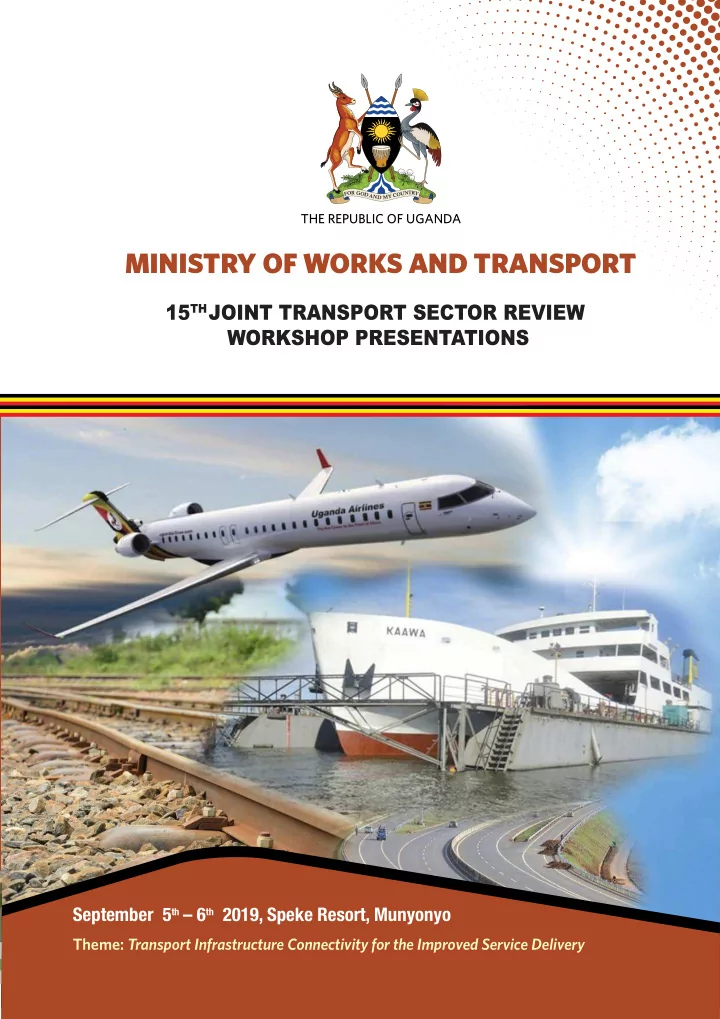
MINISTRY OF WORKS AND TRANSPORT 15 TH JOINT TRANSPORT SECTOR REVIEW - - PDF document
THE REPUBLIC OF UGANDA MINISTRY OF WORKS AND TRANSPORT 15 TH JOINT TRANSPORT SECTOR REVIEW WORKSHOP PRESENTATIONS September 5 th 6 th 2019, Speke Resort, Munyonyo Theme: Transport Infrastructure Connectivity for the Improved Service Delivery
THE REPUBLIC OF UGANDA
Theme: Transport Infrastructure Connectivity for the Improved Service Delivery
PROGRAM...........................................................................................................................1 Progress on the 14th JTSR Action Plan Matrix.....................................................................4 Annual Sector Performance Report for FY 2018/19...........................................................12 Annual Budget Monitoring Report FY 2018/19..................................................................44 Bridges to Prosperity .........................................................................................................54 Civil Society Statement.......................................................................................................65 Statement from Local Governments...................................................................................70
1 1
PROGRAM FOR THE ANNUAL 15thJOINT TRANSPORT SECTOR REVIEW WORKSHOP 5th -6th SEPTEMBER, 2019, SPEKE RESORT MUNYONYO Time Activity Presenter/Responsibility Center Chair DAY 1 SESSION 1
08:30 – 09:00 Registration of Participants Secretariat 09:00 – 09:10 Welcome Remarks PS 09:10 – 09:30 Statement from Development Partners
09:30 – 10:00 Remarks by the Hon. Minister of Works and Transport 10:00 – 10:30 Opening Remarks Guest of Honour 10:30 – 11:00 Group Photo & Break Tea Hotel SESSION 2
11:00 – 11:30 Progress on the 14th JTSR Action Plan Matrix
11:30 – 12:15 Annual Sector Performance Report for FY 2018/19 DEW/EIC 12:15 – 01:00 Plenary Discussion All 01.00 – 02:00 Lunch break Hotel SESSION 3
02:00 – 04:30 Plenary Discussion. All 04:30 Closure and Evening Tea All
1 2 2
DAY 2
Time Activity Presenter/Responsibility Center Chair SESSION 1 08:30 – 09:00 Registration of Participants Secretariat
09:00 – 09:30 Annual Budget Monitoring Report for the Sector BMAU/MoFPED 09:30 – 10:00 Joint Monitoring Report AC/PA 10:30 – 11:00 Bridges to Prosperity Country Director, Uganda 11:00 – 11:30 Tea Break Hotel SESSION 2
11:30 – 01:00 Plenary Discussion All 01:00 – 02:00 Lunch break Hotel SESSION 3
02:00 – 02:15 Statement from Civil Society Chairperson CISCOT 02:15 – 02:30 Statement from Local Governments Dean of CAOs 02:30 – 03.00 Reactions All 03.00 – 03.30 Wrap up and Way forward PS/MoWT 03:30 – 04.00 Closing Remarks
04:00 Cocktail Hotel/Secretariat
3 3
Abbreviations AC/PA Assistant commissioner / Policy Analysis CAO Chief Administrative Officer C.E.O Chief Executive Officer CISCOT Coalition of Civil Society Organizations in Transport CPP Commissioner Policy and Planning DEW/EIC Director of Engineering and Works/Engineer in Chief DG UCAA Director General Uganda Civil Aviation Authority DoT Director of Transport ED/KCCA Executive Director Kampala Capital City Authority ED/UNRA Executive Director Uganda National Road Authority ED/URF Executive Director Uganda Road Fund
MD/URC Managing Director Uganda Railways Corporation PCO Principal Communication Officer PS Permanent Secretary UNACOL Uganda National Airlines Company Ltd
3 4
2 1
14th JOINT TRANSPORT SECTOR REVIEW ACTION PLAN MATRIX, 2018
Rating Achieved Partially Achieved Not Achieved
Section A: Policy, Legislation and Standards Code Issue Action Deadline Progress Rating Resp. MDA P1 Delayed finalization
policy and legislative actions in the Sector.
the Roads Bill, 2018.
President in July, 2019 to assent to it. MoWT
National Transport and Logistics Policy and Strategy (NTLPS), 2018. Mar. 2019
reviewed in June by the Technical Committee.
the preparation
Regulatory Impact Assessment (RIA) report. MoWT
Inland Water Transport Bill, 2019. June. 2019 Bill cleared of both financial implications and legal compliance. Commenced preparation of the RIA report and Cabinet Memo for submission to Cabinet. MoWT
Memorandum
streamlining the legal status of East African Civil Aviation Academy, Soroti. Feb. 2019 i. The Cabinet Memo was submitted and approved by the Cabinet. ii. A delegation went to Arusha and it was agreed that the decision of Cabinet was to be presented to the Council of Ministers
MoWT
the Civil Aviation Amendment Bill, 2017. Mar. 2019 i. The Bill was passed by Parliament in December 2018 and it was assented to by H.E. the President in February, 2019. MoWT
5
2
Code Issue Action Deadline Progress Rating Resp. MDA ii. The Act will be disseminate in the 2nd and 3rd quarter of FY 2019/20.
Road Safety (Amendment) Bill, 2018 to Parliament. Jun. 2019 i. Cabinet approved the Bill in December 2018. ii. The Bill had a first reading in Parliament and it is now before the Physical Infrastructure Committee for consideration. MoWT
National Railway Transport Policy. Jun. 2019 i. Draft Final Report for the Policy under review by the Contract Management Technical Team. ii. To commence preparation of the RIA report. MoWT viii. Submit to Cabinet National Aviation Transport Policy. Aug. 2019 i. Policy was submitted to MoFPED for financial clearance; MoFPED raised some issues that are being addressed by the Ministry’s Contract Technical Team before resubmission. MoWT P2 Fragmented transport planning Commence preparation of the second National Transport Master Plan (2021 – 2040) Dec. 2018 Preparation of a National Integrated Transport Master Plan commenced in Jan. 2019. The Inception Report was approved in July 2019 and the assignment to be completed Dec. 2020. MoWT P3 Outdated
non- existent design manuals, standards and specifications.
manual for Non-Motorized Transport (NMT)
assignment is to be completed at the end of September, 2019. MoWT
Urban Traffic Management manual Jun.2019 Presentation was made to the SWG and the consultant is addressing the comments. KCCA
railway design manual and specifications. Jun. 2019 Procurement of consultant to provide the service under evaluation URC
1
2 1
6
4 3
Section B: Road Transport Code Issue Action Deadline Progress Rating Resp. MDA R1 Inadequate Sector financing for road maintenance.
maintenance budget from 19% to 24% of the GoU roads budget for FY 2019/20 (to UGX 670 billion)
Road maintenance share of annual roads budget was 11% in FY 2017/18, it increased to 15% in FY 2018/19 and it reduced to 12% in FY 2019/20. More efforts are being exerted to realize more increase in share URF
30 km of low volume roads using low cost seals to reduce frequency of road maintenance
36.9km of district roads in Kasese (Nyaruzigati – Kyapa – Kitabu road, 10.7km), Kamuli (Kisozi – Nawanyago road, 8.6km), Kayunga (Kyerima – Nakaseeta – Lukonda road, 12.6km and Mayuge (Bufulubi- Kyando – Buyemba road, 5.6km). 12.5 km equivalent have been sealed MoWT
60km of low volume national roads using Low Cost Seals (LCS) to reduce frequency of road maintenance
i. Design of 52km for Low Cost Seal completed:
ii. Upgrading of Lweza-Kigo (6km)
expected completion date of Dec 2019 UNRA
URF funds allocation formula to ensure that it is equitable and consistent.
i. Review of the URF funds allocation formula is still ongoing. ii. Presently, revision of parameters for allocation
funds has been
is being done URF
7
4
Code Issue Action Deadline Progress Rating Resp. MDA R2 Increased road accidents
the road crash database system
i. Consultant procured and commenced work ii. Inception report submitted iii. Roll out commenced in Kampala Metropolitan Area in May 2019. iv. Roll out phase is expected to be completed in February 2020 MoWT
the mandatory motor vehicle inspection
Negotiations held, awaiting guidance of Parliament to conclude the negotiation report.
road safety
Not sustained. Funds still inadequate. R3 Inadequate and inefficient axle load control system
weigh bridges by six units.
Procurement of 5 Multi-deck weigh bridges ongoing with the first delivery of 2 expected in Oct 2019. Installation of all the 5 is expected to be completed in Dec 2019. Procurement of 3 High Speed Weigh in Motion Systems for Magamaga, Luwero and Mbarara Weigh Stations is ongoing. The contract for installation of the three systems was signed in Jun 2019 and is under
including the civil works is expected to be completed by June 2020. UNRA
motion weighbridges at Magamaga, Luwero & Mbarara stations along Mbarara- Katuna and Mirama- Ntungamo road.
a centralized weighbridge monitoring system
R4 Weak National Construction Industry Capacity.
and accredit the Contractors’ Register
Draft register in place; the Ministry is to sign a MoU (October, 2019) with NITA – U to put the register on line. MoWT
the performance
the reservation scheme for local
Data collection from the key sector agencies in progress. The draft report will be the end
3
4 3
8
6 5
Code Issue Action Deadline Progress Rating Resp. MDA Contractors in the Sector for FY 2018/19.
initiatives in the National Construction Industry
To be undertaken when the Contractors’ register is ready.
reservation scheme for local Consultants and Contractors in public procurement
R5 Increased traffic congestion in the City and GKMA
junction improvement to ease traffic congestion in the city July 2019 48 new junctions were designed; a grant agreement was signed between Government
and construct a Traffic Control Centre to coordinate traffic flow on the major corridors in the Capital City KCCA
the Memorandum on measures to decongest the Greater Kampala Metropolitan Area (GKMA)
Draft report submitted to MoFPED for financial clearance MoWT R6 High unit cost of road construction Prepare the draft report for the study to investigate the cost of road construction and maintenance in Uganda.
Procured a consultant to undertake the study. The study will be completed in June 2020. Study still at infancy. MoWT
9
6
Section C: Railway Transport Code Issue Action Dead line Progress Rating Resp. MDA RL1 Low operational coverage
railway transport services
procurement of a civil works contractor for construction of Gulu ICD Jun 2019 Detailed designs completed and procurement of a civil works contractor is
Civil works expected to commence in January, 2020 MoWT
review for the rehabilitation works
Railway line Jul 2019 Contract at negation stage: expected to be signed end of October 2019. URC
capacity building programmes for URC Jun 2019 i. Consultancy contract awarded, expert mobilization, kick off meeting and engagement of staff and stakeholders commenced. ii. Feasibility study inception report approved. URC
evaluate the potential and capital cost of having an urban commuter rail service along the existing network and corridors Jun20 19 The contract was awarded, Expert mobilization, kick off meeting and engagement of stakeholders commenced URC RL2 Delayed implementation
Gauge Railway (SGR) Project. Acquire 76.376 acres of land for the Right of Way out of 2,026.582 acres. Jun. 2019 Implementation
preconstruction activities continues though at a slow pace. In FY 2018/19, 120.603 Acres were acquired and 640No. PAPs were compensated. The total land paid for to date is 1,089.639 Acres out of 2,994.519 Acres and the number of PAPs paid to date is 3,527 PAPs out of 10,207 PAPs. SGR
5
6 5
10
8 7
Section D: Air Transport Code Issue Action Deadline Progress Rating Resp. MDA A1 Encroachment
land for Aerodromes 5km out of 7.3 km of Tororo Aerodrome land fenced, 3.5 km (phase II) of Gulu Airport land fenced and 4km out of 8km of Arua Airport land fenced respectively Jun. 2019 Tororo -100% of works completed, and Gulu -100% of works completed. Arua 25% of works completed. At Arua, there was some delay in procurement process. CAA A2 Revival
the National Carrier
delivered and operational June 2019 i. Two CRJ900 aircraft were delivered
ii. Two CRJ900 aircraft more will be delivered end of September 2019 and go into service in October 2019. MoWT
strategy for the National Carrier June 2019 An interim Sales, Marketing and Communications strategy is in place. Section E: Inland Water Transport Code Issue Action Deadline Progress Rating Resp. MDA IWT1 Poor Inland Water Transport Safety Submit the Search and Rescue Policy to Cabinet Aug. 2019 Inception report was submitted to the Contract Management Team at the Ministry for review in July 2019. MoWT
11
8
Summary of Performance of the 14th Joint Transport Sector Review Action Plan Matrix Number of Agreed Actions Rating Section A: Policy, Legislation and Standards Section B: Road Transport Section C: Railway Transport Section C: Air Transport Section C: Inland Water Transport Total Performance Achieved 4 1 2
18% Partially Achieved 2 4 1 3
26% Not Achieved 6 12 2
21 55% Total 38
7
2019.
8 7
12
THE 15TH ANNUAL JOINT TRANSPORT SECTOR REVIEW WORKSHOP SECTOR PERFORMANCE REPORT FOR FY 2018/19 PRESENTED BY
DIRECTOR OF ENGINEERING AND WORKS/ ENGINEER IN CHIEF
THE REPUBLIC OF UGANDA
MINISTRY OF WORKS AND TRANSPORT
1
2
13
The Works and Transport Sector is composed of MoWT, UNRA, UCAA, URC, URF and KCCA Mandate i. Plan, develop and maintain an economic, efficient & effective transport infrastructure; ii. Plan, develop and maintain economic, efficient and effective transport services by road, rail, water, and air; iii. Manage public works including government structures; and iv. Promote good standards in the Construction Industry. Sector Strategic Objectives in the NDP II (2015/16 -2019/20) i. Develop adequate, reliable and efficient multimodal transport network in the Country; ii. Improve the human resource and institutional capacity of the Sector to efficiently execute the planned interventions;
3
Areas for low absorption for FY 2018/19
i. The low absorption was from Vote 113-UNRA under the Development budget for external financing. UNRA received 60.8% of the approved budget for external financing i.e. UGX 863.0bn out of UGX 1,419.10bn. ii. Of the funds released, UNRA spent UGX 573.289bn representing 66.4%
Reasons for under absorption are:
i. Appropriation of budgets on some projects before financing agreements are approved. ii. Procurement delays. iii. Lengthy land acquisition process iv. Inadequate GoU Counter part funding to support land acquisition
4
FY 2017/18 FY 2018/19 Overall Approved Budget (UGX Bn) 4,782.01 4,860.215 Overall Budget Release (UGX Bn) 4,260.77 4,437.779 % of Budget Released 89.0% 91.31% % of Budget Released Spent 89.4% 92.7%
14
3.0 SECTOR PERFORMANCE MEASURED AGAINST GOLDEN INDICATORS
Indicator #1 – Road Network in fair to good condition
5
Road Type Actual June 2018 (%ge) Target June 2019 (%ge) Actual June 2019 (%ge) National Roads (paved) 97 85 93 National Roads (unpaved) 84 72 75 District Roads (unpaved) 61 65 66 Urban Roads (paved) 78 78 78 Urban Roads (unpaved) 56 60 60 KCCA Roads (paved) 55 60 62 KCCA Roads (unpaved) 70 72 73
6
Road Type Actual June 2018 (km) Target June 2019 (km) Actual June 2019 (km) Km Increase from the previous year National Roads 4,551 4,770
4,971
420 Urban Roads 596 610 658.69 63 KCCA 595 600 612.5 17.5 Total 5,742 5,980 6,242.19 500.5
15
7
Road travel time (min/km) Actual June 2016 Actual June 2017 Actual June 2018 June 2019 Target Actual June 2019 Total fatalities 3,224 3,505 3,500 3,450 3,689 On average, 10 people die per day in road accidents!
Indicator #4 – Travel Time
Travel time within Greater Kampala was 4.2 minutes per km in FY 2017/18 and reduced to 4.1 minutes per km in FY 2018/19. This is partially a result of junction improvement
Indicator #5 - Road Construction costs
The average construction cost for upgrading roads to paved standard with bituminous surface treatment during the FY 18/19 was UGX 3.1Bn billion per kilometre as compared to UGX 2.36Bn per kilometre in the previous year. The average cost of reconstruction/rehabilitation of the paved roads was UGX 1.8Bn billion per kilometre as compared to UGX 1.96Bn per kilometre for the previous year.
8
rates
16
The road maintenance needs for the FY 2018/19 was UGX 1,807.2 Bn. UGX 512.24 Bn was allocated to road maintenance. This represents 28.3% of the annual road maintenance needs funded.
The total number of vehicles weighed in FY 2018/19 was 1,364,562 compared to 1,247,931 for last FY 2017/2018. The percentage of weighed vehicles that were overloaded decreased from 3.8% in FY 2017/18, to 3.1% in the FY 2018/19.
9
The reduction in overloaded vehicles was due to the introduction of heavy penalties for
Golden Indicator #9 - Rail Freight Volume The rail freight cargo increased from 7.5 net tonne km in FY 2017/18 to 39 net tonne km in FY 2018/19. The increase is due to the rehabilitation of the railway line and opening the southern route through Port bell. Golden Indicator #11 - Rail Modal Share on Lake Victoria Ferries The share of Freight transported by rail on Lake Victoria ferries out of the total freight volume transported through Port Bell was 0.002 % in FY 2017/18 and 35% in FY 2018/19. This is mainly due to repair of the PortBell railway line and opening up
Golden Indicator #12 - Rail Efficiency It increased from 148 km per locomotive per day in FY 2017/18 to 251 km per locomotive per day in FY 2018/19 due to a repairs and maintenance of the track. Golden Indicator #13 - Wagon Utilization
Total wagon turnaround time increased from 28 days in FY 2017/18 to 31 days in FY 2018/19 mainly because of lack of return cargo.
10
17
Golden Indicator #14 –Aircraft Movements There was a decline in non commercial aircraft movements at Entebbe Airport. In FY 2017/18 10,031 non-commercial flights were registered whereas in FY 2018/19, 8,310 non-commercial flights were recorded. The decrease in non commercial flights was because UN scaled down it’s activities at Entebbe Airport. Commercial aircraft movements rose from 29,785 commercial flights in FY 2017/18 to 32,735 commercial flights in FY 2018/19. This was a result of an increase in frequency
Golden Indicator #15 – Passenger and Freight Volumes by Air International passengers increased from 1,700,624 in FY 2017/18 to 1,921,673 passengers in FY 2018/2019. This was attributed to growth in tourism, economic activities in the country and externalisation of labour. Air traffic cargo has slightly increased from 62,093 tonnes in FY 2017/18 to 62,127 tonnes in 2018/19 against the target of 64,352 tonnes. Golden Indicator #16 – Freight Traffic on Lake Victoria Freight traffic on Lake Victoria increased from 27,665 tonnes in FY 2016/17 to 40,689.42 tonnes in the FY 2018/19.
11
12
18
13
Expenditure Category/Item Approved (Bn UGX) Released (Bn UGX) Spent (Bn UGX) % Released % Release Spent Recurrent Wage 11.866 11.866 10.488 100 88.4 Non Wage 66.740 64.598 64.427 96.8 99.7 Development GoU 370.810 637.868 637.504 172.0 99.9
295.823 295.823 69.5 100 Total GoU 449.416 714.331 712.419 158.9 99.7 Total GOU+ Donor 874.798 1,010.154 1,008.242 115.5 99.8 Approved budget for FY 2018/19 was UGX 874.798BN; Total amount released was UGX 1,010.54BN (representing 115.5% release) The over expenditure under GOU dev’t budget was due to the supplementary budget for the Dev’t
project (procurement of aircraft)
4.2.1 DIRECTORATE OF TRANSPORT (Summary of Achievements)
Government of Uganda acceded to and deposited 7 IMO conventions in April, 2019. Seven (7) Bilateral Service Agreements (BASAs) for Tanzania, South Sudan, Rwanda Turkey, United Arab Emirates, USA and DRC prepared and cleared by the Solicitor General. EACAA attained Approved Training Organization (ATO) and Approved Maintenance Organization (AMO) Certification. 03 Classification societies were approved (Libero Hellenic Shipping, International Register for Shipping [IRS] and Bureau Veritas [BV] to provide technical support in the areas of surveying of especially conventional water vessels . 368 water vessels were inspected of which 255 were registered and licensed against the target of 100 planned. 76 driving schools were inspected and licensed against the target of 85 due to inadequate funding. 1031 bus operator licenses were issued against the target of 1000 because of enhanced enforcement by the police. 30,788 PSVs were licensed and monitored against the target of 22,000. Draft Final study report on transport costs on tarmac and murram roads was received and reviewed by the Ministry. Resettlement Action Plan (RAP) report for rehabilitation of Tororo-Gulu Railway line was approved by the CGV.
14
19
Performance of Development Projects
i. Development Of Bukasa Port
Resettlement Action Plan study report was approved by the Chief Government Valuer. Environment and Social Impact Assessment (ESIA) was approved by NEMA. Construction of access road to Bukasa port (Kinawataka-Bukasa Road-8km) 35% attained.
15
ii. Development of Kabaale International Airport Completed 27.65% physical works of Phase I out of the planned 30% for FY 2018/19 .
16
20
120.603 hectares of right of the way were acquired against a target
640 PAPs were compensated. Note: Gov’t is committed and closely working with Kenya on the construction of SGR.
When Gov’t of Kenya constructs the SGR to Kisumu port, GoU will construct a link from Tororo-Majanji and then connect to Kisumu by water. This is an interim intervention
90% construction works for Katuna OSBP (Phase 1) were completed. 90% construction works for the exit road at Malaba OSBP completed. Designs for Goli and Ntoroko OSBPs completed. Phase I of Elegu completed with Phase II (staff accommodation block and warehouses) to be completed in September.
17
v. Uganda National Airlines Company Limited
Constituted a Board of Directors. Two Bombardier CRJ900 aircraft were delivered. Acquired Air Operator Certificate(AOC) for commercial flight. Recruited and trained key staff for the National Airline.
18
21
i. District, Urban and Community Access Roads
a) Rehabilitation of DUCAR 809.12 km of community access roads were improved in fifty four selected districts under interconnectivity project. 347.4km of district roads were opened and 252.5km of those were gravelled in all regions under force account.
region, 76.1km were opened and 51.4km gravelled out of the target
region, 79.5km were opened and 54.7km gravelled out of the target
region, 79.4 km were opened and 57.8 km gravelled out of the target
region, 112.4 km were opened and 88.6 km gravelled out of the target
Under Jinja unit, 132.26km were opened, 116.16 km were graded and 66.29 km graved
19
District, Urban and Community Access Roads
b). District Road equipment 96.13% average availability of the road equipment from Japan attained out of the targeted percentage of 96%. 55No. (50 minor and 5 major) repairs of the zonal road equipment from china were done. 538 out 600 targeted road equipment
Paving works for the workshop yards at Mbarara and Gulu Regional Mechanical Workshop was done and completed.
20
22
Summary of Key achievements..cont’d
c) Construction of Selected Bridges on DUCAR network…. i. 5 bridges were substantially completed: Saaka swamp Phase II (Kaliro district), Okokor Bridge (Kumi) and Kaguta bridge (Lira/Otuke), Kibembe and Tongole cable foot bridges (Sironko & Manafwa districts) ii. Performance of some of the other bridges
21
SN. Bridges Performance Annual Performance FY 2017/18 Target FY 2018/19 Actual FY 2018/19 1 Kabindula bridge (Kyankwanzi) 0% 100% 75.0% 2 Kangai Swamp (Dokolo) 0% 100% 55.0% 3 Wangobo-Nsonkwe-Namunyumya swamp crossing (Iganga) 0% 40% 45.0% 4 Muzizi Bridge (Kibaale) 0% 100% 25.0% 5 Amodo Swamp (Dokolo) 0% Design completed 5.0% 6 Kabuhuuna (Kibaale) 0% 100% 70.0% 7 Bambala bridge (Kyankwanzi) 0% 100% 90.0% 8 Kisaigi Bridge (Kakumiro) 0% 50% 80.0%
d) Other Achievements
The average availability of MV Kalangala was 98.2% against the target of 98%. The average availability of Lake Bisina ferry operation was 98%. District and Urban Council Engineers in 60 Districts and urban councils were trained in use GIS equipment and the processing Manuals were distributed to them. 198 Road maintenance gangs Leaders and 19 Road Overseers from the District Local Governments were trained in Routine Road maintenance. Produced fifty (50) technical advisory reports on building construction against the planned target of forty (40). Undertook 300 (target- 280 )material testing and quality control tests on construction materials were undertaken because they are demand driven.
22
23
CHALLENGES FOR MINISTRY OF WORKS AND TRANSPORT
Mitigation: Research on local construction materials, rollout of low cost sealing.
Mitigation: Continue engaging MoFPED to increase funding
Mitigation: Registration and classification of local contractors, implementation of PPDA regulation on reserve scheme. 23
24
INTRODUCTION
25
Approved Budget (Ugx bns) Cumulative Release (Ugx bns) Un-Released Budget Cumulative Payments ( Ugx Bns) Released Funds Unspent % Budget Released % Budget Spent % Releases Spent RECURRENT WAGE 71.1 71.1 70.4 0.7 100 99 99 NON-WAGE 27.5 26.9 0.5 26.8 0.2 98 97 99 SUB-TOTAL 98.6 98.1 0.5 97.1 0.9 100 99 99 DEVELOPMENT GOU 1,612.7 1,612.7 1,609.4 3.3 100 100 100
1,419.1 863 556.1 544.2 318.8 61 38 63 TOTAL Devt 3,031.8 2,475.7 556.1 2,153.6 322.1 82 71 87 MAINTENANCE - URF 312.6 312.6 312.2 0.4 100 100 100 GRAND TOTAL 3,442.9 2,886.4 556.6 2,562.9 323.4 84 74 89
25
GOU
Dev't Budget performed well at 99.8% of the budget released. Under external financing UNRA received only 60.8%
approved budget and spent only 66.4% of the release.
financing agreements have not been approved e.g. UGX 228.4Bn was appropriated for critical oil roads yet the loan had not yet been approved and UGX 79.7Bn was appropriated for Muyembe-Nakapiripirit and Rwenkunye-Apac yet loans for the respective projects had expired and the loan re-negotiations were still ongoing. National Roads Maintenance Budget performed at 100% though funds provided (UGX 312.6Bn) represented only 52.4% of the annual requirement of UGX 596Bn
27
5.2.1 Roads Construction
28
Six road construction projects (420.1km) were substantially completed: There are 22 ongoing road projects (new construction and upgrading) covering a total of 1,600km, at various stages of progress. The proportion of road works executed during FY 2018/19 were estimated to be equivalent to 344.4 km out of the annual target of 400km-equivalent. Total stock of paved roads now stands at 4,971km (23.8%).
No Project Name Length (KM) Financier 1 Kanoni – Sembabule-Villa Maria 110.0 GOU 2 Musiita-Lumino 104.0 GOU 3 Mukono – Kyetume-Katosi/Nyenga 74.0 GOU 4 Olwiyo – Gulu 70.3 GOU 5 Akisim-Moroto 50.3 GOU 6 Kashenyi – Mitooma 11.5 GOU
26
29
completed studies and designs for 20 road projects and 15 bridges(preliminary designs). The road projects include:-
5.2.3 National Roads Rehabilitation
30
Rehabilitation of 343Km continued on six (6) road projects. i. Nansana-Busunju Section 2 (18km) was substantially completed. ii. Nakalama-Tirinyi-Mbale(102km) : 46% physical progress
5.2.4 Bridge Construction
Source of the Nile Bridge, Nalakasi (Kaabong), Lopei (Kaabong), Kaabong bridge (Kaabong), Ruzairwe (Kibaale)
(i) Nsongi ii) Mpondwe iii) Odroo iv) Ora v) Aji vi) Opot vii) Ajeleik
5.2.5 Ferry Development
A new ferry i.e. Sigulu Ferry that will connect Namayingo district to the Islands of Dolwe & Sigulu was fully assembled and trials conducted.
27
31
7,380 km of the unpaved roads; and
56 bridges
promote Local Content.
signed up from 24% last year. This included reservation by threshold and sub-contracting; i.e. Contracts awarded to National Providers totaled to UGX 736.95bn
32
1) The financing for the road development programme remains constrained and therefore UNRA is unable to commence procurement and implementation of projects to cope with the demand.
Mitigation: Engage MoFPED to increase the MTEF to match the NDP II targets.
2) The road maintenance budget remains lower than the required, which makes provision of anticipated service low.
Mitigation: Establish term maintenance contracts. Advocate for second Generation Road Fund.
3) Procurement delays due to whistle-blowers and administrative reviews.
Mitigation: Review the PPDA regulations.
4) Land acquisition.
Mitigation: UNRA engaged MoLHUD to establish a zonal centre (special) to process land titles. Introduced a single code for land acquisition.
28
33
The Fund derives its mandate from the URF Act 2008, which confers upon it responsibility to finance the routine and periodic maintenance
public roads principally from proceeds of road user charges (RUCs) alongside other mandated finances of the Fund.
Description Approved Annual Budget UGX (bn) Total budget Release d(UGX bn) % of Annual Budget Released MoFPED Releases UNRA 312.563 312.563 100.0% DUCAR 214.735 214.699 100.0% URF Sec. Recurrent 8.350 8.386 100.4% URF Sec. Dev't 6.870 5.574 81.1% Total Amount 542.517 541.221 99.8% Approved budget for URF for FY 2018/19 was UGX 542.517 bn of which UGX 541.221 bn was released (representing 99.8% ) Of the released budget, UGX 535.648 bn was disbursed to the Designated Agencies
Wednesday, September 4, 2019
34
29
Wednesday, September 4, 2019
35
S/N KPI Target in FY 2018/19 OYRMP Actual Realised in FY 2018/19 Remarks 1 Timeliness (Average days from collection to deposit for each category) 14 calendar days max 11.5 calendar days average Achieved 36 The budget releases performed at 99.8% of the approved budget estimates, and on average took 11.5 calendar days from the start of each quarter.
30
6.2 Physical Performance of The DUCAR Maintenance Programme in FY 2018/19
S/N Works Category FY 2017/18 FY 2018/19
% of Financed Quantity Achieved atQ3
Planned Quantity Financed Quantity Achieved Quantity at Q3 Planned Quantity Financed Quantity
Achieved
Quantity at Q3
1 Routine Maintenance Manual (km) 27,682 27,682 19,356 29,725 29,725 23,576 79.3% Mechanised (km) 15,224 15,224 6,883 15,951 15,951 9,568 60.0% 2 Periodic Maintenance Paved (km) 5,389 5,389 2,956 5,308 5,308 1,988 37.5% Unpaved (km) 3 Bridges Routine (No) 22 20 15 40 40 20 50.0% Periodic (No) 4 Culvert Installation (Lines) 6,143 6,143 1,756 7,429 7,429 5,248 70.6%
All planned maintenance needs were financed. However, the districts did not meet their implementation targets.
37
a) Inadequate funding for road maintenance.
Mitigation: Continue pursuance of increased parliamentary appropriations towards road maintenance in order to protect the road asset and check backlog buildup. Side by side, the quest for empowering URF to a truly second generation (2G) Fund will continue.
b) Lack of precise real-time knowledge on size and state of the road asset which clouds planning and budgeting.
Mitigation: Continue to coordinate with DAs, MoWT, and other stakeholders in collection
c) Uncontrolled opening of roads at local government level which bloats the size
Mitigation: Review of the classification of roads in Uganda with a view of removing network size instabilities; functional inconsistencies; management ambiguities etc. The Roads Act is also awaited to guide on procedure of reclassifying upgraded road network.
Wednesday, September 4, 2019
38
31
39
THE REPUBLIC OF UGANDA
40
7.1 introduction
Uganda Civil Aviation Authority is charged with regulation of air transport in Uganda.
The primary functions of UCAA are : i. Advise GOU in relation to civil aviation policy matters and international conventions. ii. Regulation of safety, security and doing business in air transport. iii. Management and development of national airports in the country. iv. Provision of air traffic and navigation services.
traffic.
Kasese, Kisoro, Jinja, Kidepo, Lira, Pakuba, Tororo, Masindi, Mbarara and Moroto.
regional and international traffic.
41
No Department Approved Budget (‘000 Shs) Expenditure (‘000 Shs) 1 Directorate of Human Resource and Administration
90,537,080 22,140,052 79,260,843 20,848,602
2 Directorate of Air Navigation Services
11,805,349 5,760,448
3 Directorate of Airports and Aviation Security
20,271,542 11,802,251
4 Directorate of Finance
9,410,769 1,198,947
5 Directorate of Safety, Security and Economic Regulation
3,543,900 2,516,593
6 Corporate Office
20,153,190 15,750,452
7 Capital Projects
53,560,900 21,713,722
Total
231,422,782 158,851,858
Total Expenditure was 69% of the approved budget. This was mainly due to low absorption for Capital Projects whose budget performed at only 40.5%.
42
7.3 PHYSICAL PERFORMANCE OF MAJOR PROJECTS
No Project Name / Activity STATUS Remarks FY 2017/18 FY 2018/19 1 Expansion and Upgrade
Entebbe International Airport 46% 67.5%
Taxiway extension, access road- 100%; Cargo Apron-85%; Cargo Terminal-77%; Service road-83%; Runway 12/30-85% complete
2 Improvement of departures at EIA 22% 60%
Works for 3rd floor roof structure connecting bridge and fire hydrant - 100% done; Elevated access road at 60% physical progress
3 Search Park at EIA 80%
Search Park Shelter-100%; Extra 2 lanes/road-80% complete
4 Fuel Hydrant line and Fuel Farm
Cargo Apron fuel line completed and pressure tested. Construction of the Foundation for the fuel tanks
33
43
7.3 PHYSICAL PERFORMANCE OF MAJOR PROJECTS- FY 2018/19 Continued…
No Project Name Progress (June 2019) Remarks
5 Certification of Entebbe International Airport Development of the EIA Aerodrome Manual and compliance with ICAO,SARPS has been completed The manual was submitted to the regulator for evaluation 6 Establishment of a Free Port Zone at EIA UFZA took up the Land (5 Acres) and paid for it. The MoU is with Attorney General for clearance There is need to acquire the whole of MAAIF land for EIA expansion. 7 Automation of Systems at EIA – KOICA Project
Monitoring System (CMMS).
was refurbished and now operational.
at Entebbe, Soroti, Kisoro, Mbarara, Gulu, Kasese and Arua. This project is largely complete. Undergoing harmonization with existing systems.
44
No Project Name / Activity Progress (June 2019) Remarks 8 Certification of EACAA -Soroti The certification process was completed. Approved Training Organisation (ATO) certificate was issued on 19 Nov 2018. Approved Maintenance
(AMO) certificate issued 22 Oct 2018. 9 Revival of the National Airline Certification: Certification of Uganda Airlines is in advanced Stage of Phase III. Trained two Airworthiness Inspectors in Canada on the CRJ900 aircraft systems. Two aircraft were certified in the Commercial Air Transport Passengers Category. Provided guidance material to Uganda Airlines as pertains developing a Security Programme. Licensing: Air Services License (ASL) issued in November 23, 2018 Office Space: Allocated eight (8) offices to the Airline at Entebbe Airport Certification: Scheduled to provisionally Start Phase IV
July 10, 2019 while awaiting Closure
Phase III.
7.3 PHYSICAL PERFORMANCE OF MAJOR PROJECTS- FY 2018/19 Continued…
34
45 7.4 PHYSICAL PERFORMANCE OF PROJECTS AT UPCOUNTRY AIRPORTS- FY 2018/19
Sn Project Title Cost UGX (000) Status / Progress 1 Diversion and closure of the road crossing the runway at Kisoro Airfield 364,745.812 Completed 2 Supply and installation of 60 Airport Terminal lounge chairs & 40 baggage handling Trolleys at Arua Airport. 243,386.680 Delivered 3 Demarcation of landside/airside and renovation of
134,542.000 Completed 4 Construction of the Apron at Arua Airport Phase II 4,613,676.938 85% Works Complete 5 Perimeter fencing of Tororo Airfield. 800,209.389 75% Works Complete 6 Perimeter fencing of Gulu Airport (Phase II). Fencing of the recently acquired land 544,412.883 30% Works Complete 7 Perimeter fencing of Arua Airport phase 1. 687,928.079 15% Works Complete 8 Airfield Ground Lighting system for Soroti $758,640.5 Contract Signed 9 Construction of landside airside demarcation fence at Soroti Airport 305,316.258 Contractor under mobilization.
46
7.4 PHYSICAL PERMORMANCE OF PROJECTS AT UPCOUNTRY AIRPORTS- FY 2018/19
sn Project Title Cost UGX (000) Status / Progress 10 Construction of Fire Truck sheds for the newly acquired fire trucks at Soroti and Kisoro Airport 269,883.936 Contract Signed and Contractor Mobilizing to Commence Works. 11 Improving water storage and toilet facilities at Kidepo and pakuba 90,000 Contract signed. 12 Land Acquisition for the expansion
Master Plan 150,000 Survey Works Ongoing 13 Relocation of Lira Airport to the new site at Anai 3,100,000 Cadastral, topographic and geotechnical surveys ongoing. Designs for Runway, Apron and Terminal facility are being reviewed . 14 Construction of staff quarters at Arua and Moroto Airfield 645,378.0 Procurement of contractor on-going 15 Repairs of the runway at Kisoro Airfield 4,880,000 This amount is insufficient for runway extension and resurfacing. Request for additional funding has been made.
35
47
7.5 CHALLENGES FACED BY UCAA AND MITIGATION MEASURES
Measure / Strategy to address the issue
1 Limited land for the proposed airport expansion especially for EIA. MoLHUD is yet to issue titles for Plot M121 to CAA (77 Ha of former MAAIF land). The land is still inadequate and the lasting solution is to acquire the whole of plot M121 and the Kigungu Peninsula. Minister of Works and Transport to continue engaging the Minister of Agriculture, Animal Industry and Fisheries and Minister of Lands, Housing and Urban Development to resolve this matter. 2 Big and growing debt accumulated by Government Ministries and Departments and the UN (MONUSCO and UNAMIS). The debt, by end of June 2019, had accumulated to UGX 80.53 Billion. MoWT and UCAA to continue engaging MoFPED on this issue. The Auditor General approved UGX57,443,214,539 as at 30th September 2014 and this is pending clearance by MoFPED. 3 Unfavorable taxation attempts that contravene international conventions, agreements and policies. These include VAT on airport passenger service charge, taxes
equipment used in search and rescue services, security services, accident investigation and rescue and firefighting services. Minister of Works and Transport to continue engaging Ministry of Finance, Planning and Economic Development (URA) on this matter. 4 Insufficient funding for maintenance and development
VVIP&VIP operations and airport security Minister of Works and Transport to engage Minister of Finance to increase Government funding for the non-commercial services.
48
36
49
8.1. FINANCIAL PERFORMANCE OF URC- FY 2018/19
DEPARTMENT Approved Budget (UGX Bn) Budget Spent (UGX Bn) %age spent CIVIL ENGINEERING DEPARTMENT 18.97 11.24 59.3% MECHANICAL ENGINEERNG SERVICES 62.8 2.19 3.5% FINANCE, COMMERCIAL & PROCUREMENT 6.564 6.729 102.5% HUMAN RESOURCE 30.77 11.11 36.1% INFORMATION TECHNOLOGY 1.6 0.26 16.3% LEGAL DEPARTMENT 4.596 1.07 23.3% TOTAL FUNDS 125.3 32.6 26%
URC revenue estimates for 2018/19 were UGX 125.3bn of which
UGX 32.6bn was realized. The revenue was from freight
and Tanzania, and from other sources (rent, port fees, etc) Low budget realization was due to low freight volumes hauled than
antincipitated. GOU approved subvention was UGX 10.5bn of which only UGX 9.8bn was released.
50
Performance indicator Target FY 2018/19 Achieved FY 2018/19 %age acheived Remarks Net Ton Kilometre 290,537,018 39,312,152 14%
Low performance due to poor track condition, inadequate rolling stock, longer delivery times leading to low customer confidence
Metric Tons 1,157,518 196,789 17% Passengers carried 384,000 529,596 138% City de-congested of 37,828 taxis Number of trains run 1,460 3,031 208%
35 20 57% Line needs more repairs Wagon turn- around(days) 7 31 443% Low wagon availability affects delivery days Accidents Derailments 1 13 1300% Line needs more repairs Capsizements 1 3 300% Low customer confidence
37
51
Project Name: Targets Progress by June 2019 Comments
Railway line at Magamaga, Budumbuli , Nagongera and Namanve 100% 100% Works on Budumbuli, Nagongera and Namanve were completed in Feb- March 2019. Magamaga was delayed by unavailability of the Engineering train
Railway Reserve Boundary Markers, Phase III 100% 100%
Warehouse (Phase I), Port Bell warehouses and associated buildings, and Mombasa house . 100% 100% Portbell- renovated the warehouses,
guard house, toilet block, driveway pavement and fencing works
siding 100 % 100 %
100% 100%
Project Name: Progress by June 2019 Comments
Kampala Goods shed 72.96%
100% 3 No. Guard shelters installed (at CCE Annex, HQ Main gate, Former RVR main gate)
60%
Expected to be complete by 08 July 2018
crossing booms 100% Fabrication and installation of booms at 18
line.
Railway Line. Supervision contract awarded. Bids still under evaluation. Verification
PAPS
works contract.
38
53
Challenge Proposed Remedy / Mitigation Measure a) Lack of track materials for maintenance
railway police and held by the police as exhibits were re-installed on the line.
b) Slow procurement process
fittings.
contracts for routine supplies and consumables were considered. c) Vandalism / theft of track materials
and also beefing up police patrols along the track and facilitate them with motorcycles. d) Encroachment
e) Low motive power
CHALLENGES FACED BY URC AND MITIGATION MEASURES - FY 2018/19 cont…
Challenge Proposed Remedy / Mitigation Measure e) Business Partners challenges (KRC & TRC)
adherence to the Bilateral and Tri-partite Agreements f) Inadequate / poor state of the Assets
g) Low funding
External Financiers to attract more funding.
the Strategic Property Management Plan i.e. rehabilitate and develop URC estates and land using private sector funding to supplement URC income. h) Skills & Knowledge gaps
Wednesday, September 4, 2019
54
39
55
PERFORMANCE OF KAMPALA CAPITAL CITY AUTHORITY FY 2018/19 - CITY ROADS 9.0 PERFORMANCE OF KCCA DIRECTORATE OF ENGINEERING AND TECHNICAL SERVICES
9.1 FINANCIAL PERFORMANCE
DIRECTORATE OF ENGINEERING AND TECHNICAL SERVICES BUDGET PERFORMANCE FOR FY 2017/18 (UGX BN)
BUDGET ITEM APPROVED BUDGET RELEASED BUDGET TOTAL EXPENDITURE UNSPENT BALANCES ABSORBTION (%) GOU
121,297,725,239 121,292,292,324 119,750,594,153 1,541,698,171 99%
NTR
1,000,210,712 50,000,000 50,000,000
KIIDP2
157,515,619,896 95,840,825,600 60,399,694,328 35,441,131,272 63%
Grand Total 279,813,555,847 217,183,117,924 180,200,288,481 36,982,829,443 83%
56
40
9.2 PHYSICAL PERFORMANCE OF KCCA
DIRECTORATE OF ENGINEERING AND TECHNICAL SERVICES- FY 2018/19
57
Kampala City comprises 2,110km of roads of which only 616.5km is paved (29.2%). The total length of City roads completed in FY 2018/19 under GOU funding was 17.5km as given below: Luzige Road (0.3km), Mutebi Road (0.45km), Jakana Road(0.65km), Nsooba Road(0.7km),Kafeero Road(0.8km), Lumasi Road (0.5km), Muganzi Awongera Road (1.6km), Lungujja Road (1.6km), Nakibinge- Bawalakata Road(2.9km), Kimera road(1.4km), Kisosonkole road(1km), Banda Central(0.9km), Robert Mugabe Road(1.8km), Kigoowa Audi road(0.9km).
PERFORMANCE OF KCCA - DIRECTORATE OF ENGINEERING AND TECHNICAL SERVICES- FY 2018/19 continued…. Roads installed with street lights in FY 2017/18-19
No. Specific locations/ Road names FY No.
Street Lights installed 1 Bombo road, Kampala road, Jinja road, Nile Avenue, Speke road, Entebbe road, Queens way, Mutundwe, Weraga, Wansanso, Bahai, Lugoba roads , Lake Drive, Luthuli, Bandali and Princess Ann drive. 2017/18 1,067 2 Namirembe, Centenary Road, Nalukolongo Road, Bakuli, Nakulabye, and Mengo Hill Road (Under KIIDP 2 Batch 1), KAR Road 2018/19 396
58
41
Progress of Road construction works in KCCA continued….
SN Contract Name Length (Km) Progress at
end June 2019
Remarks
1 Lot-1; Design update and construction
and/or Upgrading of roads in Central Division.(details in main report) 5.4 Overall progress-89%
All roads completed except Namirembe-Luwum Street
2 Lot-2; Design update and construction
roads in the City; Reconstruction and/or Upgrading of roads in Lubaga and Kawempe Division 15.55 Overall progress- 86%
Works are substantially completed on all roads except Munaku Road
3 Lot-3; Design update and construction
and/or Upgrading of roads in Makindye division 7.35 Overall progress- 64%
Works completed
Kevina Road. Nsambya –Katwe, Appas and Juuko Roads on-going
Wednesday, September 4, 2019
59
Progress of Road construction works in Kampala-FY 2018/19
SN Contract Name Length (Km) Progress at
end June 2019
Remarks
4 Lot-4; Design update and construction of roads in the City; Reconstruction and/or Upgrading
12.15 Overall physical progress is at 96% Works are substantially complete on all roads 5 Lot-5; Extended periodic maintenance
Kalungu road- 2.5km, Mwedde, lane 1, 2, 3-0.86km and Nsambya-Audi 0.90km in Makindye Division 3.05 Overall physical progress is at 100% Works are complete on all roads (in defects liability period).
Wednesday, September 4, 2019
60
42
9.3 KEY CHALLENGES FACED IN FY 2018/19
volume traffic, and hence congestion.
way for improvement. This makes road improvements very costly as the required geometrical designs cannot be achieved without significant resettlement and acquisition of rights of way.
pedestrian facilities on most roads. In many cases pedestrians are forced to share carriageways with vehicles exposing themselves to accidents.
system is fragmented and dominated by low capacity minibuses and boda bodas. A mass transit system is needed to serve as the back bone of the transport system in Kampala.
allocations and KCCA’s own resources are insufficient to finance needed infrastructure improvements that address the continuous growth of traffic in Kampala. 61
31
62 Performance was generally positive especially for the Road and Air transport Sub- Sectors while Rail and inland water subsectors did not perform as planned due factors already highlighted, including limited funding. The Sector will continue to explore the use of non-conventional methods of financing infrastructure projects to close the funding gap. Also, the sector will continue to strengthen partnerships with stakeholders (eg NWSC, MoLHUD, MEMD, MoFPED, UMEME, Development Partners, Academia, Local Government, Civil society, Private sector etc) to come up with innovative ways to deliver transport infrastructure projects at
43
63
44
2
45
3
4
Vote Agency FY 2017/18 (UGX, bn ) FY 2018/19 Budget (UGX, bn ) % of FY 18/19 Budget %age increment 016 MoWT 461.111 874.798 18.25 91.1 113 UNRA 3,589.588 3,130.414 65.30
118 URF 417.394 542.517 11.32 30 112 KCCA 259.978 223.26 4.66
500 LGs 22.840 22.840 0.48 Total 4,793.829 100.00
5
Votes Vote Names Approved Budget (UGX, bn) Release (UGX, bn) Spent (UGX, bn) % Budget released % Release Spent 016 MoWT 874.789 1,016.311 1,014.369 116.2 99.8 113 UNRA 3,130.41 2,275.19 2,119.56 72.7 93.2 118 URF 542.517 541.221 541.221 99.8 100.0 TOTAL 4,547.72 3,832.72 3,675.15 75.7 86.6
6
47
7
Key observations
8
Key observations
9
Improved Areas
10
49
11
12
13
14
51
15
16
Key observations
17
18
53
19
55
56
57
58
59
60
61
62
63
64
65
1 | P a g e
CIVIL SOCIETY STATEMENT DURING THE 15th JOINT TRANSPORT SECTOR REVIEW WORKSHOP, 2019 PRESENTED BY By Eng. Sengendo Lawrence Chairperson CISCOT Introduction Guided by the National Interests and Objectives and Directive Principles
amended, as the Civil Society Coalition on Transport (CISCOT), we continue to play our constitutional mandate regarding participation in the formulation of government policy and in the development process of our Country. The Civil Society Coalition on Transport in Uganda (CISCOT) aims to contribute to an efficient, effective and safe transport system. It brings together organizations to harness the potential of Civil Society and to build a strong and collective voice to address the needs and concerns of citizens on transport issues. We appreciate and applaud the Honourable Minister of Works and Transport for enabling Civil Society participate and contribute during the planning and monitoring of Sector activities. Special thanks go to the Sector Working Group team headed by the Permanent Secretary who has facilitated the process of information sharing and participation of the Civil Society.
1 | P a g e
66
2 | P a g e
We also appreciate the Development Partners for their support to government even when we feel orphaned in their support structure save for ongoing capacity building efforts and statements of possible involvement in upcoming projects. Our appreciation is also extended to all
Parliament and our colleagues from the Private Sector. Whereas we have noted great achievements, there are limitations and challenges against greater delivery of transport and logistics infrastructure and services by government. We observe that we still have room for improvement within the available resource envelop. Therefore, the following issues need urgent review and redress recognizing that we live in a sustainable and human rights based development era. The notion of “leave no one behind” should be realised as we have committed to do under our international obligations on the transport and logistics targets and indicators under the Sustainable Development Goals, New Urban Agenda, the Paris Agreement/UNFCCC on climate change and the Sendai Framework on Disaster Risk Reduction and we should be trusted to monitor, evaluate and report on these with the support of the Development Partners. By way of contributing to the Sector’s growth and development, CISCOT has walked the entire spectrum of processes at the MoWT and in all relevant fora for the Sector except in the following areas: i. Procurement, ii. Contract negotiation, iii. The budgeting process, iv. Donor conferences,
67
3 | P a g e
v. Capacity building trainings, vi. Technical evaluation of works, vii. Engaging the design agenda for the soft policy issues like disability, gender responsive infrastructure and services, climate change, livelihoods, valuation and compensation of PAPs and viii. Development of RAPs. CISCOT has made a contribution and our hand is visible in the integration
NAMAs under our Nationally Determined Contributions under the Paris Agreement and the UNFCC. Popularising the NMT policy and strategy, road safety, advocacy and media engagement, community engagements and awareness campaigns, research, collaboration with the professional cadre and academia in the area of transport and logistics. Legal awareness and ADR in resolution of transport transgression including litigation when all options are exhausted. Civil Society congratulates the Ministry and Government on the efforts being made towards preparation of the National Transport and Logistics Policy and Strategy (NTLP&S) especially in the Aviation sector but the following areas in the policy need urgent attention: A comprehensive and well integrated development approach is needed in the implementation of the NTLP&S in areas of inter-ministerial coordination, data capture, analysis and storage, removal of multiple and multi-layered taxation regime, fake spare parts, poorly calibrated weighbridges, non-tariff barriers imposed by our neighbours on transport modes, increased funding to Inland water transport and expediting the River Nile Transport Project, continued policy and legal reform ( Roads
2 | P a g e
3 | P a g e 2 | P a g e
68
4 | P a g e
Bill and the tolling of roads, express way master plans/flyovers policy and plan, Local Content, UCICO Bill, Traffic and Road Safety (amendment) Bill, 2019, Land Acquisition (amendment) Bill, 2018 and promotion of Non-Motorised Transport Policy), domestication of regional and international instruments in addition to those domesticated this year, City road and urban road designs are lacking in vital people aspects including the national networks. The Minimum Wage Bill is still not yet agreed upon and this is leading to abuse and exploitation of the local workers on construction sites. Government and Development Partners should ensure that contracts designed allow for indigenous participation. This should allow for technology transfer and also cater for the increasing number of unemployed professionals. There is evidence by some Agencies trying to effect local participation but it is not yet enough. The Road Safety Policy, 2014 has never been implemented and we are seeing a growing number of accidents claiming lives and disabling bread
Ministry but has not yielded any tangible solutions to road carnage. Multimodal transport planning in the preparation of the second National Transport Master Plan should be enhanced so that projects of mass transport systems are prioritised and popularised for implementation. This should not only address connectivity for the different modes of transport but also for the populations and communities the networks traverse. Projects such as the BRT, LRT, NMT, MGR, SGR should be fast tracked to tap into their benefits to the public and the environment.
69
5 | P a g e
There is also need to emphasise balanced development of the National infrastructure to ensure no one is left behind. Faults are seen right from the City roads were more works are concentrated in one Division. This is also evident on National network development and it should be checked and aligned to the objectives of the draft NTLP&S which emphasises balanced development throughout the Country. Delays in ratification of global policies to allow participation on the international stage and adopting best practices should be avoided. Inconsistent, expensive and delayed land compensation and payments which are highly affecting the different PAPs. There is therefore urgent need for the Transport sector to prioritise issues around sensitisation, education and training of the different stakeholders and the public first to appreciate the benefits the infrastructure being developed will bring and how to benefit from it. Additionally, popularising all the new and old policies, laws and regulations in the Sector can increase support towards government and the Civil Society to carry out their constitutional mandate. Ugandans demand continued talk but more ACTION. “A developed country isn’t a place where the poor have cars. It’s where the rich use public transportation” by Gustavo Petro. THANK YOU FOR LISTENING FOR GOD AND MY COUNTRY
4 | P a g e
5 | P a g e 4 | P a g e
70 1
STATEMENT BY LOCAL GOVERNMENTS DURING THE 15th JOINT TRANSPORT SECTOR REVIEW WORKSHOP, 2019 PRESENTED BY DUNSTAN BALABA, CHIEF ADMINISTRATIVE OFFICER TORORO
Under the National Objectives and Directive Principles of State Policy, the Constitution provides that ‘the State shall be guided by the Principle of Decentralization and Devolution of Government functions and powers to the people at appropriate levels where they are best managed to direct their own affairs” Art 176(2)(a) of the Constitution states that “the system shall be such as to ensure that functions, powers and responsibilities are devolved to and transferred from CENTRAL GOVERNMENT to Local Governments Units in a coordinated manner” The Local Governments Act cap 243 operationalizes the provisions of the Constitution and specifically Part 2 of schedule 2(4) to the Act stipulates Road Services as a function and service for which District Councils are responsible for, detailing the construction, rehabilitation and maintenance of roads not under the responsibility of the Central Government. These are termed as DUCAR Network (District, Urban and Community Access Roads) In view of the above, government has prioritized road construction, rehabilitation and maintenance as a way of creating access to markets for goods/products from the rural areas, and also the movement of people from
The Uganda Road Fund was put in place by an Act of Parliament to provide resources for specifically road maintenance which Local Governments basically do. We appreciate Government for the provision of the road equipment which has gone a long way to enable Local Governments maintain DUCAR network.
71 2
As Local Governments, we do undertake the following interventions on
New roads are opened up in our LGs basically with funding from particular projects like CAIIP, PRDP, Prelinor etc.
Over a period of time, most roads had degenerated and even became impassable. Local Governments have been prioritizing this rehabilitation especially under PRDP (now DDEG)
This is categorized as below in accordance with the type of intervention to be undertaken: i. Routine manual maintenance. This is the use of road gangs to maintain roads on a daily basis using basic tools like hoes, spades, slashers and wheel barrows ii. Routine mechanized maintenance. This is done using
maintaining roads which usually involves bush clearing, shaping and ensuring that the drainage system and channels are put in place on the roads iii. Periodic Maintenance. This involves use of the road equipment and ensuring that on top of bush clearing and shaping, particular sections or the whole length is covered with gravel. These are roads worked on but could have deteriorated after two or more years and need major maintenance iv. Emergency Maintenance. This is when a sudden
needs urgent action. In most cases, funding for this may not be in the budget. Either we request for emergency funding from Uganda Road Fund or through reviewing the work plan and change it after approval by the District Roads Committee.
2 72 3
During the year under review, as Local Governments, we have been able to register the following:
by H.E the President of the Republic of Uganda
breakdowns
Transport to maintain national roads
Governments benefitted from the Low Cost Sealing Project
Authorities to tarmac
We encountered the following challenges during the year:
sub counties without accompanying funding for road maintenance leaves a gap in service delivery in those areas
away/made impassable, yet there was limited budget for emergency funding
District Engineers
utilization of the supplied road equipment. And now, instead of increasing the amount, we have seen a drastic reduction in the funds for road maintenance by over 25% this Financial Year 2019/20.
including Municipal Councils find a challenge of allocating the usage
the DUCAR network
73 4
JMC trucks supplied earlier have now worn out and this impacting
services nearer to the people, corresponding funding be identified for road maintenance in these LLGs
to be regular and yet you cannot predict with certainty
Engineers and the UIPE on the registration of Engineers
as the dividends are great especially when it comes to supporting famers to improve their household incomes
aware of the funding for rehabilitation of roads for proper planning purposes and execution
that can support tarmacking of roads
roads with the DUCAR network
District Engineers
the Local Governments and the Ministry to improve standards, ethics and policy direction. Thank you for Listening
4 74
76
Plot 57-59 Jinja Road P.O. Box 7174 Kampala, Uganda Telephone +256 259 137/322 Fax +256 414 231 369 Website: www.works.go.ug @MoWT_Uganda mowt@works.go.ug # MoWTdelivers