Ministry of Labour, Immigration and Population 1 Current ent Le - - PowerPoint PPT Presentation

ministry of labour immigration and population
SMART_READER_LITE
LIVE PREVIEW

Ministry of Labour, Immigration and Population 1 Current ent Le - - PowerPoint PPT Presentation

Ministry of Labour, Immigration and Population 1 Current ent Le Legis isla lativ ive Efforts and Mediu ium-Ter erm m Strateg tegy Myo Aung Permanent Secretary Ministry of Labour, Immigration and Population September 29, 29, 201 2016


slide-1
SLIDE 1

Ministry of Labour, Immigration and Population

1
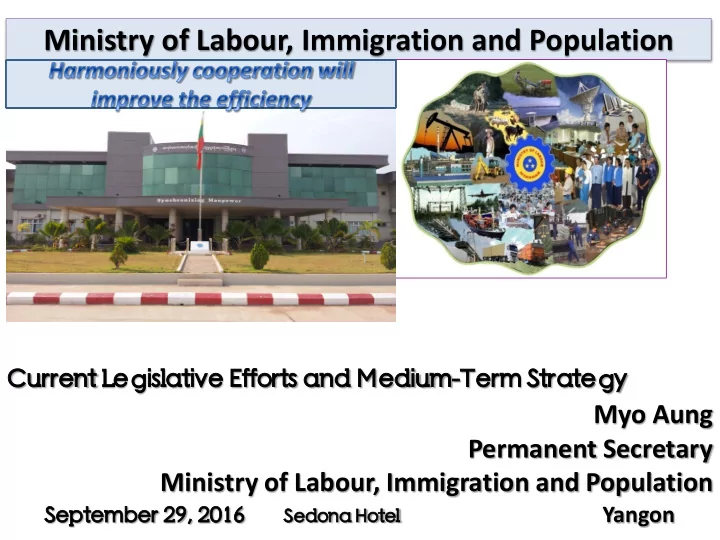
Current ent Le Legis isla lativ ive Efforts and Mediu ium-Ter erm m Strateg tegy

Myo Aung Permanent Secretary Ministry of Labour, Immigration and Population September 29, 29, 201 2016 Sedona

na Hotel el Yangon

slide-2
SLIDE 2

Vision

 To develop the country by the tripartite way based on social justice

2

slide-3
SLIDE 3

Employment policies

 To improve the productivity through decent work

 To provide the macro-economic framework with strengthens the employment opportunity  To strengthen the entrepreneurship and private investment  To improve the production rate and increase the

  • pportunities for workers

 Not to discriminate within the labour market  To develop the environmental and social improvement for long term  To be able to do the work well and to be able to change from

  • ne job to another

3

slide-4
SLIDE 4

Ministry of Labour, Immigration and Population Departments  Department of Labour  Social Security Board  Factory and Labour Laws Inspection Department  Department of Labour Relations

4

slide-5
SLIDE 5

Labour Laws being undertaken by the Ministry of Labour, Immigration and Population

5

slide-6
SLIDE 6

Department of Labour

 Workmen Compensation Act (1923)

 Dock Worker (Regulation Of Employment) Act (1948) - still in process to repeal  Employment Statistic Act (1948)  Employment Restriction Act (1959)  Overseas Employment Law (1999)  Labour Organization Law (2011)  Minimum Wage Law (2013)  Employment and Skill Development Law (2013)  Foreign Workers Law (still in process to draw the new)

6

slide-7
SLIDE 7

Factory and Labour Laws Inspection Department

 Dock workers Act (1934)  Oil Field (Worker and Welfare) Act (1951)  The Leafe and Holidays Act (1951) and the Bill which amends the Leave and Holidays Act (2014)  Factories Act (1951) and the Bill which amends the Factories Act (2016)  The Payment of Wages Law (2016)  Shops and Establishments Law (2016)  Occupational Safety and Health Law (still in process to draw the new)

7

slide-8
SLIDE 8

Social Security Board

 Social Security Act (2012)

8

slide-9
SLIDE 9

 Settlement of Labour Dispute Law (2012) And The Bill which amends the Settlement of Labour Dispute Law (2014)

Department of Labour Relations

9

slide-10
SLIDE 10

Three Laws proposed by workers/employers to amend as the first priority  Labour Organization Law (2011)  Settlement of Labour Dispute Law (2012)  Employment Contract contained in the Employment and Skill Development Law (2013)

10

slide-11
SLIDE 11

Medium - Term Strategy is that the Tripartite Consultation Meetings should be carried

  • ut

continuously to improve the industrial relations necessary for workers

It is necessary to provide the awareness raising programs and to share the knowledge relating to labour laws not only for employers and workers but also for departmental staff.

11

slide-12
SLIDE 12

The Labour Organization Law and Rules

The Labour Organization Law 

Under the Article 24 of the State Constitution of the Republic of the Union

  • f Myanmar and Freedom of Association

(ILO Convention No. 87), the Labour Organization Law was enacted by the Union Parliament Law No. 7 on October 11, 2011.

 The Trade Union Act (1926) was repealed.

12

slide-13
SLIDE 13

The Labour Organization Law and Rules

13

The Labour Organization Law  The Labour Organization Law was enacted in 2011 and Rules were issued on February 29, 2012.  Come into force on March 9, 2012.

slide-14
SLIDE 14

Under the Labour Organization Law (2011), the list of the workers'/employer's

  • rganization that already received the letter of acknowledgement

Total employer's/workers' organizations Kind of organization Employer Worker Total Basic 28 2113 2141 Township 1 122 123 Region/State

  • 15

15 Federation 1 8 9 Confederation

  • 1

1 Total 30 2259 2289

14

slide-15
SLIDE 15

According to the kind of trade, the list of the different levels labour organizations that received the letter of acknowledgement Basic Labour Organizations

No Kind of Trade Number 1 Garment 103 2 Public goods 79 3 Freight-handling 103 4 Agriculture 1466 5 Food 39 6 Construction materials 30 7 Periodicals and Publications 2 8 Meat and Fish Cold Store 5 9 Iron Melting 5 10 Mining 6 11 Transportation 48 12 Architecture 4

15

slide-16
SLIDE 16

Basic Labour Organizations

No Kind of Trade Number 13 Services 30 14 Construction 20 15 Education 11 16 Fishery 130 17 Minerals 20 18 Chemical products 4 19 husbandary 3 20 General business 5 Total 2113

According to the kind of trade, the list of the different levels labour organizations that received the letter of acknowledgement

16

slide-17
SLIDE 17

Township Labour Organizations

No Kind of Trade Number 1 Public goods 5 2 Freight handling 9 3 Transportation 5 4 Garment 3 5 Agriculture 79 6 Food 2 7 Fishery 6 8 Services 2 9 Mining 2 10 Production 2 11 Construction 2 12 General business 1 13 Minerals 3 14 Construction materials 1 Total 122

According to the kind of trade, the list of the different levels labour organizations that received the letter of acknowledgement

17

slide-18
SLIDE 18

Region/State Labour Organizations

No Kind of Trade Numbe ber 1 Agriculture 10 2 Industrial and multi-servies 2 3 Production and industrial business 1 4 Fishery 1 5 Freight handling 1 Total 15 15

According to the kind of trade, the list of the different levels labor organizations that received the letter of acknowledgement

18

slide-19
SLIDE 19

Conf nfed eder eration

No No Ki Kind of

  • f Trade

Numbe ber 1 Public goods, Agricultue, Food, Freight handling, Mining, Education, Transportation, Serivces, Husbandary, Construction, Fishery, Garment (It includes 13 sectors in total) 1 Total al 1

Labour Federations

No No Ki Kind of

  • f Trade

Numbe ber 1 Seafarer 5 2 Agriculture 2 3 Industrial and Multi-services 1 Total al 8

According to the kind of trade, the list of the different levels labour organizations that received the letter of acknowledgement

19

slide-20
SLIDE 20

Basic Employers' organizations

No Kind of Trade Number 1 Garment 9 2 Construction materials 3 3 Iron melting 2 4 Services 5 5 Food 1 6 Public goods 2 7 Agriculture 6 Total 28

Accordi rding t to the king o

  • f trade

ade, t the l list o t of the d differe rent l t levels empl ploye yers rs'

  • rganizations

ns that r recei eived ed t the l letter er o

  • f ackno

nowled edgem ement ent

20

slide-21
SLIDE 21

Township Organizations

No Kind of Trade Number 1 Garment 1 Total 1

Employers' Federation

No Kind of Trade Number 1 Myanmar Seafarer Employment Service Federation 1 Total 1

According to the kind of trade, the list of the different levels employers' organizations that received the letter of acknowledgement

21

slide-22
SLIDE 22

In carrying out to form the agriculture and farmers basic labour

  • rganization,

asking the recommendation letter

  • f

the village administration that the worker owns less than 10 acres is difficulty for workers.  In the Section 4 (a) of the Labour Organization Law, it states that the basic labour organization may be formed by a minimum number of 30 workers working in the relevant trade or activity according to the category

  • f trade or activity.

 Under the clause (ii) of sub-section (a) of Section 4 of the Labour

  • rganization Law, it states that in so forming, it shall be recommended by

not less than 10 percent of all workers of the relevant trade or activity.  Some employers do not recognize the formation of the labour

  • rganization

 Workers who are under 18 and who have retired should have a right to join in the labour organization

Difficulties submitted by workers

22

slide-23
SLIDE 23

 Section 30 of the Labour Organization Law It states that ''the employer shall allow the worker who is assigned any duty on the recommendation of the relevant executive committee to perform such duty no exceeding two days per month unless they have agreed

  • therwise. Such period shall be deemed as if he is

performing the original duty of his work.''

Difficulties that employers are facing with

23

slide-24
SLIDE 24

Employers' clarification relating to the section 30 of Labour Organization 

EC members of the labour organizations are not comply with the Section 30

  • f the labour organization law and they want to get more on-duty days than 2 days.

 Employers are facing with difficulties to run their businesses in the workplace as majority workers in the same trade want their leave entitlement.  In attending the trainings and meetings, labour organizations do not inform the employers in advance and do not take permission of the employers, and only after their attending those meetings and trainings, they inform the employer to provide them the on-duty leave through the township registration officer. So, there are problems between employers and workers in the workplace.  It is necessary to extend the formation of the employers' organization as labour organizations.

Difficulties that employers are facing with

24

slide-25
SLIDE 25

 In the ''exception'' contained in the Rules 5 (b), it states that ''the EC

member of the labour organization may be the person who has been working not less than 2 years in the relevant trade or the activity or the external person who has worked as the EC member of the labour

  • rganization that has already received the letter of acknowledgement

issued by Chief Registrar'', and  In the Rules 6 (d), it states that ''in the EC members of the labour

  • rganization formed under sub-rules (a), (b) and (c) of Rules 6, the

number of external persons included in the EC as an exception under Rules 5 (b) shall not more than 20 percent of the numbers of the EC''. But, even though the EC members of the labour organizations do not continue their jobs in the workplace due to various reasons, they are still taking part in the EC as the external, and they are not comply with Rules 6 (d) because their number are more then 20 percent of the total EC members.  The are interfering from outside.  To form the employers' organizations as the separate way of the structure

Difficulties that employers are facing with

25

slide-26
SLIDE 26

 Some labour organizations submitted the matter that their Form (7) were lost.  It is necessary to form the township labour organizations systematically in order to settle the relevant problems.  In terms of the duties of the EC members, there are disputes arisen between President and EC members of the labour organizations in keeping the Form (7).  We found that it is necessary to extend the term of the Form 7 (letter of acknowledgement) with respect to holding the Form 7.

Difficulties that the Ministry of Labour, Immigration and Population is facing with

26

slide-27
SLIDE 27

 Under the Settlement of Labour Dispute Law (2012), we have already

negotiated and settled the legal dismissal cases due to worker's infringement on workplace regulations or certain reasons. But, workers misunderstood that they were dismissed because they joined the labour organization under the Section 44 (d) of the Labour Organization Law (2011) or they took part in the strike.  Through such reasons, they submitted the complaint letters to take an action on employers under the Labour Organization Law.  The dismissed Presidents/Secretaries of the labour organizations enter the factories and carrying out the labour matters.  Workers need to realize the workplace regulations and the Labour Organization Law.

Difficulties that the Ministry of Labour, Immigration and Population is facing with

27

slide-28
SLIDE 28

 Workers need to know about the objectives and provisions

contained in the Labour Organization Law (2011), and need to carry out the objectives of the constitutions of their organizations because we see that their functions and objectives are quite different.  The ''Exception'' contained in clause (3) of the Rules 4 (f) - ''For the maritime sector in which it is not possible to form the labour

  • rganizations due to the nature of the business sector or the

geographical location, workers may establish their federations''. Under this provision, we have taken the necessary measures in the formation of their federations. Now, there are 5 federations in Maritime sector, and maritime workers are also calling for to form more federations.

Difficulties that the Ministry of Labour, Immigration and Population is facing with

28

slide-29
SLIDE 29

 Even though workers do not have the settled

  • ffice location, they are applying the formation of their
  • rganization.

 We have a problem how to settle the matter if there are two labour organizations in the same nature

  • f trade and their organizations' names are the same.

Difficulties that the Ministry of Labour, Immigration and Population is facing with

29

slide-30
SLIDE 30

There are 78 township labour offices under the Department

  • f Labour. But, the number of the labour officials is not enough and

does not cover the whole country in carrying out the labour

  • matters. It is necessary to take time (60 days) to cover the whole

country.  Due to we cannot open the township labour offices in every township, we are carrying out the activities through the existing personnel force.

Difficulties that the Ministry of Labour, Immigration and Population is facing with

30

slide-31
SLIDE 31

 According to the Notification No (5) of the Ministry of Labour dated December 31, 1976, the employment contract was started to apply, and there are 18 points in the contract.  In the Employment and Skill Development Law, it states that if a worker is hired, employer shall make the employment contract within 30 days from the date of hire.  Through the notification No. 1/2015 dated August 31, 2015, we issued the notification that the employers of the factories, workshop or establishments where more than 5 workers are employed have to make the employment contract with the hired wokers and the new workers.  The employment contract is linked up with the minimum wage.

Employment Contract

31

slide-32
SLIDE 32

 Employers' representatives from UMFCCI and MGMA (Hlaing Tharyar Tsp) and the Trade Unions federation submitted the matter to hold the tripartite consultation meeting in order to propose their suggestions, to uncover their difficulties in making the employment contract, and to delete certain points which ware contradictory to them contained in the employment contract template provided by the government. So, we conducted the tripartite consultation meeting at the office of UMFCCI on January 31, 2016.

Employment Contract

32

slide-33
SLIDE 33

 As for the tripartite consultation meeting, we notified to UMFCCI,

Employers' Federation and Trade Unions Federations that when employers and workers reach the agreement in terms of the employment contract, the Ministry of Labour will implement it under the law.  With respect to the employment contract, UMFCCI and CTUM drafting the employment contract through the formation of the Draft EC initiative committee and they submitted the draft EC to the Ministry.  The points contained in the said draft EC is differ from those of the EC provided by the government. So, we notified to both parties to submit the final form of the EC only after consulting with all employers' and workers' organizations.

Employment Contract

33

slide-34
SLIDE 34

 In terms of the employment contract, UMFCCI submitted the matter

to the Ministry of Labour in the month of June 2016.  Trade Unions Federations amended the employment contract template and submitted the suggestions to the Ministry after they had met Affiliated Associations UMFCCI, Industrial Zones Committees and

  • ther business branches many times in bi-partite way.

 When we requested AFFM-IUF, MICS-TUsF and IFOMS to sumit their suggestions, these Trade Unions Federations submitted their suggestions.  After the bi-partite meetings between employers' and workers'

  • rganizations have been completed, the tripartite meeting will be

conducted.

Employment Contract

34

slide-35
SLIDE 35

Employers and workers need to agree with the 21 points contained in the employment contract template.  After the employment contract is confirmed, the necessary actions will be taken according to the way of labour dispute settlement process.  Employment contract is very important in the labour dispute matter. So, the contract is liked up with the law.

Employment Contract

35

slide-36
SLIDE 36

 The Settlement of Labour Dispute Law was enacted by the Union Parliament Law No (5) on March 28, 2012 and come into force on April 26, 2012.  On September 30, 2014, the Draft Bill which amends the Settlement of Labour Dispute Law.  Now we are carrying out to amend this law for the second time.

Law being undertaken by the Department of Labour Relations

36

slide-37
SLIDE 37

 Township Conciliation Bodies 325  Reions/State Arbitration Bodies including Union Territory 15  Arbitration Council (Formed in tripartite way)

Arbitrations formed under the law

37

slide-38
SLIDE 38

 In the Settlement of Labour Dispute Law and Rules, there is no specific provision relating to the way of the choosing the members of Arbitration Bodies and Arbitration Council. So, we are initiating the procedures choosing the employers' and workers' representatives for Arbitration Bodies and Arbitration Council.  In terms of the labour disputes, if employers/workers are not satisfied with the decisions of Regions'/States' Arbitration Bodies including Union Territory and the decision of Arbitration Council, They could submit the writ to the Supreme Court according to the State Constitution (2008).

38

slide-39
SLIDE 39

The Functions of the Department of Labour Relations

 Under the Settlement of Labour Dispute Law, Arbitration Bodies settled the disputes as follows:

Year ar Region/Sta tate te A Arbitr trati tion Bodies es Arbitra ration n Counc ncil 2012(June/July to December) 39 cases 17 cases 2013 (January to December) 97 cases 54 cases 2014 (January to December) 78 cases 41 cases 2015 (January to December) 126 cases 63 cases 2016 (January to September 14 ) 107 cases 71 cases Total al 447 447 cases es 246 246 cases

39

slide-40
SLIDE 40

 In going on the demonstration, workers shall not carry out to reduce and lose the productivity.  Workers shall not block in front of the factory.  Organizations shall carry out their activities under the Labour Organization Law (they cannot carry out their activities under the Peaceful Assembly and Peaceful Procession Law).

40

slide-41
SLIDE 41

 As for our Ministry, we worked cooperatively together with

ILO and IOM with respect to elimination of forced labour, reduction of child labour, data collection on labour force, child labour and school-to-work transition.  In terms of the matter relating to ILO, to be able to work together with other concerned Ministries, we have been carrying out to re-establish the committee for ILO related matters.  Our Ministry will carry

  • ut

the labour force survey continuously.  In terms of 100 days Action Plan, we could open two Migrant Resource Centers in Ayeyarwaddy Region and Rakhine State.

41

slide-42
SLIDE 42

Amendment and drawing the new labour laws  It is supportive for the development of the State

economy.  It could not only protect the interests of employers and workers but also provide for peaceful workplace and improvement of productivity.  As we are now carrying out to amend the labour laws and draw the new ones, we, the Ministry are going to work cooperatively together with workers' and employers'

  • rganizations and national and international stakeholders

in order to comply with the international standars.

42

slide-43
SLIDE 43

 As for our country, now is the time to be able to move forward in a distinctive manner. Therefore, if we, the tripartite body drive in constructive manner and consolidated way, we may be able to move forward.

43

slide-44
SLIDE 44

44