
SLIDE 1
Minimum Spanning Trees 1
Minimum Spanning Trees
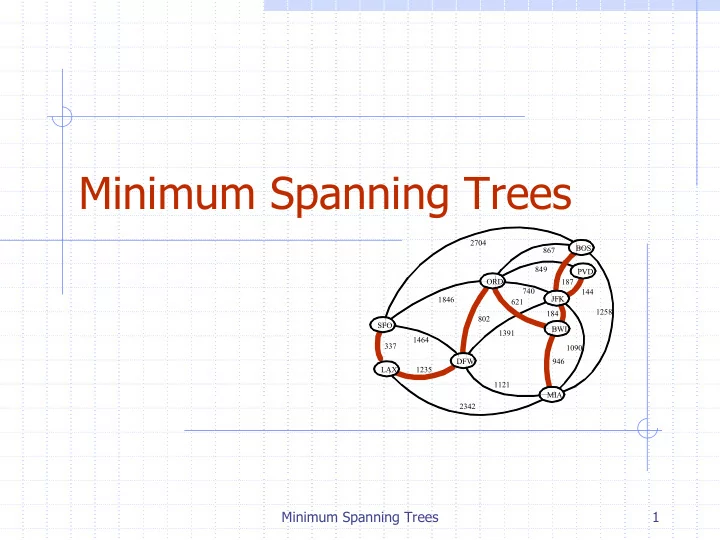
JFK BOS MIA ORD LAX DFW SFO BWI PVD 867 2704 187 1258 849 144 740 1391 184 946 1090 1121 2342 1846 621 802 1464 1235 337
Minimum Spanning Trees 2704 BOS 867 849 PVD ORD 187 740 144 - - PowerPoint PPT Presentation
Minimum Spanning Trees 2704 BOS 867 849 PVD ORD 187 740 144 JFK 1846 621 1258 184 802 SFO BWI 1391 1464 337 1090 DFW 946 LAX 1235 1121 MIA 2342 Minimum Spanning Trees 1 Outline and Reading Minimum Spanning Trees
Minimum Spanning Trees 1
JFK BOS MIA ORD LAX DFW SFO BWI PVD 867 2704 187 1258 849 144 740 1391 184 946 1090 1121 2342 1846 621 802 1464 1235 337
Minimum Spanning Trees 2
Definitions A crucial fact
Minimum Spanning Trees 3
Spanning subgraph
Subgraph of a graph G
containing all the vertices of G
Spanning tree
Spanning subgraph that is
itself a (free) tree
Minimum spanning tree (MST)
Spanning tree of a weighted
graph with minimum total edge weight
Applications
Communications networks Transportation networks
10 6 3 2 5
1
7
9 8 4
Minimum Spanning Trees 4
8 4 2 3 6 7 7 9 8 e
C
f
Cycle Property:
Let T be a minimum
spanning tree of a weighted graph G
Let e be an edge of G
that is not in T and C let be the cycle formed by e with T
For every edge f of C,
weight(f) ≤ weight(e) Proof:
By contradiction If weight(f) > weight(e) we
can get a spanning tree
replacing e with f Replacing f with e yields a better spanning tree 8 4 2 3 6 7 7 9 8
C
e f
Minimum Spanning Trees 5
Partition Property:
Consider a partition of the vertices of
G into subsets U and V
Let e be an edge of minimum weight
across the partition
There is a minimum spanning tree of
G containing edge e Proof:
Let T be an MST of G If T does not contain e, consider the
cycle C formed by e with T and let f be an edge of C across the partition
By the cycle property,
weight(f) ≤ weight(e)
Thus, weight(f) = weight(e) We obtain another MST by replacing
f with e 7 4 2 8 5 7 3 9 8 e f 7 4 2 8 5 7 3 9 8 e f Replacing f with e yields another MST U V
U V
Minimum Spanning Trees 6
We add to the cloud the
vertex u outside the cloud with the smallest distance label
We update the labels of the
vertices adjacent to u
Minimum Spanning Trees 7
Algorithm PrimJarnikMST(G) Q ← new heap-based priority queue s ← a vertex of G for all v ∈ G.vertices() if v = s setDistance(v, 0) else setDistance(v, ∞) setParent(v, ∅) l ← Q.insert(getDistance(v), v) setLocator(v,l) while ¬Q.isEmpty() u ← Q.removeMin() for all e ∈ G.incidentEdges(u) z ← G.opposite(u,e) r ← weight(e) if r < getDistance(z) setDistance(z,r) setParent(z,e) Q.replaceKey(getLocator(z),r)
A priority queue stores the vertices outside the cloud
Key: distance Element: vertex
Locator-based methods
insert(k,e) returns a
locator
replaceKey(l,k) changes
the key of an item
We store three labels with each vertex:
Distance Parent edge in MST Locator in priority queue
Minimum Spanning Trees 8
A 7 4 2 8 5 7 3 9 8 B A 7 4 2 8 5 7 3 9 8 2 B D C F E 7 2 8 ∞ ∞ B C A 7 4 2 8 5 7 3 9 8 2 5 B D C A E 7 4 2 8 5 7 3 9 8 7 2 5 7 7 D ∞ F E 7 7 D ∞ 5 4 F F C E 7
Minimum Spanning Trees 9
B D C A F E 7 4 2 8 5 7 3 9 8 3 2 5 4 7 B D C A F E 7 4 2 8 5 7 3 9 8 3 2 5 4 7
Minimum Spanning Trees 10
Graph operations
Method incidentEdges is called once for each vertex
Label operations
We set/get the distance, parent and locator labels of vertex z O(deg(z))
times
Setting/getting a label takes O(1) time
Priority queue operations
Each vertex is inserted once into and removed once from the priority
queue, where each insertion or removal takes O(log n) time
The key of a vertex w in the priority queue is modified at most deg(w)
times, where each key change takes O(log n) time
Prim-Jarnik’s algorithm runs in O((n + m) log n) time provided the graph is represented by the adjacency list structure
Recall that Σv deg(v) = 2m
The running time is O(m log n) since the graph is connected
Minimum Spanning Trees 11
Algorithm KruskalMST(G) for each vertex V in G do define a Cloud(v) of {v} let Q be a priority queue. Insert all edges into Q using their weights as the key T ∅ while T has fewer than n-1 edges do edge e = T.removeMin() Let u, v be the endpoints of e if Cloud(v) ≠ Cloud(u) then Add edge e to T Merge Cloud(v) and Cloud(u) return T
A priority queue stores the edges outside the cloud
Key: weight Element: edge
At the end of the algorithm
We are left with one
cloud that encompasses the MST
A tree T which is our
MST
Minimum Spanning Trees 12
Minimum Spanning Trees 13
which u is a member.
in operation union(u,v), we move the elements of the
smaller set to the sequence of the larger set and update their references
the time for operation union(u,v) is min(nu,nv), where nu
and nv are the sizes of the sets storing u and v
Minimum Spanning Trees 14
Algorithm Kruskal(G): Input: A weighted graph G. Output: An MST T for G. Let P be a partition of the vertices of G, where each vertex forms a separate set. Let Q be a priority queue storing the edges of G, sorted by their weights Let T be an initially-empty tree while Q is not empty do (u,v) ← Q.removeMinElement() if P.find(u) != P.find(v) then Add (u,v) to T P.union(u,v) return T
Minimum Spanning Trees 15
JFK BOS MIA ORD LAX DFW SFO BWI PVD 867 2704 187 1258 849 144 740 1391 184 946 1090 1121 2342 1846 621 802 1464 1235 337
Minimum Spanning Trees 16
JFK BOS MIA ORD LAX DFW SFO BWI PVD 867 2704 187 1258 849 144 740 1391 184 946 1090 1121 2342 1846 621 802 1464 1235 337
Minimum Spanning Trees 17
JFK BOS MIA ORD LAX DFW SFO BWI PVD 867 2704 187 1258 849 144 740 1391 184 946 1090 1121 2342 1846 621 802 1464 1235 337
Minimum Spanning Trees 18
JFK BOS MIA ORD LAX DFW SFO BWI PVD 867 2704 187 1258 849 144 740 1391 184 946 1090 1121 2342 1846 621 802 1464 1235 337
Minimum Spanning Trees 19
JFK BOS MIA ORD LAX DFW SFO BWI PVD 867 2704 187 1258 849 144 740 1391 184 946 1090 1121 2342 1846 621 802 1464 1235 337
Minimum Spanning Trees 20
JFK BOS MIA ORD LAX DFW SFO BWI PVD 867 2704 187 1258 849 144 740 1391 184 946 1090 1121 2342 1846 621 802 1464 1235 337
Minimum Spanning Trees 21
JFK BOS MIA ORD LAX DFW SFO BWI PVD 867 2704 187 1258 849 144 740 1391 184 946 1090 1121 2342 1846 621 802 1464 1235 337
Minimum Spanning Trees 22
JFK BOS MIA ORD LAX DFW SFO BWI PVD 867 2704 187 1258 849 144 740 1391 184 946 1090 1121 2342 1846 621 802 1464 1235 337
Minimum Spanning Trees 23
JFK BOS MIA ORD LAX DFW SFO BWI PVD 867 2704 187 1258 849 144 740 1391 184 946 1090 1121 2342 1846 621 802 1464 1235 337
Minimum Spanning Trees 24
JFK BOS MIA ORD LAX DFW SFO BWI PVD 867 2704 187 1258 849 144 740 1391 184 946 1090 1121 2342 1846 621 802 1464 1235 337
Minimum Spanning Trees 25
JFK BOS MIA ORD LAX DFW SFO BWI PVD 867 2704 187 1258 849 144 740 1391 184 946 1090 1121 2342 1846 621 802 1464 1235 337
Minimum Spanning Trees 26
JFK BOS MIA ORD LAX DFW SFO BWI PVD 867 2704 187 1258 849 144 740 1391 184 946 1090 1121 2342 1846 621 802 1464 1235 337
Minimum Spanning Trees 27
JFK BOS MIA ORD LAX DFW SFO BWI PVD 867 2704 187 1258 849 144 740 1391 184 946 1090 1121 2342 1846 621 802 1464 1235 337
Minimum Spanning Trees 28
JFK BOS MIA ORD LAX DFW SFO BWI PVD 867 2704 187 1258 849 144 740 1391 184 946 1090 1121 2342 1846 621 802 1464 1235 337
Minimum Spanning Trees 29
Like Kruskal’s Algorithm, Baruvka’s algorithm grows many “clouds” at once. Each iteration of the while-loop halves the number of connected compontents in T.
The running time is O(m log n).
Algorithm BaruvkaMST(G) T V {just the vertices of G} while T has fewer than n-1 edges do for each connected component C in T do Let edge e be the smallest-weight edge from C to another component in T. if e is not already in T then Add edge e to T return T
Minimum Spanning Trees 30
JFK BOS MIA ORD LAX DFW SFO BWI PVD 867 2704 187 1258 849 144 740 1391 184 946 1090 1121 2342 1846 621 802 1464 1235 337
Minimum Spanning Trees 31
JFK BOS MIA ORD LAX DFW SFO BWI PVD 867 2704 187 1258 849 144 740 1391 184 946 1090 1121 2342 1846 621 802 1464 1235 337
Minimum Spanning Trees 32
JFK BOS MIA ORD LAX DFW SFO BWI PVD 867 2704 187 1258 849 144 740 1391 184 946 1090 1121 2342 1846 621 802 1464 1235 337