Minimum Spanning Trees Tyler Moore CSE 3353, SMU, Dallas, TX April - - PDF document

minimum spanning trees
SMART_READER_LITE
LIVE PREVIEW

Minimum Spanning Trees Tyler Moore CSE 3353, SMU, Dallas, TX April - - PDF document

Notes Minimum Spanning Trees Tyler Moore CSE 3353, SMU, Dallas, TX April 9, 2013 Portions of these slides have been adapted from the slides written by Prof. Steven Skiena at SUNY Stony Brook, author of Algorithm Design Manual. For more


slide-1
SLIDE 1

Minimum Spanning Trees

Tyler Moore

CSE 3353, SMU, Dallas, TX

April 9, 2013

Portions of these slides have been adapted from the slides written by Prof. Steven Skiena at SUNY Stony Brook, author

  • f Algorithm Design Manual. For more information see http://www.cs.sunysb.edu/~skiena/

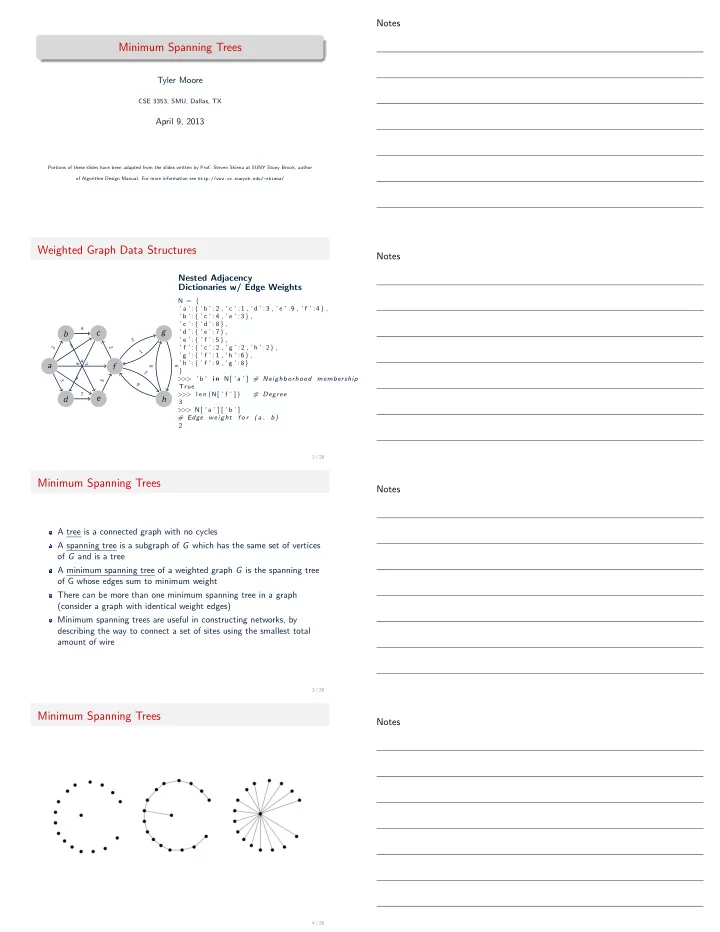
Weighted Graph Data Structures

a b d c e f h g

2 1 3 9 4 4 3 8 7 5 2 2 2 1 6 9 8

Nested Adjacency Dictionaries w/ Edge Weights

N = { ’ a ’ :{ ’ b ’ : 2 , ’ c ’ : 1 , ’ d ’ : 3 , ’ e ’ : 9 , ’ f ’ :4 } , ’ b ’ :{ ’ c ’ : 4 , ’ e ’ :3 } , ’ c ’ : { ’ d ’ : 8} , ’ d ’ :{ ’ e ’ : 7} , ’ e ’ : { ’ f ’ : 5} , ’ f ’ :{ ’ c ’ : 2 , ’ g ’ : 2 , ’ h ’ : 2} , ’ g ’ : { ’ f ’ : 1 , ’ h ’ :6 } , ’ h ’ :{ ’ f ’ : 9 , ’ g ’ :8} } > > > ’ b ’ i n N[ ’ a ’ ] # Neighborhood membership True > > > l e n (N[ ’ f ’ ] ) # Degree 3 > > > N[ ’ a ’ ] [ ’ b ’ ] # Edge weight f o r ( a , b ) 2

2 / 28

Minimum Spanning Trees

A tree is a connected graph with no cycles A spanning tree is a subgraph of G which has the same set of vertices

  • f G and is a tree

A minimum spanning tree of a weighted graph G is the spanning tree

  • f G whose edges sum to minimum weight

There can be more than one minimum spanning tree in a graph (consider a graph with identical weight edges) Minimum spanning trees are useful in constructing networks, by describing the way to connect a set of sites using the smallest total amount of wire

3 / 28

Minimum Spanning Trees

4 / 28

Notes Notes Notes Notes

slide-2
SLIDE 2

Why Minimum Spanning Trees

The minimum spanning tree problem has a long history – the first algorithm dates back to at least 1926! Minimum spanning trees are taught in algorithms courses since

1

it arises in many applications

2

it gives an example where greedy algorithms always give the best answer

3

Clever data structures are necessary to make it work efficiently

In greedy algorithms, we decide what to do next by selecting the best local option from all available choices, without regard to the global structure.

5 / 28

Prim’s algorithm

If G is connected, every vertex will appear in the minimum spanning

  • tree. (If not, we can talk about a minimum spanning forest.)

Prims algorithm starts from one vertex and grows the rest of the tree an edge at a time. As a greedy algorithm, which edge should we pick? The cheapest edge with which can grow the tree by one vertex without creating a cycle.

6 / 28

Prim’s algorithm

During execution each vertex v is either in the tree, fringe (meaning there exists an edge from a tree vertex to v) or unseen (meaning v is more than one edge away). def Prim-MST(G): Select an arbitrary vertex s to start the tree from. While (there are still non-tree vertices) Select the edge of minimum weight between a tree and nontree vertex. Add the selected edge and vertex to the minimum spanning tree.

7 / 28

Example run of Prim’s algorithm

a b c d e f g

7 8 5 9 7 5 15 6 8 9 11

d a f b e c g

8 / 28

Notes Notes Notes Notes

slide-3
SLIDE 3

Correctness of Prim’s algorithm

a b c d e f g h i Let’s talk through a “proof” by contradiction

1

Suppose there is a graph G where Prim’s alg. does not find the MST

2

If so, there must be a first edge (e, f ) Prim adds so that the partial tree cannot be extended to an MST

3

But if (e, f ) is not in MST(G), there must be a path in MST(G) from e to f since the tree is connected. Suppose (d, g) is the first path edge.

4

W (e, f ) ≥ W (d, g) since (e, f ) is not in the MST

5

But W (d, g) ≥ W (e, f ) since we assume Prim made a mistake

6

Thus, by contradiction, Prim must find an MST

9 / 28

Efficiency of Prim’s algorithm

Efficiency depends on the data structure we use to implement the algorithm Simplest approach is O(nm):

1

Loop through all vertices (O(n))

2

At each step, check edges and find the lowest-cost fringe edge that finds an unseen vertex (O(n))

But we can do better (O(m + n lg n)) by using a priority queue to select edges with lower weight

10 / 28

Prim’s algorithm implementation

a b c d e f g

7 8 5 9 7 5 15 6 8 9 11

d a f b e c g

G = { ’ a ’ :{ ’ b ’ : 7 , ’ d ’ :5 } , ’ b ’ :{ ’ a ’ : 7 , ’ d ’ : 9 , ’ c ’ : 8 , ’ e ’ : 7} , ’ c ’ : { ’ b ’ : 8 , ’ e ’ : 5} , ’ d ’ :{ ’ a ’ : 5 , ’ b ’ : 9 , ’ e ’ : 15 , ’ f ’ : 6} , ’ e ’ : { ’ b ’ : 7 , ’ c ’ : 5 , ’ d ’ : 15 , ’ f ’ : 8 , ’ g ’ : 9} , ’ f ’ :{ ’ d ’ : 6 , ’ e ’ : 8 , ’ g ’ :11} , ’ g ’ : { ’ e ’ : 9 , ’ f ’ :11} }

11 / 28

Prim’s algorithm implementation

from heapq import heappop , heappush def prim mst (G, s ) : V, T = [ ] , { } # V: v e r t i c e s i n MST, T: MST # P r i o r i t y Queue ( weight , edge1 , edge2 ) Q = [ ( 0 , None , s ) ] while Q: , p , u = heappop (Q)#choose edge w/ s m a l l e s t weight i f u i n V: continue #s k i p any v e r t i c e s a l r e a d y i n MST

  • V. append ( u )

#b u i l d MST s t r u c t u r e i f p i s None : pass e l i f p i n T: T[ p ] . append ( u ) e l s e : T[ p ]=[ u ] f o r v , w i n G[ u ] . items ( ) : #add new edges to f r i n g e heappush (Q, (w, u , v ) ) return T ””” > > > prim mst (G, ’ d ’) { ’ a ’ : [ ’ b ’ ] , ’ c ’ : [ ’ e ’ ] , ’ b ’ : [ ’ c ’ ] , ’ e ’ : [ ’ g ’ ] , ’ d ’ : [ ’ a ’ , ’ f ’ ] }

12 / 28

Notes Notes Notes Notes

slide-4
SLIDE 4

Output from Prim’s algorithm implementation

a b c d e f g

7 8 5 9 7 5 15 6 8 9 11

d a f b e c g

>>> prim_mst(G,’d’) {’a’: [’b’], ’b’: [’e’], ’e’: [’c’, ’g’], ’d’: [’a’, ’f’]}

13 / 28

Exercise: Compute Prim’s algorithm starting from a (number edges by time added)

a b c d e f g

5 12 7 8 9 4 3 4 2 5 7 2

14 / 28

Kruskal’s algorithm

Instead of building the MST by incrementally adding vertices, we can incrementally add the smallest edges to the MST so long as they don’t create a cycle def Kruskal-MST(G): Put the edges in a list sorted by weight count = 0 while (count<n-1) do Get the next edge from the list (v,w) if (component(v) != component(w)) add (v,w) to MST count+=1 merge component(v) and component(w)

15 / 28

Example run of Kruskal’s algorithm

a b c d e f g

7 8 5 9 7 5 15 6 8 9 11

a d e c d f a b e e g

16 / 28

Notes Notes Notes Notes

slide-5
SLIDE 5

Correctness of Kruskal’s algorithm

a b c d e f g h i Let’s talk through a “proof” by contradiction

1

Suppose there is a graph G where Kruskal does not find the MST

2

If so, there must be a first edge (e, f ) Kruskal adds so that the partial tree cannot be extended to an MST

3

Inserting (e, f ) in MST(G) creates a cycle

4

Since e & f were in different components when (e, f ) was inserted, at least one edge (say (d, g)) in MST(G) must be evaluated after (e, f ).

5

Since Kruskal adds edges by increasing weight, W (d, g) ≥ W (e, f )

6

But then replacing (d, g) with (e, f ) in the MST creates a smaller tree

7

Thus, by contradiction, Kruskal must find an MST

17 / 28

Exercise: Compute Kruskal’s algorithm (number edges by time added)

a b c d e f g

5 12 7 8 9 4 3 4 2 5 7 2

18 / 28

How fast is Kruskal’s algorithm?

What is the simplest implementation?

Sort the m edges in O(m lg m) time. For each edge in order, test whether it creates a cycle in the forest we have thus far built If a cycle is found, then discard, otherwise add to forest. With a BFS/DFS, this can be done in O(n) time (since the tree has at most n edges).

What is the running time?

O(mn) Can we do better? Key is to increase the efficiency of testing component membership

19 / 28

A necessary detour: set partition

A set partition is a partitioning of the elements of a universal set (i.e., the set containing all elements) into a collection of disjoint subsets Consequently, each element must be in exactly one subset We’ve already seen set partitions with bipartite graphs We can represent the connected components of a graph as a set partition So we need to find an algorithm that can solve the set partition problem efficiently: enter the union-find algorithm

20 / 28

Notes Notes Notes Notes

slide-6
SLIDE 6

Union-Find Algorithm

We need a data structure for maintaining sets which can test if two elements are in the same and merge two sets together. These can be implemented by union and find operations, where

find(i) Return the label of the root of tree containing element i, by walking up the parent pointers until there is no where to go. union(i,j): Link the root of one of the trees (say containing i) to the root of the tree containing the other (say j) so find(i) now equals find(j).

Ideally, we’d like the find to be logarithmic in the number of nodes and the union to take constant time Why do we only link the root of the trees together in union and not all nodes in the tree?

21 / 28

Example of Union-Find

a b c d e f g

7 8 5 9 7 5 15 6 8 9 11

a d e c d f a b Union-find trees a b c d e f g v C[v] findk(v) R[v] a a a 2 b f a c c c 1 d a a e c c f a a 1 g g g

22 / 28

Example of Union-Find

a b c d e f g

7 8 5 9 7 5 15 6 8 9 11

a d e c d f a b e Union-find trees a b c d e f g v C[v] findk(v) R[v] a a a 2 b f a c c a c a 1 d a a e c c a f a a 1 g g g

22 / 28

Implementing Union-Find

def f i n d k (C, u ) : # Find component rep . while C[ u ] != u : # Rep . would point to i t s e l f u = C[ u ] return u def unionk (C, R, u , v ) : u , v = f i n d k (C, u ) , f i n d k (C, v ) i f R[ u ] > R[ v ] : # Union by rank C[ v ] = u else : C[ u ] = v i f R[ u ] == R[ v ] : # A t i e : Move v up a l e v e l R[ v ] += 1

23 / 28

Notes Notes Notes Notes

slide-7
SLIDE 7

Implementing Kruskal’s algorithm

def k r u s k a l (G) : E = [ (G[ u ] [ v ] , u , v ) for u in G for v in G[ u ] ] T = s e t () # Empty p a r t i a l s o l u t i o n C = {u : u for u in G} # Component reps R = {u :0 for u in G} for , u , v in s o r t e d (E ) : # Edges , s o r t e d by weight i f f i n d k (C, u) != f i n d k (C, v ) :

  • T. add (( u ,

v )) # D i f f e r e n t reps ? Use i t ! unionk (C, R, u , v ) # Combine components return T

24 / 28

Bitcoin: digital currency

25 / 28

Bitcoin: one application of union-find algorithm

Source: http://www.nytimes.com/2013/04/08/business/media/bubble-or-no-virtual-bitcoins-show-real-worth.html 26 / 28

Using union-find algorithm to link Bitcoin transactions

Source: http://fc13.ifca.ai/proc/1-1.pdf 27 / 28

Notes Notes Notes Notes

slide-8
SLIDE 8

Using union-find algorithm to link Bitcoin transactions

Source: http://fc13.ifca.ai/proc/1-1.pdf 28 / 28

Notes Notes Notes Notes