Military Institutional Stigma and Nursing CPT Amy Brzuchalski, RN, - - PDF document

military institutional stigma and nursing
SMART_READER_LITE
LIVE PREVIEW

Military Institutional Stigma and Nursing CPT Amy Brzuchalski, RN, - - PDF document

APNA 30th Annual Conference Session 2037: October 20, 2016 Military Institutional Stigma and Nursing CPT Amy Brzuchalski, RN, MSN, DNP Student CPT Douglas Taylor, RN, BSN, DNP Student CPT Charles Walker, RN, BSN, DNP Student Daniel K. Inouye


slide-1
SLIDE 1

APNA 30th Annual Conference Session 2037: October 20, 2016 Taylor 1

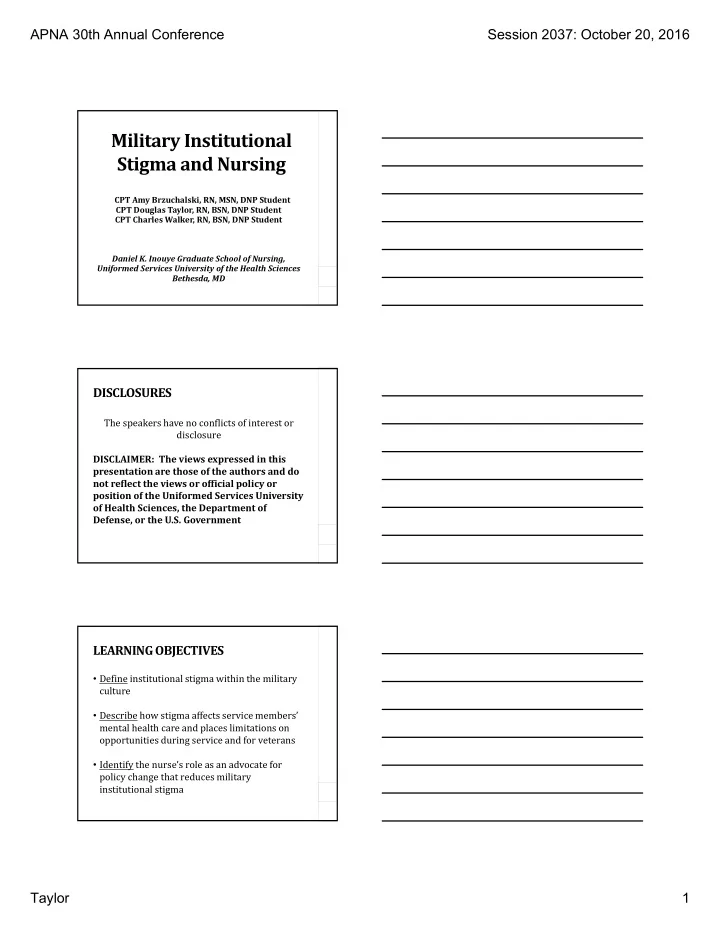
Military Institutional Stigma and Nursing

CPT Amy Brzuchalski, RN, MSN, DNP Student CPT Douglas Taylor, RN, BSN, DNP Student CPT Charles Walker, RN, BSN, DNP Student Daniel K. Inouye Graduate School of Nursing, Uniformed Services University of the Health Sciences Bethesda, MD

DISCLOSURES

The speakers have no conflicts of interest or disclosure DISCLAIMER: The views expressed in this presentation are those of the authors and do not reflect the views or official policy or position of the Uniformed Services University

  • f Health Sciences, the Department of

Defense, or the U.S. Government

LEARNING OBJECTIVES

  • Define institutional stigma within the military

culture

  • Describe how stigma affects service members’

mental health care and places limitations on

  • pportunities during service and for veterans
  • Identify the nurse’s role as an advocate for

policy change that reduces military institutional stigma

slide-2
SLIDE 2

APNA 30th Annual Conference Session 2037: October 20, 2016 Taylor 2

PERSONAL CONTEXT

  • We have over 45 years of combined military

experience

  • Each of us have witnessed or directly

experienced the detriments of mental health stigma in our military

  • We are passionate about the role mental health

plays in military readiness

MENTAL HEALTH STIGMA

(Acosta et al., 2014; Ben‐Zeev et al., 2012)

Contexts Components Consequences

  • Personal
  • Social
  • Public
  • Institutional
  • Cognitive
  • Emotional
  • Behavioral
  • Label Avoidance
  • Empirical
  • Assumed

INSTITUTIONAL STIGMA

(Corrigan, Markowitz, & Watson, 2004)

Structural Discrimination Intentional or Direct Consequences of Policy Unintentional Consequences

slide-3
SLIDE 3

APNA 30th Annual Conference Session 2037: October 20, 2016 Taylor 3

MILITARY PRESENCE OF STIGMA

2011 Active Duty Survey 39,877 Personnel from all services of US Armed Forces

  • 1/3 perceived potential harm to their career if they sought mental health

treatment

2010 Survey 2,023 Active Duty and 497 National Guard Army Soldiers

  • 31% Felt that seeking mental health care would harm their career
  • 45% Perceived that unit leadership would treat them differently
  • 40% Self‐stigmatized embarrassment, weakness, and a perceived loss of

confidence from peers

(Barlas, Higgins, Pflieger, & Diecker, 2013; Kim et al., 2010)

UNITED STATES GOVERNMENT ACCOUNTABILITY OFFICE

  • Human Capital: Additional Actions Needed to

Enhance DOD’s Efforts to Address Mental Health Care Stigma, April 2016

  • GAO Findings:
  • Perception of damage to career
  • Perception campaigns initiated, but institutional

stigma has not been addressed through policy

  • Recommendations:
  • Clarify and update policies contributing to stigma

(United States Government Accountability Office, 2016)

MENTAL HEALTH STIGMA IN THE MILITARY

  • Over 200 policies that contribute to stigma
  • Some policies are both positive or negative
  • Stigma policies limit opportunities
  • Negative terminology
  • Prohibition of action or implies incompetence
  • Limits privacy
  • Non‐mental health professionals are allowed to

question fitness

(Acosta et al., 2014)

slide-4
SLIDE 4

APNA 30th Annual Conference Session 2037: October 20, 2016 Taylor 4

POLICY EXAMPLES

Deployment Limiting Training or Job Limiting MacroMesoMicro‐level Policies

 DoD Directives and Instructions  Combatant Command Policies  Branch Specific Standards of Medical Fitness

DEPLOYMENT LIMITING POLICIES

  • DoD Directives and Policies
  • Deployment‐Limiting Medical Conditions for

Service Members and DoD Civilian Employees

  • US Combatant Command Policies
  • Individual Protection and Individual‐Unit

Deployment Policy

  • Army Regulation (AR) 40‐501 Standards of

Medical Fitness

(Department of Defense, 2007, 2008a, 2010; United States Central Command, 2013a, 2013b)

TRAINING AND JOB LIMITING POLICIES

  • Army Regulation (AR) 40‐501 Standards of

Medical Fitness

  • “emotional responses to situations of stress, when

such a reaction may interfere with the efficient and safe performance of an individual’s duties.” as a disqualifier

  • AR 601‐1 Assignment of Enlisted Personnel to

the US Army Recruiting Command

  • “no record of emotional or mental instability”

(Section II, Para 2‐4, 11) as a disqualifier

(Department of Defense, 2007, 2008a, 2010; United States Central Command, 2013a, 2013b)

slide-5
SLIDE 5

APNA 30th Annual Conference Session 2037: October 20, 2016 Taylor 5

THE DILEMMA

  • Dual Obligation of Provider
  • Care for the Patient (patient advocate)
  • Obligation to the Organization (DoD advocate)
  • Dual/Multiple Relationship Environment
  • Rank Hierarchy
  • power imbalance and differential
  • Deployed Provider
  • sole provider in an isolated location
  • potential to treat friends and/or peers

(Steel & King, 2000; American Psychological Association, 2010 )

THE PLAN: Clinical Opportunities

  • Acknowledge the intention of the these policies
  • Work within the scope of current policies
  • Maximize the positive of current policy
  • Informed Consent

(American Nurses Association, 2014; Chapman et al., 2014; Corrigan et al., 2004; Momen et al., 2012; Whalen, 2015; Weber & Weber, 2015)

THE PLAN: National Opportunities

  • GAO and Rand Report are a step towards

addressing the problem

  • Policy Advocacy
  • Nurses on Boards and Policy Development
  • 203 policies need nurses expertise in being

reworded to decrease stigma while maximizing force protection

(Acosta et al., 2014)

slide-6
SLIDE 6

APNA 30th Annual Conference Session 2037: October 20, 2016 Taylor 6

CONCLUSION

Institutional stigma exists in military policies Nurses can promote wellness within current policies and influence future policy to decrease stigma

RESOURCES

Acosta, J. D., Becker, A., Cerully, J. L., Fisher, M. P., Martin, L. T., Vardavas, R., … Schell, T. L. (2014). Mental Health Stigma in the Military. Santa Monica, Ca: RAND Corporation. Retrieved from www.rand.org/t/RR426 American Psychological Association. (2010, June 1). Ethical principles of psychologists and code of conduct [Pamphlet]. Retrieved from http://www.apa.org/ethics/code/ Barlas, F. M., Higgins, W. B., Pflieger, J. C., & Diecker, K. (2013). Department of Defense Health Related Behaviors Survey of Active Duty Military Personnel 2011. Washington, DC: Department of Defense. Retrieved from http://www.murray.senate.gov/public/_cache/files/889efd07‐2475‐40ee‐b3b0‐508947957a0f/ Ben‐Zeev, D., Corrigan, P. W., Britt, T. W., & Langford, L. (2012). Stigma of mental illness and service use in the military. Journal of Mental Health, 21(3), 264‐273. doi:10.3109/09638237.2011.621468 Chapman, P., Elnitsky, C., Pitts, B., Figley, C., Thurman, R., & Unwin, B. (2014). Mental health, help seeking, and stigma and barriers to care among 3‐and 12‐month postdeployed and never deployed US army combat medics. Military Medicine,179(8), 55‐62. doi:10.7205/MILMED‐D‐12‐00367 Corrigan, P. W., Markowitz, F. E., & Watson, A. C. (2004). Structural levels of mental illness stigma and discrimination. Schizophrenia Bulletin, 30(3), 481–491. Retrieved from http://doi.org/10.1093/oxfordjournals.schbul.a007096 Department of Defense. (2007). Force Health Protection (FHP) (No. DoD Directive 4715.11, May 10, 2004; Certified Current as of April 24, 2007). Washington, DC. Retrieved from http://www.dtic.mil/whs/directives/corres/pdf/471511p.pdf Department of Defense. (2010). Deployment‐Limiting Medical Conditions for Service Members and DoD Civilian Employees (No. DoD Instruction 6490.07, February 5, 2010). Washington, DC. Retrieved from http://www.dtic.mil/whs/directives/corres/pdf/649007p.pdf Department of the Army. (2008). Standards of Medical Fitness (No. Army Regulation 40‐501). Washington, DC. Department of the Army. (2011). Assignment of Enlisted Personnel to the U . S . Army Recruiting Command (No. Army Regulation 601‐1). Washington, DC. Retrieved from http://www.apd.army.mil/pdffiles/r601_1.pdf

RESOURCES

Health Professions Network Nursing and Midwifery Human Resources for Health. (2010). Framework for Action on Interprofessional Education & Collaborative Practice. (D. Hopikins, Ed.). Geneva, Switzerland: World Health Organization. Retrieved from http://www.who.int/hrh/resources/framework_action/en/ Kim, P., Thomas, J., Wilk, J., Castro, C., & Hoge, C. (2010). Stigma, barriers to care, and use of mental health services among active duty and national guard soldiers after combat. Psychiatric Services, 61(6), 582‐588. doi:10.1176/ps.2010.61.6.582 Momen, N., Strychacz, C., & Viirre, E. (2012). Perceived stigma and barriers to mental health care in marines attending the combat

  • perational stress control program. Military Medicine,177(10), 1143‐1148.

Staal, M. A., & King, R. E. (2000). Managing a multiple relationship environment: The ethics of military psychology. Professional Psychology: Research and Practice, 31(6), 698‐705. doi:10.1037/0735‐7028.31.6.698 United States Central Command. (2013a). Ppg‐Tab a : Amplification of the Minimal Standards of Fitness for Deployment To the Centcom Aor; To Accompany Mod Twelve To USCENTCOM Individual Protection and Individual / Unit Deployment. MacDill AFB, FL. Retrieved from http://cpol.army.mil/library/mobil/MOD12‐TabA.pdf United States Central Command. (2013b). USCENTCOM 021502Z DEC 13 MOD Twelve to USCENTCOM Individual Protection and Individual‐Unit Deployment Policy. MacDill AFB, FL. Retrieved from http://cpol.army.mil/library/mobil/MOD12‐Dec13.pdf United States Government Accountability Office. (2016). Report to Congressional Committees: HUMAN CAPITAL Additional Actions Needed to Enhance DOD ’ s Efforts to Address Mental Health Care Stigma. Washington, DC. Retrieved from http://www.gao.gov/assets/680/676633.pdf Weber, E., & Weber, D. K. (2015). Deployment Limiting Mental Health Conditions in US Military Personnel Deployed to Combat Theaters : Predictors of Theater Mental Health Evacuation. Journal of Psychology and Clinical Psychiatry, 2(4). Whalen, R. J. (2015). Predicting willingness to report behavioral health problems and seek treatment among US male soldiers deployed to Afghanistan: a retrospective evaluation. U.S. Army Medical Department Journal, 88–92. Retrieved from http://ovidsp.ovid.com/ovidweb.cgi?T=JS&PAGE=reference&D=medl&NEWS=N&AN=25651151
slide-7
SLIDE 7

APNA 30th Annual Conference Session 2037: October 20, 2016 Taylor 7

QUESTIONS