Mikihiko Nakao (KEK) December 13th, 2006, CKM workshop, Nagoya - - PowerPoint PPT Presentation

mikihiko nakao kek december 13th 2006 ckm workshop nagoya
SMART_READER_LITE
LIVE PREVIEW

Mikihiko Nakao (KEK) December 13th, 2006, CKM workshop, Nagoya - - PowerPoint PPT Presentation

Mikihiko Nakao (KEK) December 13th, 2006, CKM workshop, Nagoya mikihiko.nakao@kek.jp WG2 / 3 / 6-13-AM2 11:30 b s measurements from B factories M. Nakao 11:48 b s branching fraction NNLO P. Gambino 12:06 b s


slide-1
SLIDE 1

Mikihiko Nakao (KEK) December 13th, 2006, CKM workshop, Nagoya

mikihiko.nakao@kek.jp
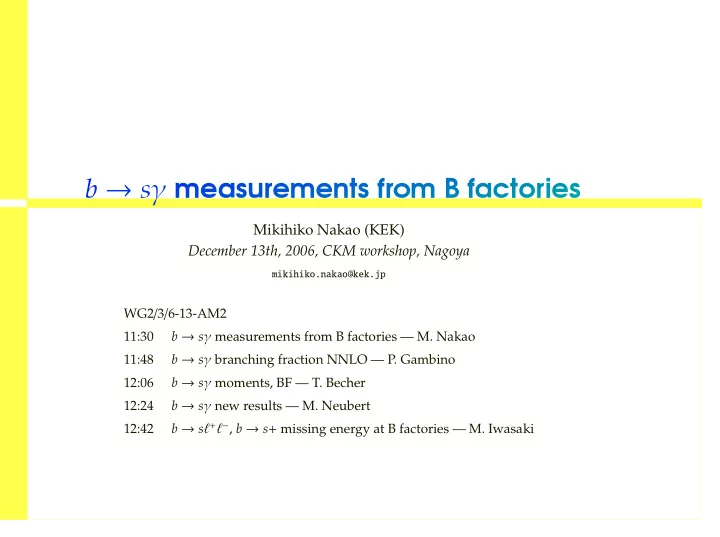
WG2/3/6-13-AM2 11:30 b → sγ measurements from B factories — M. Nakao 11:48 b → sγ branching fraction NNLO — P. Gambino 12:06 b → sγ moments, BF — T. Becher 12:24 b → sγ new results — M. Neubert 12:42 b → sℓ+ℓ−, b → s+ missing energy at B factories — M. Iwasaki

slide-2
SLIDE 2

[Experimentalists’ picture of b → sγ]

b s

b→sγ (quark level) γ γ B→Xs γ (meson level) B K π Xs π

t

W V

ts

V

* tb

Sensitivities to new physics Charged Higgs, SUSY, Left-right symmetric model. . . Photon as a probe for B decay properties universal parameters to improve Vcb, Vub and b → sγ To measure |Vts| (without assuming CKM unitarity) ∼ 7% measurement error ⇔ NLO calculation (∼ 10% error) — review of measurements (this talk) — NNLO calculations are getting ready (next three talks. . . )

— Mikihiko Nakao — p.2

slide-3
SLIDE 3

Integrated Luminosity (pb-1) (/day)

2006/12/05 07.24

200 400 600 800 1000 1200 1400 Integrated Luminosity (pb-1) (/day)

  • n resonance,
  • ff resonance,

energy scan

1000 2000 3000 4000 5000 6000 7000 x 10 2 5/3/1999 4/30/2001 4/28/2003 4/25/2005 4/23/2007

Belle log total : 690430 pb-1

Date Integrated Luminosity (pb-1)

all data,

  • n resonance,
  • ff resonance,

energy scan

Belle/KEKB has collected 700 fb−1 BaBar/PEPII has collected 390 fb−1

— Mikihiko Nakao — p.3

slide-4
SLIDE 4

Integrated Luminosity (pb-1) (/day)

2006/12/05 07.24

200 400 600 800 1000 1200 1400 Integrated Luminosity (pb-1) (/day)

  • n resonance,
  • ff resonance,

energy scan

1000 2000 3000 4000 5000 6000 7000 x 10 2 5/3/1999 4/30/2001 4/28/2003 4/25/2005 4/23/2007

Belle log total : 690430 pb-1

Date Integrated Luminosity (pb-1)

all data,

  • n resonance,
  • ff resonance,

energy scan

Belle/KEKB has collected 700 fb−1 b → sγ analysis up to 140 fb−1 BaBar/PEPII has collected 390 fb−1 b → sγ analysis up to 88 fb−1

— Mikihiko Nakao — p.3

slide-5
SLIDE 5

Full-inclusive

Photon only, no B reconstruction Off-resonance subtraction

(huge continuum background)

B → Xπ0, π0 → γγ subtraction Smeared by B momentum

10 cm

BELLE

Semi-inclusive

Standard Mbc(ES)-∆E reconstruction Sum up as many modes (e.g., B → Kπππγ) Cannot include all possible modes

Trade-off on the minimum photon energy cut

Large background ⇔ reduced model dependence as Eγ cut is lowered

— Mikihiko Nakao — p.4

slide-6
SLIDE 6

140 fb−1 on-, 15 fb−1 off-resonance

Scale factor calibration: ON − α OFF

Eγ > 1.8 GeV

Minimum Eγ bin that has ∼ 1σ signal

Continuum suppression

Not-so-fancy since no B reconstruction

1 10 10 2 10 3 10 4 10 5 10 6 1.6 1.8 2 2.2 2.4 2.6 2.8 3 CM energy [GeV] Entries per 33 MeV

π0 → γγ (similarly η → γγ)

Reduction by π0-likelihood B → π0X spectrum (continuum subtracted) B → π0X → γY subtraction

Other backgrounds

¯ n, K0

L, fake calorimeter cluster, beam b.g., . . .

Relying on MC, may be problematic with more data

In BaBar’s analysis, lepton-tag for other B to reduce background. Not obvious whether it improves figure-of-merit or not, depending on many other things.

— Mikihiko Nakao — p.5

slide-7
SLIDE 7

1850801-007

40 Data Spectator Model Weights / 100 MeV 1.5 2.5 3.5 4.5 E (GeV)

(GeV)

γ

Reconstructed E* 2 2.2 2.4 2.6 2.8 / 100 MeV)

  • 4

Partial Branching Fraction (10 0.2 0.4 0.6 0.8

B

AB AR

preliminary

E*γ [GeV] Events/100 MeV

  • 5000

5000 10000 15000 20000 25000 1.5 2 2.5 3 3.5 4

CLEO 9.1 fb−1 on Υ(4S) −4.4 fb−1 off-resonance Eγ > 2.0 GeV

[PRL87,251807(2001)]

BaBar 81.5 fb−1 on Υ(4S) −9.6 fb−1 off-resonance Eγ > 1.9 GeV

[hep-ex/0507001]

Belle 140 fb−1 on Υ(4S) −15 fb−1 off-resonance Eγ > 1.8 GeV

[PRL93,061803(2004)]

More data, lower photon energy cut

Lower Eγ cut by 0.1 GeV with roughly twice more data

— Mikihiko Nakao — p.6

slide-8
SLIDE 8

Uncorrected results from photon counting in Eγ bins give CLEO B(B → Xγ)[2.0,2.7] GeV = (3.06 ± 0.41 ± 0.26) × 10−4 BaBar B(B → Xγ)[1.9,2.7] GeV = (3.64 ± 0.29 ± 0.33 ± 0.22) × 10−4 Belle: B(B → Xγ)[1.8,2.8] GeV = (3.51 ± 0.32 ± 0.29) × 10−4 In agreement each other, and with the SM predictions,

  • after. . .

Subtraction of b → dγ (∼ −4% corr.) Corrections to the same Eγ range (up to ∼ 10% corr.) Corrections to the Eγ cut at B rest frame (∼ +5% corr.)

— Mikihiko Nakao — p.7

slide-9
SLIDE 9

82 fb−1 on-resonance data Xs system from one of 38 modes: B → Kπγ, Kππγ, Kπππγ, Kππππγ, Kη(π(π))γ, KKK(π)γ

(K = K±/K0

S, π = π±/π0)

Divide events in 18 bins of M(Xs)

0.1/0.2 GeV step from 0.6 to 2.8 GeV corresponds to Eγ > 1.9 GeV

Select |∆E| < 0.10—0.07 GeV, fit events in 5.22 < MES < 5.29 GeV

0.6 1.0 1.4 1.8 2.2 2.6 20 40 60 80 100

M (Xs) (GeV) Missing Fractions (%)

5.22 5.24 5.26 5.28 5.3 MES (GeV) Events / 0.003 (GeV)

M(X) = 1.4-1.5 GeV bin

10 20 30 40 50 60

Belle has also performed a simpler version of sum-of-exclusive analysis with less data (∼ 6 fb−1), lower M(Xs) < 2.1 GeV and less modes

— Mikihiko Nakao — p.8

slide-10
SLIDE 10

(GeV)

γ

E

1.9 2 2.1 2.2 2.3 2.4 2.5 2.6

Branching Fraction / 100 MeV

  • 0.05

0.05 0.1 0.15 0.2

  • 3

10 × Data Kinetic scheme Shape Function scheme

BABAR

Eγ = M2

B − M(Xs)2

2MB Much better resolution (1–5 MeV) compared with Eγ from calorimeter (∼ 40 MeV), no p(B) smearing BaBar B(B → Xsγ)[1.9,2.6] GeV = (3.27 ± 0.18 +0.55

−0.40 +0.04 −0.09) × 10−4

Belle B(B → Xsγ)[full range] = (3.36 ± 0.53 ± 0.42 +0.50

−0.54) × 10−4

— Mikihiko Nakao — p.9

slide-11
SLIDE 11

Belle full inclusive BaBar semi inclusive BaBar full inclusive CLEO full inclusive 2.3 2.4 0.02 0.04 1.8 1.9 2 2.1 2.2 2.3 Minimum Photon Energy (GeV) 1st moment (GeV) )

2

2nd moment (GeV

1st moment: Eγ 2nd moment: (Eγ − Eγ)2

(3rd moments are also measured by BaBar)

Observables to be directly compared with predictions Universal parameters in operator product expansion (OPE)

(several available schemes: kinetic scheme, shape function scheme. . . )

Kinetic scheme: mb (b quark mass), µ2

π (Fermi momentum)2

— Mikihiko Nakao — p.10

slide-12
SLIDE 12

[Buchmüller-Flächer, hep-ph/0507023]

Global fit (CLEO, Belle, BaBar data) to the moments from B → Xsγ to the moments from B → Xcℓν Parameters are universal Fits to B → Xcℓν and B → Xsγ are complementary Input to Vub from B → Xuℓν that recently reduced the |Vub| error significantly Combined fit results — mb to less than 1% accuracy!

mb = 4.590 ± 0.025(exp) ± 0.030(OPE) GeV, µ2

π = 0.401 ± 0.019(exp) ± 0.035(OPE) GeV2

— Mikihiko Nakao — p.11

slide-13
SLIDE 13

Shape function scheme Kinetic scheme Kagan-Neubert scheme Belle, BaBar, CLEO cut

OPE fit also improves the b → sγ measurement Very small model dependence

frac(Eγ > 1.8 GeV) = 96.7 ± 0.6% frac(Eγ > 1.9 GeV) = 93.6 ± 1.0% frac(Eγ > 2.0 GeV) = 89.4 ± 1.6%

Allow us to make an average at any Eγ cut to compare with theory (1.6 GeV is suitable now) However, this theoretical extrapolation is questionable? Lower Eγ cuts are crucial to verify the predictions 1.6 GeV should be possible, can we go down to 1.0 GeV?

— Mikihiko Nakao — p.12

slide-14
SLIDE 14

Average branching fraction for Eγ > 1.6 GeV

[Heavy Flavor Averaging Group (HFAG), hep-ex/0603003]

B(B → Xsγ; Eγ > 1.6 GeV) = (355 ± 24(stat+sys) +9

−10(shape) ± 3(dγ)) × 10−6

2 3 4 5 6

  • 4

)x10 γ X → BF(B

Buras Czarnecki Misiak Urban (NPB631:219,2002)

Average

HFAG hep-ex/0603003

  • 4

0.26)x10 ± (3.55

Belle

]

  • 1

[140 fb PRL93,061803(2004)

  • 4

0.44)x10 ± (3.50

Belle

]

  • 1

[5.8 fb PLB511,151(2001)

  • 4

0.95)x10 ± (3.69

BaBar

]

  • 1

[81.5 fb hep-ex/0507001

  • 4

0.57)x10 ± (3.92

BaBar

]

  • 1

[81.5 fb PRD72,052004(2005)

  • 4

)x10

  • 0.51

+0.62

(3.35

CLEO

]

  • 1

[9.1 fb PRL87,251807(2001)

  • 4

0.53)x10 ± (3.29

NLO

Very consistent with NLO SM, e.g., (357 ± 30) × 10−6

— Mikihiko Nakao — p.13

slide-15
SLIDE 15

Average branching fraction for Eγ > 1.6 GeV

[Heavy Flavor Averaging Group (HFAG), hep-ex/0603003]

B(B → Xsγ; Eγ > 1.6 GeV) = (355 ± 24(stat+sys) +9

−10(shape) ± 3(dγ)) × 10−6

2 3 4 5 6

  • 4

)x10 γ X → BF(B

Hurth et al. (NPB704:56,2005) Asatrian et al. (PLB585:263,2004) Buras Czarnecki Misiak Urban (NPB631:219,2002) Kagan Neubert (EPJC7:5,1999)

Average

HFAG hep-ex/0603003

  • 4

0.26)x10 ± (3.55

Belle

]

  • 1

[140 fb PRL93,061803(2004)

  • 4

0.44)x10 ± (3.50

Belle

]

  • 1

[5.8 fb PLB511,151(2001)

  • 4

0.95)x10 ± (3.69

BaBar

]

  • 1

[81.5 fb hep-ex/0507001

  • 4

0.57)x10 ± (3.92

BaBar

]

  • 1

[81.5 fb PRD72,052004(2005)

  • 4

)x10

  • 0.51

+0.62

(3.35

CLEO

]

  • 1

[9.1 fb PRL87,251807(2001)

  • 4

0.53)x10 ± (3.29

NLO

Very consistent with NLO SM, e.g., (357 ± 30) × 10−6 Many NLO SM calculations — theory error?

— Mikihiko Nakao — p.13

slide-16
SLIDE 16

Average branching fraction for Eγ > 1.6 GeV

[Heavy Flavor Averaging Group (HFAG), hep-ex/0603003]

B(B → Xsγ; Eγ > 1.6 GeV) = (355 ± 24(stat+sys) +9

−10(shape) ± 3(dγ)) × 10−6

2 3 4 5 6

  • 4

)x10 γ X → BF(B

Misiak et al (hep-ph/0609232) Becher Neubert (hep-ph/0610067)

Average

HFAG hep-ex/0603003

  • 4

0.26)x10 ± (3.55

Belle

]

  • 1

[140 fb PRL93,061803(2004)

  • 4

0.44)x10 ± (3.50

Belle

]

  • 1

[5.8 fb PLB511,151(2001)

  • 4

0.95)x10 ± (3.69

BaBar

]

  • 1

[81.5 fb hep-ex/0507001

  • 4

0.57)x10 ± (3.92

BaBar

]

  • 1

[81.5 fb PRD72,052004(2005)

  • 4

)x10

  • 0.51

+0.62

(3.35

CLEO

]

  • 1

[9.1 fb PRL87,251807(2001)

  • 4

0.53)x10 ± (3.29

NNLO

Very consistent with NLO SM, e.g., (357 ± 30) × 10−6 Many NLO SM calculations — theory error? Or slightly higher than first NNLO SM estimates?

— Mikihiko Nakao — p.13

slide-17
SLIDE 17

ACP = Γ(b → sγ) − Γ(b → sγ) Γ(b → sγ) + Γ(b → sγ)

  • 20
  • 10

10 20 2 2.5 3 3.5 4 4.5

BR(b → s γ) × 104 ACP

b→sγ

ACP(b → sγ) with SUSY, Bartl et al.

Precisely measured: HFAG ACP(B → Xsγ) = (5 ± 36) × 10−3

Belle 140 fb−1: (2 ± 50 ± 30) × 10−3, BaBar 82 fb−1: (25 ± 50 ± 15) × 10−3

but extremely small in SM: e.g., ACP = (4.2 +1.7

−1.2) × 10−3 [T.Hurth et al]

Only up to a few percent even in SUSY (with EDM constraints)

BaBar 82 fb−1: ACP(B → X(s+d)γ) = (−110 ± 115 ± 17) × 10−3

b → sγ and b → dγ are not separated — even smaller SM CPV (canceling)

— Mikihiko Nakao — p.14

slide-18
SLIDE 18

ACP(∆t) = Γ(B0(t) → K0

Sπ0γ) − Γ(B0(t) → K0 Sπ0γ)

Γ(B0(t) → K0

Sπ0γ) + Γ(B0(t) → K0 Sπ0γ) = S sin ∆m∆t + A cos ∆m∆t

ABelle = −CBaBar SM left handed coupling gives S ∼ 0.04 (or up to 0.10?), any large S is due to non-SM right handed coupling

t [ps] ∆

  • 6
  • 4
  • 2

2 4 6

Asymmetry

  • 1
  • 0.5

0.5 1

t [ps] ∆

  • 6
  • 4
  • 2

2 4 6

Asymmetry

  • 1
  • 0.5

0.5 1

∆t (ps) Raw asymmetry/(2.5 ps)

  • 1
  • 0.75
  • 0.5
  • 0.25

0.25 0.5 0.75 1

  • 7.5 -5 -2.5

2.5 5 7.5

BaBar 232M BB PRD72,051103R: SK∗0γ = −0.21 ± 0.40 ± 0.05 AK∗0γ = +0.40 ± 0.23 ± 0.04 Belle 535M BB hep-ex/0608017 Sall K0

Sπ0γ = −0.10 ± 0.31 ± 0.07

Aall K0

Sπ0γ = −0.20 ± 0.20 ± 0.06

Error on S is ∼ 0.3, still long way to the precision of the SM

— Mikihiko Nakao — p.15

slide-19
SLIDE 19

b → sγ measurements are matured, one of the most precise reference point in B physics B(B → Xsγ; Eγ > 1.6 GeV) = (355 ± 24 +9

−10 ± 3) × 10−6

In the days of NLO, b → sγ would not find new physics. . . But with NNLO, room for new physics could be still there! (though we still don’t know where NNLO will converge) Also other observables such as direct and time-dependent CPV, isospin asymmetry, photon polarization, . . . Need to improve the measurement error to go further below the expected theory error (still taking some time. . . )

b → sγ is a very hot topic once again!

— Mikihiko Nakao — p.16

slide-20
SLIDE 20

2.8 3 3.2 3.4 3.6 3.8 4 4.2 0.15 0.2 0.25 0.3 0.35 0.4 hep-ph/0603003 M >200 GeV H 250 300 400 550 900

Lower limit on type-II charged Higgs mass for any tan β

[Misiak et al, hep-ph/0609232]

M(H+) > 295 GeV (95% CL), or M(H+) ∼ 650 GeV(?) Need to decrease the experimental error! Room for other new physics

— Mikihiko Nakao — p.17