
SLIDE 1
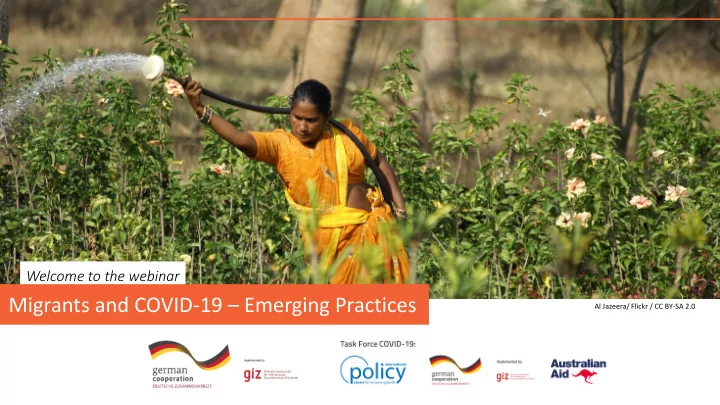
Migrants and COVID-19 – Emerging Practices
Welcome to the webinar
Al Jazeera/ Flickr / CC BY-SA 2.0
Migrants and COVID-19 Emerging Practices Al Jazeera/ Flickr / CC - - PowerPoint PPT Presentation
Welcome to the webinar Migrants and COVID-19 Emerging Practices Al Jazeera/ Flickr / CC BY-SA 2.0 simultaneous interpretation Ho How to o acce ccess fr from th the e smartphone app 1. Download the Interprefy app: How to Ho o acce
Welcome to the webinar
Al Jazeera/ Flickr / CC BY-SA 2.0
Ho How to
ccess fr from you
eb browser Ho How to
ccess fr from th the e smartphone app
ld
sporgwebinar
English option
CONNECT again.
sporgwebinar and select Eng English:
Có Cómo acce cceder des esde su su naveg egador web eb Có Cómo acce cceder des esde la la aplic licación del el smartphone
sporgwebinar
Español
nuevamente.
sporgwebin inar y seleccione Esp Español del menú de selección.
This joint effort is inspired by colleagues and
issemin inate and dis iscu cuss th the e mos
ecent con
esponses es to
19. The initiative has three major components:
1. A weekly special edition of a dedicated ne newsle letter, featuring a compilation of relevant information from all over the world on social protection initiatives dealing with COVID-19; 2. Weekly web ebin inars to foster discussions and exchanges; 3. An on
ine com
ity to systematise the information gathered
Photo by Gelani Banks on Unsplash
#SPcovid19 #COVID19 #SPresponses
Univ iversal l He Healt lth Co Coverage (U (UHC) and th the e Co Coronavirus Cri Crisis
Thursday, 2 July - 8 AM EDT/GMT-4
Adaptación de e programas de e tr transferen encias de e efec ecti tivo en en América La Latin tina y el el Ca Carib ibe para res esponder a la la pandemia COVID-19 19
Tuesday, 7 July - 10 AM EDT/GMT-4
Next webinars
Photo by 东旭 王 on Unsplash
socialprotection.org presents:
Panellists: Gabriela Benítez, World Vision Ecuador Humanitarian Response Manager Rajeev Ahal, Director, Natural Resources Management and Agroecology, GIZ India Virginia Negro, Specialist for the Western Hemisphere Regional Migration Program, International Organization for Migration (IOM) Moderator: Nancy Landa, Technical Advisor, Skills for Reintegration Global Program – Pilot Project in Mexico, Deutsche Gesellschaft für Internationale Zusammenarbeit GIZ GmbH
Migrants and COVID-19 – Emerging Practices
Panellist
Gabriela Benítez
World Vision Ecuador
Migrants and COVID-19 – Emerging Practices
Gabriela Benítez is a Local Development professional with special interest in facilitating community empowerment processes, with profound knowledge of risk management, and humanitarian and emergency
response to crises, based on humanitarian international standards to provide lifesaving assistance to the affected populations. Relevant experience designing and managing cash/voucher projects, targeting vulnerable migrants/refugees and host communities. Since 2015, Gabriela has held the position of HEA (Humanitarian and Emergency Affairs) National Coordinator for World Vision Ecuador, in charge of the implementation of Disaster Risk Reduction plans and initiatives to strengthen the capacity of communities and local actors; in 2016 Gabriela led World Vision’s Humanitarian Actions in response to the 7.8 Earthquake
Venezuelan migrant crisis; currently leading the emergency response related to COVID-19.
Panellist
Rajeev Ahal
GIZ India
Migrants and COVID-19 – Emerging Practices
Rajeev Ahal works in GIZ India as Director, Natural Resource Management and Agro-Ecology, where he leads a key bilateral project on ‘Water Security and Climate Adaptation in Rural India’, along with a host
health improvement, market led development approaches (including PPPs), value chain development, access to green finance etc. Rajeev has over 33 years of experience in working with international agencies, governments and the private sector in India and African countries on these issues, as well as participatory forest management and livelihood development initiatives. He majored in electrical engineering for his graduation and holds a Diploma in International Programme for Organisational and Systems Development from Gestalt Center for Organisational and Systems Development in Ohio.
Panellist/Discussant
Virginia Negro
International Organization for Migration (IOM)
Migrants and COVID-19 – Emerging Practices
Virginia Negro holds a PhD in Latin American Studies from the Universidad Nacional Autónoma de México (UNAM) that granted her an in-depth knowledge of the migration field, as well as a European Master in International Relations, and a Master in Semiotics from the University of Paris VIII and the University of
Program implemented by the International Organization for Migration (IOM) where she has led a range of projects promoting the labor integration of migrants, supporting the execution of national and multilateral labor migration schemes. She previously headed the research unit of the Institute of Studies and Outreach of Migration in Mexico (INEDIM), in which she coordinated consultancies aimed at developing and implementing public policies to guarantee fair and safe human mobility and the rights of migrants to work. She has also worked as an international consultant for UNICEF1 and AEBR (Association of European Border Regions), developing international cooperation projects in Mexico, Argentina and Jerusalem.
Moderator
Nancy Landa
GIZ
Migrants and COVID-19 – Emerging Practices
Nancy Landa is the Technical Advisor for “Skills for Reintegration" with Deutsche Gesellschaft für Internationale Zusammenarbeit (GIZ) in Mexico. The pilot project focuses on strengthening networks and partnerships with the aim of facilitating the integration/reintegration process of migrants, returnees, refugees and other forcedly displaced persons in Mexico. Additionally, the project promotes Intra-regional and inter-regional dialogues between key actors. Nancy holds a Masters of Global Migration from University College London and has advised and led qualitative research projects on return migration, particularly on reinsertion and reintegration policies and programs at the federal and local level. She integrates activist-research strategies to influence public conversations of post-deportation experiences and struggles of returned and deported migrants.
Emergin ing field field practic ices to
in refugee ee con
xts
16 June 2020
(M (Mis issed) Opportuniti ties? COVID-19 as an acce ccele lerator or
bloc locker of
inclu clusion of
ispla laced in in lin linkin ing soci
l protecti tion and humanitarian cash tr transfers
18 June 2020 Past Webinars: Social Protection-Migration & Forced Displacement Nexus
WEBINAR 14 SP COVID19 WEBINAR 16 SP COVID19
Reg Natarajan / Flickr / CC BY 2.0
So Social l Protection Fr Framework
WEBINAR 2 SP COVID19
Social Assistance
(non-contributory)
TYPES OF PROGRAMS: Cash transfers, Food and in-kind Assistance, etc. COUNTRY EXPERIENCES: Pakistan, Morocco, Rwanda, Colombia, Ecuador & India
Alleviating chronic poverty
Social Insurance
(contributory)
TYPES OF PROGRAMS: Health insurance coverage, sick leave, pensions, etc.
Insuring the uninsured against: adverse personal circumstances & life-cycle livelihood risks
Labour market policies
TYPES OF PROGRAMS: Training, employment intermediation services, wage subsidies, unemployment insurance, etc. COUNTRY EXPERIENCE: India
Facilitate employment & promote livelihoods, ensure basic standards at work & extend rights
Universal Health Coverage
Mig igrant workers an and COVID-19 19
Implications of COVID-19 for migrant workers and their families*:
global labour pool (2.2 billion workers). In many countries, migrant workers represent a larger share of the workforce and carrying out many essential jobs (services, construction, agriculture and agro-food processing).
economy with high levels of temporary, informal or unprotected work, characterized by precarious work conditions (low wages and worsening working conditions).
wage subsidies, unemployment benefits and other social protection measures.
*ILO (April 2020). Protecting migrant workers during the COVID-19 pandemic: Recommendations for Policy-makers and constituents [Policy Brief].
type them in the chat bar
Also, interact with us on Twitter (@SP_Gateway)
Migrants and COVID-19 – Emerging Practices
#SPorgWebinar #SPcovid19 #COVID19 #SPresponses
❖ On March, the Government of Ecuador declared: "Sanitary Emergency" and “National State of Exception” to mitigate the spread of the virus. ❖ Suspension of face-to-face activities and all type of public events; suspension of the national education system; suspension of public transportation and vehicle restriction; closure of borders and airports; president imposed a curfew to restrict internal movement of individuals and promote confinement. ❖ Ecuador, with around 17mn inhabitants, is one of the most affected countries in Latin America by COVID-19. According to figures from the Health Ministry, as of June 29, 55.665 cases have been confirmed, 4.502 deaths. ❖ Ecuador is the Latin American country with the highest mortality rate per million inhabitants, ahead of Brazil, which has a population 12 times higher.
❖ Starting in May, Ecuador relaxes the confinement measures and begins the transition from “isolation” phase to “social distancing” phase, as a strategy for the reactivation of productive sectors. ❖ According to a study by the Quito Chamber of Commerce, 82% of companies are currently operating at 0-30% of their installed capacity and only 1.7% of firms are working at 100%. Some 84% of companies have reported a decrease in sales, 35.3% reduced their payroll for the year and 70% have not generated income during the period of restrictions ❖ In addition to the effects of the pandemic, there was a paralysis in the country’s oil sector due to the rupture of two pipelines, as well as the collapse of oil prices and the fall in prices for other key export products, which has generated greater fiscal and liquidity problems
❖ The Government of Ecuador, implemented social protection projects to assist the most vulnerable families. During April, May, and June the government delivered contingency bonus to 950.000 Ecuadorian families, specially those depending on informal economic activities, such as selling goods on a day to day basis. (Contingency bonus $60 x 2 months; Family Protection Bonus $120 x 1 month)
❑ Exposed to all kinds of abuse and exploitation ❑ Families living on the streets, due to evictions for non-payment
❑ Food insecurity, families do not have the capacity to satisfy basic food needs. ❑ Pandemic precipitates the return of thousands of Venezuelan migrats to their country (entire families walking along the roads towards the borders, trying to return to Venezuela, exposed to all kind of risks) ❑ Venezuelan families do not have access to social protection programs implemented by the government (food kits, bonus) ❑ Limited access to public health services
✓ Families in situations of increased vulnerability due to the health emergency
✓ Children in situations of human mobility are not guaranteed access to education ❑ Limitations to access virtual education (internet, technology) ✓ Increased discrimination / xenophobia ❑ According to OIM, before the pandemic the 55% of venezuelan population felt discriminated
➢Food Security.- WV resources, funded by WFP ➢WASH.- WV resources ➢Health.- WV resources ➢Multipurpose Cash.- Private resources ➢Cash for economic recovery, livelihoods, micro-enterprises Since the health emergency started, World Vision Ecuador has implemented cash based interventions in the following sectors…
Implemented by
A presentation by the Indo-German cooperation
500,000+ positive cases 280,000+ people have recovered 15,000+ fatalities
Image source: www.ndtv.com
Covid-19: Impact on Incomes and Unemployment
Source: https://timesofindia.indiatimes.com/india/jobs-are-back-but-lost-income-could-hurt-millions/articleshow/76683093.cms 8 in 10 Indian households lost income. The lower middle class was hit worst as they relied on sources of income worst hit by lockdown. Rural areas hit worse than urban areas.
Internal migration in India
Source: Government of India census 2011 | WEF’s report on ‘Migration and Cities’,
India has 453.6 million migrants (Census 2011). ~120 million among them had migrated for work, employment
India’s internal migration grows at 4.5 per cent annually.
Migrant workers in India
From water stressed areas, having marginal or no land, illiterate or unskilled, migrate for short-term or seasonally for work depending on agriculture season.
Mostly youth and men who migrate alone, seeking better opportunities and better wages; mostly from eastern India.
Going on between certain regions since decades facilitated by social
workers from Ganjam, Odisha in Surat, Gujarat.]
Reference sources: https://www.livemint.com/Politics/8WPPsZygqR7Mu6e3Fgy55N/A- million-migrations-Journeys-in-search-of-jobs.html | https://alumni.ids.ac.uk/news/blogs-perspectives-provocations- initiatives/perspectives-provocations-initiatives-covid-19/546/546- Who-are-Indias-migrant-workers-whats-next-for-them
Most vulnerable category, unorganized and dependent on daily wages for living. Most affected by Covid-19
and contractors played an important role in arranging for work.
transportation shut down, hundreds of thousands of migrants walked hundreds
rural areas by now.
Image source: The Hindu
innovations
Government of India’s Covid-19 economic relief package of EUR 253 billion.
programme
Dhan (Zero balance) bank account holders; EUR 5.87 per woman per month.
EUR 71 over a year to small and marginal farmers.
disabled for an ex-gratia payment of EUR 12 per head.
micro, small and medium enterprises
Scheme for Poor) to boost employment and livelihood
the wake of COVID-19 outbreak
~EUR 67 billion spent since 2006. EUR 12 billion for 2020-21 alone. Coverage of ~138 million families across rural India. ~71 million families are active workers. ~55% of person-day generation is by women. ~20% of person-day generation is by tribal and marginalised communities.
MGNREGA is an act to provide for the enhancement of livelihood security of the households in rural areas of the country by providing at least 100 days of guaranteed wage employment in every financial year to every household whose adult members volunteer to do unskilled manual work.
distancing.
creation and durable livelihood infrastructure in creation including water conservation works, given the upcoming drought situation
Rs 202 (EUR 2.44) from Rs 182 (EUR 2.20) last year.
new demand for work, especially from return migrants from urban to rural areas.
release of all pending wage liabilities.
Image courtesy: Government of Rajasthan
in 116 Districts of 6 States of Bihar, Uttar Pradesh, Madhya Pradesh, Rajasthan, Jharkhand and Odisha
villages
infrastructure and create livelihood opportunities viz. Roads, Housing, Anganwadis, Panchayat Bhavans, various livelihood assets and Community Complexes among others.
between 12 different Ministries/Departments including Panchayati Raj, Road Transport & Highways, Mines, Drinking Water & Sanitation, Environment, Railways, Petroleum & Natural Gas, New & Renewable Energy, Border Roads, Telecom and Agriculture,
Source: https://pib.gov.in/PressReleasePage.aspx?PRID=1632861
Context
More than half of the return migrants to rural areas are unskilled/ semi-skilled workers. Hence, their immediate income opportunities are in agriculture and MGNREGA The increased rural distress, additional pressure on agricultureand NRM will result in increased stress on water resources.
Water Security and Climate Adaptation in Rural India
Indo-German Project commissioned by the German Federal Ministry for Economic Cooperation and Development (BMZ), in partnership with Ministry of Rural Development and Ministry of Jal Shakti, India. Implemented by GIZ India.
GIS & spatial data based assess-ment Climate science integration Built on the principles of IWRM "4-waters“ Water-use efficiency
Convergence
Water quantity & quality aspects Action plan for implement- ation Sub-basin planning Water Budget Community participation
Composite Water Resources Management (CWRM) Framework
1600+ staff capacitated in 5 states (so far) Planning process pilot in 13,000+ villages across 5 states CWRM Resource Centres at state and district level
A convergence approach for sustainable livelihoods in rural India
A joint implementation by project WASCA and Global Project on Food and Nutrition Security Enhancing resilience project in Madhya Pradesh, India
Key Challenges and way forward
Strengthening rural livelihoods quickly and sustainably to support rehabilitation of returning migrants Identifying the type of works and activities that can be taken up immediately with social distancing under MGNREGS Ensuring safety at worksites and monitoring social distancing. Improving disaster resilience and preparedness in rural areas (other disasters such as drought, locust attack etc.)
www.giz.de https://twitter.com/giz_gmbh https://www.facebook.com/gizprofile/
Contact
rajeev.ahal@giz.de Rajeev Ahal Director, Natural Resource Management GIZ, New Delhi, India
Looking forward to a better tomorrow ☺
https://www.youtube.com/watch?v=SutxDDFu338 MGNREGA Salutation Film for Workers
Deutsche Gesellschaft für Internationale Zusammenarbeit (GIZ) GmbH Registered offices Bonn and Eschborn Friedrich-Ebert-Allee 36 + 40 53113 Bonn, Germany T +49 228 44 60 - 0 F +49 228 44 60 - 17 66 E info@giz.de I www.giz.de Dag-Hammarskjöld-Weg 1 - 5 65760 Eschborn, Germany T +49 61 96 79 - 0 F +49 61 96 79 - 11 15
▪ Common trends in migration corridors ▪ Weaknesses and challenges of public policies and governance ▪ Impact of COVID 19 ▪ Social Protection ▪ Proposals ▪ Global frameworks for development and labor migration ▪ Instruments for managing labor migration (unilateral programs, agreements, regularization).
10
Fuente: National Geographic
Feminization of labor migration
Migrant workers in an irregular situation
Migrant workers in the informal economy Labor market and employment conditions of migrant workers Social security and protection of migrant workers
Reports indicate increasing levels
against PM and, in some cases, food insecurity, layoffs, worsening working conditions. Precarious or inadequate living conditions, and increased restrictions on movement or forced returns (to places where workers can be stigmatized as carriers of the virus). They are usually the first to be fired, but the last to be able to access tests or treatments on an equal basis with nationals. They are often excluded from national policy responses, such as wage subsidies, unemployment benefits, or social security and social protection measures. Where access to COVID-19 testing or medical treatment is available, they may not show up for fear of being detained or deported. The loss of income is also causing a reduction in the remittances sent by migrants to their families in their country of origin.
It can lead to other irregular displacement, debt bondage and human trafficking.
Travel restrictions have made it impossible for TM to enter
a contract, and for which many may have had to pay commissions and hiring expenses. Dismissals often lead not only to the loss of income, but also to the expiration of visas or work permits, so they end up in an irregular situation.
❑ Gaps and fragmentation in regional integration agreements. ❑ Weak focus on labor and rights in institutions and migratory governance. ❑ Lack of participation of the actors involved in the labor field in the consultation processes on migration. ❑ Lack of instances of social dialogue on labor migration in integration processes. ❑ Immigration and employment policies. ❑ Absence of intergovernmental commissions (with the participation of the Ministries of Labor). ❑ Weak presence of market institutions on immigration issues. ❑ Insufficient participation of migrant workers in unionization and collective bargaining processes.
Although many countries have put in place short-term social protection measures to support migrant workers, those with comprehensive social protection systems were better equipped to respond to the crisis. Where possible, such measures should be incorporated into longer-term strategies that combine them with the existing institutional structures and delivery mechanisms of national social protection systems in order to prevent fragmentation.
INCLUDING MIGRANTS PEOPLE IN THE SOCIAL PROTECTION SYSTEM
Facilitating access to social protection schemes In the context of the current crisis, countries may expand the scope of contributory and non-contributory schemes such as unemployment and sickness benefits to migrant workers, including those in the informal economy or with irregular status.
Short term
Migrant workers can be denied or have limited access to social protection benefits owing to legal or administrative restrictions but also to practical barriers. They may not be eligible for social security entitlements because of 1. the length of their employment or residence in a country 2. their nationality; the nature of their employment
In the short term, countries should seek to ensure that all migrant workers and their families have access to health care and income protection; suitable working and living conditions, including compliance with
COVID-19. In the medium-to-long term, in order to extend social protection to migrant workers and their families, countries should focus on developing and strengthening universal and inclusive national social protection systems, including social protection floors, and on establishing social security and labour agreements.
Medium – long Including migrants people in the national COVID 19 response
MEASURES
workers.
length of employment, duration of stay or minimum contribution period)
are not interrupted, such as the extension of visas, work and residence permits; amnesties and more flexible administrative procedures; or exceptions to existing immigration rules and conditions.
EXAMPLES
➢ Italy introduced a special COVID-19 economic stimulus entitled “Decreto Cura Italia”, which provides an allowance of €600 to certain categories of workers and includes migrant workers who hold a residence permit. ➢ New Zealand, as part of its COVID-19 economic response package, announced that international seasonal migrant workers are entitled to government funding if they fall sick, have to isolate themselves while working in New Zealand (from the start date of their contract) or cannot work because their employer’s business is affected by the lockdown. ➢ Ireland introduced a COVID-19 pandemic unemployment payment, which is a new social protection benefit of €350 per week for employees and self- employed workers for a maximum of 12 weeks. The benefit is available to students, nonEuropean Economic Area nationals and part-time workers aged 18–66 who have lost their employment due to the pandemic and have not been diagnosed with COVID-19. Those diagnosed with COVID-19 will receive a sickness benefit.
RETURN AND REINTEGRATION SCHEMES
Millions of migrant workers may be required to return home to low- and middle- income countries where labor markets were fragile before the COVID-19 outbreak: now further weakened by the additional strain of high levels of unemployment and serious business disruptions due to the pandemic. ➢ Families can suffer financially from the loss of the remittances normally sent to them. ➢ Reintegration plans must include skills development and recognition. ❖ Work with Ministery of labor ❖ Cash grants schemes ❖ Financial Inclusion
FINANCIAL INCLUSION
Financial inclusion is one policy complementing efforts to enhance economic participation both during and in the lead up to economic crises of this magnitude. ➢ National strategies and regulation and international standards ➢ Consumer and data protection ➢ Financial literacy ➢ Bridging humanitarian response and development approaches
Implementation of the 2030 Agenda requires a robust framework of indicators and statistical data to monitor progress, inform policy, and ensure accountability for all stakeholders. To support countries in this work, IOM developed the Migration Governance Framework (MIGOF).
Dra Virginia Negro Labor Migration Specialist Westren Hemisphere Program WHP International Organization for Migration IOM
Migrants and COVID-19 – Emerging Practices
Univ iversal l He Healt lth Co Coverage (U (UHC) and th the e Co Coronavirus Cri Crisis
Thursday, 2 July - 8 AM EDT/GMT-4
Adaptación de e programas de e tr transferen encias de e efec ecti tivo en en América La Latin tina y el el Ca Carib ibe para res esponder a la la pandemia COVID-19 19
Tuesday, 7 July - 10 AM EDT/GMT-4
Next webinars
Photo by 东旭 王 on Unsplash
Make sure to answer our webinar survey, available after the session!