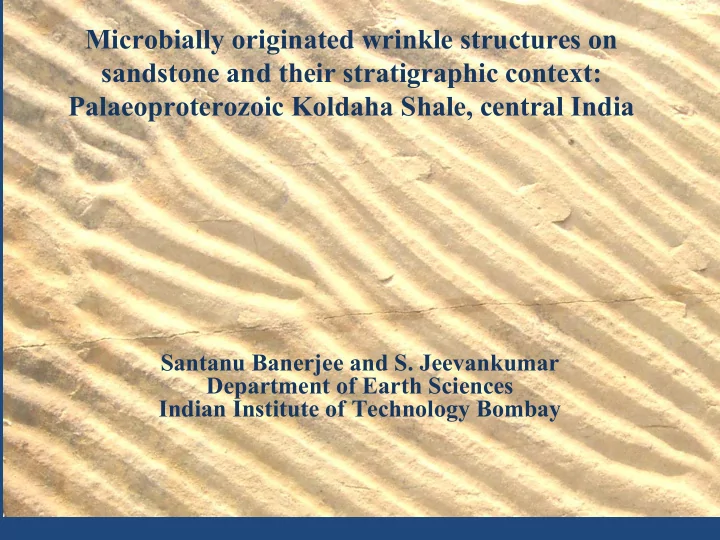
Microbially originated wrinkle structures on sandstone and their - - PowerPoint PPT Presentation

microbially originated wrinkle structures on sandstone
SMART_READER_LITE
LIVE PREVIEW

Microbially originated wrinkle structures on sandstone and their - - PowerPoint PPT Presentation

Microbially originated wrinkle structures on sandstone and their stratigraphic context: Palaeoproterozoic Koldaha Shale, central India Santanu Banerjee and S. Jeevankumar Department of Earth Sciences Indian Institute of Technology Bombay


slide-1
SLIDE 1

Microbially originated wrinkle structures on sandstone and their stratigraphic context: Palaeoproterozoic Koldaha Shale, central India

Santanu Banerjee and S. Jeevankumar Department of Earth Sciences Indian Institute of Technology Bombay

slide-2
SLIDE 2

Evolution of Life on Earth

Precambrian (4500- 540 Ma)

Evolution of life since its formation around 4500 Ma Paleozoic- Skeletal fossils appear Soft bodied metazoans appear before that Mesozoic- age of reptiles Microbes dominate the earlier part of earth’s history First record of microbe preserved in rocks- 3500 Ma Up to 540 Ma microbes were abundant This paper discusses about microbial life on sea floor around 1600 Ma

65 Ma 225 Ma 540 Ma

slide-3
SLIDE 3

Stromatolites- earth’s oldest fossils

Vindhyan, central India 1.7 Ga old

Microbially originated structures in limestones Stromatolites are reported from rocks as old as 3500 Ma, so far > 500 reports, note cyclicity in this example

slide-4
SLIDE 4

Stromatolites from shark bay world heritage site

From www.aussieactionadventures.com

Sedimentologists learn from modern- apply the concept in ancient rocks Hypersaline conditions favour microbial growth and form stromatolites

slide-5
SLIDE 5

Search for microbial mats in modern clastic sediments in hypersaline environments

Coastal areas west of Baroda

slide-6
SLIDE 6

Study area- geological map

  • Map prepared by Geological Survey of India
  • The age of rocks of importance - 1.6 Ga
  • Oldest rocks 1.7 Ga, youngest around 0.6 Ga
slide-7
SLIDE 7

Field investigations

  • Finding proper sections, mostly

we find soil covers

  • Vertical sedimentary sections were

studied in mines

  • Note variation in rock types
  • Document sedimentary features
  • Note the general trend in

lithological variation

  • Interpretation of depositional

environments

  • Interpretation of sea level

fluctuations – rise or fall

  • Collect data for graphical

representation of the section

  • Features on bedding surfaces cannot

be seen

slide-8
SLIDE 8

Search for bedding surface features

  • Search for features occurring on the bedding surfaces (red arrow)
  • Collect samples for laboratory investigations
slide-9
SLIDE 9

Varieties of wrinkle structures- positive relief

slide-10
SLIDE 10

Varieties of wrinkle structures – negative relief

slide-11
SLIDE 11

Optical microscopic investigations

0.1 mm 0.5 mm

Thin (<1 mm), dark cover at the top surface Wavy, crinkly carbonaceous fragments on magnification Suggest microbial growth soon after formation- do not confirm

slide-12
SLIDE 12

Possible microbial filaments under SEM

slide-13
SLIDE 13

Wrinkle varieties in vertical sedimentary succession

Rocks becoming coarser upward Sea level is falling Finer wrinkles forming in the deeper part (50-200 m) of the sea Coarser wrinkles forming in the shallow seas (>10-50 m)

slide-14
SLIDE 14

Conclusions

  • Discusses about microbial mat originated sedimentary

structures in 1.6 Ga-old sandstones

  • Most previous reports of microbial structures are from

limestone

  • Explains origin of wide range of wrinkle structures formed by

microbe-sediment interaction

  • Discusses variation of the wrinkle structures in vertical

sedimentary succession in response to sea level fall Thank you