
SLIDE 1
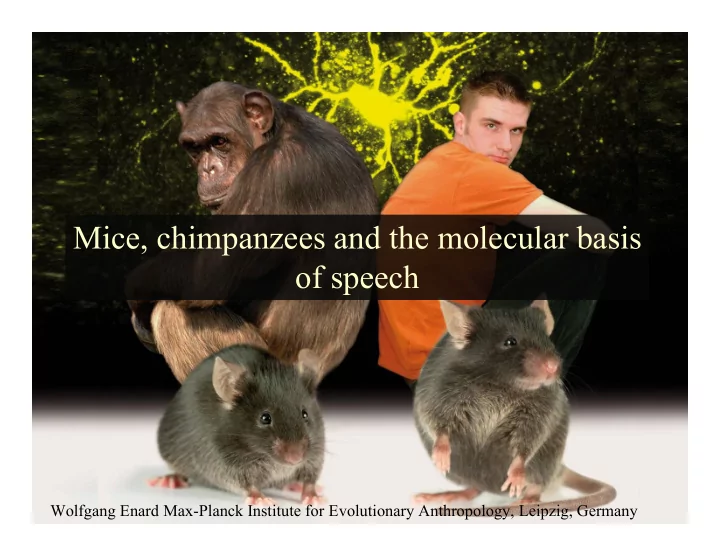
Mice, chimpanzees and the molecular basis
- f speech
Wolfgang Enard Max-Planck Institute for Evolutionary Anthropology, Leipzig, Germany
Mice, chimpanzees and the molecular basis of speech Wolfgang Enard - - PowerPoint PPT Presentation
Mice, chimpanzees and the molecular basis of speech Wolfgang Enard Max-Planck Institute for Evolutionary Anthropology, Leipzig, Germany Who is the closest ? Edward Tyson, Orang-outan, sive Homo sylvestris: or the anatomy of a pygmie compared with
Wolfgang Enard Max-Planck Institute for Evolutionary Anthropology, Leipzig, Germany
Edward Tyson, Orang-outan, sive Homo sylvestris: or the anatomy of a pygmie compared with that of a monkey, an ape and a man, 1699
„it is quite certain that the Ape which most nearly approaches man, in the totality of its organization, is either the Chimpanzee or the Gorilla.“
Thomas Huxley, Evidence as to man's place in nature, 1863
mutation C=>T
mutation C=>T Sequence DNA
Individual 1: AGTTACCATGACTAGACTAGCTGAAGGG Individual 2: AGTTACCATGACTAGACTAGCTGAAGGG Individual 3: AGTTACCATGACTAGACTAGCTGAAGGG GATCCGATCGACTTTTACATTAGCTACGACTACGACTACGAT T GATCCGATCGACTTTTACATTAGCTATGACTACGACTACGAT T GATCCGATCGACTTTTACATTAGCTATGACTACGACTACGAT T GATCGATTATGCTTGTAAACTTACAGCATCGCATACGACTAC A GATCGATTATGCTTGTAAACTTACAGCATCGCATACGACTAC
mutation C=>T
mutation C=>T
mutation C=>T
3.3 3.3 3.3 3.3 1.7 1.7 1.7 1.2 1.2 0.4
Genome-wide average of point substitutions (%)
Data from Burgress et al, 2008; Caswell et al., 2008
Chimpanzee Bonobo Human Gorilla Orang-Utan time
0.6 % 0.85 % 1.7 %
Chimpanzee Bonobo Human Gorilla Orang-Utan time
5-6 mya 7-9 mya 14-18 my
Chimpanzee Bonobo Human Gorilla Orang-Utan
Chimpanzee Bonobo Human Gorilla Orang-Utan
Chimpanzee Bonobo Human Gorilla Orang-Utan
Chimpanzee Bonobo Human Gorilla Orang-Utan
4 mya
Pääbo, 2003
Green et al. Science, 2010
0.15% 600-800 kya
Reference genome French Chinese Mbuti San Neanderthal Chimpanzee
0.3-0.4 mya
~6 million years or ~6 substitutions each 1000 bases
Linguistics Bernard Comrie Developmental Psychology Michael Tomasello Primatology Christophe Boesch Palaeoanthropology Jean-Jacques Hublin Evolutionary Genetics Svante Pääbo
Max-Planck-Institut für evolutionäre Anthropologie, Leipzig
genome
human chimpanzee
phenotype
transcripts
genome
methylation proteins
phenotype
transcripts methylation proteins enviroment enviroment
genome
human chimpanzee
genome
0.1 0.2 0.3 0.4 0.5 0.6
all (13438) perception of smell (41) spermatogenesis (80) immune response (534) neurogenesis (292) mRNA processing (99) Wingless pathway (68)
Ka/Ks
Lymphocyte activation Immune cell activation 0.05 0.1 0.15 0.2 0.25 0.3 0.35 0.4 0.45 0.05 0.1 0.15 0.2 0.25 0.3 0.35 0.4 0.45 Primates ka/ks Rodents ka/ks
Spermatogenesis
Chimpanzee Ka/Ks Human Ka/Ks 0.1 0.2 0.3 0.4 0.1 0.2 0.3 0.4
primate/mammalian gene evolution
Gene A Gene a
human chimpanzee
phenotype A phenotype a
Model organisms Human disease variants
Hurst et al. (1990) Dev Med Child Neurol 32, 352-355
male female affected non-affected
“Aa...y me aar Shuar, ah ist Bedfond. Aa me ah six.“ My name is Stewart and I live in Bedfont. I am six “D’i nam ist Zoe and’ dyl liv how-woh, I…d’i…d’a…d’i…how- woh – six” My name is Zoe and I live in Hounslow and I am six “Ah i mi-tine. I liv in Ea-ling. I am d’ine.” I am Christine I live in Ealing. I am nine “M’nam i Carol. I live in Ea-ling and I am a-leven.” My name is Carol. I live in Ealing and I am eleven.
Transcription provided by Prof. Faraneh Vargha-Khadem
and non-words
abilities
language processing Vargha-Khadem lab
Liegeois et al., Nature Neuroscience, 2003
FOX 1 2 3 4 5 6 7 8 9 10 111213 141516 17 atg tga
exon (200 bp) intron (10,000 bp)
Chromosomal breakpoint, unrel. patient R553H mutation in KE family Lai et al (2001) Nature 413, 519–523 MacDermot et al (2005), Am.J.H.G. 76, 1074
PolyQ
STOP mutation, unrel. family
polyQ FOX polyQ FOX polyQ FOX polyQ FOX
human chimpanzee
phenotype a
language/ speech
phenotype A
No language/ speech
Human FOXP2
Mutations of FOXP2 in the KE family
?
Molly Przeworski, Victor Wiebe, Svante Pääbo
Enard et al., (2002), Molecular evolution of FOXP2, a gene involved in speech and language. Nature 418, 869-872
Affected KE family member polyQ FOX H polyQ FOX R polyQ FOX R polyQ FOX R Normal / unaffected family member
polyQ FOX R polyQ FOX R S D N N E T human mouse
140 – 220 million years
3 substitutions / 715 amino acids
D..N..S E..T..N
D..N..S E..T..N D..T..N 140 – 220 million years
T=>N; N=>S D=>E
A..D..N..S V..D..T..N A..E..T..N A..D..T..N A..D..T..N A..D..T..N 140 – 220 million years
T=>N; N=>S D=>E A=>V
>1000 humans worldwide
T=>N; N=>S
A..D..N..S A..D..N..S
2 Neandertals
Krause et al., 2007
Genomic data Gene function Phenotype data
b) Genetic engeneering in humans and/or chimpanzees to test the variants
a) Crossing and backcrossing to map the trait
a) Crossing and backcrossing to map the trait b) Genetic engeneering in humans and/or chimpanzees to test the variants c) Finding a natural backmutation in humans d) Study the differences between the ancestral and the human state in vitro d) Study the differences between the ancestral and the human state in human cell lines e) Study the differences between the ancestral and the human state in mouse
Enard et al., (2009), Cell, 137, 961-971
FOX 1 2 3 4 5 6 7 8 9 10 111213 141516 17 atg tga PolyQ 2 17
T N
7 8
T N
Knock-in vector
N S
FOX 1 2 3 4 5 6 7 8 9 10 111213 141516 17 atg tga PolyQ
N S
FOX 1 2 3 4 5 6 7 8 9 10 111213 141516 17 atg tga PolyQ
N S
FOX 1 2 3 4 5 6 7 8 9 10 111213 141516 17 atg tga PolyQ
T N
FOX 1 2 3 4 5 6 7 8 9 10 111213 141516 17 atg tga PolyQ
T N
Foxp2hum/hum Foxp2wt/wt
N S
Cross with Cre mice
Foxp2ko ko/ko wt/wt Foxp2hum
FOX 1 2 3 4 5 6 7 8 9 10 111213 141516 17 atg tga PolyQ
T N
FOX 1 2 3 4 5 6 7 8 9 10 111213 141516 17 atg tga PolyQ
T N
Foxp2wt/ko Foxp2wt/wt
FOX 1 2 3 4 5 6 7 8 9 10 111213 141516 17 atg tga PolyQ
T N
FOX 1 2 3 4 5 6 8 9 10 111213 141516 17 atg tga PolyQ
Stop
polyQ FOX
polyQ FOX
polyQ FOX
polyQ FOX
polyQ FOX
polyQ FOX
polyQ FOX
polyQ FOX
polyQ FOX
polyQ FOX
polyQ FOX
polyQ FOX
polyQ FOX
polyQ FOX
polyQ FOX
polyQ FOX
Mice homozygous for humanized Foxp2 (Foxp2hum/hum) Mice homozygous for wildtype Foxp2 (Foxp2wt/wt)
expressed transcription factor
subset of cell types in a given tissue
Lai et al. 2001 Shu et al. 2001
Mouse; Ferland et al, 2003
German Mouse Clinic Consortium; Helmholtz Center; Munich
H e a r t L u n g M e t a b
i s m M
p h
y C l i n i c a l C h e m i s t r y N e u r
y E y e N
i c e p t i
P a t h
y I m m u n
y B e h a v i
Foxp2hum/hum mice are healthy, explore their enviroment more carefully, but show no difference in over 250 cardiovascular, immunological, pathological, morphological or respiratory measurements.
H e a r t L u n g M e t a b
i s m M
p h
y C l i n i c a l C h e m i s t r y N e u r
y E y e N
i c e p t i
P a t h
y I m m u n
y B e h a v i
Foxp2wt/ko mice are healthy, show a variety of subtle differences in lung function, metabolism, blood pressure, hearing and immune function and explore their enviroment slightly more.
German Mouse Clinic Consortium; Helmholtz Center; Munich
Christine Winter and Reinhard Sohr, Charite, Berlin
Frontal cortex Cerebellum Caudate-Putamen Nucleus accumbens Globus pallidus Glutamate Serotonin GABA Dopamine
Christine Winter and Reinhard Sohr, Charite, Berlin
Foxp2hum/hum mice show reduced dopamine levels (p<0.001) Foxp2wt/ko mice show increased dopamine levels (p<0.05)
0% 50% 100% 150% 200% 250% Striatum Cerebellum Globus pallidus Cortex Nucleus accumbens
Foxp2hum/hum Foxp2wt/ko
* ** * * * ** **
dopaminergic neurons
fraction of striatal neurons Foxp2
Vargha-Khadem et al., PNAS, 1998
The caudate nucleus has less grey matter and is
functional copy of FOXP2
Haesler et al., PlOS Biology, 2007
Reduced FoxP2 expression in striatal neurons impairs vocal imitation in birds
biopsies of embryos (E16.5), adolescent (P15- P21) and adult (3 month) mice
not enriched in particular functional categories
Foxp2hum/hum mice and Foxp2wt/ko mice
more branched neurits
Sabine Gehre, Eun und Johannes Schwarz; Neurology; Leipzig *
100 200 300 400 500 all primary secondary tertiary quartery neurite length (m)
Foxp2wt/wt Foxp2hum/hum * *
Foxp2hum/hum Foxp2wt/wt
Sabine Gehre und Johannes Schwarz; Neurology; Leipzig
Foxp2wt/wt Foxp2hum/hum
250 500 750 1000 1250 1500
dendrite length [m] * * Foxp2wt/wt Foxp2hum/hum Foxp2wt/ko
Johannes Schwarz; Neurology; Leipzig
cortico-striatal synapses, i.e. synaptic plasticity, is thought to be important for learning action patterns
From cortex Striatal neuron
Johannes Schwarz; Neurology; Leipzig
From Gerdeman, et al., 2003
From cortex Striatal neuron striatum
Long-term depression is a frequently studied form of synaptic plasticity at cortico- striatal synapses
Johannes Schwarz; Neurology; Leipzig
40 50 60 70 80 90 100 110
5 15 25 time (min) normalised amplitude (%) Foxp2wt/wt
(LTD)
Johannes Schwarz; Neurology; Leipzig
40 50 60 70 80 90 100 110
5 15 25 time (min) normalised amplitude (%) Foxp2wt/wt Foxp2hum/hum
* ** ** * * * * * * * * *
Groszer et al., 2008
allele show weaker long term depression
Sabrina Reimers, MPI-EVA
Layer VI bipol Striatum Thalamus Layer VI Pyr Purkinje cells Layer II/III Pyr Amygdala Piriform Pyr Layer VI LCN Layer VI iPyr Golgi Foxp2
0% 25% 50% 75% 100% 125% 150% 175%
* ** *
wt/wt hum/hum
ANOVA: Foxp2expression*genotype: p<0.05
Reimers et al, in preperation
Sabrina Reimers, MPI-EVA
Golgi circuit Layer VI bipol Striatum Thalamus Layer VI Pyr Purkinje cells Amygdala
0% 25% 50% 75% 100% 125% 150% 175%
ANOVA: circuit*genotype: p<0.01 no no yes yes yes yes
wt/wt hum/hum
Wulf Hevers, MPI-EVA
40% 60% 80% 100%
5 25 45
Normalised amplitude (%) Time (min) wt/wt hum/hum
Increased LTD in striatum is confirmed (time*genotype, p<0.05)
Wulf Hevers, MPI-EVA
1 1.5 2 2.5 3 0.1 0.2 0.3
Paired pulse ratio Time (sec)
40% 60% 80% 100%
5 25 45
Normalised amplitude (%) Time (min)
Synaptic plasticity in Purkinje cells is unchanged (time*genotype, p>0.5)
striatal circuits
reduced size and a different activction of the striatum (Vargha-Khadem et al., 2005)
imitation in birds (Haeseler et al., 2007)
Kurt Hammerschmidt, Julia Fischer, Primatenzentrum, Göttingen
50 100 75 kHz msec start PF
trend mean PF
Kurt Hammerschmidt, Julia Fischer, Primatenzentrum, Göttingen
Foxp2hum/hum mice show subtle differences in the structure of ultrasonic isolation calls.
50 100 75 kHz msec start PF
trend mean PF s l
e
t r e n d Foxp2wt/wt Foxp2hum/hum kHz
70 75 80
kHz
m e a n P F m a x . P F s t a r t P F
*** ** ** ***
changes that occurred on the human and other primate/mammalian lineages
– statistical methods to identify genes/group of genes/genomic elements where changes on particular lineages are different from expectations
information
– phenotypic changes on such lineages – functional information about genes – experimental systems such as the mouse to investigate resulting hypotheses
genotype-phenotype hypotheses
functions
precisely
Philipp Khaitovich, Michael Lachmann, Svante Pääbo
Khaitovich et al. Genome Research, 2004 Khaitovich et al. Nature Review Genetics, 2006 Enard et al., Science 2002 Khaitovich et al. , Science 2005
0% 5% 10% 15% 20% 25% 30% 35% Brain Heart Kidney Liver Testis
differently expressed genes false positives
Khaitovich et al. Science, 2005
Khaitovich et al. Nature Review Genetics, 2006 Khaitovich et al. , Science 2005
B r
a ’ s a r e a P r e f r
t a l C t x A n t . C i n g u l a t e C t x C a u d a t e n u c l e u s C e r e b e l l u m Khaitovich et al. Genome Research, 2004
Enard et al., Science 2002
Sabrina Reimers, MPI-EVA
* Cerebellum Thalamus Striatum Amygdala Piriform cortex M1 layer II/III M1 layer VI Neuronal marker Foxp2 merged
Sabrina Reimers, MPI-EVA
* * * *
0.25 0.5 0.75 1
Foxp2wt/wt Foxp2hum/hum Cerebellum Thalamus Striatum Amygdala Piriform cortex M1 layer II/III M1 layer VI Neuronal marker Foxp2 merged