MET METHOD HODOL OLOGY GY a st a standardized andardized 6-st - - PowerPoint PPT Presentation

met method hodol ology gy
SMART_READER_LITE
LIVE PREVIEW

MET METHOD HODOL OLOGY GY a st a standardized andardized 6-st - - PowerPoint PPT Presentation

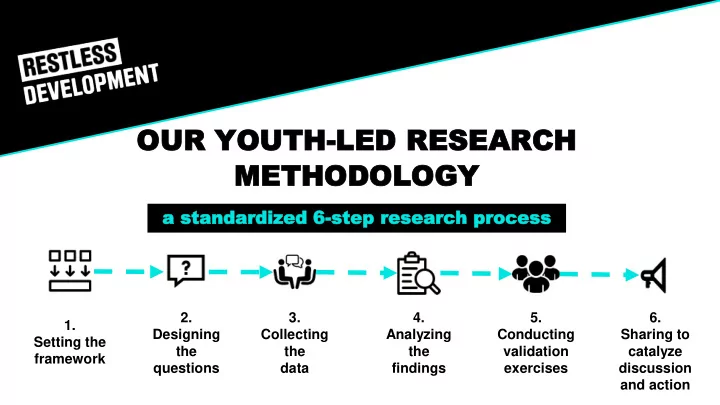
OUR OUR YOUTH YOUTH-LED LED RES RESEAR EARCH CH MET METHOD HODOL OLOGY GY a st a standardized andardized 6-st step res ep research earch proces process 2. 3. 4. 5. 6. 1. Designing Collecting Analyzing Conducting Sharing


slide-1
SLIDE 1

OUR OUR YOUTH YOUTH-LED LED RES RESEAR EARCH CH MET METHOD HODOL OLOGY GY

a st a standardized andardized 6-st step res ep research earch proces process

1. Setting the framework 2. Designing the questions 3. Collecting the data 4. Analyzing the findings 5. Conducting validation exercises 6. Sharing to catalyze discussion and action

slide-2
SLIDE 2

WHY WHY YOU YOUTH TH-LE LED D RESEARCH? RESEARCH?

gap in understanding when young people are not meaningfully engaged most academic and professional research:

slide-3
SLIDE 3

Instead, our methodology: peer-to-peer young people are uniquely able to capture the perspectives and lived experiences

  • f young people like themselves

WHY WHY YOU YOUTH TH-LE LED D RESEARCH? RESEARCH?

slide-4
SLIDE 4

WHAT WHAT MAKES MAKES YOU YOUTH TH-LE LED D RE RESE SEAR ARCH CH DIFF DIFFERE ERENT? NT?

each step has a clearly defined role for staff young researchers specifically designed to help young people lead each step of the process

slide-5
SLIDE 5

WHY WHY NOT NOT “DISEMMINATION”?

?

unclear result Implies a unidirectional presentation of information, where we speak and others

  • listen. We often do not know

what listeners do with our findings.

slide-6
SLIDE 6

INSTEAD, INSTEAD, SHAR SHARING ING FOR FOR DISCUS DISCUSSION SION AND AND ACT ACTION ION

!

co-generated, actionable solution We create space for the exchange of ideas and facilitate discussion to a practical application of findings, leveraging the expertise of all present.

slide-7
SLIDE 7

BLUE BLUEPRINT PRINTS S FOR B FOR BUILDING UILDING AGRITECH INCUBATION AGRITECH INCUBATION HUBS HUBS

slide-8
SLIDE 8

WHO WHO ARE ARE WE? WE?

We are YOUNG RESEARCHERS with the Youth Think Tank!

slide-9
SLIDE 9

WHAT WHAT IS THE IS THE YOUTH YOUTH THINK THINK TANK TANK?

A 7-country Youth-Led Research Initiative, where young people conduct research on the livelihoods issues that matter to them: To inform sector stakeholders on key issues To influence how decision-makers respond to these issues

👥👧

More info on the Youth Think Tank at https://mastercardfdn.org/the-youth-think-tank/

slide-10
SLIDE 10

the barriers and opportunities young people in sub-Saharan Africa face with:

10

Report Link: bit.ly/agritechreport2018

WHAT WHAT DID DID WE WE INVESTI INVESTIGATE? GATE?

Agr Agricultu icultura ral l Tec Techn hnolog

  • logies

ies

innovators promoters adopters designing using sharing

slide-11
SLIDE 11

Key Key Findings Findings

But today, we will focus on unpacking 1 specific finding.

5

slide-12
SLIDE 12

To To design design solutions, solutions, innov innovators ators require require sp space aces s ded dedicated icated to to the the sharing sharing of

  • f inf

informat

  • rmation,

ion, kno knowledg wledge e and and exp experti ertise se.

12

OUR F OUR FOCUS: OCUS:

slide-13
SLIDE 13

Currently There are some existing spaces that foster innovation, but these spaces are not sufficient and not inclusive, in part because they are not accessible to most young people.

We found out:

However To ensure that technologies are needs responsive, innovators should broaden their co-design process to include the very people that their solutions hope to assist.

13

slide-14
SLIDE 14

14 14

relevant information resources,

  • nline (offline)

technical expertise context knowledge space to collaborate tools for prototyping HUBS

co-create comprehensive solutions

In order to ideate, young people need access to:

slide-15
SLIDE 15

15 15

spreading awareness of existing spaces investing in building new, diverse spaces broadening access, inclusive

  • f end-users

HUBS

current gaps:

linking hubs to promote cross-learning

? ? ? ?

slide-16
SLIDE 16

16 16

efficient resource mobilization end-user buy-in needs-responsive solutions HUBS

possibilities:

collaborative problem-solving

! ! ! !

slide-17
SLIDE 17

Big Impact

For Youth in Africa

Socially and Economically

17

Potential for

slide-18
SLIDE 18

WHO? WHO? Lead? Resource and Finance? Manage? Maintain? WHERE? WHERE? Online/Offline? Accessible? Inclusive? HOW? HOW? To Involve End- Users? To Ensure Effective Use? Render Sustainable? Link?

18

KEY QUESTIONS

slide-19
SLIDE 19

LET’S DISCUSS!

We will now dive into what’s next— how we respond to this finding—in

  • ur Round Tables!