Message: Criticality of Software Qualities (SQs) Boehm SAM 2015: - - PowerPoint PPT Presentation

message criticality of software qualities sqs
SMART_READER_LITE
LIVE PREVIEW

Message: Criticality of Software Qualities (SQs) Boehm SAM 2015: - - PowerPoint PPT Presentation

Message: Criticality of Software Qualities (SQs) Boehm SAM 2015: Major source of system overruns SQs have systemwide impact System elements generally just have local impact SQs often exhibit asymptotic behavior Watch out for the


slide-1
SLIDE 1

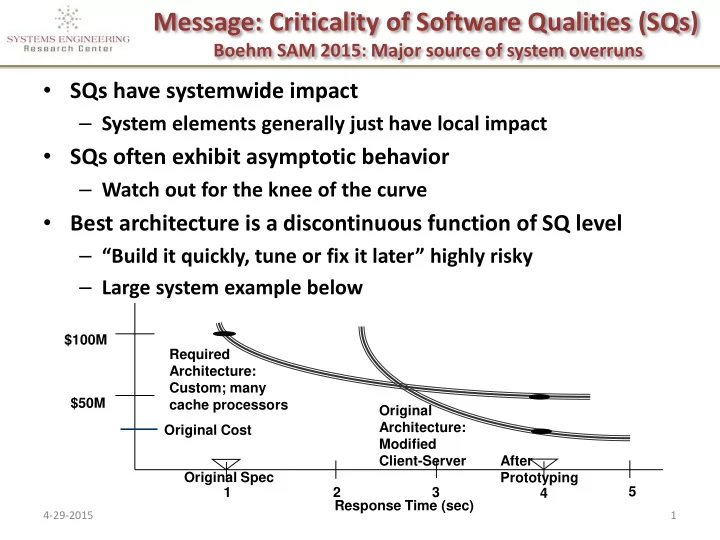
Message: Criticality of Software Qualities (SQs)

Boehm SAM 2015: Major source of system overruns

  • SQs have systemwide impact

– System elements generally just have local impact

  • SQs often exhibit asymptotic behavior

– Watch out for the knee of the curve

  • Best architecture is a discontinuous function of SQ level

– “Build it quickly, tune or fix it later” highly risky – Large system example below

4-29-2015

$100M $50M Required Architecture: Custom; many cache processors Original Architecture: Modified Client-Server 1 2 3 4 5 Response Time (sec) Original Spec After Prototyping Original Cost

1

slide-2
SLIDE 2

Issue: Need for SQs Ontology

  • Oversimplified one-size-fits all definitions

– ISO/IEC 25010, Reliability: the degree to which a system , product, or component performs specified functions under specified conditions for a specified period of time – OK if specifications are precise, but increasingly “specified conditions” are informal, sunny-day user stories.

  • Satisfying just these will pass “ISO/IEC Reliability,” even if system

fails on rainy-day user stories

– Need to reflect that different stakeholders rely on different capabilities (functions, performance, flexibility, etc.) at different times and in different environments

  • Proliferation of definitions, as with Resilience
  • Weak understanding of inter-SQ relationships

– Reliability Synergies and Conflicts with other qualities

4-29-2015 2

slide-3
SLIDE 3

Question: SQ Ontology KnowledgeBase

  • Modified version of IDEF5 ontology framework

– Classes, Subclasses, and Individuals – Referents, States, Processes, and Relations

  • Top classes cover stakeholder value propositions

– Mission Effectiveness, Resource Utilization, Dependability, Flexibiity

  • Subclasses identify means for achieving higher-class ends

– Means-ends one-to-many for top classes – Ideally mutually exclusive and exhaustive, but some exceptions – Many-to-many for lower-level subclasses

  • Referents, States, Processes, Relations cover SQ variation
  • Referents: Sources of variation by context: Product Q.; Q. In Use
  • States: Internal (beta-test); External (rural, temperate, sunny)
  • Processes: Operational scenarios (normal vs. crisis; experts vs. novices)
  • Relations: Impact of other SQs (synergies & conflicts)

4-29-2015 3

slide-4
SLIDE 4

4-29-2015 4

slide-5
SLIDE 5

Software Ownership Cost vs. Reliability

0.8 Very Low Low Nominal High Very High 0.9 1.0 1.1 1.2 1.3 1.4

1.10 0.92 1.26 0.82

Relative Cost to Develop, Maintain, Own and Operate COCOMO II RELY Rating

1.23 1.10 0.99 1.07 1.11 1.05 70% Maint. 1.07 1.20 0.76 0.69 VL = 2.55 L = 1.52

Operational-defect cost at Nominal dependability = Software life cycle cost Operational - defect cost = 0

MTBF (hours) 1 10 300 10,000 300,000

4-29-2015 5