
SLIDE 1
Merrilong Pastoral Company Sustainability in Agriculture
David Brownhill
Grain farmer NSW Australia
Or for todays
purposes – The More on Farmer or Moron!!!
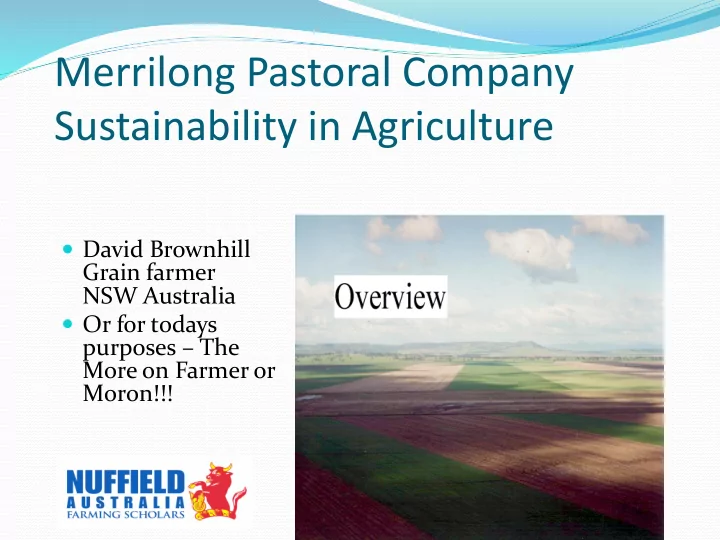
Merrilong Pastoral Company Sustainability in Agriculture David - - PowerPoint PPT Presentation
Merrilong Pastoral Company Sustainability in Agriculture David Brownhill Grain farmer NSW Australia Or for todays purposes The More on Farmer or Moron!!! Intoduction Merrilong Pastoral Company 6477 hectares ( 16 000 acres)
David Brownhill
Grain farmer NSW Australia
Or for todays
purposes – The More on Farmer or Moron!!!
Merrilong Pastoral Company 6477 hectares ( 16 000 acres) on the Liverpool Plains Fertile clay based soil The business is operated with my brother and his
Merrilong Pastoral Company aims to be profitable
Purchased first farm in 1959 Originally sheep, fat lambs and cattle Cropping began in earnest in the late 60’s Summer cropping began in 1970’s No tillage first adopted in 1980’s Full no till system mid 1990’s Controlled traffic farming system 2003 Guidance etc etc!!
Issues in the Farming System
Erosion Hard to kill weeds Glyphosate resistant weeds Reliance on herbicides Crop disease Heavy residue to plant into High input farming system - nutrition
Staff management Weather and Rain – or usually lack of it Business planning Finding the next opportunity Growing the business Planning for the next generation Volatility and Risk
Crops grown include bread wheat, durum wheat,
3800 hectares of dryland farming land 1410 hectares of pivot and flood irrigation 1400 hectares grazing land Grain Storage capacity of 13000 tonnes on farm Yields range from 0 to 10 tonnes per ha
The Fundamentals of the business
Soil Health Moisture Stubble retention, erosion minimisation People and Family Profit and Passion Enjoying what we do
The world is a hungry place Australia is export orientated We only have 22 million people We have limited moisture, fragile soils and markets
Our goal is to minimise risks, control what we can
Controlled traffic – minimising compaction
Tramlines for controlled traffic Centre row
All crops are planted inter row – barley into sorghum stubble
Summer crop planting
Sorghum – yields have increased
Selective Spraying in action
50% 55% 60% 65% 70% 75% 80% 85% 90% 95% 100% 1996 1997 1998 1999 2000 2001 2002 2003 2004 2005 2006 2007 2008 2009
Equity Range
Equity % Target Range - High Target Range - Low
Returns Expenditure and costs Scale Plant and equipment Land Use If you can’t measure it, you can’t manage it
0% 5% 10% 15% 20% 25%
Operating Return on Assets
Farms Top 20% Average Bottom 20%
Your Farm
Liverpool Plains - ROAM% Variance over five years
0.00% 5.00% 10.00% 15.00% 20.00% 25.00% 11 15 17 1 19 13 4 3 14 ROAM%
0% 5% 10% 15% 20% 25% 1000 2000 3000 4000 5000 6000 Operating Return on Assets Managed (%) Area Managed (ha)
Scale and Profitability
0.0 1.0 2.0 3.0 4.0 5.0 6.0 50 100 150 200 250 300 350 400 450 Top 20% Average Bottom 20% Plant Cost / area cropped ($/ha) Farm Income:Plant Value
Plant Ratios
Plant Cost Plant Ratio
0% 20% 40% 60% 80% 100% Top 20% Average Bottom 20% %
Land Use
Pasture Crop Fallow
Reviewing rotations
If substituting Cotton for Sorghum An additional 1500 Hectares Cotton over Sorghum $ 435 000 Sorghum Net Income 1500 Hectares Sorghum $ 2 701 500
But cotton comes with risk 2012 – I can give you just under one million reasons
Crop disease can strike at any time But What is the black swan of sorghum production??
Merrilong 1959
Merrilong, Noongah, Gowrie, Keralla Downs , Dimby Plains, Mooki Springs, Inveraray Downs -2013