Mercury Bioaccumulation within Terrestrial Foodwebs in the - - PowerPoint PPT Presentation

mercury bioaccumulation within terrestrial foodwebs in
SMART_READER_LITE
LIVE PREVIEW

Mercury Bioaccumulation within Terrestrial Foodwebs in the - - PowerPoint PPT Presentation

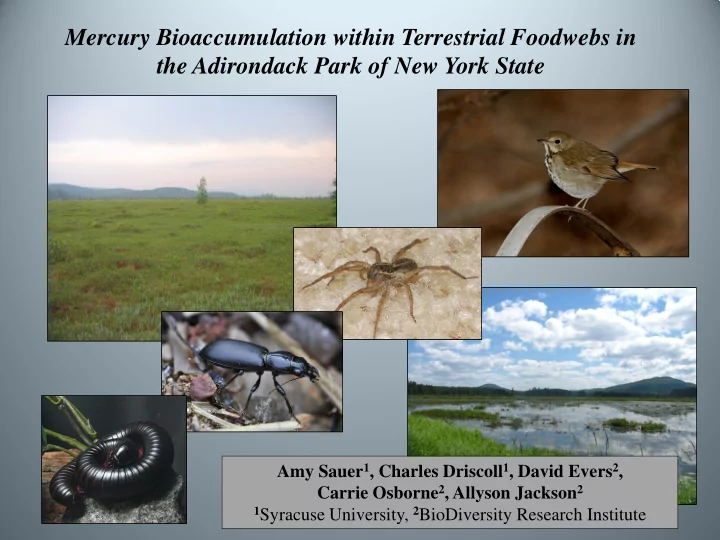
Mercury Bioaccumulation within Terrestrial Foodwebs in the Adirondack Park of New York State Amy Sauer 1 , Charles Driscoll 1 , David Evers 2 , Carrie Osborne 2 , Allyson Jackson 2 1 Syracuse University, 2 BioDiversity Research Institute


slide-1
SLIDE 1

Mercury Bioaccumulation within Terrestrial Foodwebs in the Adirondack Park of New York State

Amy Sauer1, Charles Driscoll1, David Evers2, Carrie Osborne2, Allyson Jackson2

1Syracuse University, 2BioDiversity Research Institute
slide-2
SLIDE 2

Appalachian Mountain Mercury Network

Partnering agencies and organizations to gain a better understanding of atmospheric deposition and impacts

  • f pollution on forested ecosystems using thrushes and
  • ther songbirds as indicators

All Photos by Permission or http://common-wikimedia.org

slide-3
SLIDE 3

Detrimental impacts have been documented in studies relating to amphibian and songbird communities in the Northeastern United States. (Bank et al. 2005, 2006, 2007, Evers et al. 2005, Rimmer et al. 2005)

Wildlife Studies

slide-4
SLIDE 4

Seasonally, songbirds are able to reduce the concentrations of mercury in their bodies through feather growth and egg deposition With continued ingestion

  • f prey species high in

mercury content, individuals may accumulate mercury faster than they can rid their bodies of it through natural processes

Pathways for Bioaccumulation

slide-5
SLIDE 5

Red-eyed Vireo Lincoln’s Sparrow Hermit Thrush Palm Warbler

Insectivores are widespread across the landscape ~ necessary to understand the role that these species may represent in regards to the health of the surrounding environment

Indicator Species for Terrestrial Ecosystems

slide-6
SLIDE 6

Indicator Species for Terrestrial Ecosystems

  • Regional efforts

conducted by BioDiversity Research Institute to assess the impacts of Hg on songbird species across 5 terrestrial ecosystems

  • Each system has an

indicator species that best represents the mercury risk in that particular habitat ~ identify at-risk species and sensitive habitats

Source: Hidden Risks, BRI 2011

slide-7
SLIDE 7

Indicator Species for Terrestrial Ecosystems

Source: Hidden Risks, BRI 2011

30% Reduction in nesting success 10% 20%

slide-8
SLIDE 8

Methylmercury Bioaccumulation within Montane, Terrestrial Foodwebs

  • Mercury deposition 2-5x

higher in high-elevation, boreal forests as compared to surrounding low-elevation, hardwood forests ~Miller et al. 2005

  • Do mercury concentrations in songbirds and invertebrate, prey species change

with respect to elevation, aspect and seasonal variation in high-elevation, terrestrial foodwebs on Whiteface Mountain?

slide-9
SLIDE 9

Methylmercury Bioaccumulation within Montane, Terrestrial Foodwebs

STUDY SITES 2009-2010 13 Study Sites Between 450 m – 1400 m

slide-10
SLIDE 10

Hermit Thrush LOW ~ HARDWOOD ~ 450 meters Beech/Birch/Maple Swainson’s Thrush MID ~ CONIFEROUS ~ 800 meters Balsam Fir/Red Spruce/Paper Birch Bicknell’s Thrush HIGH ~ ALPINE ZONE ~ 1300 meters

Thrush Family Invertebrates BIOTIC SAMPLES Early Summer (early -June) Mid Summer (early-July) Late Summer (early-August)

STUDY DESIGN

TEMPORAL PATTERNS ASPECT East vs. West

slide-11
SLIDE 11

Swainson’s Thrush (0.085 ppm) Hermit Thrush (0.063 ppm) Swainson’s Thrush (0.081 ppm) Swainson’s Thrush (0.120 ppm) Within-site Blood Hg Levels

Elevation Patterns – Mercury Exposure in Thrush Species Whiteface Mountain: 2009 - 2010

Hardwood – Low Elevation (0.068 ppm) Coniferous/ Alpine – High Elevation (0.089 ppm)

Bicknell’s Thrush (0.088 ppm) Bicknell’s Thrush (0.094 ppm)

Coniferous – Mid Elevation ( 0.109 ppm)

Sharp-Shinned Hawk 2009 - 1.723 ppm 2010 – 1.121 ppm Red-Tailed Hawk (Captive) 2011 - 0.041 ppm

Hermit Thrush (0.107 ppm)

slide-12
SLIDE 12

Aspect Patterns- Mercury Exposure in Boreal Songbird Species: Mercury concentrations were higher for all species sampled on the West side of Whiteface mountain, with the exception of Red-eyed Vireo, Bicknell’s Thrush and White-throated Sparrow.

0.02 0.04 0.06 0.08 0.1 0.12 0.14 0.16 0.18 0.2 White-throated Sparrow (n=24, 7) Slate-colored Junco (n=18, 17) Ovenbird (n=23, 11) Blackpoll Warbler (n=1, 2) Hermit Thrush (n=21, 10) Bicknell's Thrush (n=16, 7) Swainson's Thrush (n=19, 23) Red-eyed Vireo (n=11, 11) Blue-headed Vireo (n=1, 1)

Mean Blood Mercury (ppm, ww) Species

Blood Mercury Values (ppm) for Songbird Species on East and West Side of Whiteface Mountain: 2009-2010

East West

slide-13
SLIDE 13

Seasonal Patterns - Mercury Exposure in Boreal, Forest Species: Bicknell’s and Hermit Thrush show a decrease in Hg concentrations during the field season, while Swainson’s Thrush shows a slight increase.

y = -0.0003x + 0.1426 R² = 0.0147 y = -8E-05x + 0.0784 R² = 0.0029 y = 0.0003x + 0.0351 R² = 0.0079

0.05 0.1 0.15 0.2 0.25 150 160 170 180 190 200 210

Mean Blood Mercury (ppm, ww) Julian Day

Blood Mercury Values (ppm) for Boreal Songbird Species on Whiteface Mountain: 2009- 2010.

Bicknell's Thrush Hermit Thrush Swainson's Thrush

slide-14
SLIDE 14

Methylmercury Bioaccumulation within Sphagnum Bog and Northern Hardwood Forest Foodwebs

  • How does mercury bioaccumulate from the base of the terrestrial food chain to

top predator, songbird species?

  • Do mercury concentrations in biota vary between Sphagnum bog and adjacent,

northern hardwood forests due to differences in mercury cycling?

  • Are there detectable seasonal and species-specific patterns within and between

study sites?

slide-15
SLIDE 15

Methylmercury Bioaccumulation within Sphagnum Bog and Northern Hardwood Forest Foodwebs

Species Comparisons Bog Birds: Palm Warbler, Lincoln’s Sparrow, Nashville Warbler Forest Birds: Ovenbird, Hermit Thrush, and Red-eyed Vireo Study Sites – 2008, 2009, 2011 Spring Pond Bog Massawepie Mire Bloomingdale Bog Madawaska Flow Spatial Sampling Sphagnum Bog vs Hardwood Forest Temporal Pattern Early Season - Late May Mid Season – Late June Late season – Late July

slide-16
SLIDE 16

Breeding Songbirds: 2008-2009. Palm warblers and Red-eyed vireos had the highest Hg concentrations compared to other species. These species may be at higher risk to the impacts of Hg contamination than other associated bog and forest species.

0.2 0.4 0.6 0.8 1 1.2 1.4 1.6 1.8 2

Mean Blood Mercury (ppm, ww)

Blood Mercury Values (ppm) for Songbird Species at Bloomingdale Bog, Madawaska Flow, Massawepie Mire and Spring Pond Bog: 2008-2009

Mean Blood Mercury (ppm) Maximum Species Level Detected

LOAELs associated with 10% (0.69 ppm), 20% (1.23 ppm), 30% (1.70 ppm) reduced nesting success were determined by Jackson et al. (2010).

slide-17
SLIDE 17

Mercury Exposure by Habitat Type: 2008-2010. At all sites, Bog species were elevated over adjacent, forest species. Hardwood forests adjacent to bog habitats have forest songbirds with higher mercury levels than those documented in the Whiteface study.

0.1 0.2 0.3 0.4 0.5 0.6 0.7 0.8 0.9 1

Bloomingdale Bog (n=22, 17) Madawaska Flow (n=20, 24) Massawepie Mire (n=22, 12) Spring Pond Bog (n= 16, 20) Whiteface Mountain (n=88) Mean Blood Mercury (ppm, ww) Site

Blood Mercury Values (ppm) for Sphagnum Bog and Forest Songbird Species at Bloomingdale Bog, Madawaska Flow, Massawepie Mire, Spring Pond Bog (2008-2009) and Whiteface Mountain (2009-2010).

Forest Bog

slide-18
SLIDE 18

Seasonal Patterns - Mercury Exposure in Sphagnum Bog Species: Lincoln’s Sparrow show a decrease in Hg concentrations during the field season, while Nashville and Palm Warbler show slight increases.

y = -0.0042x + 1.0075 R² = 0.2062 y = 0.0012x - 0.1263 R² = 0.0936 y = 0.0061x - 0.4651 R² = 0.1115

0.2 0.4 0.6 0.8 1 1.2 1.4 1.6 1.8 2 140 150 160 170 180 190 200 210 220

Mean Blood Mercury (ppm) Julian Day

Blood Mercury Values (ppm) for Sphagnum Bog Songbird Species at Bloomingdale Bog, Massawepie Mire, Madawaska Flow and Spring Pond Bog: 2008 - 2009

Lincoln's Sparrow Nashville Warbler Yellow Palm Warbler

slide-19
SLIDE 19

Seasonal Patterns - Mercury Exposure in Forest Species: All species show decreases in mercury concentrations during the field season, which may be linked to seasonal dietary shifts and mercury concentrations in selected prey species.

y = -0.0018x + 0.4688 R² = 0.2024 y = -0.0008x + 0.2269 R² = 0.5711 y = -0.0041x + 1.0855 R² = 0.143

0.2 0.4 0.6 0.8 1 1.2 1.4 140 150 160 170 180 190 200 210 220

Blood Total Hg (ppm) Julian Day

Blood Mercury Values (ppm) for Forest Songbird Species at Bloomingdale Bog, Massawepie Mire, Madawaska Flow and Spring Pond Bog: 2008 - 2009

Hermit Thrush Ovenbird Red-eyed Vireo

slide-20
SLIDE 20
  • Montane ~ High elevation songbirds had elevated

Hg levels as compared to low-elevation songbirds

  • Habitat Type ~ Bog-obligate songbirds had

higher Hg levels than nearby forested species. Reinforced by BRI efforts relating high Hg levels to bog habitats

  • Species Patterns ~All bog and forest sites

identified certain species with higher Hg exposure – Yellow Palm Warbler and Red-eyed Vireo

  • Sphagnum Bog Influence ~ Elevated Hg levels in

forest songbirds suggest that Sphagnum bog systems are driving high Hg levels in biota within the immediate and surrounding environment

  • Further research needed to better characterize the

dynamics of mercury cycling through sensitive, terrestrial foodwebs

CONCLUSIONS

slide-21
SLIDE 21

Acknowledgements

Research Committee:

  • Charles Driscoll
  • David Evers
  • Mark Ritchie
  • Al Uy

Funding & In-Kind Support:

  • New York State Energy Research and

Development Authority

  • BioDiversity Research Institute
  • Northeastern Ecosystem Research

Cooperative

slide-22
SLIDE 22

Environmental Engineering Lab Members: Mario Montesdeoca Ed Mason Brad Blackwell Jason Townsend Biology Lab Members: Megan McSherry Andrew Siefert Geofrey Soka Field Assistance: Melissa Duron Julia Braunmueller Chelsea Baldino Grace Conklin Sara Nason Kendra Nash

Acknowledgements

slide-23
SLIDE 23