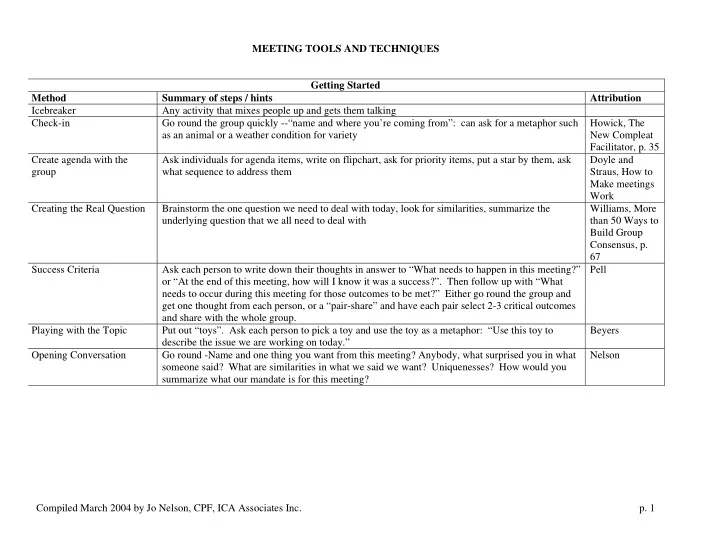
SLIDE 1 MEETING TOOLS AND TECHNIQUES Compiled March 2004 by Jo Nelson, CPF, ICA Associates Inc. p. 1 Getting Started Method Summary of steps / hints Attribution Icebreaker Any activity that mixes people up and gets them talking Check-in Go round the group quickly --“name and where you’re coming from”: can ask for a metaphor such as an animal or a weather condition for variety Howick, The New Compleat Facilitator, p. 35 Create agenda with the group Ask individuals for agenda items, write on flipchart, ask for priority items, put a star by them, ask what sequence to address them Doyle and Straus, How to Make meetings Work Creating the Real Question Brainstorm the one question we need to deal with today, look for similarities, summarize the underlying question that we all need to deal with Williams, More than 50 Ways to Build Group Consensus, p. 67 Success Criteria Ask each person to write down their thoughts in answer to “What needs to happen in this meeting?”
- r “At the end of this meeting, how will I know it was a success?”. Then follow up with “What
needs to occur during this meeting for those outcomes to be met?” Either go round the group and get one thought from each person, or a “pair-share” and have each pair select 2-3 critical outcomes and share with the whole group. Pell Playing with the Topic Put out “toys”. Ask each person to pick a toy and use the toy as a metaphor: “Use this toy to describe the issue we are working on today.” Beyers Opening Conversation Go round -Name and one thing you want from this meeting? Anybody, what surprised you in what someone said? What are similarities in what we said we want? Uniquenesses? How would you summarize what our mandate is for this meeting? Nelson
SLIDE 2 MEETING TOOLS AND TECHNIQUES Compiled March 2004 by Jo Nelson, CPF, ICA Associates Inc. p. 2 Sharing Information Method Summary of steps / hints Attribution Brainstorming Ask open-ended question, give time to brainstorm answers individually, then in group (may share ideas in pairs or threes as a middle step). Write answers on flipchart, or have small groups write them on cards or stickies Doyle and Straus, p.231 Williams p. 209 Make a presentation Present ideas logically, use visuals to illustrate when possible. Summarize with overheads, but do not spell out presentation verbatim Doyle and Straus,
Reports Suggest structure and time limit in advance: encourage use of visuals Kaner, Facilitator’s Guide to Participatory Decision-Making,
Knowledge gathering Start with what is known (data and experiences). Think together about what else needs to be known and why. Wilson, The Facilitative Way,
Journey Wall or Historical Scan On large wall timeline, brainstorm and put up events/accomplishments from the past in time blocks, reflect to process high and low points, turning points, “chapter” titles, name the whole. Reflect to extract learnings, trends Williams, p. 45 Round-robin on facts Go around the group quickly, each person naming one fact they’ve observed about the situation Nelson Individual writing Detailed instructions, say whether it will be shared with group, time limit. Give 1-minute warning for time up, then share what willing to share, discuss as a group Kaner, p. 77 Structured go-around Ask a specific open-ended question, suggest time limit, have each person answer the question in turn without interruption Kaner, p. 79 Sharing Visions Post questions that evoke visions of final outcomes. Individuals write down their own responses, then share with partners. They repeat the process with new partners several times, incorporating any good ideas they hear. Finish with a discussion to pull the ideas together Bens, Facilitating with Ease, p.150
SLIDE 3 MEETING TOOLS AND TECHNIQUES Compiled March 2004 by Jo Nelson, CPF, ICA Associates Inc. p. 3 Processing and Thinking Through Method Summary of steps Attribution Open discussion Open the topic, let the group talk. Facilitator often recognizes each person as they signal their readiness to speak. Intervene when necessary to keep things moving, ensure focus, keep ground rules observed. Doyle and Straus Circle Discussion (also known as Go around, Round Robin, Talking Stick) Introduce question or topic. Go around the group, soliciting ideas from each person in turn. Can go around the group several times. Classic Debate Pose a provocative question with two sides, first position is declared and explained, then the second position is declared and explained. Then each position gives a rebuttal to the other position. Vote. Robert’s Rules of Order A formal resolution or motion is proposed. Open discussion or debate. Vote to adopt or reject, either as proposed or with amendments. Focused Conversation Method Set a context, ask open-ended questions that draw out, in sequence, objective data, reflective responses and reactions, interpretations, and decisions. Stanfield, The Art of Focused Conversation Sequential Questioning Analyse the topic and create a list of probing questions working from macro to micro issues. Ask questions one at a time, recording answers. May have challenging statements, ask participants to agree or disagree, then explain their response, one at a time. Bens, p. 151 Questioning Process Ask 3 types of questions in order: “What” or observation questions, “So What” or meaning questions, “Now What” or application questions. Strachan, Questions that Work Analyzing Begin with questions of clarification. Ask people to share strengths they see and explore why they are strengths. Repeat for weaknesses and concerns Wilson, p. 167 Gap Analysis Identify the future state, then the present state and post on the wall. Brainstorm the “gaps” and post between the “present” and the “future”. Have small groups problem-solve how to deal with the
- gaps. Share in large group
Bens, p. 157 V-R-C Process Brainstorm (write on charts) Vision: What needs to happen; Reality: What has to change; then looking at both of these, Critical Choice: What strategic actions can we take? Wilson p. 133 Consensus Workshop Method Ask a focus question, each person brainstorms answers, write answers on cards or flipchart, cluster ideas to answer the focus question, name results, reflect and resolve Stanfield, The Workshop Book Problem-solving, Systematic Problem-Solving Identify problem, establish criteria for evaluating solutions, identify root causes, generate alternative solutions, evaluate and select a solution, develop an action plan, implement and evaluate Schwartz, The Skilled Facilitator, p. 159;
SLIDE 4 MEETING TOOLS AND TECHNIQUES Compiled March 2004 by Jo Nelson, CPF, ICA Associates Inc. p. 4 Processing and Thinking Through Method Summary of steps Attribution Bens, 168 Cause and Effect Charting Clarify differences between “cause” and “effect”. Brainstorm causes and effects in two separate
- columns. Probe each item in the “effect” column to determine what causes it. Continue until all
causes are identified. Bens, p. 159 Fishbone Diagram Draw a “fishbone” on chart paper. Write the observed effect on the “head” of the fishbone. Determine the major cause categories and write them on the “ribs” of the fishbone, then brainstorm all the possible causes on each “rib”. Bens, p. 159 Defining the problem Use one or more of the following: State problem as a question. State problem as given, then get statements of how others understand the problem. Clarify key words to tighten the problem
- description. Brainstorm problem descriptions under two columns: “Is” and “Is Not”. Use
diagrams to describe problem. Break down into component parts. Doyle and Straus, pp. 222- 225 Reframing problems Brainstorm elements of the problem under one column: “Presenting Problem”. Then in a second column, “Reframe”, state each element in a different way Kaner, p. 196 Force-field Analysis Write the problem on a flipchart. On the left, list under the heading “sustaining forces”, list all the things that support the problem and keep it going. On the right, under the heading “restraining forces”, list all the things that restrict and restrain the problem. Then ask what to do to change the
- forces. May prioritize barriers or strategies.
Doyle and Straus, 227, from NTL Variations on Force-field Analysis Forces that help us vs. Forces that Hinder Us, Pros and Cons, Things we do well and Things we could do better, Hopes and Fears, Best case scenario and Worst case scenario, Assets and Liabilities, Positives and Weaknesses, Strengths and Weaknesses, Opportunities and obstacles Bens, p. 156 Problem solving Have people share what is known and unknown, questions and concerns. Ask what all this means for what is needed next. Wilson, p. 167 Best, Worst, Most Probable List the consequences of solving and not solving a problem in six columns: What is the best consequence of solving / not solving this problem? The worst consequence? Most probable? Doyle and Straus, p. 220 Specifying Requirements Small groups/dyads brainstorm in 2 columns: Requirements and Necessary Conditions for a solution, and Topics for Further Discussion. Report and record on flipchart, prioritize key conditions Kaner, p. 156 Discussion of a model A model, plan or solution is introduced, presented and clarified. The group discusses its merits and may refine or adapt it. The group adopts the model, rejects, it, modifies it, or sends it to a group for refinement. Blue-sky thinking Ask for free-form thinking in which every crazy idea, option and possibility is welcome. Add new ideas or build on one already shared. Wilson, p. 167 “What if” thinking Begin with one possible scenario and create several more. For each assumption, ask “What if?” Wilson, p. 167
SLIDE 5 MEETING TOOLS AND TECHNIQUES Compiled March 2004 by Jo Nelson, CPF, ICA Associates Inc. p. 5 Processing and Thinking Through Method Summary of steps Attribution and explore what would happen if the assumption was different. Sharing insights Get data and information in front of the group. If there is a lot of data, consider clustering the data into common themes. Facilitate a conversation to uncover insights. Wilson, p. 167 Creating strategy First identify the blocks to getting done what is needed, then brainstorm strategies that work on removing the blocks. Wilson, p. 167 Small group work – drawing a vision Divide into twos or threes, each small group talks through its vision, and draws it on chart paper, then all groups share with the whole. Williams, p. 10 Small group work – simultaneous committees Groups of two or more are given a portion of the task to create a plan of action, then report back to the group Kaner, p. 83 Model building Identify together the constraints or values each model must consider. Ask people to work in small teams to create an image or plan of what is needed, including elements, steps, timeframes, people involved, etc. Wilson, p. 167 Gallery Tour or Walk Post flipchart work of small groups in separate parts of the room. Form cross-section “tour groups” and walk around, visiting each station for a few minutes. Get explanations, make suggestions Kaner, p. 83 Three to One Scenarios Brainstorm constraints/values to be held for a solution. Divide into 3 small groups, who each come up with a possible scenario of a solution that satisfies the constraints. Report to whole group. Process similarities, differences, implications of scenarios. Merge together to one winning solution. Williams, p. 107 Making Differences Visible Draw 3-4 large intersecting circles. Put elements of each perspective in the main part of a circle, using nonjudgmental language. Name points of connection between circles and write in the
Williams, p. 213 Cut up and Move Around Put elements of a solution on cards and move around visually on the wall to see new relationships Doyle and Straus, p. 236 Creative Thinking- Rolestorming Brainstorm answers from the perspective of a character not in the room to come up with new perspectives and insights Kaner, p. 163 Creative Thinking – Analogies Generate a list of situations or actions analogous but unrelated to the problem, describe analogy in detail, consider each analogy in relation to the original problem to come up with new perspectives Kaner, p. 163 Checkerboard or Matrix,
Draw a checkerboard or matrix. Write one set of variables across the top, one per box. Write another set of variables down the side, one per box. Brainstorm in the intersecting boxes. Can put “options” on one axis, “criteria” on the other and rate each option for each criteria. Can put “impact” on one axis, “effort” on the other, or “strategic impact/importance” on one axis and “likelihood of success” on the other. Doyle and Straus, p. 235; Bens 160-1 Positive, Concerns, Write an idea on a flipchart page. Brainstorm responses to the idea into 3 columns: Positive (What Scearce, 100
SLIDE 6
MEETING TOOLS AND TECHNIQUES Compiled March 2004 by Jo Nelson, CPF, ICA Associates Inc. p. 6 Processing and Thinking Through Method Summary of steps Attribution Interesting strikes you as positive about this idea?), Concerns (What concerns you about this idea?), Interesting (What is interesting about this idea). Discuss after the brainstorm is complete. Ways to Build Teams, p. 100 Advantages and disadvantages List advantages and disadvantages of each solution on flipchart. Discuss to weigh up the best solution. Doyle and Straus, p. 242
SLIDE 7 MEETING TOOLS AND TECHNIQUES Compiled March 2004 by Jo Nelson, CPF, ICA Associates Inc. p. 7 Bringing to Conclusion Method Summary of steps Attribution Mapping Road to Agreement Ask group to state current points of agreement. Help group name current unsettled points. Brainstorm key points to settle. Choose teams to deal with issues and build model for agreement. Williams, p. 113 Agreement: State and Restate Every few minutes, restate where they are in the flow toward agreement – agreement and not
- agreement. Use visuals as well as voice.
Williams, p. 116 Inclusive Principles Write opposing solutions in outside parts of overlapping circles. Ask: How can we do both? Write in overlapping part. Kaner, p. 187 Prioritize lists Use one of the following: Item by item voting. Person by person go-round. Dots. Secret ballot (write choice on paper and send up) Kaner, p. 111 Dots Give each person a small number of sticky dots. They walk up to the front and put on their priority item(s). Can be used with the Focused Conversation method: i.e. red dot = one you’re most passionate about, yellow=easiest to dot, green= costs least, blue=most impact. Reflect what the pattern tells you about the group’s consensus. Williams, p. 73 Bens, 158 Nelson Multi-voting Number items. Using dots, “points”, or show of hands, each person votes for at least 1/3 of the items on the list. Tally votes. Cross out items receiving the fewest number of votes. Repeat until 7
- r fewer items remain. Discuss or use another method to pick one item.
Bens, 158; Howick, p. 60 Polling Ask, “If we had to decide right now, given what we know, what is your current thinking?” Go around the group and get short answers. Nelson Straw Voting Get a show of hands for who would support a suggested solution. Follow up if necessary with one
Doyle and Straus, p. 246 Build Up After generating a list of alternatives, ask someone to name one that might work. Ask “Is there anyone who could NOT live with this one?” If there is anyone who cannot, ask for changes that could help everyone live with it. Doyle and Straus, p. 245 Eliminate Ask, “Is there any alternative you know for sure you CAN”T live with?” If there is an answer, focus on the others. Doyle and Straus, p. 246 What /Who/ When Write actions on cards or flipchart. Include who will do each action and when. Reflect with group. Williams, p. 126 Critical Path Brainstorm actions on cards, put in sequence or flow chart showing sequence and relationships Doyle and Straus, p. 250 Timelining Actions Put up a visual timeline on the wall. Write actions on cards, put in appropriate week or month
- column. Adjust to coordinate actions.
Williams p. 129, Wilson p. 130 Quick-Check-Why With all options visible, go round and ask each person to state their preferred choice at this point in
- time. No reasons or discussion. Mark the choices. Then do a second round asking each person to
Howick, p. 62-3
SLIDE 8
MEETING TOOLS AND TECHNIQUES Compiled March 2004 by Jo Nelson, CPF, ICA Associates Inc. p. 8 Bringing to Conclusion Method Summary of steps Attribution explain their choice. Only questions of clarification are allowed. Repeat both rounds until a consensus is reached. Troubleshooting After action plans are made, take a critical look at what might impede the planned activities, then plan strategies and actions to deal with each one Bens, 162 Needs and Offers Negotiation Each party thinks individually about 1. what I/we need from each other to be effective, and 2. What I/we offer to the others to meet their needs. Each presents uninterrupted to the group, then the group discusses them. Work out action steps and summarize commitments and action steps. Bens, p. 167
SLIDE 9
MEETING TOOLS AND TECHNIQUES Compiled March 2004 by Jo Nelson, CPF, ICA Associates Inc. p. 9 Closing Method Summary of steps Attribution News Spot At end of planning session, small groups create a 3 minute “TV News Spot” to report on the successful completion of project, present to whole team. Reflect on impact of project. Williams, p. 79 Content Processing Guide the group through a reflection on the product/ accomplishments of the meeting. Can use the Focused Conversation Method. Stanfield, p. 59; Williams, p. 220 Meeting Processing Guide the group through a reflection on the experience of the meeting. Can use the Focused Conversation Method. Stanfield, p. 55, 57; Williams, p. 222 Personal Commitment Ask each person to find a piece of paper they will see later and write down their personal commitment to following through on the meeting: i.e. finish the sentence “I will….” Nelson
SLIDE 10
MEETING TOOLS AND TECHNIQUES Compiled March 2004 by Jo Nelson, CPF, ICA Associates Inc. p. 10 Sources of Methods and Techniques in this Document Bens, Ingrid: Facilitating with Ease, Participative Dynamics, 1997 Doyle, Michael and Straus, David: How to Make Meetings Work, Berkley Books, 1976, 1993 Howick, Drew, Daily, Stewart, and Sprik, Abby: The Compleat Facilitator, Howick Associates, 2002 Kaner, Sam with Lenny Lind, Catherine Toldi, Sarah Fisk and Duane Berger: Facilitator’s Guide to Participatory Decision-Making, New Society Press, 1996 Nelson, Jo: The Art of Focused Conversation for Schools: New Society Press and the Canadian Institute of Cultural Affairs, 2001 Scearce, Carol: 100 Ways to Build Teams, IRI/Skylight, 1993 Schwarz, Roger: The Skilled Facilitator, Jossey-Bass, 1994 Stanfield, Brian: The Art of Focused Conversation, New Society Press and the Canadian Institute of Cultural Affairs, 1998 Stanfield, Brian: The Workshop Book, New Society Press and the Canadian Institute of Cultural Affairs, 2002 Strachan, Dorothy: Questions That Work, ST Press, 2001 Williams, R. Bruce: More than 50 Ways to Build Team Consensus, IRI/Skylight Publishing, 1993 Wilson, Priscilla, Harnish, Kathleen and Wright, Joel: The Facilitative Way, TeamTech Press, 2003 A special thanks to the facilitators of the Southern Ontario Facilitators Network who added their unpublished ideas: especially Rosemary Pell, Joanna Beyers, and Jo Nelson.