Meet the Lecturer M arla Dukharan is a graduate of the University - - PDF document

meet the lecturer m arla dukharan is a graduate of the
SMART_READER_LITE
LIVE PREVIEW

Meet the Lecturer M arla Dukharan is a graduate of the University - - PDF document

Meet the Lecturer M arla Dukharan is a graduate of the University of the West Indies and native of Trinidad and Tobago. She is recognized as a top economist and thought-leader in the Caribbean. Marla spent almost 20 years as an economist in


slide-1
SLIDE 1
slide-2
SLIDE 2

arla Dukharan is a graduate of the University

  • f the West Indies and native of Trinidad and
  • Tobago. She is recognized as a top economist and

thought-leader in the Caribbean. Marla spent almost 20 years as an economist in the banking sector, most recently as the Royal Bank of Canada’s Group Economist for their Caribbean

  • perations.

Marla entered the Fintech world in August 2017 as Chief Economist for Barbados-based Bitt Inc., leading the development of digital financial ecosystems throughout the Caribbean, using technology to boost financial and economic inclusion and lower the cost of financial services, and transcending the constraints of traditional business and banking channels. Marla produces a monthly Caribbean Economic Report, monitoring major economic developments in over 20 countries. Marla’s ability to objectively distil the relevant implications of regional and international policies and events has established her as a key point of reference for Caribbean issues, on a global scale. Because of her deep commitment to making a difference in the Caribbean, Marla has become a leading voice in the call to reduce gender and income inequality, promote new models for growth and to attract foreign investment, and to introduce fiscal responsibility frameworks.

M

Meet the Lecturer

slide-3
SLIDE 3

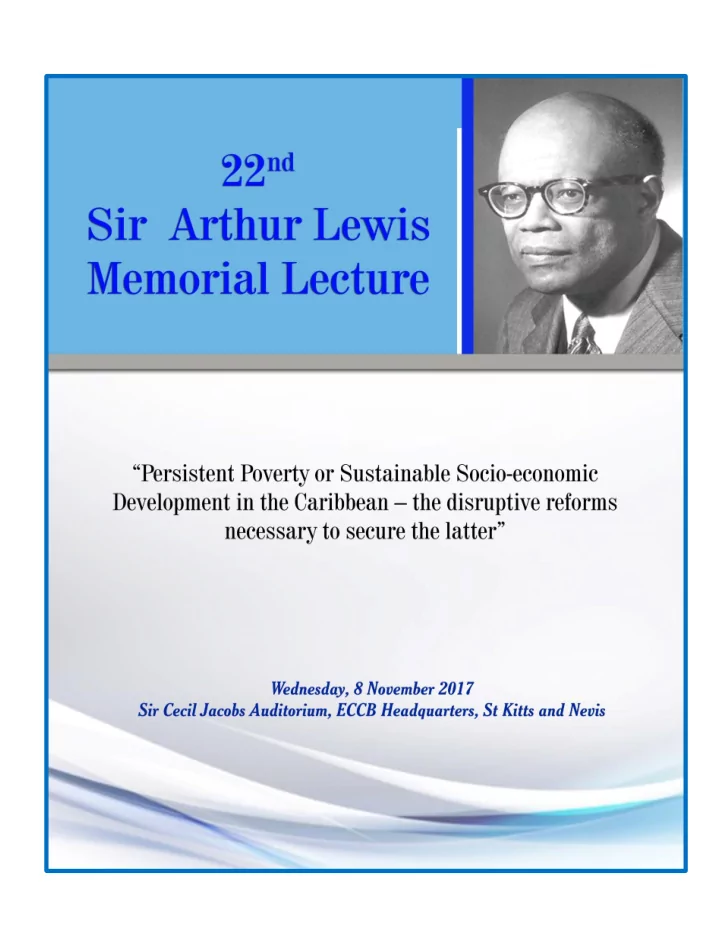
“Persistent Poverty or Sustainable Socio-economic Development in the Caribbean – the disruptive reforms necessary to secure the latter”

slide-4
SLIDE 4

22nd Sir Arthur Lewis Memorial Lecture – Marla Dukharan 1

I first want to thank Governor Timothy Antoine and his stellar team at the ECCB for bestowing this tremendous honour, in inviting me to deliver the 22nd Sir Arthur Lewis Memorial Lecture at their headquarters here in St. Kitts and Nevis. And I want to thank the entire ECCB team for the true Eastern Caribbean warmth and kindness with which they/you have treated me, and made all the arrangements leading up to this moment. Thank you! It is such a pleasure to be back here in St. Kitts, although I am still waiting to see the troupes of green monkeys my father keeps telling me to look out for. And as for Nevis – I have actually never been! But I am told that Nevis is for lovers – so unfortunately, that would have to be another trip! For me it is a tremendous honour, to be the second woman, and the second Trinbagonian, to deliver this prestigious lecture in its 22-year history. The first woman, Dr. Kari Levitt, and the first Trinbagonian, Dr. Lloyd Best, together gave us the “Plantation Economy Model”. This seminal work, like almost all academic work in this region post-1950, was arguably built on and heavily influenced by Sir Arthur Lewis’ constructive anti-imperialism, but was a critique of his “Dual economy” model, in explaining Caribbean economies. What impossible acts for me to follow!

slide-5
SLIDE 5

22nd Sir Arthur Lewis Memorial Lecture – Marla Dukharan 2

And I beg your forgiveness this evening for breaking with the tradition of paying homage to Sir Arthur Lewis at this lecture, and instead, recognizing the role of his mother in shaping his genius. And from all that I have read of Sir Arthur Lewis’ character, this is what I think he may have preferred. After his father had passed away, Sir Arthur Lewis’ mother, Ida, was left to single handedly raise five sons ranging from 5 – 17 years old. Imagine, FIVE boys! Sir Arthur Lewis said “My mother was the most highly disciplined and hardest working person I have ever known, and this, combined with her love and gentleness, enabled her to make a success of each of her children,”. This to me itself is worthy of a Nobel prize! And while it was my initial idea to dedicate this lecture to my family – my parents, my husband and my children – the giants upon whose shoulders I stand, I want instead, to dedicate this lecture to my late grandmothers. To my grandmothers:  Who were born into the vicious cycle of persistent poverty, typical of indentured labourers in Trinidad and Tobago in the post-WWI era.  Girls who were married off as child brides to young boys they didn’t even know, not because their parents didn’t love them, but because such love is a luxury that hunger cannot indulge.  They had no real freedoms or choices, due to grinding poverty, yes, but sadly, also due to misogynistic traditions thinly veiled as “religious” beliefs.

slide-6
SLIDE 6

22nd Sir Arthur Lewis Memorial Lecture – Marla Dukharan 3

 My grandmothers were basically illiterate, but they knew, with the intelligence that God gave them (rather than a solid British education, or from empirical studies in peer reviewed journals), that education is the only way to break the vicious cycle of persistent poverty.  Education, and not making child-brides of their daughters. For their eleven children each, taught them the importance of family planning, because it was a choice they never had.  These women were able, against impossible odds, to help break the cycle of poverty in their families, without a fancy World Bank or United Nations Poverty Reduction Programme. And not by a process of osmosis either – for many families remain stuck in this cycle of poverty in my country. And I have seen families descend into poverty, for a lack of a wise and determined matriarch.  My grandmothers had never worn pants, literally never wore pants, nor had they “worn the pants” so to speak, in their homes. But guess what? Who needs pants when you can wear a cape, disguised as a sari or an orni. These women, my grandmothers, are my superheroes.  So, and I thank you for indulging me, I dedicate this to my grandmothers, because I think I can safely say, with utmost humility, that this – me standing before you here this evening - is what they suffered for, and what they would have wanted.

slide-7
SLIDE 7

22nd Sir Arthur Lewis Memorial Lecture – Marla Dukharan 4

Now, on to the business of the day. This evening I will share with you my thoughts, borne out of my observations and frustrations, on three challenges we MUST address in the Caribbean, if we want to achieve the socio-economic transformation that, to me, is necessary for our very survival. I bet you didn’t know that the word “hurricane” is derived from the word “hurakan”, which was coined right here in the Caribbean by our indigenous people, centuries ago. So while the extent of destruction suffered this year is undoubtedly exceptional – after all, this is only the second time in a century that two category 5 hurricanes made landfall in one year – hurricanes have been a part of our lives in the Caribbean, forever.

slide-8
SLIDE 8

22nd Sir Arthur Lewis Memorial Lecture – Marla Dukharan 5

But it seems to me that only now have we - in the Caribbean, the wider world, and the multilateral organizations - collectively woken up to the urgency of building resilience and mitigating natural disaster risks in the Caribbean. The IMF’s latest World Economic Outlook highlighted some startling statistics, and reported that “Tropical cyclones caused damage of USD548 billion worldwide (in constant 2010 dollars) for the first 14 years of this century. Not surprisingly, these tropical cyclones have had a significant negative effect on GDP, with the biggest impact felt in small states and islands. The IMF estimates that in small states, seven years after an average storm strikes (not a category 5+ storm, just an average one!), GDP per capita is still almost 2.5% lower than if the storm had not happened.

slide-9
SLIDE 9

22nd Sir Arthur Lewis Memorial Lecture – Marla Dukharan 6

They further found that the effects of storms are very persistent: even after 20 years, the economy has not fully recovered from the shock. Yes, you heard right.

  • Twenty. Years.

Now, if nothing else, this should convince us of the importance of building

  • resilience. Not just climate resilience, but overall socio-economic resilience. But we

can’t achieve socio-economic resilience, if our economies are underperforming, because this economic underperformance translates into weak fiscal and external buffers – two of the most fundamental financial elements of resilience. When I look around the Caribbean, I am always struck by the dichotomy of the boundless potential of our people and our natural resources, versus the heartbreaking, almost universal underperformance of our economies (some more

  • bvious than others).

And I am also always shocked, that despite this sometimes brutally obvious underperformance, most of us are classified by the World Bank (whose mission it is to end poverty) as high income, and upper middle income – a classification which

  • f course belies our general conditions, and therefore misguides Multilateral

Agencies’ policies and efforts designed to address poverty specifically, and development more broadly.

slide-10
SLIDE 10

22nd Sir Arthur Lewis Memorial Lecture – Marla Dukharan 7

But let me not get derailed lamenting the acute weaknesses in our statistical infrastructure that contributed to this dichotomy. Because in the Caribbean, according to Professor Downes (2010), during the period 1995-2004, poverty levels ranged between 14 and 43% of the population, or 20%

  • n average overall. Indeed, in more recent times, poverty levels throughout the

Caribbean have been aggravated by the global economic crisis and its aftermath, where one in three of us is multi-dimensionally poor, according to the CDB. In addition to the poverty headcount, the depth and severity of poverty in the Region also suggest little or no progress. But why is it that roughly half a century post-independence, most of us have such unacceptable levels of poverty? The literature on poverty itself and socio-economic development in general, is rich in detail on the causes of persistent poverty in the Caribbean, ranging from slavery and indentureship, to climate change, and everything in between. I won’t itemize all the causes, but in my view, there are three pillars of the persistent poverty we experience in this region, that are rarely discussed, and which are certainly not meaningfully addressed in policy formulation in general.

slide-11
SLIDE 11

22nd Sir Arthur Lewis Memorial Lecture – Marla Dukharan 8

Of course the conspiracy theorist in me fears the reason for this negligence, is that certain truths, inconvenient at least and maybe even blasphemous to some, are potentially too disruptive to address – for they encroach on social norms, and on the territory of those with entrenched vested interests, or as my predecessor who delivered this lecture last year, Professor Avinash Persaud calls them, the “Anti- growth coalition”. In my view, there are three disruptive reforms necessary, not just for the socio- economic transformation so many of us desire, but to build the resilience crucial for our very survival. The first reform necessary in my view, is legislated fiscal responsibility frameworks. And to explain to you how I came to this conclusion, and why I am so passionate about this topic, I have to tell you a story. A true story. I was in bed one-night last year, writing my speaking notes to be delivered at the UNDP’s launch of the Caribbean Human Development Report, and my son, who was nine years old at the time, gets into bed and starts reading what I was typing. And he asked “mummy, what is poverty?” so I said well, poverty is the noun associated with the adjective “poor”, so someone who is poor, lives in poverty.

slide-12
SLIDE 12

22nd Sir Arthur Lewis Memorial Lecture – Marla Dukharan 9

Immediately he jumps out of my bed, runs out of the room, and comes back in with a sheet of paper. He uses my night cream on my bedside table to stencil a circle, and draws a pie chart. And he explains to me, “mummy, you see this section here, this is where we are, we are average”. So I asked him, well, what makes us “average”, to which he replies, “well, we have a house to live in, cars to drive, enough food and snacks to eat, and things that make us happy, like iPads”. So I asked, well what about the rich guys? He said, well they have everything we have, but they also have private jets. And then I asked, so what about the poor people? And he said that they don’t have cars, they don’t have a decent place to live, and they certainly don’t have the things that make them happy, like iPads. And I was curious as to why this segment was so large, and he said he thinks most people don’t have iPads and don’t have all the things they need to make them happy. True right? He then asked me, “mummy, what causes poverty?” and I said well, if you can figure that one out you’ll surely get invited to deliver the Sir Arthur Lewis Memorial Lecture in St. Kitts, and throw some shade on Amartya Sen! I asked him, what do YOU think causes poverty? And he thought for a little while, and then said, I know….the Government! Of course I had a good laugh at the irony of this statement, until Venezuela came to mind.

slide-13
SLIDE 13

22nd Sir Arthur Lewis Memorial Lecture – Marla Dukharan 10

So I decided to do some digging to determine whether there could be any truth to this notion – could the Government truly be a driver of higher levels of poverty? After all, we are taught that in general, Government spending is necessary to generate jobs and growth, and by extension, reduces poverty. But is this really the case, in the Caribbean?

slide-14
SLIDE 14

22nd Sir Arthur Lewis Memorial Lecture – Marla Dukharan 11

In the first place, it is well established in the literature, that fiscal policy in the Caribbean is predominantly pro-cyclical. According to papers written by Wendell Samuel in 2009 and the World Bank in 2016, apart from Grenada, OECS countries and Barbados were found to have pursued procyclical fiscal policy. Cotton, Finch, and Sookraj in 2013, found the fiscal policy stance in T&T to be predominantly pro- cyclical, and is even more accommodative in the 12-18 months prior to a general election! But, why is fiscal policy procyclical? According to the literature, several factors conspire to induce procyclical fiscal behavior in the Caribbean: (i) political pressures for more spending during booms and in the pre- election period (ii) lack of access to international credit markets in bad times often forces cutbacks in fiscal spending (iii) unlike industrial countries, most developing countries lack “automatic stabilisers” (such as unemployment insurance) that play an important role in making fiscal policy countercyclical.

slide-15
SLIDE 15

22nd Sir Arthur Lewis Memorial Lecture – Marla Dukharan 12

So there are some powerful factors at play, supporting pro-cyclical fiscal policy. And this is worrying, because according to a 2006 IMF working paper, procyclical fiscal policy is generally regarded as potentially damaging for welfare: it amplifies macroeconomic volatility, depresses investment in real and human capital, hampers growth, reduces income, and harms the poor (Serven, 1998; World Bank, 2000; IMF, 2005; IMF 2005b, Sturm et al 2009). Pro-cyclical fiscal policy was also found to be negatively related to income levels (Sturm, Gurtner, and Alegre 2009), as it crowds out private spending and investment, and usually results in a decline in private sector output and employment (Cologni and Manera 2011). If expansionary fiscal policies in good times are not fully offset in bad times, they may also produce a large deficit bias, which leads to debt unsustainability and eventual default. Debt unsustainability and eventual default. Sounds familiar? But apart from the established harmful effects of procyclical fiscal policy in general, in the Caribbean, according to the IMF and the IDB, expansionary fiscal policy is ineffective in generating growth. Why is this?

  • 1. A 2013 IMF paper found that in the ECCU, fiscal impact and long-run

multipliers are low, while public investment has a long-run multiplier of 0.6. The results suggest that we should have countercyclical policies to stimulate growth, and fiscal spending should focus on public investment.

slide-16
SLIDE 16

22nd Sir Arthur Lewis Memorial Lecture – Marla Dukharan 13

  • 2. Empirical research done by the Bank of Jamaica in 2012, found that the effect
  • f expansionary fiscal policy in Jamaica on GDP is weak, and not persistent.

Specifically, the fiscal multiplier was found to be very small on impact and zero over the long run.

  • 3. A 2013 IDB paper found that the fiscal multipliers in the Caribbean are

generally positive but less than 1, except for Barbados and Guyana, where fiscal multipliers are actually negative.

  • 4. The main driver of low fiscal multipliers, is leakage - A 2006 United Nations

Environment Programme report estimated leakage at around 80%, and for a few, even as high as 90% in the Caribbean. That means 80-90% of what we as consumers, and the Government spends, ‘leaks’ out via imports.

  • 5. Another important driver of low fiscal multipliers is unsustainable debt.

Greenidge et al (2012) an IMF paper demonstrated that at debt levels lower than 30% of GDP, higher debt-to-GDP is associated with faster economic

  • growth. However, as debt rises beyond 30%, the effects on economic growth

diminishes rapidly, and at debt levels reaching 55–56% of GDP, the growth impacts switch from positive to negative. Thus, beyond this threshold of 56%

  • f GDP, debt becomes a drag on growth. The majority of the Caribbean is

well beyond 56% debt/GDP, so every time the Government incurs a deficit, that is financed by additional debt, growth suffers. Bottom line, procyclical and expansionary fiscal policy has been demonstrated to be ineffective at best, and usually harmful, and various studies unanimously conclude that counter-cyclical fiscal policy can help reduce overall macroeconomic volatility, secure sustainable growth, and help to build resilience, in the Caribbean.

slide-17
SLIDE 17

22nd Sir Arthur Lewis Memorial Lecture – Marla Dukharan 14

But given the pressures to maintain procyclical and expansionary fiscal policy in the Caribbean, as outlined earlier, how do we secure countercyclical fiscal behavior? Well, adopting fiscal responsibility frameworks which promote countercyclical fiscal policy, effectively facilitates saving more during good times, so we have buffers in case natural disasters or economic shocks occur. But this specific policy recommendation, along with the supporting technical assistance, has been offered to various Caribbean countries by the International Financial Institutions for the past TWENTY YEARS. It has been documented by the IDB, that while the local authorities agree in general with the IFIs on the need for countercyclical fiscal policy and legislated fiscal responsibility frameworks, they disagree on the pace and scale of implementation. In other words, it ain’t happening under my watch! And therefore, fiscal responsibility frameworks and countercyclical fiscal policies have generally not been adopted in the Caribbean, apart from Jamaica and Grenada, under their most recent IMF programmes. So, why is it that our policymakers don’t seem to have the political will, to voluntarily do what they KNOW is right, and implement fiscal responsibility frameworks, which have been demonstrated to promote sustainable growth, reduce poverty, and build the resilience necessary for our survival? Why?

slide-18
SLIDE 18

22nd Sir Arthur Lewis Memorial Lecture – Marla Dukharan 15

So you see, my son was right! The second disruptive reform I believe we need in this region, in order to build resilience, reduce poverty, and secure sustainable socio-economic development, is the creation of a regional digital payments ecosystem, which has the power to achieve universal financial inclusion, and eliminate the need to use hard currency for intra-regional financial transactions. This concept of a regional digital payments system involves the digitization of our fiat currencies, the creation of a regional digital currency, and a multilateral clearing system, all built using distributed ledger or blockchain technology. As Sir Arthur’s mother had taught him, which surely empowered him to excel - “Anything the Europeans can do, we can do.” Already the Finns, Swedes, Norwegians and the Estonians, and other countries around the world, are building increasingly digital payments ecosystems and cashless societies. And what about us? As a region we are becoming increasingly financially excluded, because of what foreign banks call de-risking, but which to me more closely resembles investment portfolio rebalancing. And make no mistake, this is a decidedly pro-poverty trend, regardless of the label you ascribe.

slide-19
SLIDE 19

22nd Sir Arthur Lewis Memorial Lecture – Marla Dukharan 16

Financial inclusion is so important to poverty reduction, that the World Bank has set a goal of achieving Universal Financial Inclusion by 2020 - a full decade before the Sustainable Development Goals’ (SDGs) deadline – because even though it isn’t an SDG on its own, universal financial inclusion is a critical enabler for 8 of the 17 SDGs, related to reducing poverty, income inequality and gender inequality, ultimately boosting sustainable development. But de-risking is driving financial exclusion at a regional level, making trade, investment, and remittance flows more difficult, more costly, and therefore less abundant, and by extension driving poverty levels higher. In addition, growing numbers of individuals and small businesses in the region are becoming un-banked, as the cost of traditional banking services balloons, and increasingly stringent regulatory requirements disqualify even the most legitimate customers. According to the World Bank, around 2 billion people (40% of the world’s adults, 50% of the world’s poorest) are unbanked, and a whopping 85% of world’s financial transactions are in cash! Remittances, which are a lifeline for the world’s poorest, are projected to reach USD500 billion worldwide this year, but roughly 10-15% of which, or USD50-75 billion, will be lost to money transfer fees. Think about the difference that USD50- 75 billion could make to the world’s poorest, and those affected by natural disasters.

slide-20
SLIDE 20

22nd Sir Arthur Lewis Memorial Lecture – Marla Dukharan 17

But there is hope - some 1.6 billion of the 2 billion unbanked globally, have access to a mobile phone, creating the potential for mobile banking access. Mobile penetration rates in most Caribbean countries is very high, cementing the poverty- reducing potential of boosting financial inclusion via mobile banking in the region. For example, the famed M-PESA in Kenya has lifted as many as 194,000 households – 2% of the population – out of poverty, and has been especially effective in improving the economic lives of poor women and of members of female-headed

  • households. And this is of particular importance, because as Christine Lagarde said,

poverty is sexist, and guess what, so is financial exclusion - over one billion women worldwide and 52% of women in the Caribbean and Latin America are unbanked, underpinning gender inequality, which costs 10%-37% of GDP worldwide. And digital finance could add USD3.7 trillion to the GDP of emerging economies within a decade, according to a report by the McKinsey Global Institute. The benefits of digital payments extend also into anti-corruption. According to the World Bank “Blockchain technology has the ability to fight corruption and to deal with failures of governance and governments and rule of law all over the world.” Indeed, in India, digitizing government transfers cut bribe demands by 47%, and boosted beneficiaries’ payments by excluding middlemen who skimmed funds.

slide-21
SLIDE 21

22nd Sir Arthur Lewis Memorial Lecture – Marla Dukharan 18

Apart from boosting financial inclusion, lowering poverty, reducing graft, and promoting growth, there are other advantages to a central bank issued digital fiat currency on the blockchain:

  • 1. Increased Seigniorage: digital fiat currency could potentially provide over

90% cost savings in comparison to the cost of printing, transporting, securing and distributing physical notes and coins.

  • 2. Efficiency: distributed ledger technology has the potential to boost the speed

and lower the cost of clearing and settlement systems.

  • 3. Secure Non-counterfeitability: Cryptographically produced and secured

digital fiat currency cannot be counterfeited.

  • 4. Auditability: A central bank can track digital currency transactions with

superior accuracy, versus cash, which is anonymous. This means that Anti- Money Laundering (AML) and Counter Terrorist Financing (CTF) requirements will be more stringently adhered to. And higher transparency in financial transactions also means that Governments will be able to capture more revenue. Therefore, digital fiat currencies, and a regional digital currency, have the power to make domestic AND intra-regional payments more compliant with regulations, more efficient, virtually frictionless, more transparent, AND much less costly. The fact that we use USD for intra-regional transactions, to me, is absolutely

  • absurd. A regional digital currency potentially eliminates the need to use USD for

intra-regional trade, saving precious foreign currency reserves.

slide-22
SLIDE 22

22nd Sir Arthur Lewis Memorial Lecture – Marla Dukharan 19

The thinking behind this is not new – the revised Treaty of Chaguaramas made the provisions for this system, and the CARICOM Multilateral Clearing Facility made important strides in this direction. Building on this history and experience, our goal at Bitt is to create a synthetic monetary union on the blockchain, through the use

  • f digital fiat currencies, and to create a multilateral clearing and settlement facility

for the Caribbean. Bottom line - banking costs will only rise, and de-risking will only escalate, as events like #ParadisePapers for example, become more frequent, and rattle tax authorities and financial regulators worldwide. A blockchain based digital payments ecosystem can reverse the financial exclusion, and the high banking and money transfer costs that we have been subjected to in this region. Because you know what? We deserve better! And the final, but in my heart the most important idea that I want to leave you with this evening, is that our resilience, our sustainable socio-economic development, and indeed, our very survival in the Caribbean and worldwide, depends on girls. This is because girls represent the world’s single largest potential source of sustainable, climate resilient growth, once gender equality is achieved. In admiration of his mother’s discipline and dedication, Sir Arthur Lewis is quoted as saying “As a youngster in school, I would hear other boys talking about the superiority of men over women; and I used to think that they must be crazy.”

slide-23
SLIDE 23

22nd Sir Arthur Lewis Memorial Lecture – Marla Dukharan 20

The country that has the highest level of gender equality globally, is an island with a population of about 333 thousand persons. Can anyone guess which island this is? I will save it for the end – to make sure you’re all still paying attention. Just last Thursday, the World Economic Forum published its Global Gender Gap report for 2017, and found that globally, gender parity is shifting into reverse for the first time since they started measuring it – which was eleven years ago. The study found that at the current rate of progress, the overall global gender gap will take a hundred years to close, while the gender gap in the workplace will not be closed for 217 years. This year’s report highlights the fact that that even though more and more qualified women are coming out of the education system globally, their participation in the labour force, their wages, their level of seniority, and their participation in decision making, still trails those of men. And it’s getting worse. This perverse outcome is especially acute in the Caribbean, where we have largely achieved gender equality in terms of tertiary educational attainment, but these women are being underutilized and underpaid. What a waste! And one that we cannot afford in this region! This trend MUST be reversed, because it potentially puts upward pressure on poverty rates.

slide-24
SLIDE 24

22nd Sir Arthur Lewis Memorial Lecture – Marla Dukharan 21

According to the report,

  • 1. Barbados, with a rank of 23/144 countries, remains among the best-

performing countries in the region and the world on closing the Economic Participation and Opportunity gender gap, achieving parity at the level of female legislators, senior officials and managers.

  • 2. Barbados continues to take the top rank among the Caribbean nations,

followed by Cuba, 25th, the Bahamas, 27th, and Jamaica 51st, which this year sees progress reversing on Political Empowerment, healthy life expectancy and wage equality for similar work. Cuba has fully closed its gender gap in Educational Attainment for the second year running.

slide-25
SLIDE 25

22nd Sir Arthur Lewis Memorial Lecture – Marla Dukharan 22

  • 3. The Dominican Republic 70th, Belize 79th, and Suriname 86th, see notable

progress on closing their overall gender gaps due to improvements on, respectively, their Health and Survival, Economic Participation and Opportunity, and Political Empowerment sub-indexes. Studies demonstrate that gender equality and women’s empowerment are central to economic development, as well as environmental sustainability:

  • 1. McKinsey Global Institute found that if women were to participate in the

economy “identically to men”, in eight years (by 2025), we could add as much as USD28 trillion or 26% to annual global GDP (roughly the combined size of the current US and Chinese economies).

  • 2. Companies with female executives perform as much as 57% better than

companies with no women at the top. But globally, there are powerful factors preventing gender equality from becoming a reality:

  • 1. A recent study by the World Bank indicates that 155 of the 173 economies it

covered have at least one law impeding women’s economic opportunities.

  • 2. Women devote 1 to 3 hours more a day to housework than men; 2 to 10

times the amount of time a day to care (for children, elderly, and the sick), and 1 to 4 hours less a day to market activities.

  • 3. In the EU, 25% of women report care and other family and personal

responsibilities as the reason for not being in the labour force, versus only 3% of men.

slide-26
SLIDE 26

22nd Sir Arthur Lewis Memorial Lecture – Marla Dukharan 23

  • 4. Women are more likely than men to work in informal employment - In Latin

America and the Caribbean, over 54% of women in non-agricultural jobs are in informal employment. So, what to do? Well, the most gender equal place on earth, Iceland – an island with about 333,000 people, took the following measures to promote gender equality:

  • 1. The Icelandic people recognized that gender equality does not come about
  • f its own accord. Deliberate efforts by the Government, and policies have

to be implemented.

  • 2. It requires the collective action and solidarity of women human rights

defenders, political will, and tools such as legislation, gender budgeting and quotas.

  • 3. On the political front, women’s solidarity by means of political organising has

been instrumental in promoting gender equality in Iceland. During the period from 1915 to 1983, only 2%-5% of members of Parliament were women. In 2016, women accounted for 48% of elected representatives in parliament

Are we in the Caribbean, prepared to treat our women and girls fairly, pay them

equally, and provide them with the same opportunities as men, in order to reap the benefits of lower poverty, and higher levels of sustainable socio-economic development? Or will our egos and insecurities perpetuate the gender bias that increases the probability of persistent poverty?

slide-27
SLIDE 27

22nd Sir Arthur Lewis Memorial Lecture – Marla Dukharan 24

In concluding, I want to reiterate my view that in order to achieve resilience and secure sustainable socio-economic development, we must legislate appropriate fiscal responsibility frameworks, we must achieve universal financial inclusion, and we must establish gender equality. And I want to ask each of you here this evening – how committed are you, to making a difference in this region, in whatever way you can? As Anthropologist Margaret Mead famously said “Never doubt that a small group

  • f thoughtful, committed citizens can change the world; indeed, it’s the only thing

that ever has.” I thank you for your time, your patience, and your attention.

slide-28
SLIDE 28

22nd Sir Arthur Lewis Memorial Lecture – Marla Dukharan 25