Medication Disposal Kelli France, Pharm D Candidate Kim Burns, - - PowerPoint PPT Presentation

medication disposal
SMART_READER_LITE
LIVE PREVIEW

Medication Disposal Kelli France, Pharm D Candidate Kim Burns, - - PowerPoint PPT Presentation

Medication Disposal Kelli France, Pharm D Candidate Kim Burns, Professor LECOM School of Pharmacy Objectives 1. Discuss the importance of proper medication disposal 2. Describe the impact of improper medication disposal 3. Examine current


slide-1
SLIDE 1

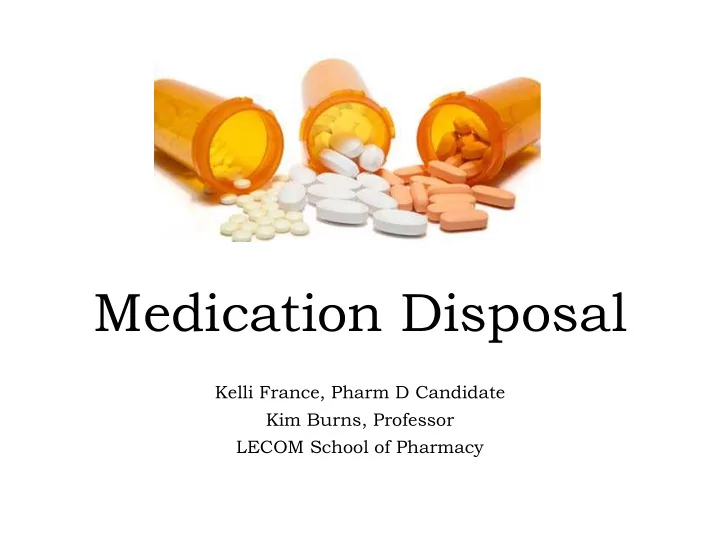
Medication Disposal

Kelli France, Pharm D Candidate Kim Burns, Professor LECOM School of Pharmacy
slide-2
SLIDE 2

Objectives

  • 1. Discuss the importance of proper medication disposal
  • 2. Describe the impact of improper medication disposal
  • 3. Examine current options for proper medication

disposal

  • 4. List current resources for medication disposal
slide-3
SLIDE 3

Medication Accumulation

  • Unused medications left in the home leads to

medication accumulation

  • Causes of medication accumulation:
  • Non-adherence
  • Changes in prescription regimen
  • Due to side effects, ineffectiveness
  • Expiration of medication

What is the best way to get rid of medications you no longer need?

slide-4
SLIDE 4

Importance of Proper Medication Disposal

Accumulation

  • f Medications

Environmental

Drug Diversion Poisonings

slide-5
SLIDE 5

Environmental1,2

  • When medications are disposed of in sewers or trash,

they can enter the environment

  • Can also enter by being excreted by people/animals
  • Drugs have been detected in water and soil
  • Including OTC pain relievers (e.g. Tylenol, ibuprofen),

antibiotics, anti-seizure medications, and anxiety medications

  • While very small amounts are being detected, there are still

concerns

  • We don’t know what the safe amount of medications in drinking water is
  • We also don’t know what kind of impact this has on the environment
  • E.g. traces of medications found in fish
slide-6
SLIDE 6

Accidental Poisoning3,4

  • A concern if medications are left in the home or thrown

in the garbage

  • Risk especially pertains to children/pets in the home
  • According to the CDC, every day more than 300 children are

sent to the hospital due to poisoning

  • Of calls made to the poison control center for children, about ½

pertained to medications

  • The amount of children who overdose on medications is

increasing over time

  • Yale School of Medicine reported that the amount of kids who

went to ER for drug overdose has doubled from 1997 – 2012

slide-7
SLIDE 7

Drug Diversion5

  • Drug diversion: when

pharmaceutical drugs are used by an individual for whom the drug was not prescribed

  • Medications (especially
  • pioids) can be taken from

homes, garbage, etc.

  • Drugs may be diverted to

family members or friends

  • Opioid epidemic: amount
  • f deaths due to overdose
  • f opioids has been rising

drastically throughout the country

Source: CDC Opioid Overdose Basics, Understanding the Epidemic

slide-8
SLIDE 8

National Ov Over erdose De se Deaths

Number of Deaths from All Drugs

10,000 20,000 30,000 40,000 50,000 60,000 Total Female Male

Source: National Center for Health Statistics, CDC Wonder

slide-9
SLIDE 9

National Ov Over erdose De se Deaths

Number of Deaths from Opioid Drugs

5,000 10,000 15,000 20,000 25,000 30,000 35,000 Total Female Male

Source: National Center for Health Statistics, CDC Wonder

slide-10
SLIDE 10

Some PA Stats

slide-11
SLIDE 11

Some PA Stats

Source: 2015 PA Coroner’s Report

slide-12
SLIDE 12

Current Options for Medication Disposal

  • Keep drugs in the house
  • NOT RECOMMENDED (safety concerns)
  • Throw away into garbage/flush down toilet
  • NOT RECOMMENDED (environmental/safety concerns)
  • Medication return units (MRU)
  • Drug take back events
  • FDA/DEA recommended home disposal
  • Only if no other options
  • Medication deactivation pouches

Preferred

slide-13
SLIDE 13

Medication Return Units (MRUs)

  • Safe way to dispose of

your medications and ensure they don’t harm the environment or get into the wrong hands

  • Many located throughout

Erie

  • 12 distributed at various

Erie area law enforcement agencies

  • Can place any unused

meds in box, where they will later be safely incinerated

slide-14
SLIDE 14

Current Locations of MRUs

  • Albion Police Department
  • Location: 26 Smock Ave, Albion, PA 16401
  • Hours available: Monday – Friday, 9 AM – 4:30 PM
  • Corry City Police Department
  • Location: 20 East South St, Corry, PA 16407
  • Hours available: 7:30 AM – 3:30 PM
  • Edinboro Police Department
  • Location: 124 Meadville St, Edinboro, PA 16412
  • Hours available: 24/7 (may need to use call button

during non-business hours)

slide-15
SLIDE 15

Current Locations of MRUs

  • Edinboro University Police Department
  • Location: 911 Scotland Rd, Edinboro, PA 16412
  • Hours available: 24/7
  • Erie County Courthouse Lobby
  • Location: 140 West 6th St, Erie, PA 16501
  • Hours available: Monday – Friday, 8 AM – 4:30 PM
  • Girard Borough Police Department
  • Location: 34 Main St West, Girard, PA 16417
  • Hours available: 8 AM – 4 PM (may call police department

after hours to have an officer come and get the medications)

slide-16
SLIDE 16

Current Locations of MRUs

  • Lake City Police Department
  • Location: 2352 Main St, Lake City, PA 16423
  • Hours available: 8:30 AM – 5 PM
  • Lawrence Park Police Department
  • Location: 4230 Iroquois Ave, Erie, PA 16511
  • Hours available: 24/7 (may need to use their phone if

non-business hours)

  • Mercyhurst University Main Campus Police

Department

  • Location: 501 East 38th St, Erie, PA 16546
  • Box located in Police and Safety, which is at lower McAuley hall
  • Hours available: 24/7
slide-17
SLIDE 17

Current Locations of MRUs

  • Mercyhurst University North East Police

Department

  • Location: 16 West Division St, North East, PA 16428
  • Hours available: 24/7
  • North East Police Department
  • Location: 58 East Main St, North East, PA 16428
  • Hours available: 24/7
  • Wesleyville Police Department
  • Location: 3421 Buffalo Rd, Erie, PA 16510
  • Hours available: 9 AM – 4 PM
  • Pennsylvania State Police Department
  • Location: 4320 Iroquois Ave, Erie, PA 16511
  • Hours available: 24/7
slide-18
SLIDE 18

Resource: DEA list of registered collectors

https://apps.deadiversion.usdoj.gov/pubdispsearch/spring/main?execution=e2s1 *does not show law enforcement agencies

slide-19
SLIDE 19

Medication Collection Events

  • DEA holds two national medication take back events

each year

  • Next event: October 28, 2017
  • Information on collection sites will be available on DEA website on

October 1, 2017

  • Occasional community take back events also take place
slide-20
SLIDE 20

FDA/DEA Recommendations

  • Only recommended if

you cannot dispose of your medications at a drop off box or take back event

  • Source: FDA: how to

dispose of unused medications

  • https://www.fda.gov/ForCo

nsumers/ConsumerUpdate s/ucm101653.htm

slide-21
SLIDE 21

Medication Deactivation Pouches

  • Located at several

pharmacies through out Erie

  • List:

https://www.attorneygener al.gov/drug_deactivation/

  • Currently, free bags made

available to customers to safely dispose of their medications

slide-22
SLIDE 22

Resources for Drug Disposal

  • Erie county department of health MRU info and

locations: https://www.eriecountypa.gov/media/557928/med- return-flyer-_1.pdf

  • DEA drug disposal information:

https://www.deadiversion.usdoj.gov/drug_disposal/

  • FDA disposal of medications:

https://www.fda.gov/drugs/resourcesforyou/consumers /buyingusingmedicinesafely/ensuringsafeuseofmedicine/ safedisposalofmedicines/ucm186187.htm

  • EPA PDF of drug disposal recommendations:

https://www.epa.gov/sites/production/files/2015- 06/documents/how-to-dispose-medicines.pdf

slide-23
SLIDE 23

Conclusion

  • Throwing away and/or leaving medications in the home

can cause various public health concerns

  • Environmental
  • Accidental poisoning
  • Drug diversion
  • Proper medication disposal is an important public health

initiative

  • Erie county has several locations available for people to

drop off unwanted or expired medications

slide-24
SLIDE 24

References

1. Pharmaceutical Waste: Pharmaceuticals in the Environment. Department of Ecology, State of Washington. http://www.ecy.wa.gov/programs/hwtr/pharmaceuticals/pages /pie.html. Accessed August 17, 2017. 2. Nikolaou A, Meric S, Fatta D. Occurrence patterns of pharmaceuticals in water and wastewater environments. Analytical and Bioanalytical Chemistry. 2007; 387(4): 1225 – 1234. 3. Protect the Ones You Love: Child Injuries are Preventable. Centers for Disease Control and Prevention Web site. https://www.cdc.gov/safechild/Poisoning/index.html. Updated April 28, 2016. Accessed August 17, 2017. 4. Fox M. More Children Sick, Dying From Opioid Overdoses:

  • Report. NBC Health News.

http://www.nbcnews.com/health/health-news/more-children- sick-dying-opioid-overdoses-report-n675731. Accessed August 17, 2017. 5. Opioid Overdose: Understanding the Epidemic. Centers for Disease Control and Prevention Web site. https://www.cdc.gov/drugoverdose/epidemic/index.html. Updated December 16, 2016. Accessed August 17, 2017.