1
MEDICAL SUPPORT TO THE WARFIGHTER: FROM BATTLEFIELD TO TERTIARY CARE - - PowerPoint PPT Presentation
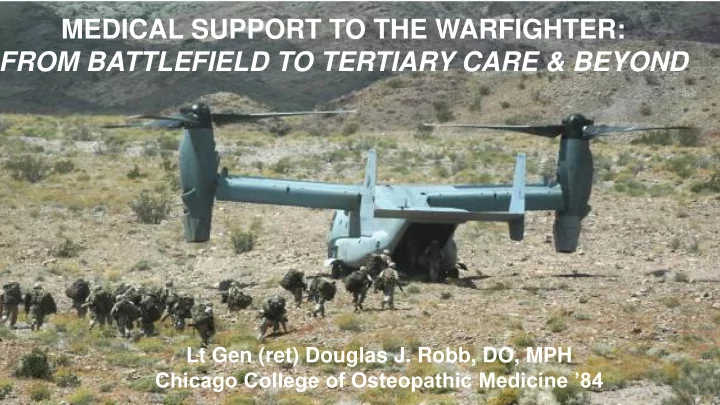
MEDICAL SUPPORT TO THE WARFIGHTER: FROM BATTLEFIELD TO TERTIARY CARE & BEYOND Lt Gen (ret) Douglas J. Robb, DO, MPH Chicago College of Osteopathic Medicine 84 1 The why AGENDA 2 the Why Not 3 and always keeping
2
AGENDA
The “why”…
3
…the “Why Not”
…and always keeping the “End State” in mind Why we are really here today!
DISCLAIMER
- The opinions expressed are those of myself and do not
represent the views of USU or the DoD
- I am not a trauma surgeon nor a critical care specialist nor a
first responder…
- But…I was the on-scene medical director for the Khobar
Towers Saudi Arabia Bombing…US Central Command senior medical advisor…Air Mobility Command senior medical advisor…Chairman of the Joint Chiefs of Staff senior medical advisor…Director Defense Health Agency
- But, most important…I listened to the trauma mafia*
*Trauma Mafia: an endearing term referring to pre-hospital/enroute care/hospital professionals
Learning Objectives
- Understand the Military Health System’s Full
Spectrum of Heath Care Support to the Warfighter
- Know the resourcing requirements to support
- Describe the Military Heath Systems leadership
transformation required to transform “silos” of excellence to a “continuum” of excellence
- Examine “Lessons Learning”: Challenges facing our
Wounded Warriors
7
Agenda
- “Continuum of Care”
- Enroute Patient Care from: Force Health Protection to Combat Casualty Care
to Forward Resuscitative Care to Theater Hospital Care to Definitive Care
- Integrated “Joint/Coalition” System of Systems
- Concept to maintain equal or greater level/quality of care at each level of
movement
- Destination: World Class NATO/Military/VA/Civilian Healthcare System
- Lessons “Learning”
Mission of the Military Health System
(operative word is “system”)
To provide Combatant Commands & Service Components with: A Medically Ready Force
(lean mean fighting machine)
& A Ready Medical Force
(lean mean saving lives machine)
BLUF: Medical Support to the Combatant Commands “Our Referral Network!”
11
- Force Health Protection
- Tactical Combat Causality Care (TCCC)
- CASEVAC/MEDEVAC
- Forward Surgical Care
- MEDEVAC
- Expeditionary Theater Hospital Care
- Aeromedical Evacuation (AE)
- Critical Care Air Transport Teams (CCATT)
- “Joint Theater Support Teams”
- Joint Theater Trauma System
- Joint Theater Medical Information Program/Electronic Health Record
- Telemedicine/Teleradiology
- Joint Logistics
- Joint Blood Program
- Destination: World Class Military/Coalition/VA/Civilian Healthcare System
Full Spectrum Healthcare
12
- Lowest Disease Non-Battle Injury (DNBI) rates
in recent recorded conflict
- Lowest Lethality Rates in recorded conflict
- WWII 30%
- Vietnam/Gulf War 24%
- OEF/OIF <10%
Translates To…
13
AIR & SEA DISTANCES
AIR AIR 7,00 7,000 0 MI MI 24 24 H HOU OURS RS SEA SEA 8,60 8,600 0 MI MI 20 20+ + DAYS SEA SEA 12 12,000 ,000 MI MI 26 26+ + DAYS
14 Battalion Aid Station “Level 1” In Theater Hospital “Level 3” Definitive Care “Level 4”
Historical Route From Injury to Definitive Care
CASUALTY EVAC
- Evac Policy -
1 Day
TACTICAL EVAC
- Evac Policy -
7 Days
STRATEGIC EVAC
- Evac Policy -
15 Days Field Hospital “Level 2”
Continuous En-route Care
15
Overseas Medical Center ASF Definitive Care Theater Hospital CASF EMEDS MASF Theater Hospital Care Forward Resuscitative Care Battalion Aid Station First Responder Care US Medical Center
Continuous En-route Care:
Stable…Stabilized… Stabilizing
CASEVAC/MEDEVAC 1 Hour TACTICAL MEDEVAC/AE 1-24 Hours TACTICAL/STRATEGIC AE 24-72 Hours
16
Force Health Protection
Begins BEFORE You Step to the Jet!
- Deployment Medical Guidance
- Pre/Post Deployment Health
Assessments
- Immunizations
- Chemoprophylaxis
- Occupational Environmental
Health Surveillance
17
- HMMV is struck & disabled
T+ 00:00
18
- Care Under Fire
- Combat Application Tourniquet (CAT)
- Hemostatic Dressing
- Tactical Field Care
- Hypothermia Prevention
- Combat Pill Pack: Antibiotics/ Pain Control
- Combat Casualty Evac Care
- Rapid Casualty Assessment (ABCs)
- Control Hemorrhage (CABs)
- Treat penetrating chest trauma
- Maintain airway/package for transport
“Correct Intervention At The Correct Time In The Continuum Of Combat Care!”
- First Responder Care: Tactical Combat Causality Care
19
MEDEVAC & Tactical Operations Center
20
- Taken to LV II Forward Surgical Care
- Arrival B/P 80 systolic
- Undergoes exploratory laparotomy:
- Left Nephrectomy
- Splenectomy
- Packing of abdomen
- 8 units PRBC’s
- B/P 90’s systolic
T+ 00:25
21
Forward Surgical Teams Shock Trauma Platoons
Level II: Forward Surgical/Resuscitative Care
T+ 03:00
- Arrives LV III Theater Hospital
- Cold
- Coagulopathic
- Acidotic
- Taken straight to OR
23
Level II/III: Theater Expeditionary Hospitals
24
Injury Cause Trends: Percentage of Total by Cause
51.1% 25.0% 8.7% 15.1% EXPLOSIVE DEVICE GSW MVC OTHER
25
THE “POWER” OF COALITION MEDICAL!
26
- Re-explored
- Packed, surgical
control gained
- Urgent blood drive for
AB+ blood
- Patient warmed to 38
degrees
T+ 03:00 to T + 06:00
27
- Transported to ICU
- CT scan of spine
- Ongoing DCR/DCS
- “Urgent” evacuation
request placed
T+ 06:00
NAVY NAVY
MEDCENS
SERM RMC
DDEAMC
GPR GPRMC
BAMC
PRM RMC
TAMC
Ai Air Force
MEDCENS
WRM WRMC
MAMC
NARM NARMC
WAMC WRAMC
ERM RMC
LRMC Germany
Iraq raq Ku Kuwait Afghanistan tan Overflow Exams/Medevac Workflow/workloads Radiologist
LEGEND
18th MEDCOM 121st General Hospital
- JOINT THEATER SUPPORT:
TELEMEDICINE & TELERADIOLOGY
29
T+ 10:00
- CCATT team alerted
- Patient prepared for transport
- C-17 arrives from Germany
- Cargo unloaded
30
Aeromedical Evacuation Cargo In… …Patients Out!
31
- ERPSS-10 bed
- Mobile 24hr staging at tactical
airheads
- Rapid response staging
- ERPSS – 50/100 bed
- 24hr staging at strategic airheads
- Support to Theater Hospital
- Transport to AE aircraft
En Route Patient Staging System (ERPSS)
32
Tactical Aeromedical Evacuation (AE): Intra-theater
Hub & Spoke
- C-130/NATO
- Opportune A/C
33
Ga Garma mabak Cha Chaghcharan Qal’eh-ye ye No Now Meyma ymaneh Ke Keleft ft Jeyr yretan Sar-e Pol Sama mangan Pol-e Kh Khomr mri Taloqan Feyzab yzabad Esh shkash shem Cha hari rika kar Farah Farah Delar Delaram Lash shkar Ga Gah
Herat Ba Bamian mian Shind Shindand Zar Zaranj Ba Baghlan lan Spin Spin Bo Bolda ldak Ba Baghran Ba Balkh lkh Jacobabad Sha Shamsi msi Mazar-e-Sharif
Bar arak aki Gh Ghazni
Gardez Jalal alalaba bad Khowst st Konduz Shir Shir Khan Shk Shkin in Orgun-e De Deh Raw Rawod Geresk sk Qala lat
Bagram Kandahar
Kabul
Kar arshi shi Kha hana naba bad Mir iram m Sha Shah Tarin in Kowt Ter ermez mez
Strategic AE: Inter-theater
GE GE UK/GE
34
Global Patient Movement
166 131
45 47 56 52 48 56 48 47 40
643 703 745 812 752 827
271 242 257 318 261 303 238 320 251 297 276 303 313
31 35 31 41
721 779 698 653 686 728 614 896 977 802 865 881 865 884 843 877 946 720 878 804
500 1000 1500 2000 2500 3000 Patient Movement Requests ▪ CENTCOM ▪ EUCOM ▪ NORTHCOM ▪ SOUTHCOM* ▪ PACOM
Aeromedical Evacuation: Lifeline Home
36
“FLYING ICUs” Critical Care Air Transport (CCAT)
37
- CCATT arrives at ICU
- CCATT moves patient
to AMBUS to flight line
- Patient loaded for flight
T+ 10:00
‘Stabilized…stabilizing’ AE Pt Transportation
- Secured airway
- Shock treated/Hemorrhage controlled
- Fractures Immobilized/splinted
- Damage control surgery
- Initial control of contamination
- Damage Control Resuscitation: prevent “lethal
triad” acidosis, coagulopathy and hypothermia
- Subsequent re-exploration & definitive repair
38
39
- Patient loaded for flight
- 7 hour mission to Germany
- AMBUS transfer to Landstuhl
Regional Medical Center, Germany
T+ 12:00
40
- Taken to OR
- Re-explored/wash outs
T+ 24:00
41
- Patient transferred
to WRNMMC with CCATT
T + 36:00
T + 4,500:00 hrs Joint Trauma System…got him there!
43
What have we learned…learning
44
PTSD mTBI
Chronic Pain/ Substance Abuse/ Other MH dx
PTSD, mTBI, “other” MH Diagnosis
Yesterday’s Understanding
PTSD: Post Traumatic Stress Disorder mTBI: Mild Traumatic Brain Injury MH: Mental Health
45
PTSD mTBI
Chronic Pain/ Substance Abuse/ Other MH dx
PTSD, mTBI, “other” MH Diagnosis
Today’s Understanding
PTSD: Post Traumatic Stress Disorder mTBI: Mild Traumatic Brain Injury MH: Mental Health
Lew, Otis, Tun et al., (2009). Prevalence of Chronic Pain, Post-traumatic Stress Disorder and Post-concussive Symptoms in OEF/OIF Veterans: The Polytrauma Clinical Triad. JRRD.
Complexity of Injury
Prevalence of Chronic Pain, PTSD & TBI in a sample of 340 polytrauma OEF/OIF veterans
PTSD 68.2% 42.1% TBI 66.8% Chronic Pain 81.5% 5.3% 12.6% 6.8%
47
Partnerships: DoD, VA, NIH, academic centers, public/private organizations, NCAA, NFL
Understanding TBI & PTSD
48
49
Value of Joint Trauma System: Transformation of Combat Casualty Care
Body Armor/Tactical Combat Casualty Care/ Damage Control Surgery & Resuscitation/CCATT
5 10 15 20 25 30 35 40 45 Rev War War of 1812 Civil War WW I WW II Korea Viet Nam Gulf War I OEF/OIF
Wartime US Lethality Rate (%)
Joint Trauma System “continuum of excellence” Individual Services “silos of excellence”
Battalion Aid Station “Level 1” In Theater Hospital “Level 3” Definitive Care “Level 4”
Stable patients…
CASUALTY EVAC
- Evac Policy -
1 Day
TACTICAL EVAC
- Evac Policy -
7 Days
STRATEGIC EVAC
- Evac Policy -
15 Days Field Hospital “Level 2”
Continuum of Care: “Silos” of Excellence
Pre-Hospital
Overseas Medical Center ERPSS Definitive Care Theater Hospital ERPSS CSH/EMEDS/EMF ERPSS Theater Hospital Care Forward Resuscitative Care Battalion Aid Station First Responder Care US Medical Center
JTS Continuum of Care: “Continuum” of Excellence
Stable…Stabilized…Stabilizing Patients
CASEVAC/MEDEVAC 1 day = 1 Hour TACTICAL MEDEVAC/AE 7 days = 1-24 Hours TACTICAL/STRATEGIC AE 15 days = 24-72 Hours
Joint Trauma System Army & AF trauma community Navy trauma community Civilian trauma community
Continuum of Care…Continuum of Excellence
JTTS/JTS World-Wide Grand Rounds: 08:00 EST Thursday
LRMC Bastion Bagram J-Bad Kandahar Ballad Bethesda Naval WRAMC Ibn Sina Naval San Diego Palo Alto VA Tampa VA WHMC BAMMC Richmond VA
54
“Silos” of Excellence vs “Continuum” of Excellence Building a Unified Civilian-Military Trauma System
Air Force & civilian surgeons worked hand-in-hand through the night to treat patients’ visible wounds in the operating rooms… while also addressing invisible wounds at the bedside.
Evolution of Knowledge Skill Currency Across Conflicts
Continued Advances in Tactical Combat Casualty Care/Damage Control Surgery & Resuscitation/Enroute Care requires a Continuous Learning Organizational Approach
57
Total number of OIF/OEF amputees
- ver 1600
Transtibial 27% Transfemoral 29% Upper Extremity Loss 18% Multiple Limb Loss 26%
Major Limb Amputations
Polytrauma: Complex Co-morbid Challenges
58
- Brain Injury
- Spinal Cord Injury
- Limb Trauma/Amputation
- Facial Trauma
- Peripheral Nerve Injury
- Internal Organ Damage
- Pain Management
- Burns
- Infection
- Sensory Loss (Vision/Hearing)
Amputee Care: Innovations
- Early, Comprehensive Rehabilitation
- Military Advanced Rehabilitation Centers (ARCs)
- Walter Reed National Military Medical Center in Bethesda, MD/Center for the Intrepid (CFI) in San Antonio, TX/Comprehensive Combat & Complex Casualty Care San
Diego, CA
- Veterans Administration PolyTrauma Rehabilitation Centers (PRCs)
- Richmond/Tampa/Minneapolis/Palo Alto/San Antonio
- Specialized interdisciplinary teams composed of:
- rehabilitation physicians, therapists, surgical and medical/nursing specialists, prosthetists, orthotists, nurses, social workers, pain and
behavioral/mental health specialists, nutrition, speech/language pathology, rehabilitation engineering, assistive technology, peer support, vocational rehabilitation, recreation therapy, case management, and social work.
- Advanced Technology
- Microprocessor Variable Dampening Prosthetic Knees
- Powered prosthetics
- Enhanced prosthetic sockets
- Robotic hands/arms
- Advanced human machine interfaces
- Near future: direct skeletal attachment/osseointegration
- Technological advances are only one component of a comprehensive and holistic approach to caring for
service members with limb loss
- Early interdisciplinary rehabilitation coordination and involvement in military ARC’s and VA Polytrauma
Centers is critical to success!
60
Amputee Care: Lessons Learning
- Create Centers of Excellence
- Incorporate Rehabilitation Principles
- Limit Convalescent Leave
- Introduce Recreational/ Motivational
Activities
- Provide Holistic Care
- Education/Training/Research
61
Defense & Veterans Center for Integrative Pain Management (DVCIPM)
62
63
Awesome (z) Time (t)
“Great Ideas” as a Function of Time
World War I
- IV fluids
- Blood transfusions
- Motorized ambulances
- Topical antisepsis
World War II
- Whole blood/plasma available
- Specialty-specific surgical
groups
- Antibiotics
- Fixed wing aeromedical
evacuation
Korean Conflict
- Improved fluid resuscitation
- Forward availability of definitive
surgery
- Helicopters for patient
evac/transport
- Primary repair/grafts for vascular
injury
Vietnam
- Improved use of helicopters
- Improved laboratory support
- Portable radiology equipment
- Mechanical ventilators in theater
Desert Shield/Storm
- Burn team augmentation of
evacuation hospitals to provide theater-wide burn care
- Intercontinental aeromedical
transport of burn patients
GWOT/OCO
- Military trauma system (JTTS/JTTR)
- Improved tourniquets
- Hemostatic agents
- Common use of external fixators
- “Damage control” resuscitation
- “Damage control” surgery
SUMMARY: CONTINUUM OF CARE
INTEGRATED “JOINT/COALITION/CIVILIAN” SYSTEMS OF SYSTEMS
65
There’s No Coming Home….
66
…without all of you!
67
68
Back-Up
69