Train ined to Kil ill: Battlefield Part rticipation in in - - PowerPoint PPT Presentation

train ined to kil ill
SMART_READER_LITE
LIVE PREVIEW

Train ined to Kil ill: Battlefield Part rticipation in in - - PowerPoint PPT Presentation

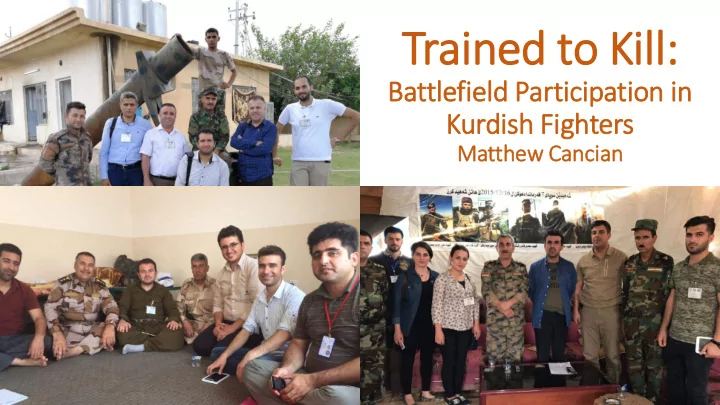
Train ined to Kil ill: Battlefield Part rticipation in in Kurdish Fig ighters Matthew Cancia ian Can US training improve the battlefield participation of our partners? Combat motivation: the reasons why soldiers under fire believe that


slide-1
SLIDE 1

Train ined to Kil ill:

Battlefield Part rticipation in in Kurdish Fig ighters

Matthew Cancia ian
slide-2
SLIDE 2
slide-3
SLIDE 3
slide-4
SLIDE 4
slide-5
SLIDE 5

Can US training improve the battlefield participation of our partners?

slide-6
SLIDE 6

Combat Motivation Battlefield Participation Combat Effectiveness

Combat motivation: the reasons why soldiers under fire believe that they should continue fighting

slide-7
SLIDE 7

Combat Motivation Battlefield Participation Combat Effectiveness

Battlefield participation: attempting to defeat the enemy when under fire (vis non-participation by either fleeing or hiding)

slide-8
SLIDE 8

Combat Motivation Battlefield Participation Combat Effectiveness

Combat effectiveness: the “pound for pound” contribution of each soldier towards achieving victory under enemy fire

slide-9
SLIDE 9
slide-10
SLIDE 10

Colonel Trevor Dupuy

“German divisions were 20 percent more effective than US divisions… Nine of the top 10 divisions in World War II were German."

slide-11
SLIDE 11

Cohesion Combat Motivation

slide-12
SLIDE 12
slide-13
SLIDE 13
slide-14
SLIDE 14

Combat Motivation Battlefield Participation Combat Effectiveness

How does the experience of combat feed back into battlefield participation?

slide-15
SLIDE 15

Combat Motivation Battlefield Participation Combat Effectiveness

Modern System Tactics

slide-16
SLIDE 16

Modern- System Tactics

“A tightly interrelated complex of cover, concealment, dispersion, suppression, small-unit independent maneuver, and combined arms”

  • Biddle 2006
slide-17
SLIDE 17

Cover and Concealment

slide-18
SLIDE 18

Dis ispersion

slide-19
SLIDE 19

Suppression

slide-20
SLIDE 20

Combat Motivation Battlefield Participation Combat Effectiveness US Training

Modern System Tactics

slide-21
SLIDE 21
slide-22
SLIDE 22

2014 – 2017: Untrained Volunteers, Internally Trained Regulars, and Western Modern-System Training

2014 – 2017: Untrained Volunteers, Internally Trained Regulars, and Western Modern-System Training

slide-23
SLIDE 23

“Today the Barw rwari Bala trib ibe showed up in in our thousands… to show them that we are here and that they will never take Kurdistan.”

slide-24
SLIDE 24
slide-25
SLIDE 25
slide-26
SLIDE 26
slide-27
SLIDE 27

This is not helpful

slide-28
SLIDE 28
slide-29
SLIDE 29
slide-30
SLIDE 30
slide-31
SLIDE 31
slide-32
SLIDE 32

Sinjar Mosul Erbil Halabja Kirkuk

slide-33
SLIDE 33
slide-34
SLIDE 34
slide-35
SLIDE 35
slide-36
SLIDE 36
slide-37
SLIDE 37

Untrained Internal Coalition

32.9% 31.2% 35.8%

slide-38
SLIDE 38

Hypothesis 1:

Calculations of success will be marginally increased by internal training but dramatically increased by coalition training

slide-39
SLIDE 39

On a scale of zero to ten, how confident are you in your unit’s readiness for combat?

slide-40
SLIDE 40

Untrained Internal Coalition

slide-41
SLIDE 41

Untrained Internal Coalition

slide-42
SLIDE 42

Untrained Internal Coalition

slide-43
SLIDE 43

Regress Training on Confidence No Clustering Regress Training on Confidence Clustering on Bases

Internal Coalition Internal Coalition

slide-44
SLIDE 44

Hypothesis 2:

Coalition training will have a greater positive effect on battlefield participation than internal training

slide-45
SLIDE 45

Untrained Internal Coalition

slide-46
SLIDE 46

Untrained Internal Coalition Modern System Non- Modern System

slide-47
SLIDE 47

Modern System Non- Modern System

slide-48
SLIDE 48

Modern System Non- Modern System 2,283 Peshmerga

slide-49
SLIDE 49

Modern System Non- Modern System 1,739 Peshmerga

Cutting Out Non-Combatants Reduces the Sample to 1,739

slide-50
SLIDE 50

Modern System Non- Modern System 955 Peshmerga

Cutting Out Non-Riflemen Reduces the Sample to 955

slide-51
SLIDE 51

I’ll read a number of statements. Don’t tell me which ones you agree with, just tell me how many.

In combat:

slide-52
SLIDE 52

Control Group Sensitive Group

  • There was a lot of noise
  • The situation was confusing
  • I didn’t fire back but just

waited for it to be over +

I’ll read a number of

  • statements. Don’t tell me

which ones you agree with, just tell me how many. In combat:

slide-53
SLIDE 53

Modern System Non- Modern System Non- Modern System Modern System Control Group Sensitive Group

slide-54
SLIDE 54

Non- Modern System Modern System Control Group Sensitive Group

slide-55
SLIDE 55

Non- Modern System Modern System Control Group Sensitive Group

slide-56
SLIDE 56

Non- Modern System Modern System Control Group Sensitive Group

+ ? = + ? =

slide-57
SLIDE 57

Non- Modern System Modern System Control Group Sensitive Group

.169* .028

*: p<.01

slide-58
SLIDE 58
slide-59
SLIDE 59

Traditional Argument:

“The source of combat motivation is key – we just need to know what motivates people and we will know both their battlefield participation”

slide-60
SLIDE 60
slide-61
SLIDE 61
slide-62
SLIDE 62

Combat Motivation Battlefield Participation Combat Effectiveness US Training

Modern System Tactics

slide-63
SLIDE 63
slide-64
SLIDE 64

Counter argument #1:

“Training is just changing the source

  • f combat motivation – driving

people from ideology to group solidarity or faith in their training”

slide-65
SLIDE 65
slide-66
SLIDE 66

Counter argument #2:

“Coalition training is pumping up soldiers to kill, not making them more effective”

slide-67
SLIDE 67
slide-68
SLIDE 68

Counter argument #3:

“Coalition training is just proxying for improved equipment or fire support”

slide-69
SLIDE 69
slide-70
SLIDE 70
slide-71
SLIDE 71