
SLIDE 1
1
Central Representation of Touch
John H. Martin, Ph.D. Center for Neurobiology & Behavior Columbia University CPS
Mechanosensation
- Touch and tactile exploration
- Vibration and pressure sensations;
important for clinical testing
- Limb position sense
- ∑ Stereognosia: identify 3-D shapes of
grasped objects
Dorsal column-medial lemniscal system
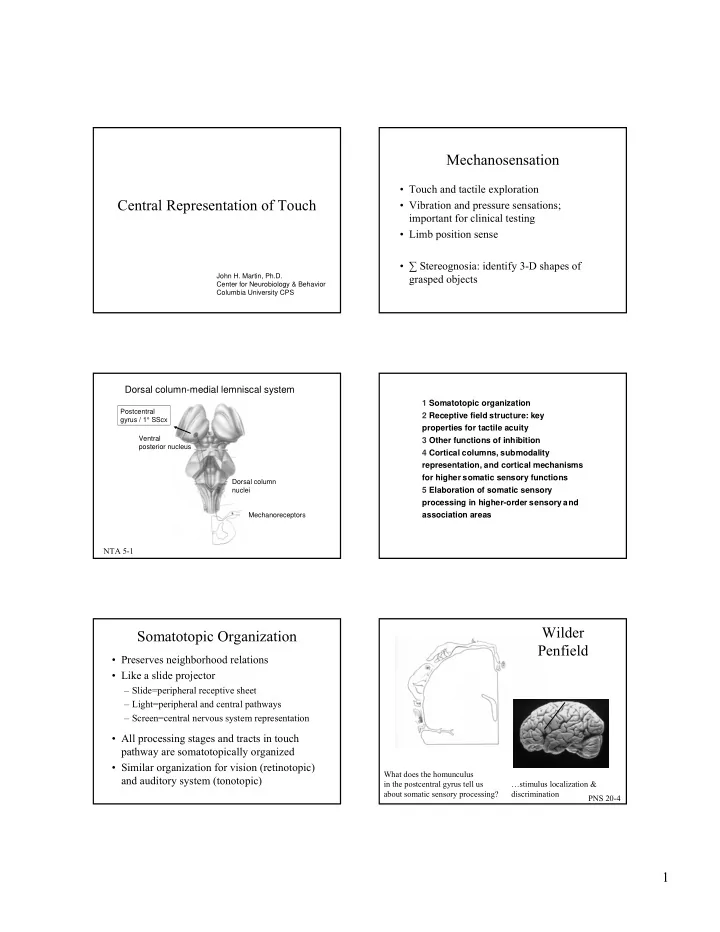
Mechanoreceptors Dorsal column nuclei Postcentral gyrus / 1° SScx Ventral posterior nucleus
NTA 5-1 1 Somatotopic organization 2 Receptive field structure: key properties for tactile acuity 3 Other functions of inhibition 4 Cortical columns, submodality representation, and cortical mechanisms for higher somatic sensory functions 5 Elaboration of somatic sensory processing in higher-order sensory and association areas
Somatotopic Organization
- Preserves neighborhood relations
- Like a slide projector
– Slide=peripheral receptive sheet – Light=peripheral and central pathways – Screen=central nervous system representation
- All processing stages and tracts in touch
pathway are somatotopically organized
- Similar organization for vision (retinotopic)