Mechanisms in Procedures Mechanisms in Procedures CS 105 Tour of - - PowerPoint PPT Presentation

mechanisms in procedures mechanisms in procedures
SMART_READER_LITE
LIVE PREVIEW

Mechanisms in Procedures Mechanisms in Procedures CS 105 Tour of - - PowerPoint PPT Presentation

Mechanisms in Procedures Mechanisms in Procedures CS 105 Tour of the Black Holes of Computing P() { Passing control To beginning of procedure code y


slide-1
SLIDE 1

Machine-Level Programming III: Procedures Machine-Level Programming III: Procedures

Topics

x86-64 stack discipline

Register-saving conventions

Creating pointers to local variables

CS 105 “Tour of the Black Holes of Computing”

– 2 – CS 105

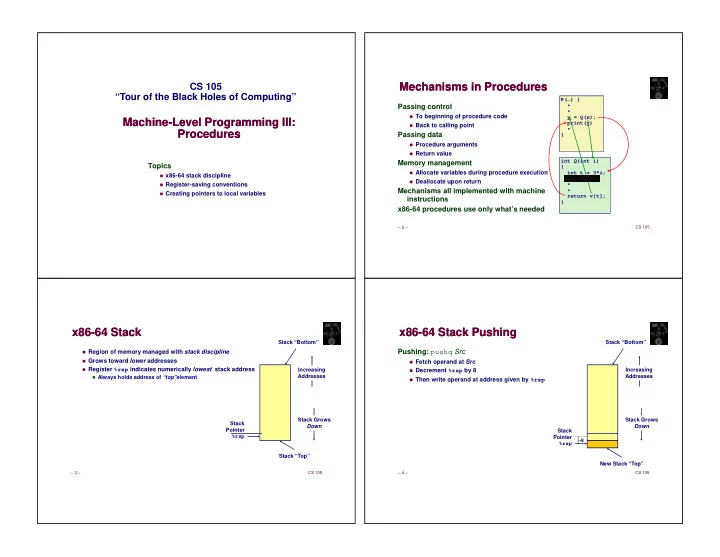
Mechanisms in Procedures Mechanisms in Procedures

Passing control

To beginning of procedure code

Back to calling point

Passing data

Procedure arguments

Return value

Memory management

Allocate variables during procedure execution

Deallocate upon return

Mechanisms all implemented with machine instructions x86-64 procedures use only what’s needed

P(…) {

  • y = Q(x);

print(y)

  • }

int Q(int i) { int t = 3*i; int v[10];

  • return v[t];

}

– 3 – CS 105

x86-64 Stack x86-64 Stack

Region of memory managed with stack discipline

Grows toward lower addresses

Register %rsp indicates numerically lowest stack address

Always holds address of “top”element

Stack Pointer %rsp Stack Grows Down Increasing Addresses Stack “Top” Stack “Bottom”

– 4 – CS 105

x86-64 Stack Pushing x86-64 Stack Pushing

Pushing: pushq Src

Fetch operand at Src

Decrement %rsp by 8

Then write operand at address given by %rsp

Stack Grows Down Increasing Addresses New Stack “Top” Stack “Bottom” Stack Pointer %rsp

  • 8
slide-2
SLIDE 2

– 5 – CS 105

x86-64 Stack Popping x86-64 Stack Popping

Popping: popq Dest

Read memory data at address given by %rsp

Increment %rsp by 8

Write to Dest

Stack Pointer %rsp Stack Grows Down Increasing Addresses New Stack “Top” Stack “Bottom”

+8

– 6 – CS 105

0x100 0x108 %rsp %rax %rdx %rsp %rax %rdx %rsp %rax %rdx 0x100 555 0x108 0x108 0x110 0x118 0x100 555 213 213 123

Stack Operation Examples Stack Operation Examples

0x108 0x110 0x118 555 213 123 0x108 0x100 pushq %rax 0x108 0x110 0x118 213 123 213 popq %rdx 213

– 7 – CS 105

Procedure Control Flow Procedure Control Flow

Use stack to support procedure call and return

Procedure call: call or callq

call label Push return address onto stack; jump to label

Return address value

Address of instruction just beyond call

Procedure return: ret or retq (or rep; ret)

Pop address (of instruction after corresponding call) from stack

Jump to that address

– 8 – CS 105

Control-Flow Example #1 Control-Flow Example #1

0000000000400550 <mult2>: 400550: mov %rdi,%rax

  • 400557: retq

0000000000400540 <multstore>:

  • 400544: callq 400550 <mult2>

400549: mov %rax,(%rbx)

  • 0x400544

0x120

  • %rsp

0x120 0x128 0x130 %rip

slide-3
SLIDE 3

– 9 – CS 105

Control-Flow Example #2 Control-Flow Example #2

0000000000400550 <mult2>: 400550: mov %rdi,%rax

  • 400557: retq

0000000000400540 <multstore>:

  • 400544: callq 400550 <mult2>

400549: mov %rax,(%rbx)

  • 0x400550

0x118 0x400549

  • %rsp

0x120 0x128 0x130 0x118 %rip

– 10 – CS 105

Control-Flow Example #3 Control-Flow Example #3

0000000000400550 <mult2>: 400550: mov %rdi,%rax

  • 400557: retq

0000000000400540 <multstore>:

  • 400544: callq 400550 <mult2>

400549: mov %rax,(%rbx)

  • 0x400557

0x118 0x400549

  • %rsp

0x120 0x128 0x130 0x118 %rip

– 11 – CS 105

Control-Flow Example #4 Control-Flow Example #4

0000000000400550 <mult2>: 400550: mov %rdi,%rax

  • 400557: retq

0000000000400540 <multstore>:

  • 400544: callq 400550 <mult2>

400549: mov %rax,(%rbx)

  • 0x400549

0x120

  • %rsp

0x120 0x128 0x130 %rip

– 12 – CS 105

Carnegie Mellon

Procedure Data Flow Procedure Data Flow

Registers First 6 arguments Return value Stack Only allocate stack space when needed

%rdi %rsi %rdx %rcx %r8 %r9 %rax Arg 7

  • • •

Arg 8 Arg n

  • • •
slide-4
SLIDE 4

– 13 – CS 105

Carnegie Mellon

Diane’s Silk Dress Cost $89 Diane’s Silk Dress Cost $89

Registers

%rdi %rsi %rdx %rcx %r8 %r9

– 14 – CS 105

Data-Flow Example Data-Flow Example

long mult2(long a, long b) { long s = a * b; return s; } void multstore(long x, long y, long *dest) { long t = mult2(x, y); *dest = t; } 0000000000400550 <mult2>: # a in %rdi, b in %rsi 400550: mov %rdi,%rax # a 400553: imul %rsi,%rax # a * b # s in %rax 400557: retq # Return 0000000000400540 <multstore>: # x in %rdi, y in %rsi, dest in %rdx

  • • •

400541: mov %rdx,%rbx # Save dest 400544: callq 400550 <mult2> # mult2(x,y) # t in %rax 400549: mov %rax,(%rbx) # Save at dest

  • • •

– 15 – CS 105

Stack-Based Languages Stack-Based Languages

Languages That Support Recursion

E.g., C, Pascal, Java, Python, Racket, Haskell, …

Code must be “reentrant”

Multiple simultaneous instantiations of single procedure

Need some place to store state of each instantiation

Arguments Local variables Return pointer

Stack Discipline

State for given procedure needed for limited time

From when called to when return

Callee returns before caller does

Stack Allocated in Frames

State for single procedure instantiation

– 16 – CS 105

Call Chain Example Call Chain Example

Code Structure

yoo(…) {

  • who();
  • }

who(…) {

  • • •

amI();

  • • •

amI();

  • • •

} amI(…) {

  • amI();
  • }

yoo who amI amI amI

Call Chain

Procedure amI is recursive

amI

slide-5
SLIDE 5

– 17 – CS 105

Carnegie Mellon

%rbp

Stack Frames Stack Frames

Contents

Return information

Local storage (if needed)

Temporary space (if needed)

Management

Space allocated when procedure entered

“Set-up” code Frame includes push done by call instruction

Deallocated upon return

“Finish” code Includes pop done by ret instruction

%rsp

  • proc
  • – 18 –

CS 105

Carnegie Mellon

Example Example

yoo who amI amI amI amI yoo %rbp %rsp

  • yoo

yoo(…) {

  • who();
  • }

– 19 – CS 105

yoo(…) {

  • who();
  • }

Carnegie Mellon

Example Example

yoo who amI amI amI amI yoo %rbp %rsp

  • yoo

who

who(…) {

  • • •

amI();

  • • •

amI();

  • • •

}

– 20 – CS 105

yoo(…) {

  • who();
  • }

who(…) {

  • • •

amI();

  • • •

amI();

  • • •

}

Carnegie Mellon

Example Example

yoo who amI amI amI amI yoo %rbp %rsp

  • yoo

who amI

amI(…) {

  • amI();
  • }
slide-6
SLIDE 6

– 21 – CS 105

Carnegie Mellon

Example Example

yoo who amI amI amI amI yoo %rbp %rsp

  • yoo

who amI amI

yoo(…) {

  • who();
  • }

who(…) {

  • • •

amI();

  • • •

amI();

  • • •

} amI(…) {

  • amI();
  • }

amI(…) {

  • amI();
  • }

– 22 – CS 105

Carnegie Mellon

Example Example

yoo who amI amI amI amI yoo %rbp %rsp

  • yoo

who amI amI amI

yoo(…) {

  • who();
  • }

who(…) {

  • • •

amI();

  • • •

amI();

  • • •

} amI(…) {

  • amI();
  • }

amI(…) {

  • amI();
  • }

amI(…) {

  • amI();
  • }

– 23 – CS 105

Carnegie Mellon

Example Example

yoo who amI amI amI amI yoo %rbp %rsp

  • yoo

who amI amI

yoo(…) {

  • who();
  • }

who(…) {

  • • •

amI();

  • • •

amI();

  • • •

} amI(…) {

  • amI();
  • }

amI(…) {

  • amI();
  • }

– 24 – CS 105

Carnegie Mellon

Example Example

yoo who amI amI amI amI yoo %rbp %rsp

  • yoo

who amI

yoo(…) {

  • who();
  • }

who(…) {

  • • •

amI();

  • • •

amI();

  • • •

} amI(…) {

  • amI();
  • }
slide-7
SLIDE 7

– 25 – CS 105

Carnegie Mellon

Example Example

yoo who amI amI amI amI yoo %rbp %rsp

  • yoo

who

yoo(…) {

  • who();
  • }

who(…) {

  • • •

amI();

  • • •

amI();

  • • •

}

– 26 – CS 105

Carnegie Mellon

Example Example

yoo who amI amI amI amI yoo %rbp %rsp

  • yoo

who amI

yoo(…) {

  • who();
  • }

who(…) {

  • • •

amI();

  • • •

amI();

  • • •

} amI(…) {

  • amI();
  • }

– 27 – CS 105

Carnegie Mellon

Example Example

yoo who amI amI amI amI yoo %rbp %rsp

  • yoo

who

yoo(…) {

  • who();
  • }

who(…) {

  • • •

amI();

  • • •

amI();

  • • •

}

– 28 – CS 105

Carnegie Mellon

Example Example

yoo who amI amI amI amI yoo %rbp %rsp

  • yoo

yoo(…) {

  • who();
  • }
slide-8
SLIDE 8

– 29 – CS 105

Carnegie Mellon

x86-64/Linux Stack Frame x86-64/Linux Stack Frame

Current Stack Frame (“Top” to Bottom)

“Argument build:” Parameters for function about to be called

Local variables (if can’t keep in registers)

Saved register context

Old frame pointer (optional)

Caller Stack Frame

Return address

Pushed by call instruction

Arguments for this call

  • %rbp
  • %rbp
  • %rsp
  • – 30 –

CS 105

Carnegie Mellon

Example: incr Example: incr

long incr(long *p, long val) { long x = *p; long y = x + val; *p = y; return x; } incr: movq (%rdi), %rax addq %rax, %rsi movq %rsi, (%rdi) ret

  • %rdi

p %rsi valy %rax x

– 31 – CS 105

Carnegie Mellon

Example: Calling incr #1 Example: Calling incr #1

call_incr: subq $16, %rsp movq $15213, 8(%rsp) movl $3000, %esi leaq 8(%rsp), %rdi call incr addq 8(%rsp), %rax addq $16, %rsp ret long call_incr() { long v1 = 15213; long v2 = incr(&v1, 3000); return v1 + v2; } %rsp

  • 15213
  • %rsp
  • %rsp+8

– 32 – CS 105

Carnegie Mellon

Example: Calling incr #2 Example: Calling incr #2

call_incr: subq $16, %rsp movq $15213, 8(%rsp) movl $3000, %esi leaq 8(%rsp), %rdi call incr addq 8(%rsp), %rax addq $16, %rsp ret long call_incr() { long v1 = 15213; long v2 = incr(&v1, 3000); return v1 + v2; } 15213

  • %rsp
  • %rsp+8
  • %rdi

&v1 %rsi 3000

slide-9
SLIDE 9

– 33 – CS 105

Carnegie Mellon

Example: Calling incr #3 Example: Calling incr #3

call_incr: subq $16, %rsp movq $15213, 8(%rsp) movl $3000, %esi leaq 8(%rsp), %rdi call incr addq 8(%rsp), %rax addq $16, %rsp ret long call_incr() { long v1 = 15213; long v2 = incr(&v1, 3000); return v1 + v2; } 18213

  • %rsp
  • %rsp+8
  • %rdi

&v1 %rsi 3000

– 34 – CS 105

Carnegie Mellon

Example: Calling incr #4 Example: Calling incr #4

call_incr: subq $16, %rsp movq $15213, 8(%rsp) movl $3000, %esi leaq 8(%rsp), %rdi call incr addq 8(%rsp), %rax addq $16, %rsp ret long call_incr() { long v1 = 15213; long v2 = incr(&v1, 3000); return v1 + v2; } 18213

  • %rsp
  • %rsp+8
  • %rax
  • %rsp
  • – 35 –

CS 105

Carnegie Mellon

Example: Calling incr #5 Example: Calling incr #5

call_incr: subq $16, %rsp movq $15213, 8(%rsp) movl $3000, %esi leaq 8(%rsp), %rdi call incr addq 8(%rsp), %rax addq $16, %rsp ret long call_incr() { long v1 = 15213; long v2 = incr(&v1, 3000); return v1 + v2; }

  • %rax
  • %rsp
  • %rsp
  • – 36 –

CS 105

Carnegie Mellon

Register Saving Conventions Register Saving Conventions

When procedure yoo calls who:

yoo is the

who is the

Can register x be used for temporary storage?

Contents of register %rdx overwritten by who

This could be trouble something should be done!

Need some coordination

yoo:

  • • •

movq $15213, %rdx call who addq %rdx, %rax

  • • •

ret who:

  • • •

subq $18213, %rdx

  • • •

ret

slide-10
SLIDE 10

– 37 – CS 105

Carnegie Mellon

Register Saving Conventions Register Saving Conventions

When procedure yoo calls who:

yoo is the

who is the

Can register x be used for temporary storage? Conventions

  • Caller saves temporary values in its frame before the call

Callee saves temporary values in its frame before using Callee restores them before returning to caller

– 38 – CS 105

Carnegie Mellon

x86-64 Linux Register Usage #1 x86-64 Linux Register Usage #1

%rax

Return value

Caller-saved

Can be modified by procedure

%rdi, ..., %r9

Arguments (Diane’s silk dress)

Caller-saved

Can be modified by procedure

%r10, %r11

Caller-saved

Can be modified by procedure

%rax %rdx %rcx

  • %r8

%r9 %r10 %r11 %rdi %rsi

  • Remember

Diane!

– 39 – CS 105

Carnegie Mellon

x86-64 Linux Register Usage #2 x86-64 Linux Register Usage #2

%rbx, %r12, %r13, %r14

Callee-saved

Callee must save & restore

%rbp

Callee-saved

Callee must save & restore

May be used as frame pointer or as scratch

Can mix & match

%rsp

Special form of callee save

Restored to original value upon exit from procedure

%rbx %rsp

  • %rbp

%r12 %r13 %r14

– 40 – CS 105

Carnegie Mellon

Callee-Saved Example #1 Callee-Saved Example #1

call_incr2: pushq %rbx subq $16, %rsp movq %rdi, %rbx movq $15213, 8(%rsp) movl $3000, %esi leaq 8(%rsp), %rdi call incr addq %rbx, %rax addq $16, %rsp popq %rbx ret long call_incr2(long x) { long v1 = 15213; long v2 = incr(&v1, 3000); return x + v2; } %rsp

  • 15213
  • %rsp
  • %rsp+8

%rbx

slide-11
SLIDE 11

– 41 – CS 105

Carnegie Mellon

Callee-Saved Example #2 Callee-Saved Example #2

call_incr2: pushq %rbx subq $16, %rsp movq %rdi, %rbx movq $15213, 8(%rsp) movl $3000, %esi leaq 8(%rsp), %rdi call incr addq %rbx, %rax addq $16, %rsp popq %rbx ret long call_incr2(long x) { long v1 = 15213; long v2 = incr(&v1, 3000); return x + v2; } %rsp

  • 15213
  • %rsp
  • %rsp+8

%rbx

– 42 – CS 105

Carnegie Mellon

/* Recursive popcount */ long pcount_r(unsigned long x) { if (x == 0) return 0; else return (x & 1) + pcount_r(x >> 1); }

Recursive Function Recursive Function

pcount_r: movl $0, %eax testq %rdi, %rdi je .L6 pushq %rbx movq %rdi, %rbx andl $1, %ebx shrq %rdi call pcount_r addq %rbx, %rax popq %rbx .L6: rep; ret

– 43 – CS 105

Carnegie Mellon

/* Recursive popcount */ long pcount_r(unsigned long x) { if (x == 0) return 0; else return (x & 1) + pcount_r(x >> 1); }

Recursive Function Terminal Case Recursive Function Terminal Case

pcount_r: movl $0, %eax testq %rdi, %rdi je .L6 pushq %rbx movq %rdi, %rbx andl $1, %ebx shrq %rdi call pcount_r addq %rbx, %rax popq %rbx .L6: rep; ret

  • %rdi

x Argument %rax Return value Return value

– 44 – CS 105

Carnegie Mellon

/* Recursive popcount */ long pcount_r(unsigned long x) { if (x == 0) return 0; else return (x & 1) + pcount_r(x >> 1); }

Recursive Function Register Save Recursive Function Register Save

pcount_r: movl $0, %eax testq %rdi, %rdi je .L6 pushq %rbx movq %rdi, %rbx andl $1, %ebx shrq %rdi call pcount_r addq %rbx, %rax popq %rbx .L6: rep; ret

  • %rdi

x Argument %rsp

  • %rbx
slide-12
SLIDE 12

– 45 – CS 105

Carnegie Mellon

/* Recursive popcount */ long pcount_r(unsigned long x) { if (x == 0) return 0; else return (x & 1) + pcount_r(x >> 1); }

Recursive Function Call Setup Recursive Function Call Setup

pcount_r: movl $0, %eax testq %rdi, %rdi je .L6 pushq %rbx movq %rdi, %rbx andl $1, %ebx shrq %rdi call pcount_r addq %rbx, %rax popq %rbx .L6: rep; ret

  • %rdi

x >> 1

  • Rec. argument

%rbx x & 1 Callee-saved

– 46 – CS 105

Carnegie Mellon

/* Recursive popcount */ long pcount_r(unsigned long x) { if (x == 0) return 0; else return (x & 1) + pcount_r(x >> 1); }

Recursive Function Call Recursive Function Call

pcount_r: movl $0, %eax testq %rdi, %rdi je .L6 pushq %rbx movq %rdi, %rbx andl $1, %ebx shrq %rdi call pcount_r addq %rbx, %rax popq %rbx .L6: rep; ret

  • %rbx

x & 1 Callee-saved %rax Recursive call return value

– 47 – CS 105

Carnegie Mellon

/* Recursive popcount */ long pcount_r(unsigned long x) { if (x == 0) return 0; else return (x & 1) + pcount_r(x >> 1); }

Recursive Function Result Recursive Function Result

pcount_r: movl $0, %eax testq %rdi, %rdi je .L6 pushq %rbx movq %rdi, %rbx andl $1, %ebx shrq %rdi call pcount_r addq %rbx, %rax popq %rbx .L6: rep; ret

  • %rbx

x & 1 Callee-saved %rax Return value

– 48 – CS 105

Carnegie Mellon

/* Recursive popcount */ long pcount_r(unsigned long x) { if (x == 0) return 0; else return (x & 1) + pcount_r(x >> 1); }

Recursive Function Completion Recursive Function Completion

pcount_r: movl $0, %eax testq %rdi, %rdi je .L6 pushq %rbx movq %rdi, %rbx andl $1, %ebx shrq %rdi call pcount_r addq %rbx, %rax popq %rbx .L6: rep; ret

  • %rax

Return value Return value %rsp

slide-13
SLIDE 13

– 49 – CS 105

Carnegie Mellon

Observations About Recursion Observations About Recursion

Handled without special consideration

Stack frames mean that each function call has private storage

Saved registers & local variables Saved return pointer

Register saving conventions prevent one function call from corrupting another’s data

…unless the C code explicitly does so (e.g., buffer overflow in future lecture)

Stack discipline follows call / return pattern

If P calls Q, then Q returns before P Last-In, First-Out

Also works for mutual recursion

P calls Q; Q calls P

– 50 – CS 105

Carnegie Mellon

x86-64 Procedure Summary x86-64 Procedure Summary

Important Points

Stack is the right data structure for procedure call & return

If P calls Q, then Q returns before P

Recursion (& mutual recursion) handled by normal calling conventions

Can safely store values in local stack frame and in callee- saved registers

Put function arguments at top of stack

Result return in %rax

Pointers are addresses of values

On stack or global

  • %rbp

(Optional) %rsp