
SLIDE 1
Mechanisms in E. coli & human mismatch repair Paul Modrich - - PowerPoint PPT Presentation
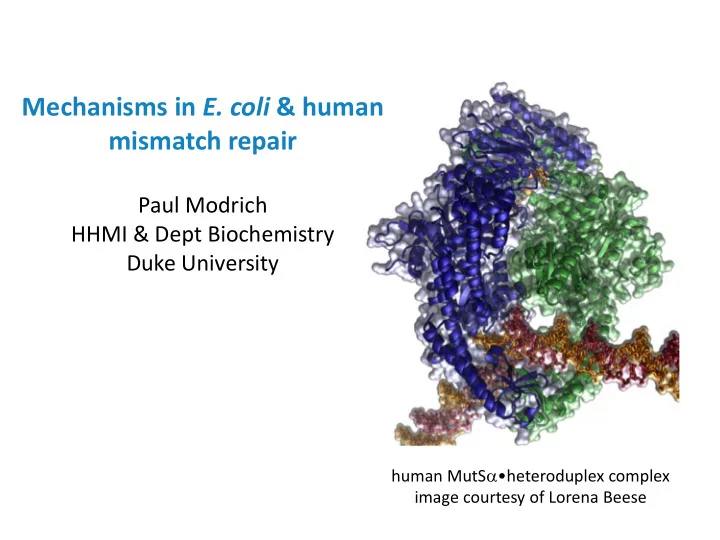
Mechanisms in E. coli & human mismatch repair Paul Modrich HHMI & Dept Biochemistry Duke University human MutS heteroduplex complex image courtesy of Lorena Beese Microsatellite instability in tumor cells LA Aaltonen et al
Tumor cell line Microsatellite instability 3’ G-T heteroduplex repair (fmol) Defect
HeLa (cervix) No 9
No 13
No 7.4
Yes < 0.3 MutSα HCT-15 (colon) Yes < 0.3 MutSα HEC-59 (endometrial) Yes < 0.3 MutSα HCT 116 (colon) Yes < 0.3 MutLα Vaco 481 (colon) Yes < 0.3 MutLα RKO (colon)* Yes < 0.3 MutLα Vaco 5 (colon)* Yes 0.4 MutLα Vaco 6 (colon)* Yes < 0.3 MutLα AN3CA (endometrial)* Yes < 0.3 MutLα
*sporadic cancers with MLH1 epigenetically silenced