Measuring YouTube Content Delivery over IPv6 Q/A Recommendations - - PowerPoint PPT Presentation

measuring youtube content delivery over ipv6
SMART_READER_LITE
LIVE PREVIEW

Measuring YouTube Content Delivery over IPv6 Q/A Recommendations - - PowerPoint PPT Presentation

Motivation Prague, CZ July 2017 Jacobs University Bremen, Germany Jrgen Schnwlder TU Munich, Germany Jrg Ott Aalto University, Helsinki, Finland Saba Ahsan Joint work with SIGCOMM Computer Communication Review Published at: IETF


slide-1
SLIDE 1

Motivation Methodology Success Rate IPv6 Preference TCP connect times Startup Delay Tiroughput Stall Events Recommendations Q/A

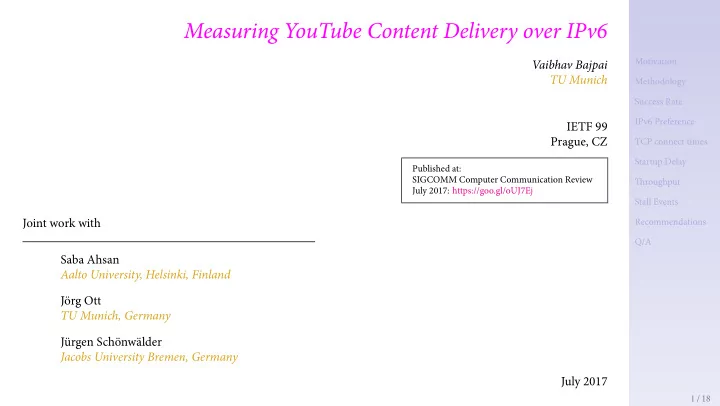
Measuring YouTube Content Delivery over IPv6

Vaibhav Bajpai TU Munich IETF 99 Prague, CZ

Published at: SIGCOMM Computer Communication Review July 2017: https://goo.gl/oUJ7Ej

Joint work with Saba Ahsan Aalto University, Helsinki, Finland Jörg Ott TU Munich, Germany Jürgen Schönwälder Jacobs University Bremen, Germany July 2017

1 / 18

slide-2
SLIDE 2

Motivation Methodology Success Rate IPv6 Preference TCP connect times Startup Delay Tiroughput Stall Events Recommendations Q/A

Motivation

▶ IPv6 contributes ∼25% [1] of traffjc within Comcast. ▶ Swisscom reports ∼60% [1] of IPv6 traffjc is YouTube. ▶ IPv6 traffjc largely dominated by YouTube [2].

2009 2010 2011 2012 2013 2014 2015 2016 2017 0% 5% 10% 15% 20% Google IPv6 Adoption

shaded region represents the duration of the longitudinal study.

Do users experience benefjt (or sufger) from YouTube streaming over IPv6? ∼100 dual-stacked SamKnows probes (∼66 difgerent origin ASes)

NETWORK TYPE # RESIDENTIAL 78 NREN / RESEARCH 10 BUSINESS / DATACENTER 08 OPERATOR LAB 04 IXP 01 RIR # RIPE 60 ARIN 29 APNIC 10 AFRINIC 01 LACNIC 01 2 / 18

slide-3
SLIDE 3

Motivation Methodology Success Rate IPv6 Preference TCP connect times Startup Delay Tiroughput Stall Events Recommendations Q/A

Research Contribution

▶ HE (RFC 6555) makes clients to prefer streaming YouTube videos over IPv6. ▶ Observed performance (both in terms of latency and throughput) over IPv6 is worse. ▶ Stall rates are low, bitrates that can be reliably streamed are comparable. ▶ When a stall occurs, stall durations over IPv6 are higher. ▶ Worse performance is due to GGC nodes that are IPv4-only.

Tiis is the fjrst study to measure YouTube content delivery over IPv6

3 / 18

slide-4
SLIDE 4

Motivation Methodology Success Rate IPv6 Preference TCP connect times Startup Delay Tiroughput Stall Events Recommendations Q/A

Methodology | Selection of YouTube Videos

▶ Using YouTube v3 API [3]. ▶ Video Selection Criteria:

  • 1. Video duration > 60s.
  • 2. Available in Full HD.
  • 3. No regional restrictions.

▶ List updated every 12h. ▶ Probes daily pull the list. ▶ Tie test supports non-adaptive and step-down playout modes only. ▶ Results are biased our vantage points (centered largely around EU, US and JP).

4 / 18

slide-5
SLIDE 5

Motivation Methodology Success Rate IPv6 Preference TCP connect times Startup Delay Tiroughput Stall Events Recommendations Q/A

Success Rate

▶ Number of successful

iterations to total iterations.

▶ Tie test executes once every

hour (over both AF).

0.0 0.2 0.4 0.6 0.8 1.0 CCDF Success Rate IPv6 (102) 80% 85% 90% 95% 100% 0.0 0.2 0.4 0.6 0.8 1.0 IPv4 (102) ['14 - '17]

▶ 99% of probes achieve success rate of more than 94% over IPv4. ▶ 97% of probes achieve success rate of more than 94% over IPv6. ▶ Slightly lower success rates over IPv6 due to network issues closer to probes.

5 / 18

slide-6
SLIDE 6

Motivation Methodology Success Rate IPv6 Preference TCP connect times Startup Delay Tiroughput Stall Events Recommendations Q/A

IPv6 Preference

95% 96% 97% 98% 99% 100% 0.0 0.2 0.4 0.6 0.8 1.0 CCDF Web (871) Audio (871) Video (871)

['14 - '17]

IPv6 Preference

▶ RFC 6724 [4] makes apps prefer connections made over IPv6. ▶ RFC 6555 [5] allows apps to fallback to IPv4 when IPv6 connectivity is bad. ▶ TCP connections over IPv6 are preferred at least 97% of the time.

Clients prefer streaming YouTube videos over IPv6

6 / 18

slide-7
SLIDE 7

Motivation Methodology Success Rate IPv6 Preference TCP connect times Startup Delay Tiroughput Stall Events Recommendations Q/A

TCP connect times

−100 −75 −50 −25 25 50 ∆t (ms) 0.0 0.2 0.4 0.6 0.8 1.0 CDF Web (6.5M) Audio (6.5M) Video (6.5M) ['14 - '17] TCP connect times

▶ 63% of a/v streams (and 72% of the web connections) are slower over IPv6. ▶ 14% of a/v streams are at least 10 ms slower over IPv6.

7 / 18

slide-8
SLIDE 8

Motivation Methodology Success Rate IPv6 Preference TCP connect times Startup Delay Tiroughput Stall Events Recommendations Q/A

TCP connect times

−5 ∆t (ms) TCP Connect Times Web Jan 2015 Jan 2016 Jan 2017 Jul Jul Jul −0.4 −0.3 −0.2 −0.1 0.0 ∆t (ms) TCP Connect Times Audio Video

▶ TCP connect times consistently higher over IPv6 and have not improved over time. ▶ TCP connect times towards the webpage worse over IPv6 than towards media servers.

8 / 18

slide-9
SLIDE 9

Motivation Methodology Success Rate IPv6 Preference TCP connect times Startup Delay Tiroughput Stall Events Recommendations Q/A

Sequence Diagram (contd.)

9 / 18

slide-10
SLIDE 10

Motivation Methodology Success Rate IPv6 Preference TCP connect times Startup Delay Tiroughput Stall Events Recommendations Q/A

Startup Delay

−5 −4 −3 −2 −1 1 ∆s (s) 0.0 0.2 0.4 0.6 0.8 1.0 CDF 6.5M ['14 - '17] Startup Delay

▶ 80% of the samples are slower over IPv6. ▶ Half of the samples are at least 100 ms slower over IPv6.

10 / 18

slide-11
SLIDE 11

Motivation Methodology Success Rate IPv6 Preference TCP connect times Startup Delay Tiroughput Stall Events Recommendations Q/A

Startup Delay

▶ Prebufgering durations are ∼25 ms higher over IPv6. ▶ Startup delays are ∼100 ms higher over IPv6. ▶ Initial interaction with the web server makes startup delay worse over IPv6.

11 / 18

slide-12
SLIDE 12

Motivation Methodology Success Rate IPv6 Preference TCP connect times Startup Delay Tiroughput Stall Events Recommendations Q/A

Sequence Diagram (contd.)

12 / 18

slide-13
SLIDE 13

Motivation Methodology Success Rate IPv6 Preference TCP connect times Startup Delay Tiroughput Stall Events Recommendations Q/A

Tiroughput

−4 −2 2 4 ∆tp (MB/s) 0.0 0.2 0.4 0.6 0.8 1.0 CDF

Video (6.5M) Audio (6.5M)

['14 - '17] Throughput

Jan 2015 Jan 2016 Jan 2017 Jul Jul Jul −1.0 −0.7 −0.4 −0.1 0.2 ∆tp (MB/s) Throughput Video Audio

▶ 80% of video and 60% audio samples achieve lower throughput over IPv6. ▶ Tie throughput is consistently lower over IPv6, but it has improved over time.

13 / 18

slide-14
SLIDE 14

Motivation Methodology Success Rate IPv6 Preference TCP connect times Startup Delay Tiroughput Stall Events Recommendations Q/A

Sequence Diagram (contd.)

14 / 18

slide-15
SLIDE 15

Motivation Methodology Success Rate IPv6 Preference TCP connect times Startup Delay Tiroughput Stall Events Recommendations Q/A

Stall Rates

0.0 0.2 0.4 0.6 0.8 1.0 CDF Stall Rate IPv6 (102) 0% 5% 10% 15% 20% 25% 30% 0.0 0.2 0.4 0.6 0.8 1.0 IPv4 (102) ['14 - '17]

▶ 90% of the probes witness less than 1% stall rate over both address families. ▶ Bitrates reliably streamed is also comparable over both address families.

15 / 18

slide-16
SLIDE 16

Motivation Methodology Success Rate IPv6 Preference TCP connect times Startup Delay Tiroughput Stall Events Recommendations Q/A

Stall Durations

−60 −40 −20 20 40 60 ∆st (s) 0.0 0.2 0.4 0.6 0.8 1.0 CDF 1.7K ['14 - '17] Stall Durations

▶ 80% of samples experience stall durations that are at least 1s longer.

16 / 18

slide-17
SLIDE 17

Motivation Methodology Success Rate IPv6 Preference TCP connect times Startup Delay Tiroughput Stall Events Recommendations Q/A

Recommendations

▶ Update RFC 6555 with a lower HE timer value.

▶ We have shown [6] that reducing HE timer value to 150 ms (from 300 ms) helps.

2009 2010 2011 2012 2013 2014 2015 2016 2017 0.00% 0.05% 0.10% 0.15% 0.20% W6D W6LD 6to4/Teredo Decline

▶ ISPs should put latency as a fjrst-class citizen. ▶ ISPs should ensure GGC nodes are dual-stacked.

▶ Request an IPv6 prefjx allocation from Google. 17 / 18

slide-18
SLIDE 18

Motivation Methodology Success Rate IPv6 Preference TCP connect times Startup Delay Tiroughput Stall Events Recommendations Q/A

Takeway

▶ Clients prefer streaming YouTube videos over IPv6. ▶ Observed performance (both in terms of latency and throughput) over IPv6 is worse. ▶ Stall rates are low, but when a stall occurs, stall durations over IPv6 are higher. ▶ Worse performance due to GGC nodes that are IPv4-only. ▶ Reproducibility Considerations:

▶ Tie test is open-sourced: https://github.com/sabyahsan/youtube-test ▶ Tie dataset is released: https://github.com/vbajpai/2017-ccr-youtube-analysis

www.vaibhavbajpai.com bajpaiv@in.tum.de | @bajpaivaibhav

18 / 18

slide-19
SLIDE 19

Motivation Methodology Success Rate IPv6 Preference TCP connect times Startup Delay Tiroughput Stall Events Recommendations Q/A

References

[1]

  • NANOG. (2016) IPv6 traffjc percentages? [Online]. Available: https:

//mailman.nanog.org/pipermail/nanog/2016-January/083624.html [2]

  • N. Sarrar, G. Maier, B. Ager, R. Sommer, and S. Uhlig, “Investigating

IPv6 Traffjc - What Happened at the World IPv6 Day?” ser. Passive and Active Measurement Conference, 2012, pp. 11–20. [Online]. Available: https://doi.org/10.1007/978-3-642-28537-0_2 [3]

  • G. Developers. (2017) YouTube Data API. [Online]. Available:

https://developers.google.com/youtube/v3/docs/videos/list [4]

  • D. Tialer, R. Draves, A. Matsumoto, and T. Chown, “Default Address

Selection for Internet Protocol Version 6 (IPv6),” RFC 6724 (Proposed Standard), RFC Editor, Fremont, CA, USA, pp. 1–32, Sep. 2012. [Online]. Available: https://www.rfc-editor.org/rfc/rfc6724.txt [5]

  • D. Wing and A. Yourtchenko, “Happy Eyeballs: Success with

Dual-Stack Hosts,” RFC 6555 (Proposed Standard), RFC Editor, Fremont, CA, USA, pp. 1–15, Apr. 2012. [Online]. Available: https://www.rfc-editor.org/rfc/rfc6555.txt [6]

  • V. Bajpai and J. Schönwälder, “Measuring the Efgects of Happy

Eyeballs,” ser. Applied Networking Research Workshop, 2016. [Online]. Available: http://dl.acm.org/citation.cfm?id=2959429 18 / 18