MD 355 - South Corridor Advisory Committee Meeting # 7 Executive - - PowerPoint PPT Presentation

md 355 south corridor advisory committee meeting 7
SMART_READER_LITE
LIVE PREVIEW

MD 355 - South Corridor Advisory Committee Meeting # 7 Executive - - PowerPoint PPT Presentation

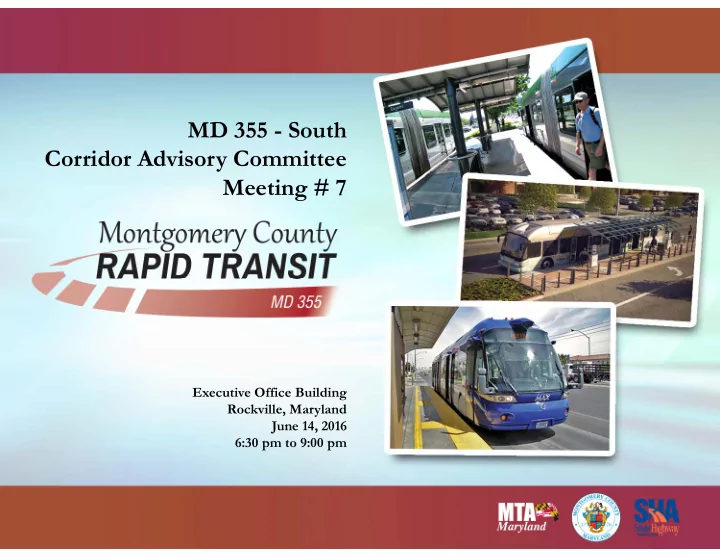
MD 355 - South Corridor Advisory Committee Meeting # 7 Executive Office Building Rockville, Maryland June 14, 2016 6:30 pm to 9:00 pm 1 Welcome Agenda: Public Open Houses Summary..10 min

slide-1
SLIDE 1

1

MD 355 - South Corridor Advisory Committee Meeting # 7

Executive Office Building Rockville, Maryland June 14, 2016 6:30 pm to 9:00 pm

slide-2
SLIDE 2

2

Welcome

Agenda:

  • Public Open Houses Summary………………….……………………….…10 min
  • Alternatives Screening Criteria………………………...……….….........20 min
  • Conceptual Alternatives Development
  • Running ways…………………………………………………………………40 min
  • Tabletop Discussion.…………………………………………………………….60 min
  • Additional Q&A ........................................................................10 min

Note: Each topic will be followed by a question and answer session. Please hold questions and comments until the section presentation is complete.

slide-3
SLIDE 3

3

Public Open Houses Summary

  • Approximately 160 people attended
  • Outreach efforts included:
  • 75,000+ Postcards
  • Informational fliers
  • Print ads
  • Public service announcements
  • Languages used in the outreach: English, Spanish, Russian,

Chinese and Vietnamese

  • All meeting materials available on the project website:

montgomerycountymd.gov/RTS/md355openhouses.html

slide-4
SLIDE 4

4

Public Open Houses Summary

  • 50+ comments received. Themes include:
  • Relation of BRT to Metro
  • BRT amenities
  • Impact to traffic operations
  • Improved bicycle facilities
  • Dedicated BRT lanes to attract riders
  • Fix existing infrastructure (roads, Metro)
  • Parking needs at northern stations
  • Service should be frequent (5‐10 min)
slide-5
SLIDE 5

5

Questions?

 Public Open House Summary Q&A

  • Alternatives Screening Criteria
  • Conceptual Alternatives Development
  • Running ways
  • Tabletop Discussion
  • Additional Q&A
slide-6
SLIDE 6

6

Corridor Planning Process

Existing Conditions and Data Collection (Completed) Corridor Goals/Objectives Draft Preliminary Purpose and Need (Ongoing) Public Open Houses (Spring 2016) (Completed) Conceptual Alternatives Development (Ongoing) Preliminary Analysis

  • f Conceptual

Alternatives (Summer 2016) Alternatives Public Workshop (Fall 2016) Alternatives Retained for Detailed Study (ARDS) (Late 2016)

We are here

slide-7
SLIDE 7

7

Screening Criteria Process MD 355 Corridor Needs MD 355 BRT Project Purpose Screening Criteria RTS Goals and Objectives

Preliminary Purpose and Need

slide-8
SLIDE 8

8

Alternatives Screening and Selection Process

  • 1. Identify

Constraints

  • 2. Comparative

Screening

  • 3. Detailed Analysis /

Selection

Public Input

{ {

Current Phase Completed Late 2016 Next Phase Completed Fall 2018

ARDS LPA

slide-9
SLIDE 9

9

Alternatives Screening Criteria

  • Screening criteria elements include:
  • Transit Ridership (BRT, Local bus,

total)

  • Boardings by station
  • Travel time (BRT, Automobiles)
  • Person throughput
  • Jobs/people within 45 & 60

minutes of activity centers

  • Property impacts
  • Environmental impacts
  • Costs (Capital, Operating)

Project Purpose

Improve Quality of Service Improve Mobility Opportunities Enhance Quality of Life Support Master Planned Development

Support Sustainable and Cost Effective Trasnportation Solutions

slide-10
SLIDE 10

10

Questions?

 Preview of Public Open House Q&A  Alternatives Screening Criteria

  • Conceptual Alternatives Development
  • Running ways
  • Tabletop Discussion
  • Additional Q&A
slide-11
SLIDE 11

11

Conceptual Alternatives – Running Way

  • Utilized the Countywide Transit Corridors

Functional Master Plan as a starting point

  • Developed five build alternatives for analysis

purposes in addition to the no‐build alternative

  • Divided the study into seven different

sections recognizing changing corridor characteristics – One size does not fit all

  • A minimum of two different running way
  • ptions being evaluated for every section
slide-12
SLIDE 12

12

Conceptual Alternatives – Running Way

IT IS POSSIBLE THAT ONE OR MORE OF THE ALTERNATIVES RECOMMENDED FOR DETAILED STUDY MAY BE A HYBRID OF THE ALTERNATIVES AS CURRENTLY PROPOSED

slide-13
SLIDE 13

13

Conceptual Alternatives – Running Way

  • Middlebrook Road to Clarksburg

Section 7 – Germantown / Clarksburg (~6.2 miles)

  • MD 124 (Montgomery Village Avenue) to Middlebrook Road

Section 6 – Montgomery Village / Germantown (~3.2 miles)

  • Summit Avenue to MD 124 (Montgomery Village Avenue)

Section 5 – Gaithersburg (~1.4 miles)

  • College Parkway to Summit Avenue

Section 4 – Rockville / Shady Grove (~3.2 miles)

  • Dodge Street to College Parkway

Section 3 – Rockville Town Center (~1.8 miles)

  • Grosvenor Metrorail Station to Dodge Street

Section 2 – White Flint / Rockville (~4.1 miles)

  • Bethesda Metrorail Station to Grosvenor Metrorail Station

Section 1 – Bethesda (~3.2 miles)

slide-14
SLIDE 14

14

Conceptual Alternatives – Running Way Three Challenging Sections

Section 5 ‐ Gaithersburg

  • 5 lane section
  • Center left turn lane used to access businesses
  • Buildings in close proximity to roadway
  • Bridge over railroad tracks and roadway

Section 3 – Rockville Town Center

  • Buildings in close proximity to roadway
  • Service roads providing inter‐parcel connectivity
  • Rail tracks on east side in close proximity to roadway
  • Park and historic property

Section 1 ‐ Bethesda

  • Buildings in close proximity to roadway south of Jones Bridge Road
  • Federal properties abutting both sides of roadway
  • Three listed historic properties
  • Beltway bridges
slide-15
SLIDE 15

15

Conceptual Alternatives – Running Way Alternatives Under Consideration

  • Alternative 1 – No Build
  • Alternative 2 – Transportation System Management (TSM)
  • Alternative 3A and 3B
  • Proposes BRT service mostly in the median
  • Only Sections 1, 3 and 7 are different between the two
  • Alternative 3A provides service from Grosvenor Metrorail Station to

Clarksburg Outlets

  • Alternative 3B provides service from Bethesda Metrorail Station to

Redgrave Place

  • Alternative 3A proposes lane repurposing for Section 5
  • Alternative 3B proposed lane repurposing for Sections 1, 3 and 5
slide-16
SLIDE 16

16

Conceptual Alternatives – Running Way Alternatives Under Consideration

  • Alternative 4A and 4B
  • Proposes BRT service mostly in the curb
  • Alternative 4A transitions to median for Sections 3,4 and 5
  • Alternative 4A provides service from Grosvenor Metrorail

Station to Redgrave Place

  • Alternative 4B provides service from Bethesda Metrorail

Station to Redgrave Place

  • Alternative 4A proposes lane repurposing for Section 5
  • Alternative 4B proposed lane repurposing for Sections 1, 3

and 5

slide-17
SLIDE 17

17

Conceptual Alternatives – Running Way Alternative 1 – No Build

  • Includes planned and programmed transit and roadway

improvements as currently listed in the Consolidated Long‐Range Plan

slide-18
SLIDE 18

18

Conceptual Alternatives – Running Way Alternative 2 – Transportation System Management

  • Enhanced bus service in existing lanes
  • Queue jumps at some intersections
  • Transit Signal Priority (TSP) at some intersections
slide-19
SLIDE 19

19

Conceptual Alternatives – Running Way Alternative 3A

  • Provides new BRT service from the Grosvenor Metrorail Station to the

Clarksburg Outlets

  • No BRT service between Bethesda and Grosvenor Metrorail
  • Service would be on dedicated lane(s) from Grosvenor Metrorail

Station to Middlebrook Road along MD 355

  • Service would be in mixed traffic north of Middlebrook Road up to the

Clarksburg Outlets

  • Two dedicated median lanes where feasible proposed for Sections 2, 4, 6
  • Bi‐directional dedicated median lane proposed for Sections 3 and 5
  • Widening proposed for Sections 2, 3, 4, and 6
  • Repurposing of center turn lane along Section 5
  • In mixed traffic north of Middlebrook Road along Observation Drive
slide-20
SLIDE 20

20

Conceptual Alternatives – Running Way Alternative 3B

  • Provides new BRT service from the Bethesda Metrorail Station to the

Redgrave Place in Clarksburg

  • Service would be on dedicated lane(s) from Bethesda Metrorail

Station to Redgrave Place along MD 355

  • All running way options remain the same as Alternative 3A except for:
  • Section 1 – BRT would operate on the curb lane. Lane repurposing
  • f off‐peak direction lane.
  • Section 3 – Lane repurposing of two inside lanes to provide two

dedicated median BRT lanes.

  • Section 8 – Service along MD 355
slide-21
SLIDE 21

21

Conceptual Alternatives – Running Way Alternative 4A

  • Provides new BRT service from the Grosvenor Metrorail Station to

Redgrave Place in Clarksburg

  • No BRT service between Bethesda and Grosvenor Metrorail Station
  • Service would be on dedicated lane(s) from Grosvenor Metrorail

Station to Redgrave Place along MD 355

  • Two dedicated curb lanes where feasible proposed for Sections 2, 6 and 7
  • Two dedicated median lanes where feasible proposed for Section 4
  • Bi‐directional dedicated lane proposed for Sections 3 and 5
  • Widening proposed for Sections 2, 3, 4, 6 and 7
  • Repurposing of center turn lane along Section 5
slide-22
SLIDE 22

22

Conceptual Alternatives – Running Way Alternative 4B

  • Provides new BRT service from the Bethesda Metrorail Station to

Redgrave Place in Clarksburg

  • Service would be on dedicated lane(s) from Bethesda Metrorail

Station to Redgrave Place along MD 355

  • All running way options remain the same as Alternative 4A except for:
  • Section 1 – BRT would operate on the curb lane. Lane repurposing of
  • ff‐peak direction lane.
  • Section 3 – Lane repurposing of two outside lanes to provide two

dedicated curb BRT lanes.

  • Section 4 – Two dedicated curb lanes where feasible
slide-23
SLIDE 23

23

Conceptual Alternatives – Next Steps

  • The next step in the process is to complete the preliminary analysis
  • f the alternatives
  • The analysis performed will be used to complete the screening

criteria information and compare alternatives

  • This information will also be used to guide the ARDS selection
slide-24
SLIDE 24

24

Questions?

 Preview of Public Open House Q&A  Alternatives Screening Criteria  Conceptual Alternatives Development  Running ways

  • Tabletop Discussion
  • Additional Q&A
slide-25
SLIDE 25

25

Tabletop Discussion

  • In an open house format, CAC members will have the opportunity

to:

  • Discuss the alternatives screening criteria in more detail
  • Gain an understanding on the alternatives being proposed
  • Review and provide input on the proposed running way
  • ptions being evaluated for the different sections along the

corridor

slide-26
SLIDE 26

26

Tabletop Discussion

slide-27
SLIDE 27

27

Additional Questions

slide-28
SLIDE 28

28

Adjournment