MD 355 - North Corridor Advisory Committee Meeting # 5 Sidney - - PowerPoint PPT Presentation

md 355 north corridor advisory committee meeting 5
SMART_READER_LITE
LIVE PREVIEW

MD 355 - North Corridor Advisory Committee Meeting # 5 Sidney - - PowerPoint PPT Presentation

MD 355 - North Corridor Advisory Committee Meeting # 5 Sidney Kramer Upcounty Regional Services Center Germantown, Maryland December 10, 2015 6:30 pm to 9:00 pm Welcome Agenda: BRT Project Management Team Update


slide-1
SLIDE 1

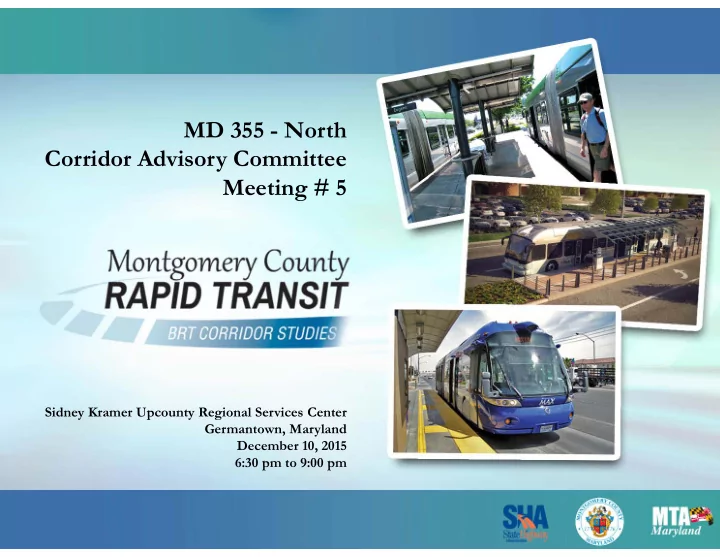
MD 355 - North Corridor Advisory Committee Meeting # 5

Sidney Kramer Upcounty Regional Services Center Germantown, Maryland December 10, 2015 6:30 pm to 9:00 pm
slide-2
SLIDE 2

2

Welcome

Agenda:

  • BRT Project Management Team Update ............................... 10 min
  • Project Process & Schedule ................................................... 20 min
  • Goals & Objectives/Preliminary Purpose & Need ................. 20 min
  • Conceptual Alternatives Development .................................. 15 min
  • Breakout Discussions .......................................................... 45 min
  • Discussion and Sharing ....................................................... 30 min
  • Additional Q&A ...................................................................... 10 min
slide-3
SLIDE 3

3

BRT Project Management Team Update

  • MCDOT, SHA, MTA partnership continues uninterrupted
  • Management of US 29 and MD 355 Corridor Studies transferred

from SHA to MTA

  • SHA has seen increase in highway related projects, straining

resources

  • MTA has available resources
  • MTA brings additional transit‐related expertise
  • All consultant teams will remain involved
slide-4
SLIDE 4

4

Questions?

BRT Project Management Team Update Q&A

  • Project Process & Schedule
  • Goals & Objectives/Preliminary Purpose & Need
  • Conceptual Alternatives Development
  • Breakout Activity
  • Discussion and Sharing
  • Additional Q&A
slide-5
SLIDE 5

5

Corridor Planning Process

Existing Conditions and Data Collection Corridor Goals/ Pre-Purpose and Need Conceptual Alternatives Development Project Introduction Public Meeting Preliminary Analysis of Conceptual Alternatives Alternatives Public Workshop Alternatives Retained for Detailed Study (ARDS)

We are here

slide-6
SLIDE 6

6

MD 355 Milestone Schedule

Summer 2015 Fall 2015 Winter 2016 Spring 2016 Summer 2016 Fall 2016 Winter 2017 Spring 2017 Summer 2017 Fall 2017 Winter 2018 Spring 2018 Summer 2018 Fall 2018 Winter 2019 Project Purpose and Need Background Conceptual Alternatives Project Introduction Public Meeting Ridership, Traffic and Impacts Analysis

  • Alts. Public Workshop

ARDS Package Alternatives Refinement Build Traffic & Ridership Environmental Tech Analysis Draft Corridor Report Public Workshop LPA Selection CAC meetings through

  • ARDS. Future meetings

TBD based upon

  • utcome of ARDS
slide-7
SLIDE 7

7

Planning Timeline

Identification of Needs and Conceptual Alternatives Alternatives Retained for Detailed Study Selection of Locally Preferred Alternative Entry Into Federal Approval Process (Begin NEPA) Federal Approvals Granted (NEPA Complete)

Federal Approval Process (NEPA)

Project Begins Project Complet e

WE ARE HERE

Preliminary Purpose and Need Purpose and Need

slide-8
SLIDE 8

8

Questions?

BRT Project Management Team Update  Project Process & Schedule Q&A

  • Goals & Objectives/Preliminary Purpose & Need
  • Conceptual Alternatives Development
  • Breakout Activity
  • Discussion and Sharing
  • Additional Q&A
slide-9
SLIDE 9

9

Development of Goals and Objectives CAC Input

  • CAC Meeting #2
  • Corridor Planning Study
  • Overview
  • Needs and Values Exercise
  • CAC Meeting #3
  • Draft Preliminary Purpose and Need language
  • Purpose
  • Need
  • Existing and Projected Traffic & Transit Conditions
slide-10
SLIDE 10

10

Development of Goals and Objectives CAC Input – Meeting #2 Exercise

slide-11
SLIDE 11

11

Development of Goals and Objectives Inputs

M-NCPPC M-NCPPC

SHA SHA

PUBLIC & CAC PUBLIC & CAC

MTA MTA RTS

Steering Committee

RTS

Steering Committee

MCDOT MCDOT

Measures of Effectiveness

Needs Goals

Objec- tives

slide-12
SLIDE 12

12

Development of Goals and Objectives CAC Input

CAC Needs

Provide Competitive, Predictable Service Encourage Ridership Maximize User Experience

Quantifiable Objectives

Make Trips Faster and More Reliable Increase Transit Ridership Provide appealing transit service that will attract new riders

slide-13
SLIDE 13

13

Goal Objectives

slide-14
SLIDE 14

14

Goal Objectives

slide-15
SLIDE 15

15

CAC Needs

Create Multi- Modal Opportunities Create Neighborhood Connections Encourage Long Distance Commuter Use

Quantifiable Objectives

Create Direct Modal Transfers Enhance Bike/Ped Access and Feeder Bus Provide Parking at Key Stations

Development of Goals and Objectives CAC Input

slide-16
SLIDE 16

16

Goal Objectives

slide-17
SLIDE 17

17

Goal Objectives

slide-18
SLIDE 18

18

Support Sustainable and Cost Effective Transportation Solutions Maintain Environmental Quality Minimize Cost of Building and Operating Transportation Services

Goal Objectives

slide-19
SLIDE 19

19

Purpose and Need

Purpose and Need = WHAT and WHY Purpose

  • WHAT are the major goals and objectives?
  • WHY will they be addressed by this project?

Need

  • WHAT are the existing or forecasted problems?
  • WHY are these problems occurring?

These fundamental questions provide support for later phases:

  • Conceptual alternatives analysis: options for how to address the what

and why

  • Recommendations: the “best” options for how to satisfy the

what and why

slide-20
SLIDE 20

20

Purpose and Need Development

Preliminary Purpose and Need

Role:

  • Living document
  • Basis for alternatives evaluation
  • Follows NEPA guidelines
  • Saves time in formal NEPA process

NEPA Purpose and Need

Role:

  • Basis for Selected Alternative

Evaluation

  • Provide consensus between regulatory

agencies

  • Adopted by federal lead agency
slide-21
SLIDE 21

21

Preliminary Purpose and Need Process

Utilizes quantifiable data to identify problem(s) that require attention and further study

Acknowledges problems have multiple potential solutions

Forms baseline for comparison

  • f future

evaluations

Drives conceptual alternatives discussion

Supports recommendation

  • f alternatives

for detailed study

WE ARE HERE

slide-22
SLIDE 22

22

Preliminary Purpose and Need Document Next Steps

  • CAC Member Review and Comment
  • Facilitators will email link to Draft Document in mid‐December
  • Provide comments by end of January 2016
  • CAC Member comments will be combined with comments from the

Spring public meetings

slide-23
SLIDE 23

23

Questions?

BRT Project Management Team Update  Project Process & Schedule  Goals & Objectives/Preliminary Purpose & Need Q&A

  • Conceptual Alternatives Development
  • Breakout Activity
  • Discussion and Sharing
  • Additional Q&A
slide-24
SLIDE 24

24

Conceptual Alternatives Development Process

  • Work completed
  • Existing conditions evaluation
  • Goals and Objectives
  • Needs identification
  • Next Steps
  • Obtain CAC Member Input
  • Complete Draft Preliminary Purpose and Need
  • Develop conceptual alternatives
  • Present conceptual alternatives for public input
slide-25
SLIDE 25

25

What makes a Conceptual Alternative?

  • Components:

1. Running way

  • Physical location and interaction with surrounding

environment for the BRT 2. Station locations

  • Specific location of BRT stops

3. Service plan

  • BRT operational characteristics (headways, hours of

service, bus routing)

slide-26
SLIDE 26

26

  • Running Way options have been identified for consideration
  • The proposed options can be mixed and matched along different

segments of the corridor to best fit within the surrounding area

  • Location and dimensions of proposed roadway elements will vary

throughout the corridor

  • NOT EVERY OPTION IS APPROPRIATE FOR EVERY

SEGMENT OF THE MD 355 CORRIDOR

Conceptual Alternative Component BRT Running Way

slide-27
SLIDE 27

27

Conceptual Alternative Component BRT Running Way

Considerations:

  • BRT operations (speed, reliability)
  • Traffic operations
  • Visibility
  • Connectivity
  • Potential impacts
slide-28
SLIDE 28

28

BRT in Mixed Traffic

Brampton, Canada Brampton, Canada

slide-29
SLIDE 29

29

BRT Queue Jump

Queue Jump Concept

slide-30
SLIDE 30

30

Reversible / Bi‐Directional BRT Lane

Eugene, Oregon

slide-31
SLIDE 31

31

Bi‐Directional BRT Lane

Eugene, Oregon

slide-32
SLIDE 32

32

Dedicated Median BRT Lanes

Alexandria, Virginia Chicago, Illinois (Concept)

slide-33
SLIDE 33

33

Dedicated Curb BRT Lanes

Snohomish County, Washington Chicago, Illinois (Concept)

slide-34
SLIDE 34

34

Conceptual Alternative Component Station

  • Began with station locations as proposed in the Countywide Transit

Corridors Functional Master Plan

  • Made revisions to station locations based on further study by the City of

Gaithersburg and input from the City of Rockville and the Montgomery County Department of Transportation

  • Considerations:
  • Adjacent land use
  • Proposed development
  • Ease of access (vehicles, bicycles, pedestrians)
  • Connectivity to existing and proposed transit service
slide-35
SLIDE 35

35

Station Configuration – Median Running

Eugene, Oregon Changzhou, China

slide-36
SLIDE 36

36

Station Configuration – Curb Running

Brooklyn, New York Brooklyn, New York

slide-37
SLIDE 37

37

Conceptual Alternative Component Operations Plan

Considerations:

  • Bus Routing (Spurs)
  • Transfer Points
  • Headways/Frequencies
  • Number of Buses
slide-38
SLIDE 38

38

Conceptual Alternative Component Sample Operations Plan

10 buses per hour 6 min headways 5 buses per hour 12 min headway 10 buses per hour 6 min headways 10 buses per hour 6 min headways 15 buses per hour 4 min headways 5 buses per hour 12 min headways Bethesda Metro Shady Grove Metro Lake Forest Transit Center Clarksburg

slide-39
SLIDE 39

39

Conceptual Alternatives Development Breakout Activity

Three Topics to Discuss:

1. Running Way ‐ What running way(s) may be appropriate for this segment of MD 355? 2. Station locations, surroundings, and access ‐ What station locations may be appropriate for this segment of MD 355? 3. Service and operations ‐ What activity centers should the BRT system serve?

slide-40
SLIDE 40

40

Questions?

BRT Project Management Team Update  Project Process & Schedule  Goals & Objectives/Preliminary Purpose & Need  Conceptual Alternatives Development  Breakout Activity  Discussion and Sharing  Q&A

  • Additional Q&A
slide-41
SLIDE 41

41

Additional Questions

slide-42
SLIDE 42

42

Adjournment