MCI Course Content The course is concerned with the topics of - - PDF document

mci course content
SMART_READER_LITE
LIVE PREVIEW

MCI Course Content The course is concerned with the topics of - - PDF document

14.05.2014 International Communication, Conference, HiOA,13-14. May, 2014 Multicultural Identity in Teacher Education. Some perspectives from an International class Presentation by Geir Hoaas, Oslo, Associate professor, Religion &


slide-1
SLIDE 1

14.05.2014 1

«International Communication», Conference, HiOA,13-14. May, 2014

“Multicultural Identity in Teacher Education. Some perspectives from an International class”

Presentation by Geir Hoaas, Oslo, Associate professor, Religion & Ethics Faculty of Education and International Studies Coordinator for International courses:

  • Multicultural Identity in a Global World (MCI)
  • Alternative International period of Practice and Studies in Africa

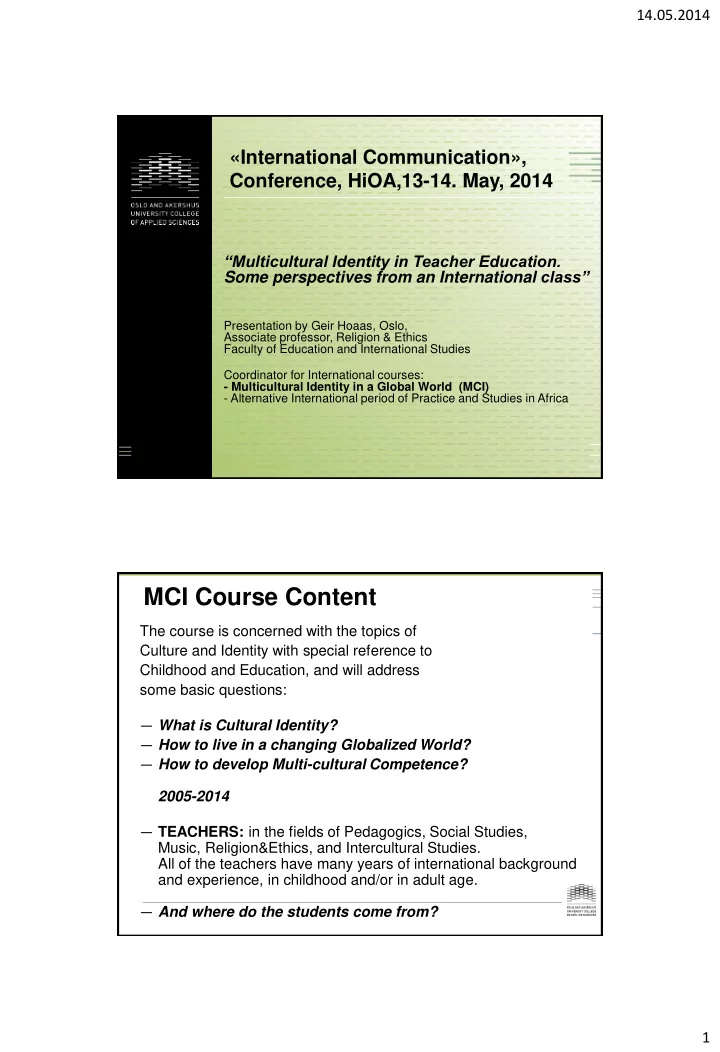
MCI Course Content

The course is concerned with the topics of Culture and Identity with special reference to Childhood and Education, and will address some basic questions: — What is Cultural Identity? — How to live in a changing Globalized World? — How to develop Multi-cultural Competence? 2005-2014 — TEACHERS: in the fields of Pedagogics, Social Studies, Music, Religion&Ethics, and Intercultural Studies. All of the teachers have many years of international background and experience, in childhood and/or in adult age. — And where do the students come from?

slide-2
SLIDE 2

14.05.2014 2 Students, from 42 countries, 10 -17 countries in each class

Austria 1 Belgium 24 Brazil 2 Bulgaria 1 Burma 1 China 14 Colombia 2 Czech Rep. 11 Denmark 3 England 4 Finland 2 France 4 Georgia 2 Germany 25 Ghana 1 Greece 6 Hungary 12 Iceland 2 Italy 11 Japan 1 Kenya 1 Latvia 1 Libya 1 Lithuania 9 Nepal 1 The Netherlands 35 Nigeria 1 N.Ireland 1 Norway 26 Philippines 1 Poland 3 Portugal 5 Russia 2 South Africa 1 Spain 25 Syria 1 Sweden 1 Switzerland 5 Tunisia 1 Turkey 1 Ukraine 2 USA 8 Total 262 (15-33 in each class)

These fundamental questions will be treated through the following topics:

—Cultural Identity and Cultural Awareness —Childhood and Identity Construction —Intercultural Communication, theory and practical experience —Culture and World-view —Culture and Religion —Culture and Ethics —Human Rights and Childhood —Cultural Identity and Racism —Traditions, Festivals, and Rituals —Processes of Globalization —Global Consciousness —Cross-cultural Competence —Social Commitment in a Globalized World

slide-3
SLIDE 3

14.05.2014 3

SYLLABUS

Jan.21- May 22 —Week 4: Info, ”Get-to-know”, Intro, Cultural Awareness —5-8: Classes, Tues – Friday (08:30 – 11:15/13:00) —9-10: Fieldwork (schools, kindergartens) —11-13: Classes, Tues – Friday —14-15: Fieldwork, 3 days a week, + discussion —(16: Easter-break) —17-19: Reports and Presentation in class —20-21: Preparations for Exam, Oral Exam

Other Activities

—Cultural Presentations, all countries, whether 1 or several students, twice a week, 20-25 min., —Excursions, from International Office (all faculties), and our own (MCI), average once a week, to:

  • Museums, concerts, outdoor attractions, sports
  • Anti-Racist Center, Oslo International Culture Center,

Oslo Red Cross Culture Center. —Fieldwork-discussions, both before and after the fieldwork-periods, discussing issues observed —Social gatherings, upon arrival, midway presentations, final Goodbye party.

10

slide-4
SLIDE 4

14.05.2014 4 Requirements for all students, 20/30 ECTS credit-points:

  • 1. Active participation in classes and discussions
  • 2. Individual or group-presentation of one's own culture

with reference to educational challenges Exam Exam portfolio for 30 ECTS credit-points:

  • 1. One paper on a subject treated in the course, ca.2000 words
  • 2. Fieldwork paper, of 6000-7000 words, based on an expanded

period of fieldwork, with presentation in class

  • 3. Oral examination based on fieldwork report and course

syllabus, primarily on the Required Readings.

  • 4. Total grade for the course, includes both Fieldwork paper

and Oral exam

For internal/Norwegian studenter

Norwegian students of MCI follow the same plan as the external students, with presentations and requirements. BUT, with following emphasis:

  • Leader-practice in 6.sem. of ECE students is integrated in

the program, in weeks 2-3 (before start) and weeks 9-10 (Fieldwork for the others).

  • The final Fieldwork paper is recognized as their Bachelor-

thesis, with a separate grade on the transcript of records.

  • The total grade for the whole MCI-course (30 ECTS)

consists of the Fieldwork paper and the Oral exam.

slide-5
SLIDE 5

14.05.2014 5

Background of MCI-Students

— National: mainly European, but in all classes also some from Asia, Africa, USA, or Latin-America — Cultural: consciousness of History and Culture vary much, some have dramatic events in recent past (Baltics, Czech Rp.) some have strong cultural identity-markers (language…) some have a rather indistinct notion of cultural belonging — Religious: some from «secularized» Europe (Nordic, German) some from religious schools (Dutch, Belgian) some from societies dominated by religion (Spanish, Italian) some from atheistic traditions (Czech R., Hungary, Baltics) — Secularized Europe — Religious traditions, background

Culture-presentations in class

What do the students focus on?

  • Traditional aspects of their culture: major festivals,

nature, architecture, costumes, food, drinks, and music.

  • History, religion and traditional values are in the fore,

rather than raising critical and sensitive issues in their home-society.

  • Symbols: flag, colors, buildings, famous people (royal,

music, arts, sports, science…)

  • Modern student environment, what are young people

pre-occupied with, concerned about?

  • Some expose their values and world-view, but mostly

indirectly.

slide-6
SLIDE 6

14.05.2014 6

Research: Survey among students attending the MCI, in the period

  • f 2005-2009

Value-clause in Norwegian schools

“….The school shall build on respect for human worth, freedom of speech, loving your neighbour, equality and solidarity- the way these basic values are expressed in Christian and humanistic tradition, different religions, worldviews, and UN`s Declaration on Human Rights. The school should promote democracy, equality and scientific way of thinking. Pupils shall develop knowledge, skills and attitudes for them to be able to cope with their lives, and to participate in work and community society……”

— Source: http://www.udir.no/Stottemeny/English/Curriculum-in-English/Curricula-in-English/

slide-7
SLIDE 7

14.05.2014 7

A Surprising subject in schools: RLE subject (Religion, Philosophy of Life, and Ethics): “The subject shall teach knowledge of Christianity, other world religions and philosophies of life, and ethical and philosophical

  • themes. It shall also teach the significance of Christianity as

cultural heritage in our society. For this reason, Knowledge of Christianity will be a major portion of the learning content of the

  • subject. This involves allowing for local variations in the scope of

subjects between the main subject areas in order to satisfy competence aims for the subject. Religion, Philosophies of life and Ethics is an ordinary school subject intended to bring all pupils together. The Norwegian Education Act demands that the teaching of this subject be

  • bjective, critical and pluralistic. This implies that the subject be

taught impartially and based on facts, and that the different world religions and philosophies of life shall be presented with respect.”

Source: http://www.udir.no/Stottemeny/English/Curriculum-in-English/Curricula-in-English/

Value-clause in Norwegian Kindergartens “…. The Kindergarten shall be based on

fundamental values in the Christian and humanist heritage and tradition, such as respect for human dignity and nature, on intellectual freedom, charity, forgiveness, equality and solidarity, values that also appear in different religions and beliefs and are rooted in human rights... Kindergartens shall promote equality and work against all forms of discrimination.”

Source: http://www.regjeringen.no/upload/KD/Vedlegg/Barnehager/engelsk/Act_no_64_of_June_2005_web.pdf

slide-8
SLIDE 8

14.05.2014 8

Nordic «Child-centered Pedagogy» «Participation», one of the 3 P’s in the CRC

Ethical Values in Kindergartens

  • Friendship
  • Helpfulness
  • Respect
  • Tolerance
  • Solidarity
  • Empathy

Key concepts: Recognition, Acceptance, Mutuality, Dialogue —How do we teach these values?? —Democracy?

The fundamental values of kindergartens

 Care, upbringing and learning in kindergartens

shall promote human dignity, equality, intellectual freedom, tolerance, health and an appreciation of sustainable development.

(Norwegian Kindergarten Act, Section 2, Content of kindergartens)

30

slide-9
SLIDE 9

14.05.2014 9

Participation, elements included from the CRC

—Children in kindergartens shall have the right to express their views on the day-to-day activities of the kindergarten. —Children shall regularly be given the opportunity to take active part in planning and assessing the activities of the kindergarten. —Children’s views shall be given due weight according to their age and maturity.

(Norwegian Kindergarten Act, Section 3, Children’s right to participation)

Values, Worldview, and Religion

Responses from MCI-students? Surprise:

  • Children’s Participation is not new to many, but the

strong focus and the implementation is unusual.

  • Adult-child relationship: the «Acceptance» and

«Recognition» aspect dominates, sometimes turning into «chaos».

  • Few, if any, have a subject in public school like the RLE.

True, some have gone to «religious schools».

  • Few, if any, have experienced activities with a religious

touch, in preparing for festivals (Christmas, Easter, Id-al- Fitr, Divali, Vesak..), including children with diverse backgrounds

slide-10
SLIDE 10

14.05.2014 10

Culture-shock, Re-orientation of Values

CS can be a process from enthusiasm in meeting the new culture, to frustrations and anger, to disillusion. The question is whether the U-curve turns upward, taking in new stimuli, adjusting, accommodating, and finding one’s

  • wn style in the new environment, being relaxed, fitting in.

Shock? For most students it is rather some frustrations

  • ver practicalities, some surprises concerning habits,

customs, and also surprises about different values:

  • Outdoor life, closeness to nature, «dangerous play»,

such as climbing in trees and rocks, using sharp tools, and the little ones taking their nap outside in 5-6 minus

  • Adult-child relations, the strong emphasis on Participation
  • Religious content visible.
  • Summary: MCI-students Attitudes

— Part of the Modern World, Individual freedom, choice, and deep into «Social Media» as a vital Identity-factor. — Rather firmly embedded in one’s own culture, traditions, and Worldview. — Yet, at the outset, not too conscious of the implications, something that gradually changes. — Being exposed to a different society, different education system, with different values, makes an impact. — Being exposed to other students with different values, views, makes an impact. — «Ethnocentrism», more complex, has nuances — «Neo-essentialism» or «Chauvinism», too narrow. — «Acculturation», finding a balance, including both cultural identity and integrity, as well as openness for changes.

slide-11
SLIDE 11

14.05.2014 11

VISIONS!

—Building a broad network, utilizing for PR! —Recruit students from diverse backgrounds! —Create a socially secure environment! —An academic exiting environment! —Open communication between students and teachers! —Give a total experience of multiculturalism from both theory and practice!

Challenges

—Ability in English? —Academic Traditions, Standard? —Study-habits? —Used to being abroad? —Economy of Student? —Economy of MCI-course?

slide-12
SLIDE 12

14.05.2014 12

Literature, References

— P.S. Adler (1998) “Beyond Cultural Identity: Reflections on Multiculturalism” in Bennett,M.J. Basic concepts of Intercultural Communication. Intercultural Press. — J.A. Banks (2009) The Routledge International Companion to Multicultural Education, Routledge, London and New York. — G. Baumann (1999) The Multicultural Riddle, Routledge, London and New York. — M.J. Bennett, ed. (1998) Basic Concepts of Intercultural Communication, (pp.215- 224), Intercultural Press, Yarmouth, Maine. — J.W. Berry, Y.H. Poortinga, M.H. Segall, P.R. Dasen (2002) Cross-Cultural Psychology, Cambridge University Press. — H. Bowe, K. Martin (2007) Communication Across Cultures, Cambridge University Press, Cambridge. — Ø. Dahl (2001). Møter mellom mennesker. Interkulturell kommunikasjon [Encounter between people. Intercultural communication], Gyldendal, Oslo. — J.S. Gundara (2000) Interculturalism, Education and Inclusion, Sage Publications, Thousand Oaks, CA. — G. Hoaas (2014) “It Gave Me a New Insight!” Some Perspectives from Students in an International Course. Universal Journal of Educational Research, vol 2:1, pp.80-89 — G. Hofstede (2001) Culture’s Consequence: Comparing Values, Behavior, Institutions, and Organizations Across Nations, Sage Publications, Thousand Oaks, CA. — M. Jans (2004) “Children as citizens. Towards a contemporary notion of the child participation”, in Childhood 2004:1, Sage Publications

Literature, References (cont.)

— A.T. Kjørholt (2011) “Rethinking young children’s rights for participation in diverse cultural contexts”, in M.Kernan & E.Singer (eds) Peer Relationships in Early Childhood Education and Care. New York. Routledge, pp 38-49 (13pp) — F.R. Kluckhohn, F.L. Strodtbeck (1960) Variations in Value Orientations, Row and Peterson, New York. — S. May (1999) Critical Multiculturalism. Rethinking Multicultural Education and Antiracist Education, Falmer Press, London. — M.B. McGuire (2002) Religion. The Social Context, Wadsworth Publ.Co., Belmont. — B. Parekh (2006) Rethinking Multiculturalism. Cultural Diversity and Political Theory, Palgrave Macmillan, New York. — I. Piller (2011) Intercultural Communication. A Critical Introduction, Edinburgh Univ.Pr — D.C. Pollock, R.E.Van Reken (2009) Third Culture Kids. Growing Up Among Worlds, Nicholas Brealey Publishing, Boston. — D.L. Sam, J.W. Berry, eds. (2006) The Cambridge Handbook of Acculturation Psychology, Cambridge University Press. — L.A. Samovar, R.E. Porter, E.R. McDaniel (2010) Communication between Cultures, 7th ed., Wadsworth Publ. Comp., Boston. — N. Smart (1998) The World’s Religions, Cambridge University Press, New York. — C. Ward, S. Bochner, A. Furnham (2001) The Psychology of Culture Shock, Routledge, London & New York. — L. Woodhead, ed. (2009) Religions in the Modern World, Routledge, London & NY.