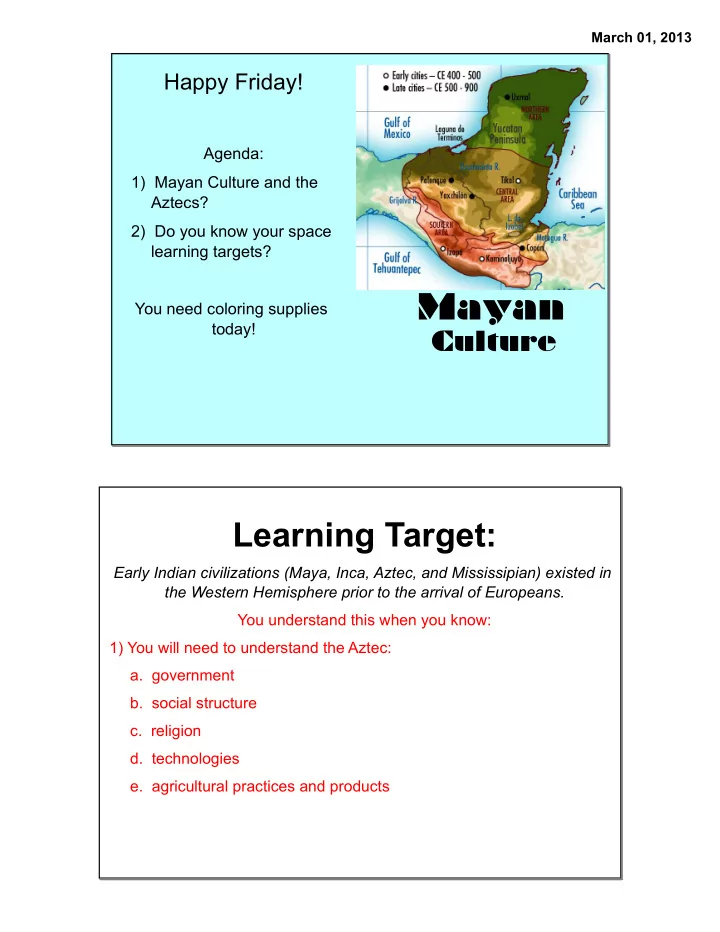
Mayan You need coloring supplies today! Culture Learning Target: - - PDF document

mayan
SMART_READER_LITE
LIVE PREVIEW

Mayan You need coloring supplies today! Culture Learning Target: - - PDF document

March 01, 2013 Happy Friday! Agenda: 1) Mayan Culture and the Aztecs? 2) Do you know your space learning targets? Mayan You need coloring supplies today! Culture Learning Target: Early Indian civilizations (Maya, Inca, Aztec, and


slide-1
SLIDE 1

March 01, 2013

Mayan

Culture

Happy Friday!

Agenda: 1) Mayan Culture and the Aztecs? 2) Do you know your space learning targets? You need coloring supplies today!

Learning Target:

Early Indian civilizations (Maya, Inca, Aztec, and Mississipian) existed in the Western Hemisphere prior to the arrival of Europeans. You understand this when you know: 1) You will need to understand the Aztec:

  • a. government
  • b. social structure
  • c. religion
  • d. technologies
  • e. agricultural practices and products
slide-2
SLIDE 2

March 01, 2013

Mexico United States

Guatemala

Honduras

Pacific Ocean Gulf of Mexico Mayan Lands

Tikal

Tulum

Palenque

Chichen Itza

Bonampak

The Mayan Map Tikal

Tulum

Palenque

Chichen Itza

Bonampak

slide-3
SLIDE 3

March 01, 2013

Mexico United States Guatemala Honduras

Pacific Ocean Gulf of Mexico Mayan Lands

Tikal

Tulum

Palenque

Chichen Itza

Bonampak

You will see this on the quiz! Do you know where things go?

It means "at the well of the mouth of Itza. "

Important Mayan Cities Chichen Itza

/ /

slide-4
SLIDE 4

March 01, 2013

Chichen Itza is known for all of the architecture. Hundreds of building stood once in this area.

The sacred well

Possibly the best known construction

  • n

the site is Kukulkan's

  • Pyramid. El Castillo

(Kukulkan- Quetzalcoatl). Approximately 75 feet tall.

Another Important City: Palenque

This city was once covered with trees and bushes. It was uncovered and studied. Within this city, there are many sculptures, buildings, and carvings that help us learn about the Mayan culture.

Pacal the Great was found in a tomb inside

  • f the Temple of

Inscriptions.

The Temple of Inscriptions

Palenque has the highest average rainfall each year.

slide-5
SLIDE 5

March 01, 2013

Another important Mayan City: Tikal ("at the waterhole" or the "place of voices") Located in the Peten rainforest in Guatemala. A lot was known about Tikal because of the massive amounts of hieroglyphics and lists found within the buildings. A list of rulers was found!

slide-6
SLIDE 6

March 01, 2013

Mayan Introductory Video

Mayan Vocabulary List

City-state: a Mayan city and its nearby town or village; each city-state was controlled by a different ruler. Ajaw: the name for the ruler of the city- state; Mayans believed these were selected by the gods.

slide-7
SLIDE 7

March 01, 2013

Mayan Vocabulary List

City-state: a Mayan city and its nearby town or village; each city-state was controlled by a different ruler. Ajaw: the name for the ruler of the city- state; Mayans believed these were selected by the gods.

Temples: typically the tallest building in a Mayan city-state; they were considered to be homes to the gods and the Mayans used them as a place to pray Nobles: important people

  • f a high-ranked birth
slide-8
SLIDE 8

March 01, 2013

Terraces: flat areas carved into hillsides used to grow crops Irrigation: a man-made system of Slash-and-burn: a farming technique where forest trees and plants are cut down and burned, so crops can later be planted in the area

bringing water to crops Hieroglyphs (Glyph): a writing system used by the Mayans; made mostly of pictures and symbols to represent a word Mesoamerica: the land that is presently known as Mexico and Central America

slide-9
SLIDE 9

March 01, 2013

Mayan Hieroglyphics

On your brown bag (or paper if you didn't bring in a bag): Create a glyph for each word (except glyph!) Each word should be defined with a glyph progression showing how pictures got easier to draw/carve over time!

Original Glyph for Mesoamerica (detailed drawing)

Final Cursive for Mesoamerica

(Very simple drawing)

Definition: Land we know as Mexico and Central America

  • Classic Maya settled in

Guatemala

  • Dense rainforest covered

land making farming hard

  • Climate was hot and humid
  • Seasonal rainfall was

depended on for water

  • Rain soaked through

limestone leaving little surface water

  • Built large ceremonial

centers/ city-states at different sites.

  • At Tikal, Temple I was

built, 130 foot-high step pyramid

  • Successfully farmed in rain forest

by using slash-and-burn techniques and a system of raised fields and irrigated gardens

  • Created irrigation networks to

support concentrated urban centers, like Tikal Planted and harvested corn, squash, beans, and

  • ther crops in fields
slide-10
SLIDE 10

March 01, 2013

  • Was considered a god-king
  • responsible for political leadership
  • lords, mostly men, but women had great influence on political decisions
  • Lived near ceremonial centers and helped lords run cities
  • gathered taxes, supplies and labor for construction projects
  • served as war captains who led peasant armies during war
  • Were powerful because the maintained favor with the gods
  • led religious rituals, calculated positions of stars, and treated the sick
  • practiced himan sacrafice on a limited scale.
  • Merchants traded salt, cotton, fish and animal skins for
  • bsidian, jade, feathers, and cocoa beans over long distances
  • artisans produced sculptures and murals to pay tribute to gods
  • Men worked in fields; women managed the household
  • rewarded for loyalty by being allowed to attend royal

marriages and important ceremonies

  • Recruited from surplus children, war prisoners,

and criminals

  • required to do difficult or undesirable tasks like

grinding maize (corn)

  • not badly treated, but sometimes killed or buried

with master

In Groups you will be working together to read about different patterns of Mayan culture, on your iPad, and fill out graphic organizers associated with each part of the Mayan Culture. (Linked to Mrs. Wise's website!) Each group will be responsible for only one section of the reading. Then you will make a brochure from your portion of the reading that other groups will use to fill out the rest of the pieces of their graphic organizers. That will only make you responsible for reading one piece of this puzzle, but able to get the rest of the information by reading the work of others! Timeline: Day 1 - read and fill in the graphic organizer (as a group of 8 or so) Day 2 - finish graphic organizer and begin brochure (brochures done in groups of 3-4 with each section having 2 finished brochures) Day 3/4 - Completion of brochure Suggestions (as you cannot all be working on one paper at once): Person 1 - responsible for photos - separate paper taped on later Person 2 - setup/assembly of brochure (gluing, titles, labels, pictures in correct locations) Person 3/4 - writing of the sections of the brochure

Mayan Reading and Brochure

slide-11
SLIDE 11

March 01, 2013

slide-12
SLIDE 12

March 01, 2013