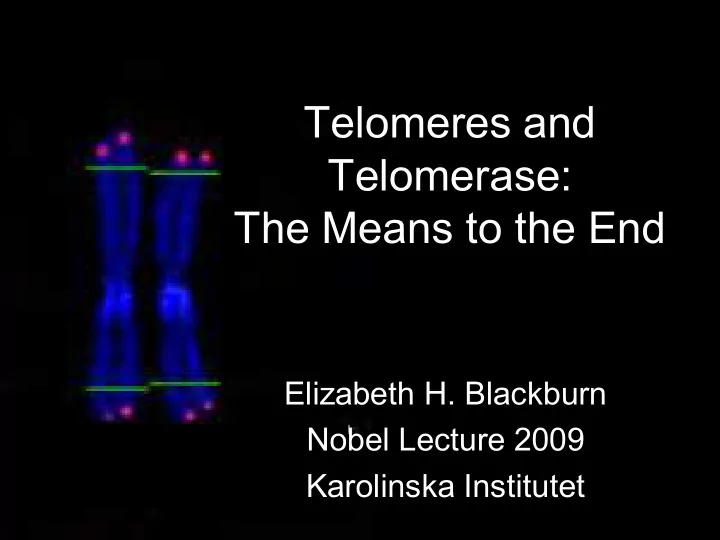
Telomeres and Telomerase: The Means to the End Elizabeth H. - - PowerPoint PPT Presentation
Telomeres and Telomerase: The Means to the End Elizabeth H. Blackburn Nobel Lecture 2009 Karolinska Institutet Maize breeding Ancient. Mayan corn god . modern - cytogenetics - chromosome discoveries Barbara McClintock Cold Spring
Maize breeding Mayan corn god
- cytogenetics
- chromosome discoveries
Ancient….
…. modern
Barbara McClintock end part Telo-mere (tel’uh mer or te lō mēr)
- named by Hermann Muller
Cold Spring Harbor, 1947
Common Shoelace, 10x.
ag·let (ag’lit) n. A tag or sheath, as of plastic, on the end of a lace, cord, or ribbon to facilitate its passing through eyelet holes.
Pond scum (a.k.a. Tetrahymena thermophila)
Photographed in Prague, 1999, demonstrating an
- ptical principle by
which a partial solar eclipse can be viewed.
Joe Gall
Tetrahymena thermophila
- Contains abundant very
short linear chromosomes
Beginning to piece together the first telomeric DNA sequence…
… and data that the telomeric DNA repeat unit was tandemly repeated
- Contains abundant very
short linear chromosomes
- They end in TTGGGG
repeats.
Tetrahymena thermophila
Blackburn and Gall, 1978
Blackburn and Gall, 1978 Szostak and Blackburn 1982; Shampay, Szostak and Blackburn 1984
Chromosome with centromere
- Contains abundant very
short linear chromosomes
- They end in TTGGGG
repeats.
- How did the repeats get
there?
Tetrahymena thermophila
Blackburn and Gall, 1978
- Telomeric GGGGTT repeat tracts on minichromosomes in a ciliate
were heterogeneous in numbers. Blackburn and Gall, 1978
- Telomeric GGGGTT repeat tract DNA was found added to various
sequences in ciliate minichromosomes as a result of new telomeres forming on chromosomes, during development of the somatic
- nucleus. Blackburn et al, 1982
- Telomeric DNA gradually grew longer as trypanosome cells
- multiplied. Bernards et al, 1983
- Yeast telomeric TG1-3 repeat DNA was added directly to the ends of
Tetrahymena T2G2 repeat telomeres maintained in yeast. Szostak and Blackburn 1982; Shampay, Szostak and Blackburn 1984 RESULTS WITH TELOMERIC DNA THAT COULD NOT BE READILY EXPLAINED BY THEN-CURRENT MODELS FOR DNA REPLICATION
- AND…….
- Barbara McClintock had noted a maize mutant stock that had lost the
normal capacity for broken maize chromosome ends to heal early on plant development.
- B. McClintock, personal comm. 1983
Was a new enzyme at work in cells that could extend telomeric DNA?
RESULTS WITH TELOMERIC DNA THAT COULD NOT BE READILY EXPLAINED BY THEN-CURRENT MODELS FOR DNA REPLICATION
T T G T G T G G G G G G T G T G G G
DISCOVERY OF TELOMERASE Tetrahymena cell extract Mg++ dGTP + TTP
5’ 3’ OH
SYNTHETIC TELOMERE IN TEST TUBE
Greider and Blackburn, 1985
T T G T G T G G G G G G T G T G G G G T G T G G G G
GGGGTTGGGGTTGGGGTTGGGGTTG CCCCAACCC
5' 3'
AACCCCAAC
5' 3'
The solution to telomere attrition Telomerase: a telomere-synthesizing reverse transcriptase
Chromosome Terminus
GGGTTG
Greider and Blackburn, 1985, 1987, 1989
TERT protein TER RNA
Blackburn lab members and friends at UC Berkeley 1986 Ed Orias
TELOMERASE RNA gene
A vector based on Tetrahymena rDNA replication properties
Yu et al, 1990
GGGGTTGGGGTTGGGGTTGGGGTTG CCCCAACCC
5' 3'
AACCCCAAC
5' 3'
The solution to telomere attrition Telomerase: a telomere-synthesizing reverse transcriptase
Chromosome Terminus
TERT protein TER RNA
G C C C
Yu et al, Nature 1990
How do Tetrahymena cells respond when telomerase is nonfunctional?
Guo-Liang Yu John Bradley Laura Attardi
Yu et al, Nature 1990
GGGGTTGGGGTTGGGGTTGGGGTTG CCCCAACCC
5' 3'
AACCCCAAC
5' 3'
The solution to telomere attrition Telomerase: a telomere-synthesizing reverse transcriptase
Chromosome Terminus
GGGTTG
Greider and Blackburn, 1985, 1987, 1989
TERT protein TER RNA
GGGGTTGGGGTTGGGGTTGGGGTTG CCCCAACCC
5' 3'
AACCCCAAC
5' 3'
A telomerase RNA mutant unable to copy the template
Chromosome Terminus
Yu et al, 1990; Gilley et al, 1996
TERT protein TER RNA
U A
STOP
cell divisions
Telomeres provide a reservoir of replenishable DNA
No Senescence
Telomeres replenished by telomerase
Tetrahymena thermophila
Plenty of telomerase Yu et al, Nature 1990 Genetically kill telomerase
Telomeres progressively shorten
Tetrahymena ceased divisions They become “mortal” Cells are immortal
celldivisions After a delay, senescence
Predicted, if DNA replication alone acts on DNA: Loss of DNA from the chromosome end (the DNA ‘end-replication problem’)
Watson, 1972, Olovnikov, 1971
cell divisions Eventual senescence
Lack of functional telomerase: Progressive loss of DNA from the chromosome end
cell divisions No Senescence
Telomeres replenished by telomerase
Immortal
Yu et al, Nature 1990
“Mortal”
Inactivate telomerase
Tetrahymena thermophila
How did Tetrahymena cells respond when telomerase is forced to make the wrong DNA sequence?
Guo-Liang Yu John Bradley Laura Attardi
Yu et al, Nature 1990
GGGGTTGGGGTTGGGGTTGGGGTTG CCCCAACCC
5' 3'
AACCCCAAC
5' 3'
Telomerase: a telomere-synthesizing reverse transcriptase: the sequence matters
Chromosome Terminus
Ye at al, 1990; John Bradley unpubl.
TERT protein TER RNA
G C C C C
Tetrahymena thermophila
WILD TYPE
Tetrahymena thermophila mutant-sequence telomeres Cells rapidly lost viability!
Telomeres cap ends
- f chromosomes
Part of an ancient Greek sarcophagus Pergamonmuseum, Berlin
McEachern and Blackburn. Nature, 1995.
elomerase
elomere dynamics: a homeostatic system
In humans? In cancer cells
HIGH telomerase characterizes malignant human cancer cells
cell divisions
Cells keep dividing
HIGH telomerase characterizes malignant human cancer cells
Cancer- promoting
Context: in cancer cells
GTTAGGGTTAGGGTTAGGGTTAG CAATCCC 5' 3' Chromosome Terminus Protein
TERT
RNA
TER
CAAUCCCAAUC 5' 3'
Human Telomerase
Exploiting the high telomerase of cancer cells to make toxic telomeric DNA
GTTAGGGTTAGGGTTAGG CAATCCC 5' 3' Chromosome Terminus RNA
TER
5' 3'
CAAUCCCAAAAUC
Mutant-template Kim et al., 2001
Exploiting the high telomerase of cancer cells to make toxic telomeric DNA
RNA
TER
5' 3' GGGTTAGG
GTTTT AG GTTAGGGTTTT AGGGTTTTAGG CAAUCCCAAAAUC
Mutant-template Kim et al., 2001
Exploiting the high telomerase of cancer cells to make toxic telomeric DNA
Telomeric Complex
- Telomeric DNA
- Telomeric sequence-specific binding proteins
Exploiting the high telomerase of cancer cells to make toxic telomeric DNA
Rapid fusions of telomeres uncapped by mutant template telomerase RNA
WT-telomerase RNA mutant-template telomerase
Mutant telomerase RNA in human bladder cancer (LNCaP) cells
- note cell death
What have we learned from forcing telomerase misfunction in human cancer cells?
Altering the telomeric DNA sequence
- Rapid fusions cause genomic disaster
- Independent of:
- p53, pRb (all mutant sequences tested)
- ATM or NHEJ (for certain mutant sequences)
Li et al, 2004; Brad Stohr, Lifeng Xu
Mutant Telomerase
We are turning the high telomerase activity of tumor cells back onto the cells to cause cell death. Current: in vivo delivery to treat tumors in model systems.
In normal cells in humans?
Immortal
Yu et al, Nature 1990
“Mortal”
Inactivate telomerase
Tetrahymena thermophila
cell divisions
Telomeres replenished by telomerase
Cells keep dividing
- Active:
stem cells, germ cells
- Detectable:
many normal adult cell types (quantifiable activity)
- Highly active: ~90% of human tumors
In humans
cell divisions
Cells keep dividing
Plenty of telomerase: Addition and shortening stay balanced
cell divisions
Cells keep dividing
Upregulated telomerase in humans: telomeres grow in vivo
Weng, Granger and Hodes, 1997
Slower net loss/cell division cell divisions
senescence comes later
Predicted, if some telomerase: Slow loss of DNA from chromosome ends
Faster net loss/cell division cell divisions
Senescence sooner
Predicted, if less telomerase: Faster loss of DNA from chromosome ends
- genetic
- genetic
- environment/life factors
Telomerase - known genetic defects in telomerase genes cause disease risk in mice* and humans**
Telomerase
Telomere length maintenance
Reduces ability
- f cells
to replenish
Disease impact
*Greider, DePinho groups and others ** Dokal group and others
Chronic Stress
Disease impact
Chronic psychological stress - a known non-genetic determinant of human disease risk
Chronic psychological stress and telomeres
PBMC telomerase activity/ 10,000 cells
M = .053, SE = .016 M = .092, SE = .016 p < .045
The lowest and highest stress quartiles of the whole sample are compared.
Epel et al, 2004, PNAS
Caregiver mothers and chronic stress
0.02 0.04 0.06 0.08 0.1 0.12
High stress Low stress
0.2 0.4 0.6 0.8 1 1.2 1.4 1.6 High stress Low stress Average t/s ratio
Low stress High stress
PBMC Telomere length
Telomerase activity was ~ 50% lower in high stress group
controlling for age and body mass index: F(3,27) = 12.8, p < .001
Telomeres were shorter in high stress group (equiv. 9 - 17 yrs of extra “aging”)
Stressor Duration and Telomere length
Study 1: Caregiver mothers and chronic stress
0 2 4 6 8 10 12 Number of years of care-giving PBMC Telomere length
Epel et al, 2004, PNAS
The more years the mothers had been in this objective stressor situation, the lower* were their PBMC telomere length and telomerase *after correcting for all other available factors
Study 1: Caregiver mothers and chronic stress
Epel et al, 2004, PNAS
Chronic Stress
Telomerase Telomere Length
We and others have replicated these findings in independent studies Epel et al (2004; 2006; 2008; unpubl.) Chronic stress - reduces PBMC telomere length maintenance
4 6 8 10 12 14
Dispostional Pessimism
4000 4500 5000 5500 6000 6500 7000
T e l
- m
e r e L e n g t h ( b a s e p a i r s )
W W W W W W W W W W W W W W W W W W W W W W W W W W W W W W W W W W W W
Figure 1. Association between dispositional pessimism and telomere length in post-menopausal women (r = -.55, p = .001; n = 36). This association appears independent of age, dispositional optimism, perceived stress, neuroticism, and health behaviors. The relationship still remained excluding the one participant in the upper left quadrant, who was not a statistical outlier but who exhibited the longest mean TL (r = -.53, p = .001).
PESSIMISM, INFLAMMATION AND CELL AGING PESSIMISM, INFLAMMATION AND CELL AGING
Study 2: Post-menopausal women: Pessimism and shorter PBMC telomeres
P < .001
O’Donovan, A., Lin, J., Wolkowitz, O., Dhabhar, F.S., Tillie, J.M., Blackburn, E., and Epel, E. Brain, Behavior and Immunity, 2008
“Every stress leaves an indelible scar, and the organism pays for its survival after a stressful situation by becoming a little older.”
- Hans Selye
A SOBERING THOUGHT..
Chronic stress - reduces PBMC telomere length maintenance
Signal input Signal Integration and processing
? ?
Disease impact
Chronic life stress wears down telomeres
Major common diseases of aging have been linked to shorter telomeres (many independent studies)
Telomerase mutations and diseases
Cancer risk
Vulliamy, T. et al. (2001) Risques et al; Joshua et al., Shen et al (2007)
Pulmonary fibrosis
Armanios, M. et al. (2007)
Cardiovascular disease
Brouilette, S. et al. (2003) (plaques, heart attacks, Benetos, A. et al. (2004) calcificoric aortic valve stenosis) Kurz, D. J. et al. (2006) Starr et al (2007) Brouilette et al (2007)
Vascular dementia
von Zglinicki, T. et al. (2000)
Degenerative conditions
(osteoarthritis, osteoporosis) Zhai, G., et al. (2006) Valdes, A. M. et al. (2007)
Diabetes
Valdes, A. M. et al. (2005) Aviv, A. et al. (2006)
General risk factors for chronic disease
Gardner, J. P. et al. (2005)
- obesity and insulin resistance
Telomere shortness links to common disease states
Cancer
Vulliamy, T. et al. (2001) Risques et al; Joshua et al., Shen et al (2007)
Pulmonary fibrosis
Armanios, M. et al. (2007)
Cardiovascular disease
Brouilette, S. et al. (2003) (plaques, heart attacks, Benetos, A. et al. (2004) calcificoric aortic valve stenosis) Kurz, D. J. et al. (2006) Starr et al (2007) Brouilette et al (2007)
Vascular dementia
von Zglinicki, T. et al. (2000)
Degenerative conditions
(osteoarthritis, osteoporosis) Zhai, G., et al. (2006) Valdes, A. M. et al. (2007)
Diabetes
Valdes, A. M. et al. (2005) Aviv, A. et al. (2006)
General risk factors for chronic disease
Gardner, J. P. et al. (2005)
- obesity and insulin resistance
DYNAMICS OF CHANGE?
- LONGITUDINAL STUDIES
The Dogma was…..
- Telomeres shorten over time,
unidirectionally
– Based entirely on cross sectional studies
The new findings
- Telomeres lengthened in ~1/4th of adults during 2.5 years
MacArthur Aging Study Epel et al. Aging 2009
5 10 15 20 25 30 35 40 45 50 Percent Shorter Same Longer
This opens the door for identifying malleable determinants of rate of change! Also: Nordfjäll K et al. PLoS Genet. 2009 Farzaneh-Far R, et al. PLOS One, in press.
%
RATE of loss of telomere length predicts cardiovascular disease death in elderly men
Those with telomere shortening (dashed line) over the initial 2.5 year period had 3.0 times greater likelihood of death over the 12 years since the baseline blood draw, compared to those without telomere shortening (solid line).
Epel et al, 2009 Proportion surviving
0 2 4 6 8 10 12
Time (years since baseline blood draw)
1.0 0.9 0.8 0.7 0.6 0.5
Telomeres grew/same Telomeres shortened MacArthur Aging Study
Telomere length and telomerase: Biomarkers or causal mechanisms for aging-related disease
Genetic Environmental Life histories/ behavioral
Telomerase activity Telomere length Risk for aging-related diseases
Cancer Mental disorder Cardiovascular disease Poor immune function
The journey…
From basic biological research on the molecular nature
- f telomeres and their maintenance mechanisms….
to….. human life stories and their effects on telomere maintenance…. to…. in turn, the impact of telomeres on health and disease
SUMMARY Correct telomere maintenance is crucial
“Sumarian Bee Goddesses tending a telomere” Julie Newdoll, 2008