Short telomeres (ST) correlate with Background vulnerability, - - PowerPoint PPT Presentation

short telomeres st correlate with
SMART_READER_LITE
LIVE PREVIEW

Short telomeres (ST) correlate with Background vulnerability, - - PowerPoint PPT Presentation

Outline Short telomeres (ST) correlate with Background vulnerability, toxicity and early death in elderly AOC patients receiving carboplatin: a multicenter GINECO study trial. Methods Photo CHLS Results Falandry C., Horard B., Alexandre J.,


slide-1
SLIDE 1

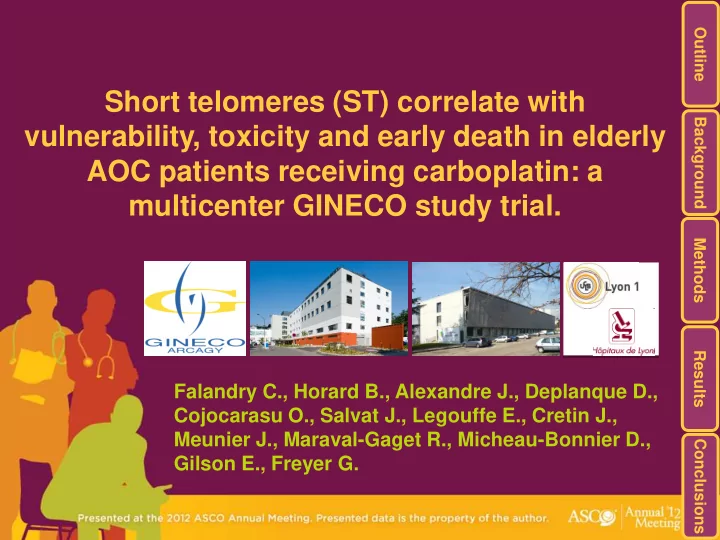
Short telomeres (ST) correlate with vulnerability, toxicity and early death in elderly AOC patients receiving carboplatin: a multicenter GINECO study trial.

Falandry C., Horard B., Alexandre J., Deplanque D., Cojocarasu O., Salvat J., Legouffe E., Cretin J., Meunier J., Maraval-Gaget R., Micheau-Bonnier D., Gilson E., Freyer G.

Outline Background Methods Results Conclusions

Photo CHLS

slide-2
SLIDE 2

The telomere connection

Homologous recombination Non Homologous End Joining Replication fork stalling High sensitivity to

  • xydative stress

End-replication problem Hayflick L. Exp Cell Res 1961;25:585-621. Olovnikov AM. J Theor Biol 1973;41:181-90. Greider CW. Cell 1987;51:887-98. Rudolph KL. Cell 1999;96:701-12.

Outline Background Methods Results Conclusions

t-loop D-loop

Strand invasion of 3’ overhang

circular DNA

slide-3
SLIDE 3

PRESENTED BY:

Telomere and aging

ALT telomere lengthening Chromosomal recombinations – telomere healing Tissue renewal loss Pro-inflammatory secretory phenotype Pro-tumorogenic potential

  • loss of telomerase activity ?
  • Higher turn over ?
  • Inflammaging ?
  • Oxydative stress ?

Telomerase activation

60

Cancer Senescence

Telomere length Age

Outline Background Methods Results Conclusions

slide-4
SLIDE 4

Method

Outline Background Methods Results Conclusions

slide-5
SLIDE 5

Ovarian cancer in the elderly

Outline Background Methods Results Conclusions

  • Subgroup analyses: standards feasible in selected elderly

patients : primary surgery, carboplatin-paclitaxel

  • GINECO experience: treatment completion rate

 1999-2003: 72% for carboplatin-cyclophosphamide (n=83)  2004-2006: 68% for carboplatin-paclitaxel (n=75)

Multivariate analysis: negative impact of

  • Age
  • Stage (IV vs III)
  • Paclitaxel-based treatment
  • Depression and emotional disorders
  • Lymphopenia

Freyer G. Ann Oncol 2005;16:1795-800. Trédan O. Ann Oncol 2007;18:256-62

slide-6
SLIDE 6

The telomeric working hypothesis

↓ telomere length

( = telomere attrition)

Lymphocyte dysfunction

Old age Lymphopenia Depression

Emotional disorders

↓ Survival ↑ Toxicities Cawthon RM. Lancet 2003;361:393-5. Epel ES. Proc Natl Acad Sci U S A 2004;101:17312-5.

Outline Background Methods Results Conclusions

Elderly woman GINECO trials 1 & 2

?

slide-7
SLIDE 7

Elderly woman GINECO trial 3

Outline Background Methods Results Conclusions

  • 111 patients with stage III/IV ovarian cancer

included from 08/2007 to 01/2010 treated with 6 cycles of carboplatin monotherapy (AUC5), +/- primary cytoreduction

  • Primary endpoint: Impact of geriatric covariates on survival
  • Secondary endpoint:

– Impact of telomere length on treatment completion rate (TCr), tolerance and overall survival.

Standard Terminal Restriction Fragment analysis performed at inclusion, after 3 and 6 cycles

slide-8
SLIDE 8

Patients characteristics

Total (%) 111 (100) Age (years) Median 78 ≥ 80 45 (41) Extremes 70-93 Performance status 0-1 63 (57) 2-3 48 (43) ≥ 1 dependence ADL 61 (55) ≥ 1 dependence on IADL 93 (75) Emotional disorders Screening 20 (18) HADS ≥ 15 41 (37) ≥ 4 co-medications 76 (69) Outline Background Methods Results Conclusions

slide-9
SLIDE 9

Development of a Geriatric Vulnerability Score (GVS) in multivariate analysis

See poster 9079 by Freyer, G. et al.:

Patient and survivor care Sat June 2: 8:00-12:00

5 5

GVS<3 Censored GVS>3

Time (months) 10 20 30 40

OS (%)

100 50

GVS =  vulnerability factors :

Major :

  • score ADL < 6
  • score IADL < 25
  • albuminemia < 35g/L

Minor :

  • Lymphopenia < 1G/L
  • score HADS > 14

Outline Background Methods Results Conclusions

=> Vulnerable if GVS  3

slide-10
SLIDE 10

A weak correlation between telomere length and age

Outline Background Methods Results Conclusions

y = -26,462x + 8120,9 R2 = 0,0341

4000 4500 5000 5500 6000 6500 7000 7500 8000 8500 70 75 80 85 90 95

Telomere length Age

  • 111 patients sampled, 109/111 evaluable (duplicate analysis)
slide-11
SLIDE 11

Patient telomere length and treatment completion rate (TCr)

  • With a cut-off of 5770bp, TL discriminates 2 groups of

patients with different TCr

Outline Background Methods Results Conclusions

Treatment completion rate (TCr)

0% 20% 40% 60% 80% 100% ST LT

p=0.02

n = 34

Short

n = 75

Long 59% 80% Telomere length

slide-12
SLIDE 12

Severe toxicity increases with telomere shortening

Outline Background Methods Results Conclusions

event

Observed Risk: short/long telomere group 95% confidence interval P Serious Adverse Events 2.69 1.17-6.19 .019 Unplanned hospital admissions 2.14 0.92-4.95 .070 Grade > 3 non-hematological toxicities 2.04 0.88-4.71 .095

slide-13
SLIDE 13

Vulnerability increases with telomere shortening

  • No significant correlation with any of the GVS components
  • BUT a correlation between patient telomere length (Short

vs Long) and vulnerability (GVS  3;  2 major criteria)

GVS =  vulnerability factors :

Major :

  • score ADL < 6
  • score IADL < 25
  • albuminemia < 35g/L

Minor :

  • Lymphopenia < 1G/L
  • score HADS > 14

=> Vulnerable if GVS  3 0% 20% 40% 60% 80% 100% Short Long

Outline Background Methods Results Conclusions

OR = 2.17, p=0.06

Vulnerable pts (GVS > 3; > 2 major C, %) Telomere length Short Long

slide-14
SLIDE 14

Overall survival

Time Survival 10 20 30 40 0.0 0.2 0.4 0.6 0.8 1.0 IVvsIII=0, ST5999=0 IVvsIII=0, ST5999=1 IVvsIII=1, ST5999=0 IVvsIII=1, ST5999=1

Time (months) Overall survival

Stage III, telomere size ≥ 6000bp Stage III, telomere size < 6000bp Stage IV, telomere size ≥ 6000bp Stage IV, telomere size < 6000bp

Outline Background Methods Results Conclusions

  • Multivariate analysis :

– Stage (IV vs III) HR=2,53 [1.54-4.27]; p=0,0003 – Telomere < 6000bp HR=1,57 [0.98-2.51]; p=0,06

slide-15
SLIDE 15

Back to the telomeric working hypothesis

↓ telomere length

( = telomere attrition)

↓ telomerase

activity Lymphocyte dysfunction

Old age

?

Lymphopenia Depression

Emotional disorders

↓ Survival ↑ Toxicities Other vulnerability factors ?

Elderly woman GINECO trials 1 & 2

  • A partial overlap between TL and geriatric vulnerability

factors

Outline Background Methods Results Conclusions

slide-16
SLIDE 16

Dealing with controversies

From Gilson and Geli, Nat Rev Mol Cell Biol 2007

  • Measuring directly DNA damage response
  • In cell nuclei : TIFs (Telomere-dysfunction Induced Foci)
  • DNA-damage biomarkers

Jiang et al, Proc Natl Acad Sci U S A 2008;105:11299-304. Augereau et al, Blood 2011;118:1316-22.

Outline Background Methods Results Conclusions

slide-17
SLIDE 17

Take home messages

Outline Background Methods Results Conclusions

Telomere length estimation

  • is feasible using standard procedure
  • Identifies a group of elderly patients with Short Telomeres who:
  • Have a lower chance to complete their planned 6 chemotherapy

courses

  • Have a higher risk of chemotherapy toxicity (number of serious

adverse events, unplanned hospital admissions and severe non- haematological grade 3-4 toxicity)

  • Partially overlaps with patient subsets according to the vulnerability

score GVS

  • Might be a risk factor for premature death independent from FIGO

stage

slide-18
SLIDE 18

Acknowledgements

  • The GINECO office

study team

Douglas Micheau-Bonnier Nicolas Gane Bénédicte Votan

  • The patients participating in the trial
  • The co-investigators
  • Fondation de France
  • The French Ministry of Health
  • Hospices civils de Lyon

Raymonde Maraval Gaget Jérôme Alexandre Marie-Noëlle Certain Laure Chauvenet Martin Combe Jacques Cretin Hervé Curé Philippe Deguiral Gaël Deplanque Michel Fabbro Olivier Gisserot Jean-Paul Guastalla Salima Kalla Marie-Christine Kaminsky Rémy Largillier Annick Le Rol Daniela Lebrun-Jezekova Eric Legouffe Catherine Ligeza-Poisson Elisabeth Luporsi Jérôme Meunier Frank Priou Jocelyne Provençal Eric Pujade-Lauraine Isabelle Ray-coquard Frédérique Rousseau Jacques Salvat Francesco Savinelli Emmanuel Sevin Laëtitia Stefani Jean-Marie Tigot Olivier Tredan Béatrice Weber Gabriel Yazbek