Case Presentation dense breasts and no mammographic correlate to - - PDF document

case presentation
SMART_READER_LITE
LIVE PREVIEW

Case Presentation dense breasts and no mammographic correlate to - - PDF document

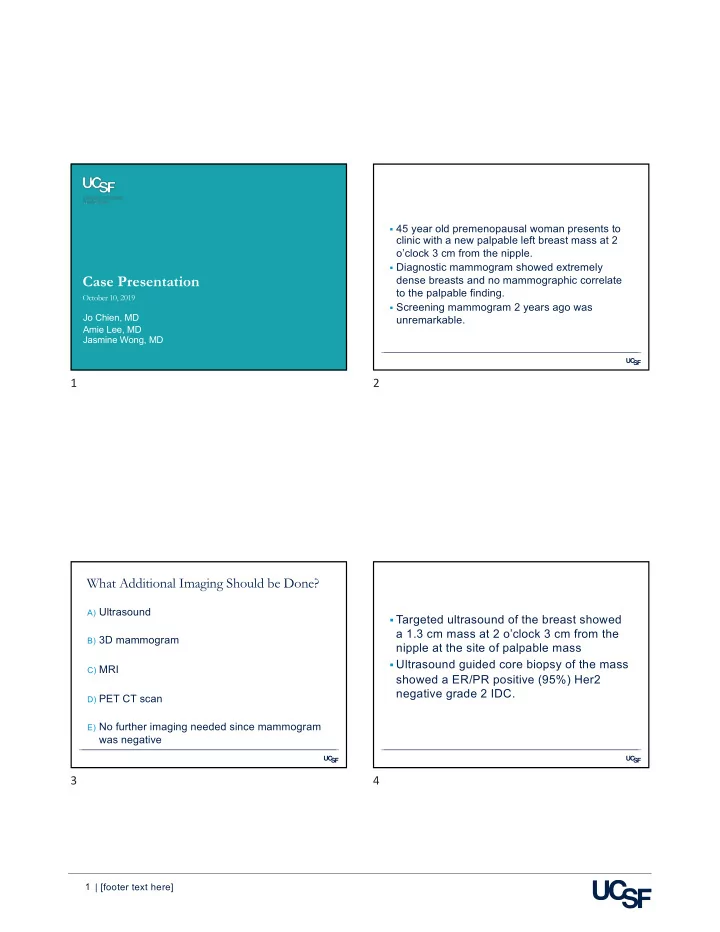
45 year old premenopausal woman presents to clinic with a new palpable left breast mass at 2 oclock 3 cm from the nipple. Diagnostic mammogram showed extremely Case Presentation dense breasts and no mammographic correlate to the


slide-1
SLIDE 1

1 | [footer text here] Jo Chien, MD Amie Lee, MD Jasmine Wong, MD

Case Presentation

October 10, 2019

1

§ 45 year old premenopausal woman presents to

clinic with a new palpable left breast mass at 2

  • ’clock 3 cm from the nipple.

§ Diagnostic mammogram showed extremely

dense breasts and no mammographic correlate to the palpable finding.

§ Screening mammogram 2 years ago was

unremarkable.

2

What Additional Imaging Should be Done?

A) Ultrasound B) 3D mammogram C) MRI D) PET CT scan E) No further imaging needed since mammogram

was negative

3

§ Targeted ultrasound of the breast showed

a 1.3 cm mass at 2 o’clock 3 cm from the nipple at the site of palpable mass

§ Ultrasound guided core biopsy of the mass

showed a ER/PR positive (95%) Her2 negative grade 2 IDC.

4

slide-2
SLIDE 2

2 | [footer text here]

Should a Breast MRI be performed?

A) Yes B) No C)It’s complicated…

5

§ Patient elects to undergo a partial

mastectomy and sentinel lymph node biopsy

§ Surgical pathology showed a 1.5 cm grade

2 ER/PR positive (95%) Her2 negative IDC with negative margins, 1 positive sentinel lymph node (3mm) and 2 negative sentinel lymph nodes

6

How should the positive sentinel lymph node be managed?

A) Completion axillary lymph node dissection B) Mastectomy C) Surveillance ultrasounds of the axilla D) No further surgical management, refer to

radiation oncology

E) Repeat sentinel lymph node biopsy

7

What adjuvant systemic therapy should be

  • ffered?

A) Chemotherapy B) Endocrine Therapy C) Chemotherapy followed by hormone

therapy

D) Need more information – send molecular

profiling

8

slide-3
SLIDE 3

3 | [footer text here] § Medical oncology sends a MammaPrint

test – results show low risk signature

9

Which adjuvant systemic therapy do you recommend?

A) Chemotherapy B) Tamoxifen C) Ovarian suppression D) Aromatase inhibitor E) Ovarian suppression and aromatase inhibitor

10

§ The patient is risk averse and elects to start

  • n ovarian suppression and letrozole.

§ She develops intolerable joint pain and

vaginal dryness, and would like to discontinue her hormone therapy due to her side effects.

§ She is exercising 5 days a week and doing

acupuncture weekly

11

Which of the following options would be inappropriate to recommend?

A) Hold AI for 2 weeks then try a different one,

continue OS

B) A trial of E-string for vaginal dryness C) A trial of duloxetine for joint pain D) Stop OS, continue with AI alone E) Switch to tamoxifen alone

12

slide-4
SLIDE 4

4 | [footer text here]

What Surveillance Imaging Should This Patient Have?

A) Annual Bilateral Screening Mammograms B) Annual Breast MRI C) 3D Screening Mammogram and Breast MRI,

alternating every 6 months

D) Annual Screening Mammogram and Breast

Ultrasound

13 14