May 9-11, 2018 Omaha, NE 44th Annual Midwest Pharmacy Residents - - PDF document

may 9 11 2018 omaha ne 44th annual midwest pharmacy
SMART_READER_LITE
LIVE PREVIEW

May 9-11, 2018 Omaha, NE 44th Annual Midwest Pharmacy Residents - - PDF document

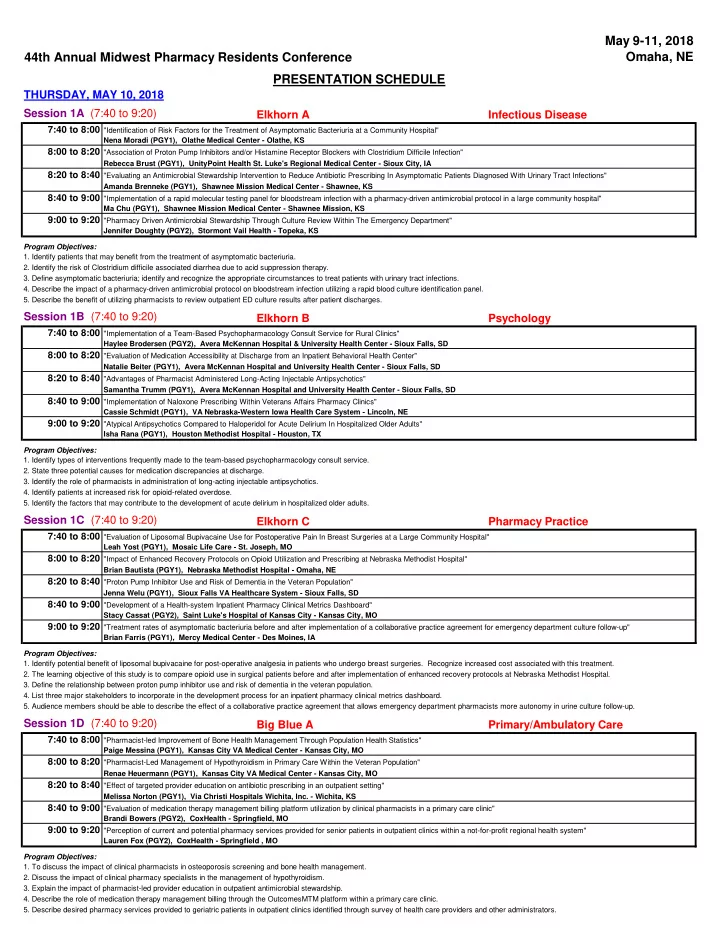
May 9-11, 2018 Omaha, NE 44th Annual Midwest Pharmacy Residents Conference PRESENTATION SCHEDULE THURSDAY, MAY 10, 2018 Session 1A (7:40 to 9:20) Elkhorn A Infectious Disease 7:40 to 8:00 "Identification of Risk Factors for the


slide-1
SLIDE 1

44th Annual Midwest Pharmacy Residents Conference May 9-11, 2018 Omaha, NE

THURSDAY, MAY 10, 2018 Session 1A (7:40 to 9:20) Elkhorn A Infectious Disease

7:40 to 8:00 8:00 to 8:20 8:20 to 8:40 8:40 to 9:00 9:00 to 9:20

Program Objectives:

Session 1B (7:40 to 9:20) Elkhorn B Psychology

7:40 to 8:00 8:00 to 8:20 8:20 to 8:40 8:40 to 9:00 9:00 to 9:20

Program Objectives:

Session 1C (7:40 to 9:20) Elkhorn C Pharmacy Practice

7:40 to 8:00 8:00 to 8:20 8:20 to 8:40 8:40 to 9:00 9:00 to 9:20

Program Objectives:

Session 1D (7:40 to 9:20) Big Blue A Primary/Ambulatory Care

7:40 to 8:00 8:00 to 8:20 8:20 to 8:40 8:40 to 9:00 9:00 to 9:20

Program Objectives:

PRESENTATION SCHEDULE

"Identification of Risk Factors for the Treatment of Asymptomatic Bacteriuria at a Community Hospital" Nena Moradi (PGY1), Olathe Medical Center - Olathe, KS "Association of Proton Pump Inhibitors and/or Histamine Receptor Blockers with Clostridium Difficile Infection" Rebecca Brust (PGY1), UnityPoint Health St. Luke's Regional Medical Center - Sioux City, IA "Evaluating an Antimicrobial Stewardship Intervention to Reduce Antibiotic Prescribing In Asymptomatic Patients Diagnosed With Urinary Tract Infections"

  • 1. Identify patients that may benefit from the treatment of asymptomatic bacteriuria.
  • 2. Identify the risk of Clostridium difficile associated diarrhea due to acid suppression therapy.
  • 3. Define asymptomatic bacteriuria; identify and recognize the appropriate circumstances to treat patients with urinary tract infections.
  • 4. Describe the impact of a pharmacy-driven antimicrobial protocol on bloodstream infection utilizing a rapid blood culture identification panel.
  • 5. Describe the benefit of utilizing pharmacists to review outpatient ED culture results after patient discharges.

Amanda Brenneke (PGY1), Shawnee Mission Medical Center - Shawnee, KS "Implementation of a rapid molecular testing panel for bloodstream infection with a pharmacy-driven antimicrobial protocol in a large community hospital" Ma Chu (PGY1), Shawnee Mission Medical Center - Shawnee Mission, KS "Pharmacy Driven Antimicrobial Stewardship Through Culture Review Within The Emergency Department" Jennifer Doughty (PGY2), Stormont Vail Health - Topeka, KS Samantha Trumm (PGY1), Avera McKennan Hospital and University Health Center - Sioux Falls, SD "Implementation of Naloxone Prescribing Within Veterans Affairs Pharmacy Clinics" Cassie Schmidt (PGY1), VA Nebraska-Western Iowa Health Care System - Lincoln, NE "Atypical Antipsychotics Compared to Haloperidol for Acute Delirium In Hospitalized Older Adults" Isha Rana (PGY1), Houston Methodist Hospital - Houston, TX "Implementation of a Team-Based Psychopharmacology Consult Service for Rural Clinics" Jenna Welu (PGY1), Sioux Falls VA Healthcare System - Sioux Falls, SD "Development of a Health-system Inpatient Pharmacy Clinical Metrics Dashboard" Stacy Cassat (PGY2), Saint Luke's Hospital of Kansas City - Kansas City, MO "Treatment rates of asymptomatic bacteriuria before and after implementation of a collaborative practice agreement for emergency department culture follow-up" Brian Farris (PGY1), Mercy Medical Center - Des Moines, IA Haylee Brodersen (PGY2), Avera McKennan Hospital & University Health Center - Sioux Falls, SD "Evaluation of Medication Accessibility at Discharge from an Inpatient Behavioral Health Center" Natalie Beiter (PGY1), Avera McKennan Hospital and University Health Center - Sioux Falls, SD "Advantages of Pharmacist Administered Long-Acting Injectable Antipsychotics" "Evaluation of Liposomal Bupivacaine Use for Postoperative Pain In Breast Surgeries at a Large Community Hospital" Leah Yost (PGY1), Mosaic Life Care - St. Joseph, MO "Impact of Enhanced Recovery Protocols on Opioid Utilization and Prescribing at Nebraska Methodist Hospital" Brian Bautista (PGY1), Nebraska Methodist Hospital - Omaha, NE "Proton Pump Inhibitor Use and Risk of Dementia in the Veteran Population"

  • 1. Identify types of interventions frequently made to the team-based psychopharmacology consult service.
  • 2. State three potential causes for medication discrepancies at discharge.
  • 3. Identify the role of pharmacists in administration of long-acting injectable antipsychotics.
  • 4. Identify patients at increased risk for opioid-related overdose.
  • 5. Identify the factors that may contribute to the development of acute delirium in hospitalized older adults.

"Pharmacist-led Improvement of Bone Health Management Through Population Health Statistics" Paige Messina (PGY1), Kansas City VA Medical Center - Kansas City, MO "Pharmacist-Led Management of Hypothyroidism in Primary Care Within the Veteran Population" Renae Heuermann (PGY1), Kansas City VA Medical Center - Kansas City, MO "Effect of targeted provider education on antibiotic prescribing in an outpatient setting"

  • 1. Identify potential benefit of liposomal bupivacaine for post-operative analgesia in patients who undergo breast surgeries. Recognize increased cost associated with this treatment.
  • 2. The learning objective of this study is to compare opioid use in surgical patients before and after implementation of enhanced recovery protocols at Nebraska Methodist Hospital.
  • 3. Define the relationship between proton pump inhibitor use and risk of dementia in the veteran population.
  • 4. List three major stakeholders to incorporate in the development process for an inpatient pharmacy clinical metrics dashboard.
  • 5. Audience members should be able to describe the effect of a collaborative practice agreement that allows emergency department pharmacists more autonomy in urine culture follow-up.
  • 1. To discuss the impact of clinical pharmacists in osteoporosis screening and bone health management.
  • 2. Discuss the impact of clinical pharmacy specialists in the management of hypothyroidism.
  • 3. Explain the impact of pharmacist-led provider education in outpatient antimicrobial stewardship.
  • 4. Describe the role of medication therapy management billing through the OutcomesMTM platform within a primary care clinic.
  • 5. Describe desired pharmacy services provided to geriatric patients in outpatient clinics identified through survey of health care providers and other administrators.

Melissa Norton (PGY1), Via Christi Hospitals Wichita, Inc. - Wichita, KS "Evaluation of medication therapy management billing platform utilization by clinical pharmacists in a primary care clinic" Brandi Bowers (PGY2), CoxHealth - Springfield, MO "Perception of current and potential pharmacy services provided for senior patients in outpatient clinics within a not-for-profit regional health system" Lauren Fox (PGY2), CoxHealth - Springfield , MO

slide-2
SLIDE 2

THURSDAY, MAY 10, 2018 Session 1E (7:40 to 9:20) Big Blue B Hematology/Oncology

7:40 to 8:00 8:00 to 8:20 8:20 to 8:40 8:40 to 9:00 9:00 to 9:20

Program Objectives:

Session 1F (7:40 to 9:20) Big Blue C Clinical Services Management

7:40 to 8:00 8:00 to 8:20 8:20 to 8:40 8:40 to 9:00 9:00 to 9:20

Program Objectives:

Session 1G (7:40 to 9:20) Council Bluffs A Internal Medicine

7:40 to 8:00 8:00 to 8:20 8:20 to 8:40 8:40 to 9:00 9:00 to 9:20

Program Objectives:

Session 1H (7:40 to 9:20) Council Bluffs B Critical Care

7:40 to 8:00 8:00 to 8:20 8:20 to 8:40 8:40 to 9:00 9:00 to 9:20

Program Objectives: Shelbie Ralph (PGY2), The University of Kansas Health System - Kansas City, KS "Evaluation of the tolerability and cytomegalovirus reactivation with an intensive prophylaxis strategy in haploidentical transplant patients" Sara Johnson (PGY1), The University of Kansas Health System - Kansas City , KS "Analysis of Fungitell Assay and Intravenous Immunoglobulin Interaction In Allogenic Bone Marrow Transplant Patients" Megan Rieder (PGY1), The University of Kansas Health System - Kansas City, KS "Evaluation of Maintenance Regimens for Multiple Myeloma Patients Post-transplant" Jordan Snyder (PGY2), University of Kansas Health System - Kansas City, KS "Medication Interactions with Oral Chemotherapy Agents: A Focus on the BCR-ABL Tyrosine Kinase Inhibitors in Patients with Chronic Myeloid Leukemia" Ryan Fleer (PGY2), The University of Kansas Health System - Kansas City, KS "Oral Chemotherapy Toxicity Monitoring: Assessment of Adherence at a Single Institution" "Evaluation of transitional care management service opportunities by clinical pharmacists in a community health system" Jordan Rowe (PGY2), CoxHealth - Springfield, MO "Impact of Cost Transparency on Drug Utilization" Stella Kim (PGY1), Houston Methodist Hospital - Houston, TX "An Evaluation of the Impact of Transitioning to a Paperless Warfarin Monitoring System"

  • 1. Determine if maintenance regimen has an impact of progression free survival in multiple myeloma patients post-transplant.
  • 2. Characterize the pharmacodynamic impact of drug-drug interactions in patients utilizing BCR-ABL tyrosine kinase inhibitors for chronic myeloid leukemia.
  • 3. Express the importance of safeguards such as toxicity monitoring for oral chemotherapy (OC).
  • 4. Identify adequate cytomegalovirus prophylaxis in haploidentical transplant patients.
  • 5. Understand immunoglobulin administration effects on Fungitell assay results.
  • 1. Describe the required billing components of transitional care management services as defined by the Centers for Medicare and Medicaid Services.
  • 2. To identify the impact of real-time cost display, coupled with a lower-cost alternative, on medication prescribing behavior.
  • 3. Evaluate the current warfarin management service workflow for hospitalized patients receiving warfarin anticoagulation and identify potential barriers to implementing a paperless warfarin
  • 4. Identify strategies with potential to decrease mismanagement of renally-dosed medications in a hospital pharmacy setting.
  • 5. Describe a process to achieve extended beyond use dating of compounded sterile products in an Academic Medical Center.

Andrew Tarleton (PGY1), Abbott Northwestern Hospital - Minneapolis, MN "Implementation and Quality Assessment of a Renal Dosing Protocol In the Inpatient Pharmacy" William Hawes (PGY1), UAMS Medical Center - Little Rock, AR "Implementing USP <71> Sterility Testing Process to Extend the Beyond Use Dating of Compounded Sterile Products at an Academic Medical Center" Bryan Haugen (PGY1), University of Minnesota Medical Center - Fairview - Minneapolis, MN monitoring system and ways one can work to overcome those challenges. Laken Brock (PGY1), Mercy Hospital Joplin - Joplin, MO "Glycemic Control In Psychiatric Inpatients After Implementation of a Carbohydrate-Counting, Insulin-Based Regimen" Nicole Bendon (PGY1), Hennepin County Medical Center - Minneapolis, MN "Impact of Revised Clinical Pathway and Pharmacist Intervention on Discharge Prescribing Practices of Proton Pump Inhibitors" Emilie Hudalla (PGY1), Minneapolis VA Health Care System - Minneapolis, MN "Clinical Event Impact of Augmented Versus Standard Prophylactic Enoxaparin Dosing in Hospitalized Obese Patients" Taylor Pick (PGY1), CHI Health Immanuel - Omaha, NE "Evaluation of Prescribing Practices for Inpatient Fentanyl Patches Following Implementation of an Electronic Medical Record Alert" Julie Beck (PGY1), North Kansas City Hospital - North Kansas City, MO "Initiation of a pharmacy technician-led concierge program with pharmacist follow-up: An economic and clinical evaluation" "Impact of Single IV Dose antibiotic on outcomes for patients discharged from the emergency department on oral antibiotic" Michael Thiefault (PGY2), Mercy Medical Center - Des Moines, IA "Effect of intrapleural alteplase and dornase alfa on surgical decortication rates in pleural infections" Allisha Gabriel (PGY1), Wesley Medical Center - Wichita, KS "Sucrose-containing intravenous immunoglobulin and the incidence of renal failure in patients with at least one risk factor"

  • 1. Discuss the clinical impact of utilizing a dose augmented prophylactic enoxaparin dosing protocol in the hospitalized obese population as compared to standard dosing.
  • 2. Define opioid tolerance in terms of the required duration of therapy, minimum daily dose and what clinical patient factors may justify a lower initial dose.
  • 3. Recognize the impact that a MHT and a pharmacist can make upon patients in a medical/surgical floor and discuss implications of the result of this pilot program.
  • 4. Identify whether glycemic control may be improved with carbohydrate-counting insulin regimens compared to fixed-dose regimens in a psychiatric inpatient population.
  • 5. Identify when short term proton pump inhibitor treatment (≤8 weeks) is indicated on hospital discharge.
  • 1. Determine utility in use of a single-dose IV antibiotic before discharge compared to oral antibiotic therapy in patients that are deemed stable to be discharged from the ED on oral antibiotics.
  • 2. Review literature assessing the use of dornase alfa and alteplase and the effects on surgical decortication rates in pleural infections.
  • 3. Describe the proposed pathophysiology of sucrose-containing IVIG-induced acute renal failure.
  • 4. Review vasopressor recommendations in the Surviving Sepsis guidelines.
  • 5. Review data in regards to time to initiation of pharmacological venous thromboembolism (VTE) prophylaxis in traumatic brain injury (TBI) patients based off utilization of the Wesley Medical Center

Christina Cheong (PGY1), Wesley Medical Center - Wichita , KS "Weight Based vs Non-weight Based Norepinephrine in Septic Shock and Additional Vasopressor Requirements" Michael Reichert (PGY2), Wesley Medical Center - Wichita, KS "Timing of Initiation of Venous Thromboembolism Prophylaxis in Traumatic Brain Injury Patients in Accordance with Hospital Protocol" Laura Saladrigas (PGY1), Wesley Medical Center - Wichita , KS trauma department TBI VTE prophylaxis algorithm adapted from the Parkland Protocols Modified Berne-Norwood Criteria.

slide-3
SLIDE 3

THURSDAY, MAY 10, 2018 Session 1I (7:40 to 8:20) Missouri Infectious Disease

7:40 to 8:00 8:00 to 8:20

Program Objectives:

Session 1J (7:40 to 8:20) Platte Critical Care

7:40 to 8:00 8:00 to 8:20

Program Objectives:

Session 2A (10:40 to 12:00) Elkhorn A Infectious Disease

10:40 to 11:00 11:00 to 11:20 11:20 to 11:40 11:40 to 12:00

Program Objectives:

Session 2B (10:40 to 12:00) Elkhorn B Critical Care

10:40 to 11:00 11:00 to 11:20 11:20 to 11:40 11:40 to 12:00

Program Objectives:

Session 2C (10:40 to 12:00) Elkhorn C Pharmacy Practice

10:40 to 11:00 11:00 to 11:20 11:20 to 11:40 11:40 to 12:00

Program Objectives: antimicrobials. "Influence of Genes Important in Renal Sodium Handling and the Blood Pressure Response to a Diuretic in Hypertension" Jennifer Ross (PGY1), University of Minnesota Medical Center - Fairview - Minneapolis, MN

  • 2. Describe impact of blood pressure changes in patients who were mathematically predicted to respond or not respond to diuretic therapy based on multiple genes influencing renal sodium handling.

"Impact of bivalirudin versus heparin for patients with left ventricular assist device (LVAD) thrombosis" Megan Hansen (PGY2), Nebaska Medicine - Omaha, NE "Comparison of Laboratory Results Before and After the Implementation of a Pharmacist-Driven Continuous Infusion Bivalirudin Dosing Protocol" Nate Martin (PGY1), Nebraska Medicine - Omaha, NE

  • 1. Describe clinical outcomes associated with the treatment of LVAD thrombosis with heparin and bivalirudin.
  • 2. Identify the safety and efficacy impacts of a pharmacist-driven bivalirudin dosing protocol.

"Evaluation of Treatment Duration in Patients with Hospital Acquired Pneumonia, Health Care Associated Pneumonia, or Community Acquired Pneumonia at a "Retrospective review of prophylactic vancomycin for Clostridium difficile infection prevention in immunocompromised patients" Jacob DeCleene (PGY1), University of Minnesota Medical Center - Fairview - Minneapolis, MN

  • 1. Compare the rates of Clostridium difficile in the solid organ and stem cell transplant patient population in those who take prophylactic oral vancomycin versus historical controls.

Alexandria Stringberg (PGY1), University of Missouri Health Care - Columbia, MO

  • 1. Discuss the value of a unit-based pharmacy satellite in an emergency department.
  • 2. Describe the components of the discharge pharmacy trifecta and the value this provides to a patient discharging from the hospital.
  • 3. Identify the most common clinical indicators that exclude patients from eligibility or clinical benefit from DOAC therapy for nonvalvular atrial fibrillation.
  • 4. Summarize the process of implementing a pharmacist facilitated discharge medication review.
  • 3. Describe association between IV albumin and loop diuretic administration and duration of mechanical ventilation in hypoproteinemic patients compared to patients who receive loop diuretic alone.

"Assessing the value of a unit-based emergency department pharmacy satellite services" Akeem Bale (PGY1), Houston Methodist Hospital - Houston, TX "Impact of Discharge Pharmacy Trifecta Optimization at a Health-System Community Hospital on Improving Patient Care Transitions" Brittney Rohrer (PGY1), HealthEast St. John's Hospital - Maplewood, MN "Implementation of a Pharmacist Facilitated Discharge Medication Review"

  • 4. Review the uses of 4PCC in patients with acute hemorrhage.

"Effect of Intravenous Albumin and Loop Diuretic Therapy on Duration of Mechanical Ventilation" Kailey Frenzel (PGY1), CHI Health Creighton University Medical Center - Bergan Mercy - Omaha, NE "An Evaluation of Candidacy For Direct Oral Anticoagulants In Patients With Nonvalvular Atrial Fibrillation Poorly Controlled on Warfarin" Nathan Zimmermann (PGY1), St. Joseph's Hospital - St. Paul, MN "The impact of dexmedetomidine as an adjunct to benzodiazepines on rate of intubation in critically ill patients treated for alcohol withdrawal syndrome" Patrick Korienek (PGY1), Mayo Clinic Health System - Franciscan Healthcare - La Crosse, WI "Retrospective Analysis of the Safety of 4-factor Prothrombin Complex Concentrate in Warfarin and Non-warfarin Patients" Antonio Luo (PGY1), CHI Health Creighton University Medical Center-Bergan Mercy - Omaha, NE

  • 1. Explain the risk of moderate to severe acute kidney injury associated with 24-72 hours of concomitant anti-pseudomonal ß-lactam and vancomycin administration.
  • 2. Discuss the clinical impact of dexmedetomidine in conjunction to benzodiazepines for alcohol withdrawal syndrome.

Daniella Smid (PGY1), Iowa Methodist Medical Center - Des Moines, IA

  • 1. Describe opportunities to expand upon benefits of rapid molecular diagnostic testing in combination with real-time interventions.
  • 2. Review the appropriate treatment duration of antibiotics for uncomplicated CAP, HAP, and HCAP.
  • 3. Utilize beta-lactam allergy assessment and penicillin skin testing to optimize antimicrobial treatment while minimizing drug interactions, adverse effects, cost, and exposure to broad spectrum

"Incidence of acute kidney injury among critically ill patients with brief concomitant exposure to an anti-pseudomonal beta-lactam and vancomycin" Diana Schreier (PGY1), Mayo Clinic - Rochester, MN

  • 4. Utilize an AUC/MIC vancomycin empiric dosing nomogram to increase both safety and efficacy of vancomycin dosing throughout the health system.

"Evaluation of clinical pharmacists use of a blood culture follow-up protocol utilizing rapid molecular diagnostic testing" Alexandra Kerrigan (PGY1), Mercy Medical Center - Des Moines, IA "Implementation and Evaluation of an Allergy Assessment Program at a Three Hospital System" Steven Jordan (PGY1), Iowa Methodist Medical Center - Des Moines, IA "Development and Implementation of an Empiric Vancomycin AUC/MIC Dosing Nomogram in Adult Patients" Community Teaching Hospital. " Meredith Mitchell (PGY1), Freeman Health System - Joplin , MO

slide-4
SLIDE 4

THURSDAY, MAY 10, 2018 Session 2D (10:40 to 12:00) Big Blue A Primary/Ambulatory Care

10:40 to 11:00 11:00 to 11:20 11:20 to 11:40 11:40 to 12:00

Program Objectives:

Session 2E (10:40 to 12:00) Big Blue B Hematology/Oncology

10:40 to 11:00 11:00 to 11:20 11:20 to 11:40 11:40 to 12:00

Program Objectives:

Session 2F (10:40 to 11:40) Big Blue C Community Practice

10:40 to 11:00 11:00 to 11:20 11:20 to 11:40

Program Objectives:

Session 2G (10:40 to 11:40) Council Bluffs A Pediatrics/Neonatology

10:40 to 11:00 11:00 to 11:20 11:20 to 11:40

Program Objectives:

Session 2H (10:40 to 12:00) Council Bluffs B Primary/Ambulatory Care

10:40 to 11:00 11:00 to 11:20 11:20 to 11:40 11:40 to 12:00

Program Objectives: "Evaluation and Improvment of The Supply Selection Process In Home Infusion" Emma Huepfel (PGY1), Fairview Health Services - Minneapolis , MN

  • 3. To outline the effectiveness of pharmacist-led academic detailing visits to improve PDMP and UDT inquiry rates among patients on opioids.

"Evaluation of High-Dose Methotrexate Serum Concentration Requirement for Discharge" Marissa Ausman (PGY2), Nebraska Medicine - Omaha, NE "Olanzapine as a Rescue Anti-Emetic In Patients with Hematopoietic Stem Cell Transplant (HSCT)" Taylor Monson (PGY1), Nebraska Medicine - Omaha, NE "Cost-Effectiveness Analysis of Midostaurin for the Initial Treatment of Acute Myeloid Leukemia" "Academic Detailing To Improve Prescription Drug Monitoring And Urine Drug Test Inquiry Rates Among Long Term Opioid Users" William Bruneau (PGY1), Minneapolis VA Health Care System - Minneapolis, MN "A Targeted Approach To Improve Documented Counseling For New Teratogenic Medication Prescriptions" Keri Enyi (PGY1), Minneapolis VA Health Care System - Minneapolis , MN

  • 1. Describe interventions that can be used to ensure accurate supply selection within a home infusion pharmacy.
  • 2. The purpose of this project is to characterize emergency department use based on the National Home Infusion Association classification and determine areas to better care for infusion patients.

"Implementing A Pharmacist Driven Adherence Program for Insulin Naïve Diabetics" Adam Beeler (PGY1), The Univeristy of Kansas Health System - Kansas City, MO "Impact of Community Pharmacist Intervention on Concurrent Benzodiazepine and Opioid Prescribing Patterns" Georgia Luchen (PGY1), University of Kansas School of Pharmacy and Balls Food Stores - Overland Park, KS

  • 1. Describe communication barriers that patients who identify as English as a second language experience in healthcare and solutions to overcome these barriers.
  • 2. Discuss how education and counseling provided by a pharmacist in the outpatient retail setting to insulin naïve diabetic patients can impact adherence to diabetic medications.

Mallory Crain (PGY2), Barnes-Jewish Hospital - St. Louis, MO

  • 1. To discuss the safety of discharging appropriate patients once the high-dose methotrexate level is ≤ 0.3 microMol/L
  • 2. Identify patients at high risk for invasive fungal infections and recommend an appropriate prophylactic strategy.
  • 3. Describe the utility of olanzapine for improved delayed and breakthrough nausea and vomiting in patients undergoing hematopoietic stem cell transplant.

"Perception of Interpretation Services for Patients with English as a Second Language during Pharmacist-Led Chronic Disease State Management Programs" Laura Litwin (PGY1), Balls Food Stores and The University of Kansas School of Pharmacy - Overland Park, KS Julie Tran (PGY1), Mercy Hospital Springfield - Springfield, MO

  • 1. Discuss the potential benefits from optimizing the role of a clinical pharmacist in dosing and monitoring vancomycin in pediatric patients.
  • 2. Describe the impact that a pharmacist-led intervention made on the time-to-administration of cefazolin for pediatric trauma cases.
  • 3. To describe the difference in using intravenous acetaminophen and not using acetaminophen in post-operative pediatric patients using mean total morphine equivalence (mg/kg) per patient.

"Measuring Medication-Related Experiences after Frequent Review of Patient's New Oral Medications" James Hwang (PGY1), United Hospital - St. Paul , MN

  • 3. To describe the impact of a pharmacist intervention on benzodiazepine and opioid co-prescribing patterns in community pharmacies in the Kansas City Metropolitan area.

"Evaluation of Pediatric Vancomycin Dosing and the Role of the Pharmacist" Betty Sponsel (PGY1), Stormont Vail Health - Topeka, KS "Pharmacist-led standardization of cefazolin dosing for pediatric trauma patients within the emergency department" Jennifer Grimes (PGY1), Mercy Hospital - Springfield, MO "Use of IV Acetaminophen in Post-Operative Pediatric Patients to Decrease use of Opioids"

  • 3. Explain the potential significance of medication regimen reviews in keeping patients in an independent living situation and at a lower level of care.
  • 4. To help clinicians understand how EHR tools can be built and how to collaborate with technical staff to implement them in order to improve their practice.

"Medication Regimen Review for Patients Returning to Independent Living Following Skilled Nursing Facility Stay" Jayson Thompson (PGY1), Lake Region Healthcare - Fergus Falls, MN "Creation and Customization of Electronic Health Record Tools for Medication Therapy Management" Logane Kiehnau (PGY1), Allina Health - Minneapolis, MN

  • 1. Assess medication-related experiences after frequent interactive review of patient's new oral medications. Specifically, answers to Hospital Consumer Assessment of Healthcare Providers and
  • 2. Recall ways in which pharmacists can supplement and add benefits to current COPD care.

Systems (HCAHPS) questions about medication communication and 30-day readmission rates will be analyzed before and after this intervention. "Understanding Emergency Department Use Outcome in Home Infusion Patients and the Implications to the Future of Practice" Alicia Ranasinghe (PGY1), Fairview Pharmacy Services - Minneapolis, MN "Incidence of Invasive Fungal Infections in High-Risk Oncology Patients" Jared Matya (PGY2), Nebraska Medicine - Omaha, NE "Impact Of Pharmacist Interventions On COPD-related Quality Of Life" Michael Serlin (PGY1), SSM Health St. Clare Hospital - Fenton, MO

  • 4. Identify the benefits of midostaurin when added on to standard of care treatment for patients with AML.
  • 4. Describe opportunities for improving teratogenic medication counseling and documentation.
slide-5
SLIDE 5

THURSDAY, MAY 10, 2018 Session 3A (1:10 to 2:50) Elkhorn A Infectious Disease

1:10 to 1:30 1:30 to 1:50 1:50 to 2:10 2:10 to 2:30 2:30 to 2:50

Program Objectives:

Session 3B (1:10 to 2:50) Elkhorn B Critical Care

1:10 to 1:30 1:30 to 1:50 1:50 to 2:10 2:10 to 2:30 2:30 to 2:50

Program Objectives:

Session 3C (1:10 to 2:50) Elkhorn C Pharmacy Practice

1:10 to 1:30 1:30 to 1:50 1:50 to 2:10 2:10 to 2:30 2:30 to 2:50

Program Objectives:

Session 3D (1:10 to 2:50) Big Blue A Primary/Ambulatory Care

1:10 to 1:30 1:30 to 1:50 1:50 to 2:10 2:10 to 2:30 2:30 to 2:50

Program Objectives: "Inappropriate Antibiotic Usage In Asymptomatic Bacteriuria" Jordan Kunkel (PGY1), UnityPoint Health - Allen Hospital - Waterloo, IA "Assessing Nursing Perceptions of Patient Sleep Hygiene in the Intensive Care Unit in Order to Develop a Sleep Bundle to Decrease Delirium" Angela Chu (PGY1), Truman Medical Centers - Kansas City, MO

  • 1. Identify appropriate infusion and titration rates of dexmedetomidine for promotion of effective, safe and cost-conscious sedation in mechanically ventilated patients.
  • 2. Explain the possible complications associated with a mechanical thrombectomy procedure.

"Design, Implementation, and Results of an Electronic Health Record-Based 48-72 Hour Timeout for Antimicrobial Stewardship" Aaron Skoglund (PGY1), North Memorial Health Hospital - Robbinsdale, MN "Evaluation of Asymptomatic Bacteriuria Treatment and Outcomes in an Emergency Department at a Community Hospital" Lorena Hernandez (PGY1), Mercy Medical Center- Cedar Rapids - Cedar Rapids, IA "Impact of Implementing a Beta-Lactam Allergy Clinical Practice Guideline on Inpatient Antibiotic Prescribing" Danielle Ritchie (PGY1), Mercy Medical Center-North Iowa - Mason City, IA

  • 3. Recognize the importance of AUC:MIC vs. trough-based vancomycin dosing in patients with documented Staphylococcus aureus bacteremia.
  • 4. Identify which regimen presents a greater risk of acute kidney injury.

"Improving Dexmedetomidine Use for Sedation in Mechanically Ventilated Patients" Lauren Dubosh (PGY1), Abbott Northwestern Hospital - Minneapolis, MN "Utility of Clevidipine for Blood Pressure Management in the Setting of Mechanical Thrombectomy for Acute Ischemic Stroke: a retrospective study" Alexandra Lang (PGY1), Sanford Medical Center - Fargo, ND "Assessment of Trough-based Vancomycin Dosing in Patients with Staphylococcus aureus Bacteremia in Comparison to AUC:MIC Ratio Target" Alexander McGraw (PGY1), Southeast Hospital - Cape Girardeau, MO "Incidence of acute kidney injury following treatment with vancomycin plus meropenem or vancomycin plus piperacillin-tazobactam at a tertiary care hospital" Perry Carrington (PGY1), University of Missouri Health Care - Columbia, MO

  • 1. Identify factors associated with the inappropriate prescribing of antibiotics for asymptomatic bacteriuria.
  • 2. Identify when a beta-lactam test dose may be given to patients with a reported penicillin or cephalosporin allergy.
  • 5. Discuss the role of an antimicrobial timeout and some of the challenges associated with its implementation.

"Impact of a Procalcitonin Lab Bundle on Appropriate Antibiotic Treatment Decisions in Critically Ill Patients" Kerra Cissne (PGY2), Truman Medical Centers - Kansas City, MO

  • 3. Describe challenges patients with heart failure encounter once discharged from the hospital. Identify roles a transition of care pharmacist may have to assist patients with heart failure.
  • 5. Discuss the importance of pharmacist involvement in decreasing COPD readmission rates.

"Development of a Merit-Based Incentive Payment System And Quality Focused Ambulatory Care Pharmacy Practice Model at a Tertiary Referral Medical Center" Emily Murray (PGY1), Avera McKennan Hospital and University Health Center - Sioux Falls, SD "Liraglutide Use When Combined With Insulin Therapy In Va Pharmacist-Run Diabetes Clinic" Melissa Sutton (PGY1), Nebraska Western Iowa VA - Grand Island, NE "Transition of Care Pharmacists Assisting in the Management of Congestive Heart Failure Patients to Improve Time to Next Hospitalization" Susan Voong (PGY1), Covenant Medical Center - Waterloo, IA "Potential Cost Savings Using Consignment Services And Increased Access to Factor Products" Maria Shiue (PGY1), Essentia Health - St. Joseph's Medical Center - Brainerd, MN

  • 1. Identify strategies, initiated by pharmacists, to reduce IV acetaminophen drug expenditure.
  • 2. To identify interventions pharmacy can make in reducing incidences of inpatient hypoglycemia.

"Pharmacist Goal Directed COPD Inhaler Therapy Impact on Readmission Rates" Katherine Thompson (PGY1), Bryan Medical Center - Lincoln, NE

  • 4. Identify non-pharmacologic interventions to promote patient sleep hygiene in the ICU.
  • 4. Identify cost savings benefit of consignment services and explain impact of increased availability of factor products.
  • 3. Review the characterization of asymptomatic bacteriuria, recognize how frequently asymptomatic bacteriuria is mistreated, and summarize the complications associated with improper treatment.
  • 5. Recall the different time frame procalcitonin should be followed in critically ill patients as opposed to non-critically ill patients.

"Development, Implementation and Assessment of Interventions Designed to Reduce Intravenous Acetaminophen Usage at Park Nicollet Methodist Hospital" Andrew Thies (PGY1), Methodist Hospital - St. Louis Park, MN "Implementation of a Pharmacy Diabetes Management System to Reduce Incidence of Hypoglycemia" Bushra Naz (PGY1), Cass Regional Medical Center - Harrisonville, MO

  • 3. Describe how veterans can be referred to pharmacy clinic for tobacco cessation.
  • 5. Recognize the importance of medical nutrition therapy as a key component of diabetes management.

"Evaluation Of Tobacco Cessation Consult Service in a Veterans Affairs Pharmacy Clinic" Shelby Boschult (PGY1), Nebraska-Western Iowa Health Care System - Grand Island Division - Grand Island, NE "Implementation of a Nurse-Led Protocol For Initiation And Titration of Metformin Therapy In Type-2 Diabetes Patients" Jillian Murphy (PGY1), VA Nebraska-Western Iowa-Grand Island - Grand Island, NE

  • 1. Describe performance-based payment adjustments to reimbursements.
  • 2. Determine the average percent reduction in bolus insulin at the initiation of liraglutide.

"Evaluation of the Use of Medical Nutrition Therapy for Diabetic Patients in a Veterans Affairs Pharmacy Clinic" Tina Chov (PGY1), VA Nebraska-Western Iowa Health Care System - Lincoln, NE

  • 4. Describe the use of the Nursing Metformin Protocol at VA Nebraska-Western Iowa Health Care System-Grand Island.
slide-6
SLIDE 6

THURSDAY, MAY 10, 2018 Session 3E (1:10 to 2:50) Big Blue B Hematology/Oncology

1:10 to 1:30 1:30 to 1:50 1:50 to 2:10 2:10 to 2:30 2:30 to 2:50

Program Objectives:

Session 3F (1:10 to 2:50) Big Blue C Infectious Disease

1:10 to 1:30 1:30 to 1:50 1:50 to 2:10 2:10 to 2:30 2:30 to 2:50

Program Objectives:

Session 3G (1:10 to 2:50) Council Bluffs A Clinical Services Management

1:10 to 1:30 1:30 to 1:50 1:50 to 2:10 2:10 to 2:30 2:30 to 2:50

Program Objectives:

Session 3H (1:10 to 2:50) Council Bluffs B Transplant

1:10 to 1:30 1:30 to 1:50 1:50 to 2:10 2:10 to 2:30 2:30 to 2:50

Program Objectives: "Characterization Of Oncology Related Medication Issues In The Emergency Department Among Oncology Patients Who Received Chemotherapy Two Weeks Prior" Godsfavour Umoru (PGY1), Houston Methodist Hospital - Houston, TX "Olanzapine Versus Fosaprepitant For Chemotherapy-Induced Nausea And Vomiting Prophylaxis In Patients Receiving Single-Day High-Dose Melphalan" Ekim Ekinci (PGY2), Houston Methodist Hospital - Houston, TX

  • 3. Identify how to improve outcomes of patients newly prescribed oral chemotherapy in an outpatient center.
  • 5. By the end of this presentation, the audience should be able to explain the effect of first-dose rate titration of paclitaxel on incidence and severity of hypersensitivity reactions.

"Ceftriaxone One Gram vs Two Grams in Obese, Hospitalized Patients" Jordan Lentsch (PGY1), Fargo VA Health Care System - Fargo, ND "Increased Platelet Counts: Potential Diagnostic Marker for Osteomyelitis in Patients with Chronic Ulcers?" Mason Magle (PGY1), Fargo VA Health Care System - Fargo, ND "Assessment Of The Prescribing Patterns, Adverse Effects, And Drug Interactions Of Oral Chemotherapy Agents" Jenna Solomon (PGY2), Houston Methodist Hospital - Houston, TX "Evaluation of rasburicase dosing in tumor lysis syndrome" Elizabeth Diller (PGY1), Barnes-Jewish Hospital - St. Louis, MO

  • 1. Identify potential medication-related interventions for the most common adverse events among oncology patients in the emergency department.
  • 2. Identify olanzapine's potential role in chemotherapy-induced nausea and vomiting prophylaxis in patients receiving conditioning regimens for hematopoietic stem cell transplantation

"Comparison Of Hypersensitivity Reaction Incidence And Severity During Paclitaxel Administration With And Without First Dose Infusion Rate Titration" Jessica Martin (PGY1), Trinity Health - Minot, ND

  • 4. Identify the potential benefits of utilizing a rasburicase 3 mg flat dosing strategy for the treatment and prevention of tumor lysis syndrome.
  • 3. Identify resources necessary to expand antimicrobial stewardship pharmacy services at St. Cloud Hospital.

stewardship program. "Bar Code Medication Administration (Bcma) Implementation In Procedural Areas" Louis Dunn (PGY1), HealthEast Bethesda Hospital - Minneapolis, MN "Development, Implementation, and Evaluation of a Pharmacy Rounding Rotation with a Community Hospital-Based Family Medicine Teaching Team" Bridget Veldman (PGY1), Park Nicollet Methodist Hospital - St. Louis Park, MN "Expansion of an Antimicrobial Stewardship Program at a Tertiary Regional Medical Center" John Mullen (PGY1), St. Cloud Hospital - St. Cloud, MN "Impact of Pharmacy Antimicrobial Stewardship Policies in a Community Hospital" Jacinta Herman (PGY1), St. Luke's Hospital - Superior, WI

  • 1. Describe the outcomes of 1 vs 2 gram dosing strategies of ceftriaxone in obese, hospitalized patients.
  • 2. Define the utility of reactive thrombocytosis in the diagnosis of osteomyelitis versus chronic leg ulcer.

"Impact of an Antibiotic Time-Out Program at a Community Hospital with an Established Antibiotic Stewardship Program" Brandon Smith (PGY1), United Hospital - St. Paul , MN

  • 5. Determine the impact of a pharmacist initiated antibiotic time out at 48 hours of empiric antibiotics on total days of empiric antibiotics at a community hospital with an established antibiotic
  • 4. Describe how pharmacist intervention can positively impact antimicrobial stewardship outcomes through reducing the duration of therapy with broad-spectrum antibiotics.
  • 3. Identify surgical procedures that may benefit from administration of liposomal bupivacaine.
  • 5. Describe the utility of the High-alert Medication Stratification Tool-Revised (HAMST-R) in assessing and decreasing adverse drug events due to high-risk medications.

"Evaluation of the use of Oral Valganciclovir for the Treatment of Cytomegalovirus (CMV) Infections in Pediatric Intestinal Transplant Recipients" Molly Henry (PGY2), Nebraska Medicine - Omaha, NE "A Review Of Urinary Tract Infection Incidence In Kidney Transplant Recipients Intolerant To Trimethoprim-Sulfamethoxazole" Jillian Bishop (PGY1), The University of Kansas Health System - Kansas City , KS "An Evaluation of Liposomal Bupivacaine at a Community Hospital" Jacob DeCelles (PGY1), Olathe Medical Center - Olathe, KS "Assessing The Potential Billing Opportunities Of Inpatient Pharmacist Provided Medication Services Under Current Missouri Statutes" Dylan LeBlanc (PGY1), Mercy Hospital Joplin - Joplin, MO

  • 1. Identify potential safety benefits associated with use of barcode medication administration (BCMA).
  • 2. Identify methods to evaluate a clinical pharmacy rounding rotation with a medical teaching team.

"Evaluation of an inpatient high-alert medication list using an objective, standardized medication safety tool" Brittany Hawke (PGY2), Allina Health - Mercy Hospital - Coon Rapids, MN

  • 4. Explain the process for billing inpatient pharmacy services.
  • 3. Identify the response difference to anticoagulation with unfractionated heparin in hospitalized elderly and adult patient groups.
  • 5. Understand role of anti-thymocyte globulin for induction immunosuppression in renal transplant recipients. Apply results of current research to a renal transplant recipient in regards to optimal

"Achieving Therapeutic Anticoagulation Levels In An Elderly Population: An Evaluation of an Institution's Heparin Protocol" Adley Lemke (PGY1), Hennepin County Medical Center - Minneapolis, MN "Retrospective, Nested Case-Control Study Of The Impact Of Immunosuppression On Post-Transplant Malignancy Among Adult Heart Transplant Patients" Rachel Bubik (PGY1), Mayo Clinic - Rochester - Rochester, MN

  • 1. Evaluate the safety and efficacy of the use of oral valganciclovir in treating CMV infections in the pediatric intestinal transplant population.
  • 2. Recognize the need, or lack thereof, for UTI prophylaxis when patients are unable to tolerate TMP-SMX after a renal transplant.

"Anti-Thymocyte Globulin Dosing Strategies in Renal Transplant Recipients" Kent Botkin (PGY2), Barnes-Jewish Hospital - St. Louis, MO dosing of anti-thymocyte globulin for induction immunosuppression.

  • 4. Explain the relationship between overall exposure to induction and maintenance immunosuppression and the development of malignancy in heart transplant patients post-transplant.
slide-7
SLIDE 7

THURSDAY, MAY 10, 2018 Session 3I (2:10 to 2:50) Missouri Pharmacy Practice

2:10 to 2:30 2:30 to 2:50

Program Objectives:

Session 3J (2:10 to 2:50) Platte Critical Care

2:10 to 2:30 2:30 to 2:50

Program Objectives:

Session 4A (3:00 to 4:20) Elkhorn A Infectious Disease

3:00 to 3:20 3:20 to 3:40 3:40 to 4:00 4:00 to 4:20

Program Objectives:

Session 4B (3:00 to 4:20) Elkhorn B Transplant

3:00 to 3:20 3:20 to 3:40 3:40 to 4:00 4:00 to 4:20

Program Objectives:

Session 4C (3:00 to 4:20) Elkhorn C Pharmacy Practice

3:00 to 3:20 3:20 to 3:40 3:40 to 4:00 4:00 to 4:20

Program Objectives: "Impact of Proactive Review of Denials in a Health System Infusion Center" Lauren Edwards (PGY2), The University of Kansas Health System - Kansas City, KS "Creation and Implementation of a Pharmacy-Specific 30-Day Readmission Risk Assessment Tool:The Made Score" Kyle Hoelting (PGY1), The University of Kansas Health System - Kansas City, KS Alyson Schwebach (PGY2), Avera McKennan Hospital & University Health Center - Sioux Falls, SD

  • 1. Identify the impact of continuing Selective Serotonin Reuptake Inhibitors/Serotonin-Norepinephrine Reuptake Inhibitors in Critically-ill Patients.
  • 2. Explain the importance of identifying and treating delirium in ICU patients.

"The Impact Of Antimicrobial Stewardship Interventions On Appropriateness Of Antibiotics At Discharge" Kenneth Gorsegner (PGY1), Regions Hospital - St. Paul , MN

  • 1. Develop workflow optimization to ensure proactive review of denied medications in an outpatient non-oncology infusion center.
  • 2. Identify metrics that increase risk of 30-day readmission post-discharge.

"Impact Of Continuing Selective Serotonin Reuptake Inhibitors/Serotonin-Norepinephrine Reuptake Inhibitors In Critically-Ill Patients" Tyler Finocchio (PGY2), Avera McKennan Hospital & University Health Center - Sioux Falls, SD "Improving Delirium Assessments Using The Confusion Assessment Method For The Intensive Care Unit (Cam-Icu): A Quality Improvement Project"

  • 1. Identify common infectious disease diagnoses that are more likely to be associated with inappropriate antimicrobial prescribing.
  • 2. Determine the appropriate dosing and monitoring parameters for vancomycin therapy, and assess the effectiveness of the new pharmacist-driven vancomycin dosing protocol by comparing the
  • 3. Describe the purpose of using a rapid-acting PCR test to guide the treatment of meningitis and encephalitis.
  • 4. Identify antibiotic prescribing habits when treating suspected aspiration pneumonia.

"Tacrolimus concentration-to-dose ratios in kidney transplant recipients and relationship to outcomes" Felicia Bartlett (PGY1), Barnes-Jewish Hospital - St. Louis, MO "A Quality Improvement Project To Evaluate A Pharmacist-Driven Vancomycin Protocol For A Level 1 Trauma Center" Angelita Incer (PGY1), Regions Hospital - St. Paul , MN "Evaluating the Effect of a Meningitis/Encephalitis Polymerase Chain Reaction Test on Antimicrobial Use" Katelyn Zink (PGY1), Saint Luke's Hospital - Kansas City, MO "Aspiration Pneumonia and the Role of Anaerobic Antimicrobials" Zachary Lawrence (PGY1), Saint Luke's Hospital - Kansas City, MO proportion of patients who achieved vancomycin goal levels, and the proportion of patients who developed AKI before and after protocol implementation.

  • 1. Discuss the impact of tacrolimus concentration-to-dose ratios on kidney transplant outcomes including biopsy-proven acute rejection, graft survival and patient survival.
  • 2. Evaluate safety and efficacy of direct oral anticoagulants in solid organ transplant recipients.
  • 3. Describe risk factors for acute cellular rejection (ACR) in adult heart transplant recipients who receive steroid-only induction therapy.
  • 4. Describe the association of 4T and HEP scores to available HIT diagnostic tests in patients requiring MCS.

"Transitions of Care: Pharmacist Discharge Medication Review" Sukdong Lee (PGY1), North Memorial Health Hospital - Robbinsdale, MN "Safety And Efficacy Of Direct Oral Anticoagulants Post-Transplant With Concomitant Calcineurin Inhibitors" Katie McMurry (PGY2), Barnes-Jewish Hospital - St. Louis, MO "Identification of variables associated with acute cellular rejection in adult heart transplant recipients with steroid-only induction" Meghann Davis (PGY2), Houston Methodist Hospital - Houston, TX "Evaluation Of Heparin Induced Thrombocytopenia Using Probability Scores In A Mechanical Circulatory Support Population" Tracey Thomas (PGY1), Houston Methodist Hospital - Houston, TX

  • 1. Describe the benefits of pharmacist involvement with hospital discharge medication review in a mid-size community hospital.
  • 2. Describe the purpose and function of a medication access coordinator program and discuss how a MAC program affects patient care, nursing/provider staff, and hospital resources.
  • 3. Identify components of a TOC scoring tool that impact identification of patients at increased risk of unplanned 30-day readmissions.
  • 4. Describe the impact of pharmacist involvement in the discharge medication reconciliation process on 30-day readmission rates among patients discharged from an acute care facility to an acute

"Evaluating The Implementation Of An Oral Antineoplastic Medication Access Coordinator In A Community Cancer Center" Nathan Evers (PGY1), Mercy Medical Center - North Iowa - Mason City, IA "Impact of Pharmacist-Driven Transitions of Care Services and a Hospital-Derived High-Risk Medication Reconciliation Score on Unplanned 30-Day Readmissions" John Curley (PGY1), Essentia Health - St. Mary's Medical Center - Duluth, MN "Impact Of Pharmacist Involvement In Discharge Medication Reconciliation To Reduce 30-Day Readmission Rates" Chris Smith (PGY1), Stormont Vail Health - Topeka, KS rehabilitation facility.

slide-8
SLIDE 8

THURSDAY, MAY 10, 2018 Session 4D (3:00 to 4:20) Big Blue A Primary/Ambulatory Care

3:00 to 3:20 3:20 to 3:40 3:40 to 4:00 4:00 to 4:20

Program Objectives:

Session 4E (3:00 to 4:20) Big Blue B Hematology/Oncology

3:00 to 3:20 3:20 to 3:40 3:40 to 4:00 4:00 to 4:20

Program Objectives:

Session 4F (3:00 to 4:20) Big Blue C Cardiology

3:00 to 3:20 3:20 to 3:40 3:40 to 4:00 4:00 to 4:20

Program Objectives:

Session 4G (3:00 to 4:20) Council Bluffs A Critical Care

3:00 to 3:20 3:20 to 3:40 3:40 to 4:00 4:00 to 4:20

Program Objectives: "Impact of Subdissociative-Dose Ketamine on Opioid Consumption and Pain Control in Acute Sickle Cell Crisis at an Academic Medical Center" Kristin Peterson (PGY1), Truman Medical Centers - Kansas City , MO

  • 1. Outline the steps necessary to implement a practice change in prescribing habits in the Emergency Department and discuss methods to assess the impact of ketamine in treatment of acute
  • 2. With new direct acting antivirals on the market, community pharmacists can recommend appropriate therapy, identify drug interactions, and improve patients' compliance.
  • 3. Identify strategies for increasing prescription capture rates in the ambulatory setting.
  • 4. Identify the hepatitis B vaccine dosing strategy with the highest seroconversion rate utilized in HIV-infected adults at an academic medical center ID clinic.

"Rates Of Invasive Fungal Infections After Dose-Adjustment Of Delayed-Released Posaconazole" Dylan Barth (PGY1), Mayo Clinic Hospital - Rochester - Rochester, MN "Evaluation of Community Pharmacists' Impact on Patient Outcomes in Hepatitis C Infected Individuals" Sara Schenkelberg (PGY1), Walgreens Local Specialty-Kansas City - Kansas City, MO "Impact Of In-Clinic Pharmacy Education On Prescription Capture Rates" Jordan Carter (PGY2), The University of Kansas Health System - Kansas City, KS "Evaluation of Hepatitis B Vaccine Dosing Strategies Utilized in Human Immunodeficiency Virus Infected Adults at an Academic Medical Center Infectious Disease Clinic" Frank Fanizza (PGY2), The University of Kansas Health System - Kansas City, KS sickle cell crisis.

  • 1. Explain the relationship between dose-adjustment of posaconazole DRT and rates of invasive fungal infection.
  • 2. Describe the negative implications of improper supportive care regimens for patients receiving high-dose methotrexate.
  • 3. Identify four pharmacotherapeutic options for DVT prophylaxis in post-operative orthopedic patients.
  • 4. Assess the current knowledge of weight-based dosing of intravenous immune globulin, analyze the impact on practice, and apply results with making a switch from actual weight dosing to ideal

"Incidence of Bleeding and Identification of Associated Risk Factors in Patients Following Eptifibatide (Integrilin) Administration During Percutaneous Coronary Intervention" Susan Lewis (PGY1), The University of Kansas Health System - Kansas City, KS "Incidence Of Delayed Elimination And Effect Of Altering Supportive Management In Patients Reciving High-Dose Methotrexate: A Retrospective Study" Kristen Peterson (PGY1), Mayo Clinic - Rochester - Rochester, MN "Multi-Center Study Of Clinical Outcomes Associated With The Use Of Novel Oral Anticoagulants Versus Aspirin In Post-Operative Orthopedic Patients" Pooja Patel (PGY1), Mayo Clinic Health System - Franciscan Healthcare - La Crosse, WI "Actual Versus Ideal Weight-Based Dosing of Intravenous Immune Globulin In Hospitalized Patients: A Multicenter Analysis of Patient Outcomes" Jeremy Grindeland (PGY1), Sanford Medical Center - Fargo, ND weight dosing inside a hospital system

  • 1. Identify the factors that increase the risks of bleeding in patients who receive eptifibatide during percutaneous coronary intervention.
  • 2. Compare rates of supratherapeutic anti-Xa levels in patients with moderate renal impairment to patients with normal renal function. Compare rates of major and minor bleeding events in patients
  • 3. Assess both the efficacy and safety of direct oral anticoagulants (apixaban, rivaroxaban, edoxaban and dabigatran) in under and overweight patients.
  • 4. Identify specific risk factors that puts heart failure patients at a higher risk of experiencing an exacerbation.

"Effect of hemodynamic instability on the initiation of post-intubation sedation in the emergency department" Ai-Chen (Jane) Ho (PGY1), Houston Methodist Hospital - Houston, TX "Comparison of supratherapeutic anti-Xa levels in patients receiving therapeutic enoxaparin with normal renal function or moderate renal impairment" Carolyn Parr (PGY1), University of Minnesota Medical Center - Minneapolis, MN "Safety and Efficacy of Direct Oral Anticoagulants in Under and Overweight Patients" Joanna Saleh (PGY1), Fairview Southdale Hospital - Edina , MN "Utilization of a Novel Diuretic Protocol in the Emergency Department to Identify Potential Heart Failure Readmission Avoidance" Nathan Donovan (PGY1), SSM Health DePaul Hospital - St. Louis, MO with moderate renal impairment to patients with normal renal function.

  • 1. Describe the impact of time to initiating continuous analgesia post rapid sequence intubation in hemodynamically unstable patients.
  • 2. Identify patients within the hospital setting that need acid suppression therapy based on their given disease states and/or risk factors.
  • 3. Discuss the current literature regarding systemic corticosteroid dosing in mechanically ventilated patients with an acute exacerbation of chronic obstructive pulmonary disease.
  • 4. Describe the correlation between serum sodium and intracranial pressure with continuous infusion 3% HTS therapy.

"Evaluation of acid suppression therapy and stress ulcer prophylaxis in the intensive care unit" Sadi Bren (PGY1), CHI St. Alexius Health - Bismarck, ND "Effects of corticosteroid dosing on mechanical ventilation in acute exacerbations of chronic obstructive pulmonary disease" Ashley Martin (PGY1), Via Christi Hospital Wichita, Inc. - Wichita, KS "Correlative Effects Of 3% Sodium Chloride Continuous Infusion On Intracranial Pressure For Patients With Traumatic Brain Injury Or Intracanial Hemorrahage: An Evaluative Retrospective Study" Elizabeth Pegelow (PGY1), Regional Health Rapid City Hospital - Rapid City, SD

slide-9
SLIDE 9

THURSDAY, MAY 10, 2018 Session 4H (3:00 to 4:20) Council Bluffs B Pharmacy Practice

3:00 to 3:20 3:20 to 3:40 3:40 to 4:00 4:00 to 4:20

Program Objectives:

Session 4I (3:00 to 4:20) Missouri Infectious Disease

3:00 to 3:20 3:20 to 3:40 3:40 to 4:00 4:00 to 4:20

Program Objectives:

Session 4J (3:00 to 4:20) Platte Critical Care

3:00 to 3:20 3:20 to 3:40 3:40 to 4:00 4:00 to 4:20

Program Objectives:

Session 5A (4:30 to 5:30) Elkhorn A Infectious Disease

4:30 to 4:50 4:50 to 5:10 5:10 to 5:30

Program Objectives:

Session 5B (4:30 to 5:30) Elkhorn B Community Practice

4:30 to 4:50 4:50 to 5:10 5:10 to 5:30

Program Objectives: "A Retrospective Review Comparing Team-Based Care to Usual Care for A1C Lowering Over 12 Months" Paige Hagen (PGY1), SSM Health St. Clare Hospital - Fenton, MO

  • 1. Explain the impact of a pharmacist in team-based care for the management of diabetes related outcomes.
  • 2. Discuss the benefits of clinical pharmacist services in a hemodialysis unit setting.
  • 3. Recognize the different options available to monitor and titrate a continuous unfractionated heparin infusion when a patient uses rivaroxaban or apixaban.
  • 4. Identify the impact of pharmacist intervention with discharge counseling in a rural hospital setting.

"Early Identification of Septic Patients & Timing of Antibiotic Administration after System & Process Re-Design at an Academic Medical Center's Emergency Department" Hannah Stonewall (PGY2), Nebraska Medicine - Omaha, NE "Pharmacist in the Hemodialysis Unit: evaluating outcomes of a hemodialysis pharmacist" Megan Robinson (PGY1), Sanford USD Medical Center - Sioux Falls, SD "Current practices in transitioning hospitalized patients from rivaroxaban or apixaban to a continuous unfractionated heparin infusion: a retrospective review" Alex Smith (PGY1), Sanford USD Medical Center - Sioux Falls, SD "Pharmacist Conducted Patient Education at Discharge in a Rural Hospital Setting" Becky Horne Dunn (PGY1), Lake Region Healthcare - Fergus Falls, MN

  • 1. Explain the importance of the early identification of septic patients in the emergency department setting.
  • 2. List the indications for which the FDA recommends against the use of fluoroquinolones due to risks associated with therapy outweighing benefits and discuss possible pharmacist interventions to
  • 3. Describe patient outcomes that may be effected by rapid diagnostic technology.
  • 4. Discuss outcomes associated with MRSA de-escalation in culture-negative pneumonia.

"Intracranial Hemorrhage and Incidence of Venous Thromboembolism" Nikki Heeren (PGY1), Avera McKennan - Sioux Falls, SD "Assessing Appropriate use of Fluoroquinolones for Treatment of Acute Bronchitis, Acute Sinusitis, Acute Cystitis and COPD Exacerbations in a Veterans Affairs Health Care System Outpatient Clinics". Elizabeth Morris (PGY1), VA Nebraska-Western Iowa Health Care System - Omaha Division - Omaha, NE "Accelerate Time To Discharge: Real-Time Stewardship With Rapid Diagnostic Technology" Kelsey McCain (PGY1), University of Arkansas for Medical Sciences - Little Rock , AR "Outcomes Of Gram-Positive Antibiotic De-Escalation In Nosocomial Pneumonia" Maren Cowley (PGY2), Barnes-Jewish Hospital - St. Louis, MO improve prescribing patterns of fluoroquinolones.

  • 1. Describe guideline recommendations for venous thromboembolism prophylaxis after an intracranial hemorrhage.
  • 2. Assess the safety and monitoring of quetiapine when used for treating intensive care unit (ICU) delirium based on American Heart Association's recommendations published in 2010.
  • 3. Calculate an MRC-ICU score to determine patient complexity.
  • 4. Describe the appropriateness of initial empirical regimens toward infecting Pseudomonas aeruginosa HAP/VAP and its impact on clinical outcomes.

"Acute Kidney Injury with Intravenous Vancomycin Used in Combination with Other Nephrotoxic Medications: A Retrospective Chart Review" Katherine Albright (PGY1), CHI St. Alexius Health - Bismarck, ND "Evaluation of Safety and Monitoring of Quetiapine in Critically Ill Patients" Tiffany Chiu (PGY1), CoxHealth - Springfield, MO "Identification of critical ill patients who have the greatest need for a pharmacist medication therapy management intervention: The adaptation of a Novel Medication Regimen Complexity (MRC-ICU) Scoring Tool". Jacob Reeder (PGY2), CoxHealth - Springfield, MO "Antimicrobial Appropriateness in Adult Patients with Culture-positive Pseudomonas aeruginosa Secondary to Hospital-acquired and Ventilator-associated Pneumonia" Lilian Ooi (PGY2), Nebraska Medicine - Omaha, NE "Retrospective Comparison Of Allometric Dosing Versus Traditional Dosing For Vancomycin" Nick Young (PGY1), Regional Health Rapid City Hospital - Rapid City, SD "Retrospective Comparison Of Area Under The Curve: Minimum Inhibitory Concentration (Auc:Mic) Dosing Versus Traditional Dosing For Vancomycin" Brianna Jansma (PGY1), Sanford USD Medical Center - Sioux Falls, SD

  • 1. Identify relevant factors that effect the incidence of acute kidney injury associated with intravenous vancomycin use in order to review current dosing recommendations.

Emily Cook (PGY1), Fairview Northland Medical Center - Princeton, MN

  • 2. Discuss the correlation between vancomycin trough levels using traditional dosing methods and the allometric dosing method.
  • 3. Evaluate the correlation between vancomycin trough levels using traditional dosing methods and the AUC/MIC dosing method.

"Implementation of Pharmacy Led Medication Histories in a 54-bed Hospital"

  • 2. Discuss the observations & perspectives of pharmacists & physicians involved in implementation & transferal process of the hypertension management program to the second clinic pharmacy
  • 3. Discuss the implementation of a medication synchronization program within a clinic pharmacy for refugee patients including insight regarding barriers and facilitators to the program success.

"Transferring A Pharmacist-Led Hypertension Management Program From One Clinic Pharmacy To Another: A Qualitative Case Study" Kelsey Kaku (PGY1), Creighton University - Omaha, NE "Evaluating the Process of Implementing a Clinic Pharmacy-Based Medication Synchronization Program for Refugee Patients with Chronic Disease States: A Qualitative Case Study". Trisha Benjamin (PGY1), Creighton University - Omaha, NE

  • 1. Describe the potential role of pharmacy residents and students in the process of acquiring medication histories.
slide-10
SLIDE 10

THURSDAY MAY 10, 2018 Session 5C (4:30 to 5:30) Elkhorn C Pharmacy Practice

4:30 to 4:50 4:50 to 5:10 5:10 to 5:30

Program Objectives:

Session 5D (4:30 to 5:30) Big Blue A Primary/Ambulatory Care

4:30 to 4:50 4:50 to 5:10 5:10 to 5:30

Program Objectives:

Session 5E (4:30 to 5:30) Big Blue B Pharmacy Practice

4:30 to 4:50 4:50 to 5:10 5:10 to 5:30

Program Objectives:

Session 5F (4:30 to 5:30) Big Blue C Critical Care

4:30 to 4:50 4:50 to 5:10 5:10 to 5:30

Program Objectives:

Session 5G (4:30 to 5:30) Council Bluffs A Pediatrics/Neonatology

4:30 to 4:50 4:50 to 5:10 5:10 to 5:30

Program Objectives:

Session 5H (4:30 to 5:30) Council Bluffs B Internal Medicine

4:30 to 4:50 4:50 to 5:10 5:10 to 5:30

Program Objectives: "Evaluation of a Bedside Medication Delivery Program on Hospital Readmission Rates" Lauren McCann (PGY1), CoxHealth - Springfield , MO "Implementation of a pharmacist-driven weight-based antibiotic protocol in the emergency department" Mai Doan (PGY1), Fairview Ridges Hospital - Burnsville, MN "Implementing a take-home naloxone program in a community hospital setting" Andrea Prince (PGY1), Cox Medical Center South - Springfield, MO "Utilization Of Video-Based Appointments Within Pharmacy Medication Therapy Management Clinic For Home Based Primary Care Patients" Amanda Janisch (PGY1), VA Black Hills Health Care System - Fort Meade, SD

  • 1. Evaluate the design and implementation of an Opioid Overdose Education and Naloxone Distribution program.
  • 2. Review findings of a bedside medication delivery program on hospital readmission rates in patients with heart failure, pneumonia, acute myocardial infarction and chronic obstructive pulmonary
  • 3. Discuss the objectives and results of implementing a weight-based antibiotic protocol in the emergency department.

disease. Dacey Eggers (PGY1), VA Black Hills Health Care System - Fort Meade, SD

  • 1. Describe the outcomes of implementing video-based appointments within a clinical pharmacy setting.
  • 2. To evaluate the impact of a pharmacist-run new patient medication appointment on care provided to new Veterans at VA Black Hills Health Care System.

"Impact of a pharmacist-run new patient medication appointment at a Veterans Affairs community-based outpatient clinic" Margit Hansing (PGY1), VA Black Hills Health Care System - Fort Meade, SD "Integrating "ANNIE" into pharmacy medication management clinics to improve patient self-monitoring and reporting" "Implementing a Standardized Training Program for Compounding Sterile Preparations to Improve Overall Compliance with USP 797 Standards" Bradley Zimmermann (PGY2), United Hospital - Part of Allina Health - St. Paul , MN "Estimating Fall Risk Using An Electronic Health Record Tool"

  • 3. Evaluate the pros and cons of using the mobile health App, ANNIE, in pharmacy medication management clinic.

"Pharmacist Participation in Discharge Medication Reconciliation" Aisha Sajjad (PGY1), United Hospital - St. Paul , MN

  • 3. Recognize those medication combinations that put our elderly patients at increased risk of falls.

"Icer: an Evaluation of Interventions and Outcomes in Critically Ill Patients Based on the use of the ICU Confusion Assessment Method (ICAM), Critical Care Pain Observation Tool (CPOT), Early Mobility, and the Richmond Agitation and Sedation Scale (RASS)" Adis Keric (PGY2), Regions Hospital - St. Paul , MN Dane Mellgren (PGY1), Hennepin County Medical Center - Minneapolis, MN

  • 1. Discuss the impact of a pilot project involving pharmacist participation in discharge medication reconciliation.
  • 2. Identify the critical components of a training program aimed at improving technician understanding and adherence to USP 797 standards during daily workflow in the IV room.

"Evaluation of an evidence-based sedation vacation and titration protocol for mechanically ventilated patients in an intensive care setting" Kelsie Mowry (PGY1), Saint Luke's Hospital - Kansas City, MO

  • 1. Recognize the importance of using objective assessment tools and implementing early mobility in intubated, critically ill patients to improve outcomes.

"Emergent warfarin reversal with prothrombin complex concentrates: An indication-based variable intensity protocol" Chenshan Zhou (PGY1), Saint Luke's Health System - Kansas City, MO "Effect of an oral glucose gel protocol on neonatal intensive care unit admissions"

  • 2. Discuss the impact of the implementation of a lower fixed-dose 4-factor prothrombin complex concentrate (4F-PCC) protocol on clinical outcomes and cost effectiveness.
  • 3. Describe the clinical outcomes associated with employing a standardized sedation vacation and titration protocol.

"Impact of a New Enteral Feeding Protocol on Neonatal TPN use" Sara Magill (PGY1), Nebraska Medicine - Omaha, NE

  • 2. Recognize the potential treatment options for neonatal hypoglycemia.
  • 3. Identify the impact of an influenza immunization navigator on pediatric vaccination rates.

"The Clinical Impact of Intravenous Calcium Utilization in Hyperkalemia" Sahar Torabi (PGY2), Barnes-Jewish Hospital - St. Louis, MO Hailey Sullivan (PGY1), VIa Christi Hospitals Wichita, Inc. - Wichita, KS "Implementation Of An Influenza Immunization Navigator In A Stand-Alone Pediatric Hospital" Beverly Ann Pitogo (PGY1), Children's Hospital & Medical Center - Omaha, NE

  • 1. Discuss the effect of aggressive initiation of enteral feeds on TPN utilization in premature infants in the Neonatal Intensive Care Unit.

"Evaluation Of A Pharmacist Consult To Better Direct Medication Administration Around Scheduled Hemodialysis" Kevin Mogen (PGY1), Allina Health - Mercy Hospital - Coon Rapids, MN "VTE Prophylaxis and Bleeding Events in Patients with End-Stage Liver Disease" Sarah Bailey (PGY1), Nebraska Medicine - Omaha, NE

  • 1. Explain current recommendations regarding the use of intravenous calcium in hyperkalemia.
  • 2. Identify the most common type of medication error around hemodialysis.
  • 3. Describe bleeding events in patients with ESLD who receive VTE prophylaxis compared to those who do not receive VTE prophylaxis.
slide-11
SLIDE 11

THURSDAY MAY 10, 2018 Session 5I (4:30 to 5:30) Missouri Infectious Disease

4:30 to 4:50 4:50 to 5:10 5:10 to 5:30

Program Objectives:

Session 5J (4:30 to 5:30) Platte Clinical Services Management

4:30 to 4:50 4:50 to 5:10 5:10 to 5:30

Program Objectives:

FRIDAY, MAY 11, 2018 Session 6A (7:40 to 9:40) Elkhorn A Infectious Disease

7:40 to 8:00 8:00 to 8:20 8:20 to 8:40 8:40 to 9:00 9:00 to 9:20 9:20 to 9:40

Program Objectives:

Session 6B (7:40 to 9:40) Elkhorn B Internal Medicine

7:40 to 8:00 8:00 to 8:20 8:20 to 8:40 8:40 to 9:00 9:00 to 9:20 9:20 to 9:40

Program Objectives: Matt Mason (PGY2), Houston Methodist Hospital - Houston, TX "Comparison Of Rapid Molecular Diagnostic Platforms In Conjunction With Antimicrobial Stewardship Efforts For Gram-Positive Bloodstream Infections"

  • 1. Discuss the advantages of utilizing a PCR-based platform versus mass spectrometry for patients with gram-positive bacteremia.
  • 2. Discuss benefits of oral fosfomycin for treatment of extended-spectrum beta-lactamase-producing Enterobacteriaceae and carbapenem-resistant Enterobacteriaceae urinary tract infections
  • 3. Identify specific characteristics of patients with nosocomial pneumonia who are at higher risk of failing de-escalation to fluoroquinolone monotherapy.

"Oral Fosfomycin Versus Standard Intravenous Therapy For Extended-Spectrum Beta-Lactamase And Carbapenem-Resistant Enterobacteriaceae Urinary Tract Infections" Jade Hefler (PGY1), Houston Methodist Hospital - Houston , TX "Predictors of Treatment Failure Following De-Escalation to a Fluoroquinolone in Culture Negative Nosocomial Pneumonia" Amanda Bultas (PGY1), Barnes-Jewish Hospital - St. Louis, MO "Implementation and evaluation of a pharmacy compliance management system" Kevin Mahler (PGY2), The University of Kansas Health System - Kansas City, KS "Algorithm for Formulary Evaluation of Biosimilars by the Pharmacy & Therapeutics Committee" Stephen Andrews (PGY2), The University of Kansas Health System - Kansas City, KS

  • 1. Identify ways to develop a structured drug diversion education program that is sustainable and changes the culture within a health system.

"Implementation Of Drug Diversion Education In A Health System" Jason Kim (PGY2), The University of Kansas Health System - Kansas City, KS "Incidence of Acute Kidney Injury from Combination Therapy of Vancomycin and Piperacillin-Tazobactam" Nathan Sylvain (PGY1), Southeast Hospital - Cape Girardeau, MO "Implementation of an allometric vancomycin dosing protocol in a community hospital" Nolan Whipple (PGY1), Salina Regional Health Center - Salina, KS "Evaluation of procalcitonin levels and antibiotic utilization pre-and post-implementation of pharmacist provided interventions" Kiera Murray (PGY1), Covenant Medical Center - Waterloo, IA

  • 2. List important characteristics/features to consider when selecting a compliance software solution. Describe the benefits of implementing a compliance software solution.
  • 3. Explain the FDA biosimilar approval process and how the labeled indications and cost considerations impact the Pharmacy & Therapeutics committee's evaluation and decision.

"Clinical Comparison of Polymerase Chain Reaction Versus Enzyme Immunoassay in Treatment of Clostridium Difficile Associated Diarrhea" Kaylie Gabur (PGY1), Hennepin County Medical Center - Minneapolis, MN "Checkpoint Inhibitor Monitoring - Are The Old Ways Still The Best Ways?" Gavin Meeks (PGY1), Hennepin County Medical Center - Minneapolis, MN "Impact of Rounding up Serum Creatinine on Vancomycin Trough Levels Obtained from Creatinine Clearance Based Protocols in the Early- versus Late-elderly Patients" Caleb Gibson (PGY1), Mercy Hospital - Springfield, MO Tianrui Yang (PGY2), Houston Methodist Hospital - Houston, TX "Improving inpatient glycemic control in general medicine patients at an academic medical center" Lance Schneider (PGY2), University of Missouri Health Care - Columbia, MO "Opioid Prescribing Habits Between Provider Groups for Back Pain in the Emergency Medicine Setting" John Trnka (PGY1), Mayo Clinic Health System - Mankato - Mankato, MN "Characterization of Emergency Department Visit Secondary to Opioid-Related Adverse Drug Event in Three Age-Specific Groups"

  • 1. Identify if there was an increase in treatment of clostridium difficile infection after transitioning from EIA to PCR testing in an academic medical center.
  • 4. Define AKI according to Kidney Disease: Improving Global Outcomes (KDIGO) guidelines and identify the negative consequences of AKI. Interpret results of a study at a community hospital
  • 5. Discuss the impact of an allometric vancomycin dosing protocol on the rate of target trough attainment in obese patients.
  • 6. Recognize why procalcitonin levels are valuable for antimicrobial stewardship and determine when it may be appropriate to deescalate or discontinue antibiotics.

"Comparison Of Levothyroxine Dosing In Patients With And Without Heart Failure" "Negative pressure wound therapy (NPWT) with vancomycin wound instillation: A single-center case series" Andrea Clarens (PGY1), Sanford Medical Center - Fargo, ND "Evaluation of the Impact of an Automatic Therapeutic Formulary Substitution of Chronic Obstructive Pulmonary Disease Inhalers through an Approved Therapeutic Substitution Policy". Maren McGurran (PGY1), Sanford Medical Center - Fargo, ND

  • 2. Recognize unique toxicity profiles related to checkpoint inhibitor immunotherapies.
  • 3. To review if the current practice of rounding serum creatinine in the elderly population to a pre-determined value based on age alone allows for proper patient care.

examining rates of AKI with concomitant use of vancomycin and piperacillin-tazobactam Edin Mehmedovic (PGY1), Cox Health - Springfield, MO

  • 1. Summarize pathophysiology of thyroid hormone and heart failure.
  • 4. Review current recommendations and best practices for inpatient glycemic control in non-critically ill patients.
  • 5. Describe opioid utilization within the Emergency Department between provider groups in patients presenting with back pain.
  • 6. Identify similarities and differences between emergency room visits secondary to opioid related adverse drug events in three different age groups.
  • 2. Describe vancomycin wound instillation and its current role at Sanford Medical Center Fargo.
  • 3. Review the effect of a therapeutic substitution on COPD inhalers on readmission, mortality, and pharmacy cost.
slide-12
SLIDE 12

FRIDAY, MAY 11, 2018 Session 6C (7:40 to 9:40) Elkhorn C Pharmacy Practice

7:40 to 8:00 8:00 to 8:20 8:20 to 8:40 8:40 to 9:00 9:00 to 9:20 9:20 to 9:40

Program Objectives:

Session 6D (7:40 to 9:40) Big Blue A Primary/Ambulatory Care

7:40 to 8:00 8:00 to 8:20 8:20 to 8:40 8:40 to 9:00 9:00 to 9:20 9:20 to 9:40

Program Objectives:

Session 6E (7:40 to 9:40) Big Blue B Hematology/Oncology

7:40 to 8:00 8:00 to 8:20 8:20 to 8:40 8:40 to 9:00 9:00 to 9:20 9:20 to 9:40

Program Objectives: Kristine Manlimos (PGY2), Abbott Northwestern Hospital - Minneapolis, MN "Impact Of In-Hospital Transitions Of Care On Second Dose Antibiotic Delay Among Sepsis Patients" Elisabeth Hanson (PGY1), Essentia Health - St. Mary's Medical Center - Duluth, MN "The Effect of Drug-Allergy Interaction Alert Optimization and Alert Fatigue in a Health System" Melissa Rieger (PGY1), Essentia Health - St. Mary's Medical Center - Duluth, MN "Real time and cost evaluation of medication shortages and effects on patient care in an academic medical center" "Return on Investment for Pharmacy Services at a Freestanding Emergency Department and Urgent Care Center" "Opioid Prescribing Trends In The Uams Emergency Department" Taylor James (PGY1), UAMS Medical Center - Little Rock, AR "Alteplase 1 mg/1 mL versus 2 mg/2 mL for the clearance of thrombotically occluded central venous access devices" Angela Dugan (PGY1), Via Christi Hospitals Wichita, Inc. - Wichita, KS Shannon Baltrusaitis (PGY1), VA Eastern Kansas Health Care System - Topeka , KS "Pharmacist Assistance with Shared Decision Making for Drug Therapy Selection in Patients with Depression" Danielle Larson (PGY1), Northeast Iowa Family Practice Center and Waverly Health Center - Waterloo , IA "Impact of Pharmacist-Led Management of Type 2 Diabetes in Veterans on Intensive Insulin Regimens in an Outpatient Clinic Setting" Vivian Nguyen (PGY2), Kansas City VA Medical Center - Kansas City, MO "Evaluation of Discharge Notes for Appropriate Transitions to Pharmacist-Lead Clinics" Chelsea Stallings (PGY1), Truman Medical Centers - Kansas City, MO

  • 1. Evaluate current pharmacy services and determine if able to expand existing services at a freestanding emergency department and urgent care center.
  • 4. Describe the impact of in-hospital transitions of care on delayed second dose antibiotic administration for sepsis patients.
  • 5. Discuss alert fatigue and evaluate optimization of drug-allergy interaction alerts within an electronic health record.
  • 6. Identify how medication shortages may lead to medication errors in the health care system.

"Association Between Degree of Glycemic Control and 10-Year Fracture Risk in Elderly Veterans " "Factors Associated With Inappropriate Pain Medication Administration Based On Patient-Reported Pain Scores In Acute Care Settings" Chenise Meyer (PGY1), Essentia Health - St. Joseph's Medical Center - Brainerd, MN "Integrating Ambulatory Pharmacy Services in a Health-System Nephrology Department" Jacob Lenzmeier (PGY1), University of Minnesota College of Pharmacy - Clearwater, MN

  • 2. Identify the opioid prescribing trends amongst the ED providers and implement strategies to ensure the appropriateness of opioid prescriptions at discharge and the safety of the patients.
  • 3. Recognize the mechanism of action for alteplase in the clearance of thrombotically occluded CVADs.

Brittanie Venard (PGY1), Regional Health Rapid City Hospital - Rapid City, SD "Analysis of Febrile Neutropenia Treatment in Bone Marrow Transplant Patients at Avera McKennan Hospital in Accordance with IDSA Guidelines" Tyler Fenton (PGY1), Avera McKennan Hospital - Sioux Falls, SD "Evaluation of the Accuracy of Low Molecular Weight Heparin-Calibrated Anti-Xa Levels as a Surrogate Marker to Measure Rivaroxaban and Apixaban Activity" Joseph Statz (PGY1), Avera McKennan Hospital & University Health Center - Sioux Falls, SD "Pharmacogenomically Driven Therapy For Neoadjuvant Breast Cancer Patients" Tera Raymond (PGY1), Kansas City VA Medical Center - Kansas City, MO

  • 1. Recognize the association between diabetes and fracture risk.
  • 4. Describe two benefits of shared decision making compared to traditional patient-clinician communication.
  • 5. Identify potential adverse drug reactions associated with intensive insulin regimens.
  • 6. Discuss the impact of discharge summaries in developing appropriate continuity of care to outpatient pharmacy-led clinics for the Veteran population.

"Chemotherapy-Induced Nausea And Vomiting Outcomes After Implementing Standardized Patient Education" "Correlation Between Vitamin D Levels and Event Free Survival in Patients Receiving Rituximab for Non Hodgkin Lymphoma" Christine McNamara (PGY2), Avera Cancer Institute - Sioux Falls, SD "Evaluating The Effects Of Flat-Based Oral Antineoplastic Dosing In Patients With Body Mass Index Extremes" Sarah Anderson (PGY2), Avera Cancer Institute at Avera McKennan Hospital and University Center - Sioux Falls, SD

  • 2. Identify factors influencing pain management in an acute care setting.
  • 3. Describe medication related problems identified when initiating comprehensive medication management in an ambulatory nephrology setting.

Kai Zheng (PGY1), Avera McKennan Hospital & University Health Center - Sioux Falls, SD

  • 1. Identify the incidence and complications of chemotherapy-induced nausea and vomiting (CINV) and strategies to reduce CINV.
  • 4. Discuss the diagnostic criteria and treatment approaches for patients with febrile neutropenia.
  • 5. Explain the value a surrogate marker would have to measure rivaroxaban and apixaban activity in certain circumstances.
  • 6. Identify risk factors for poorer outcomes of neoadjuvant therapy in the breast cancer patient population.
  • 2. Discuss the relationship between vitamin D and Non Hodgkin Lymphoma.
  • 3. Describe the potential impacts of body weight extremes, both obesity and cachexia, on medication pharmacokinetics and pharmacodynamics.
slide-13
SLIDE 13

FRIDAY, MAY 11, 2018 Session 6F (7:40 to 9:40) Big Blue C Pediatrics/Neonatology

7:40 to 8:00 8:00 to 8:20 8:20 to 8:40 8:40 to 9:00 9:00 to 9:20 9:20 to 9:40

Program Objectives:

Session 6G (7:40 to 9:40) Council Bluffs A Community Practice

7:40 to 8:00 8:00 to 8:20 8:20 to 8:40 8:40 to 9:00 9:00 to 9:20 9:20 to 9:40

Program Objectives:

Session 6H (7:40 to 9:40) Council Bluffs B Psychology

7:40 to 8:00 8:00 to 8:20 8:20 to 8:40 8:40 to 9:00 9:00 to 9:20 9:20 to 9:40

Program Objectives: Hannah Sauer (PGY1), Mayo Clinic - Rochester, MN "Clinical impacts of continuous albuterol 50 mg/hr or greater in pediatric patients with status asthmaticus" Tessa Reynolds (PGY1), Wesley Medical Center - Wichita, KS "Development of Parenteral Nutrition Associated Liver Disease and Other Adverse Effects in Neonates Receiving SMOFlipid or Intralipid" Lindsey Smith (PGY1), Wesley Medical Center - Wichita, KS "Safety and Efficacy of Inhaled Tobramycin in Neonatal Patients" "The effect of topical lidocaine on safety net antibiotic prescription fill rates in children with non-severe acute otitis media" "Antenatal Steroids in Late Preterm Infants: A Retrospective Study" Tiffany Ramos (PGY1), CHI Creighton University Medical Center - Bergan Mercy - Omaha, NE "Adherence To Institution Guidelines For The Treatment Of Neonatal Abstinence Syndrome: A Retrospective Review" Jon Van Breusegen (PGY1), CHI Creighton University Medical Center - Bergan Mercy - Omaha, NE Erica Wilkinson (PGY1), University of Kansas School of Pharmacy/Dillons Pharmacy - Wichita, KS "Evidence-based evaluation of medical marijuana information on commonly used Web sites" Katelyn Boatwright (PGY1), UMKC School of Pharmacy Drug Information Center - Kansas City, MO "Use of Health Risk Screening to Influence Enrollment in the CDC Diabetes Prevention Program at a Grocery Store Pharmacy Chain" Chelsea Snodgrass (PGY1), UMKC/Balls Food Stores - Kansas City , KS "Impact Of Community Pharmacists On Missouri Medicaid Patients With Moderate-To-Severe Persistent Asthma" Krista Weaver (PGY1), University of Minnesota Medical Center - Fairview - Minneapolis, MN

  • 1. State the potential impact of optimizing pain control on antibiotic stewardship for children with acute otitis media.
  • 4. Review the safety and efficacy of higher dose continuous albuterol in pediatric patients with status asthmaticus.
  • 5. Evaluate the incidence of parenteral nutrition associated liver disease in neonates who received SMOFlipid versus Intralipid.
  • 6. Review literature on safety and efficacy of inhaled tobramycin in neonatal patients.

"Evaluation of a Community Pharmacy Based Travel Health Clinic on Patient Understanding and Satisfaction" "Impacting Transitions Of Care: The Role Of Pharmacist Medication Reviews In The Skilled Nursing Population" Erin Schreiber (PGY1), Prairie Parkway Pharmacy - Cedar Falls , IA "Utility of Community Pharmacy Staff Partnering with Prescribers to Improve Statin Use in Patients with Diabetes" Courtney Feist (PGY1), South Dakota State University College of Pharmacy and Allied Health Professions and Lewis Drug - Brookings, SD

  • 2. Identify pharmacoeconomic impact of antenatal steroid use in late preterm infants.
  • 3. Identify the need to institute a protocol for the management of neonatal abstinence syndrome.

Toni McCain (PGY1), Allina Health Mercy Hospital-Unity Campus - Fridley, MN "Medical Cannabis: Effects on Opioid and Benzodiazepine Requirements for Pain Control" Megan O'Connell (PGY1), HealthEast St. Joseph's Hospital - St. Paul, MN "Impact of Pharmacist Involvement in Inpatient Addiction Recovery Services Consults on Prescribing Rates of Alcohol Use Disorder Pharmacotherapy within a Veteran Population". Kevin Rauwerdink (PGY1), Minneapolis VA Health Care System - Minneapolis, MN "Retrospective Review of Long-acting Injectable Antipsychotic Dosing in a System of Community Hospitals" Kathryn Hartley (PGY1), UMKC School of Pharmacy/Red Cross Pharmacy - Excelsior Springs, MO

  • 1. Describe the benefit of travel health information presented in a community pharmacy setting on patient understanding and satisfaction.
  • 4. Describe the accuracy of the medical claims regarding medical marijuana on commonly used Web sites.
  • 5. Determine whether lifestyle modification or metformin is more beneficial to patients with prediabetes to reduce progression to type 2 diabetes mellitus (T2DM).
  • 6. Determine the most frequent drug-related problems identified by community pharmacists for Missouri Medicaid patients with moderate-to-severe persistent asthma.

"Evaluation of a decentralized pharmacist's role on an inpatient mental health unit at a metro community hospital" "Improving Chronic Disease State Management in Hospitalized Patients with Mental Illness" Samantha Holmes (PGY1), United Hospital - St. Paul , MN "Rates and Appropriate Justification of Antipsychotic Polypharmacy in a 100-Bed Mental Health Unit" Shelby Storsveen (PGY1), Regions Hospital - St. Paul , MN

  • 2. Identify the need for pharmacist medication reviews during transitions of health care for skilled nursing facility patients.
  • 3. Identify common reasons for patients and providers to decline statin therapy for patients with diabetes in the study population.

Kacie McMurphy (PGY1), SSM Health DePaul Hospital - St. Louis, MO

  • 1. Identify opportunities for strengthening the role of a decentralized mental health pharmacist.
  • 4. Discuss the effects of medical cannabis on opioid and benzodiazepine dosage requirements for pain control.
  • 5. Discuss the role of pharmacists in making treatment recommendations for alcohol use disorder for patients during an inpatient medicine hospitalization.
  • 6. Identify adverse outcomes of incorrect LAI antipsychotic dosing and how correct dosing can remedy these.
  • 2. Discuss how a pharmacist intervention can be utilized to improve chronic disease states and preventative care in an inpatient psychiatric population.
  • 3. Describe rate of antipsychotic polypharmacy and rate of appropriate justification for antipsychotic polypharmacy, as well as assess methods to improve antipsychotic polypharmacy prescribing.
slide-14
SLIDE 14

FRIDAY, MAY 11, 2018 Session 6I (7:40 to 9:40) Missouri Infectious Disease

7:40 to 8:00 8:00 to 8:20 8:20 to 8:40 8:40 to 9:00 9:00 to 9:20 9:20 to 9:40

Program Objectives:

Session 6J (7:40 to 9:40) Platte Critical Care

7:40 to 8:00 8:00 to 8:20 8:20 to 8:40 8:40 to 9:00 9:00 to 9:20 9:20 to 9:40

Program Objectives:

Session 7A (10:00 to 12:00) Elkhorn A Infectious Disease

10:00 to 10:20 10:20 to 10:40 10:40 to 11:00 11:00 to 11:20 11:20 to 11:40 11:40 to 12:00

Program Objectives: Nicholas Cowley (PGY1), CoxHealth - Springfield , MO "Increasing Appropriate Utilization of Oral Antibiotics On Admission/In The Emergency Department" Addy Rickels (PGY1), Abbott Northwestern Hospital - Minneapolis, MN "Evaluation of the Effectiveness of a Staphylococcus Aureus Bacteremia Treatment Checklist" Hailey Soukup (PGY1), Abbott Northwestern Hospital - Minneapolis, MN "A Retrospective Analysis of Pneumococcal Pneumonia Outcomes in the Inpatient Setting" "Prevalence of Directed Therapy in the Absence of a Formal Antibiotic Timeout Procedure" "MRSA Nasal Culture and Its Role in De-Escalation of MRSA-Targeted Therapy" Nicholas Kovarik (PGY1), SSM Health St. Mary's Hospital - St. Louis, MO "Implementation and Evaluation of Extended Infusion Piperacillin/Tazobactam" Samuel Mikovich (PGY1), SSM Health St. Mary's Hospital - St. Louis, MO Adam Blevins (PGY2), Barnes-Jewish Hospital - St. Louis, MO "Weight-based dosing of intravenous insulin for acute management of hyperkalemia in the emergency department: a retrospective chart review" Laura Halsey (PGY1), Fairview Southdale Hospital - Edina, MN "Evaluation of post-operative clinical outcomes in Jehovah's Witness patients who receive prothrombin complex concentrate during cardiac surgery." Jesse Harris (PGY1), Houston Methodist Hospital - Houston , TX "Effectiveness of 4 Factor Prothrombin Complex Concentrate and Vitamin K versus Standard Therapy of Fresh Frozen Plasma and Vitamin K in Vitamin K Antagonist Megan Wachter (PGY1), CHI Health Creighton University Medical Center-Bergan Mercy - Omaha, NE

  • 1. Discuss the potential benefits of a formal antibiotic timeout procedure.
  • 4. Explain that administering antibiotics with high bioavailability orally on admission/in the emergency department does not affect patient outcomes and results in cost avoidance.
  • 5. Characterize important components of SAB management and how they improved with development of a treatment checklist.
  • 6. Identify CDC recommended indications for pneumococcal vaccination in adults and evaluate the outcomes between vaccinated and non-vaccinated patients admitted to CHI Health hospitals in the

Omaha metro area. "Incidence of Acute Kidney Injury (AKI) in Critically Ill Patients Receiving Vancomycin with Concomitant Piperacillin/Tazobactam, Cefepime, or Meropenem" "Influence of Genes Involved in the Renin-Angiotensin-Aldosterone System and the Blood Pressure Response to Angiotensin Converting Enzyme Inhibition and Angiotensin Receptor Blockade in Hypertension". Danielle Walla (PGY1), University of Minnesota Medical Center - Fairview - Minneapolis, MN "Direct oral anticoagulant use in patients with a history of bariatric surgery" Sam Xiong (PGY1), University of Minnesota Medical Center - Minneapolis , MN

  • 2. Identify opportunities specific to your respective institution for implementation of a pharmacist-driven MRSA nasal swab de-escalation service.
  • 3. Identify opportunities and processes to implement an extended infusion piperacillin/tazobactam dosing protocol.

Jim Orris (PGY1), Cass Regional Medical Center - Harrisonville, MO "Evaluation of Fluoroquinolone Use for Urinary Tract Infections in the Emergency Department After Pharmacist Led Education" Janessa Paden (PGY1), Mosaic Life Care - St. Joseph, MO "Triple site intervention for methicillin-resistant Staphylococcus aureus colonized patients in a veteran Community Living Center" Kaitlyn Parks (PGY1), Sioux Falls VA Healthcare System - Sioux Falls, SD "Implementation of a Pharmacist-Driven Assessment of Appropriate Antibiotic Selection In Patients With Reported Beta-Lactam Allergy" Associated Intracerebral Hemorrhage". Krutina Garcia (PGY1), Houston Methodist Hospital - Houston, TX

  • 1. Discuss the evidence associating vancomycin and piperacillin/tazobactam with increased rates of acute kidney injury and how this applies to the critically ill patient population.
  • 4. Describe the effect of weight-based versus standard dosing of insulin for treatment of hyperkalemia.
  • 5. Investigate the safety and efficacy of prothrombin complex concentrate among patients undergoing major cardiac surgery that refuse allogeneic blood products.
  • 6. Identify the products that are utilized to manage a vitamin K antagonist associated intracerebral hemorrhage.

"Implementing Vancomycin AUC Dosing in a Critical Access Hospital"

  • 2. Describe the impact of genetic information to predict blood pressure (BP) response to angiotensin-converting enzyme inhibitor (ACE-I) and angiotensin receptor blocker (ARB) therapy.
  • 3. Characterize efficacy and safety outcomes in patients receiving a direct oral anticoagulant and who have a history roux-en-y, sleeve gastrectomy, or duodenal switch.
  • 5. Describe the combined usage of procalcitonin, respiratory PCR, and EMR anti-microbial stewardship to reduce antibiotic usage in patients with likely viral infection.
  • 6. To review the effect of an electronic medical record based urinary tract infection algorithm on reducing the rate of inappropriate prescribing for asymptomatic bacteriuria.

Ashley Holmes (PGY2), Saint Luke's Hospital of Kansas City - Kansas City, MO "Effectiveness of Urinary Tract Infection Algorithm on Antimicrobial Initiation and Selection" Chang Kun Kim (PGY1), Saint Luke's Hospital of Kansas City - Kansas City, MO

  • 1. Identify potential barriers critical access hospitals may face when attempting to switch to AUC-based vancomycin dosing from traditional trough-based dosing.
  • 2. Recognize increases in fluoroquinolone resistance rates and how to apply to empiric antibiotic prescribing for urinary tract infections in the Emergency Department.
  • 3. Discuss the efficacy of a triple site intervention method, including mupirocin nasal ointment, chlorhexidine body solution, and chlorhexidine oral rinse, for the eradication of MRSA colonization in a

"Use of procalcitonin and a polymerase chain reaction panel to reduce antibiotic use via an EMR alert" Tony Moradi (PGY1), Saint Luke's Hospital of Kansas City - Kansas City, MO

  • 4. Describe the impact of a pharmacist-driven best-practice alert on antimicrobial use through the incidence of appropriate penicillin and cephalosporin use.

veteran Community Living Center.

slide-15
SLIDE 15

FRIDAY, MAY 11, 2018 Session 7B (10:00 to 11:20) Elkhorn B Transplant

10:00 to 10:20 10:20 to 10:40 10:40 to 11:00 11:00 to 11:20

Program Objectives:

Session 7C (10:00 to 11:20) Elkhorn C Pharmacy Practice

10:00 to 10:20 10:20 to 10:40 10:40 to 11:00 11:00 to 11:20

Program Objectives:

Session 7D (10:00 to 12:00) Big Blue A Primary/Ambulatory Care

10:00 to 10:20 10:20 to 10:40 10:40 to 11:00 11:00 to 11:20 11:20 to 11:40 11:40 to 12:00

Program Objectives:

Session 7E (10:00 to 12:00) Big Blue B Hematology/Oncology

10:00 to 10:20 10:20 to 10:40 10:40 to 11:00 11:00 to 11:20 11:20 to 11:40 11:40 to 12:00

Program Objectives: "Treatment and outcomes of orthotopic liver transplant patients secondary to hepatitis C virus" Yixin Chen (PGY2), Houston Methodist Hospital - Houston, TX

  • 1. Describe the risk of hepatitis C virus recurrence post orthotopic liver transplantation in patients who have achieved sustained virologic response.
  • 2. Describe the impact of vitamin D levels on immune-mediated graft function.
  • 3. Describe the incidence of acute rejection, graft loss, and death post-intestinal transplantation in the setting of DSA monitoring, and discuss the descriptive analysis of DSAs (including presence,
  • 4. Describe the incidence, risk factors, timeline, and treatment for viral enteritis post-intestinal transplant and explain the impact it has on transplant outcomes.

"The Impact of a Change In Intraarticular Injection Formula for Initial Knee Replacement Surgery" "Evaluation of Vitamin D Status on Immune-Mediated Graft Function at 1 Year After Kidney Transplantation" Christine Pham (PGY1), Houston Methodist Hospital - Houston, TX "Evaluation of Prospective Monitoring of Donor Specific Antibodies in Intestinal Transplant Recipients" Kelsey Klein (PGY1), Nebraska Medicine - Omaha, NE "Evaluation of Viral Enteritis in Intestinal Transplant Recipients" Abigail Schweitzer (PGY1), Nebraska Medicine - Omaha, NE clearance, and timing). Kayla Leeser (PGY1), UMKC Drug Information Center - Kansas City, MO "Evaluation of Pharmacist And Physician Managed Warfarin Therapy in an Academic Medical Center" Akosua Boateng (PGY1), CHI Health Creighton University Medical Center-Bergan Mercy - Omaha, NE

  • 1. Discuss the efficacy of ropivacaine and epinephrine compared to liposomal bupivacaine in the multimodal pain management of total knee arthroplasty postoperative pain control.
  • 2. Discuss the advantages and disadvantages of electronic versus paper documentation of vancomycin pharmacokinetic services.

Jacky Lee (PGY1), CHI Health St. Elizabeth - Lincoln, NE "Electronic Versus Paper Documentation For Vancomycin Pharmacokinetic Services" Adnan Omanovic (PGY1), CHI Health Saint Elizabeth - Lincoln, NE "Biosimilars: Formulary Inclusion & Substitution Considerations" "Standardizing Patient Care: Improving Pharmacist Involvement In Transitions of Care" Nahirony Sanchez (PGY1), Lawrence Memorial Hospital - Lawrence, KS "Evaluation of Management of Abnormal Urine Drug Screens in a Veteran Population" Brittney Worth (PGY1), VA Nebraska-Western Iowa Health Care System - Omaha Division - Omaha, NE "Impact of a Pharmacist Intervention to Minimize Hypoglycemia Risk In At-Risk Veterans as Part of The Veterans Affairs Hypoglycemia Safety Initiative" Stephanie Demers (PGY1), VA Nebraska-Western Iowa Healthcare System - Omaha Division - Omaha, NE

  • 3. Report key factors utilized in the decision-making process for biosimilar formulary inclusion and substitution.
  • 4. Discuss how effective and efficient dosing of warfarin affects time to reaching a therapeutic INR.

"Cost Savings and Interventions Made After Pharmacist Comprehensive Medication Review for an Employer Group" Amanda Waggett (PGY1), Prairie Parkway Pharmacy - Cedar Falls, IA "Survey of Clinic Providers on the Initiation of Pharmacist-Led Ambulatory Services" Katelyn Beachner (PGY1), Lawrence Memorial Hospital - Lawrence, KS "Implementation of Hypertension Management By Pharmacists Within Patient Aligned Care Teams at a Veterans Affairs Health Care System" Alexandra Dugan (PGY1), VA Nebraska-Western Iowa Health Care System - Omaha Division - Omaha, NE Crystal Wright (PGY1), Avera McKennan Hospital and University Health Center - Sioux Falls, SD "Impact of Pharmacy Managed Outpatient Services on volume of patient-physician visits" Dialo Ambari (PGY1), Cox Medical Center Branson - Branson, MO "A comparison of palonosetron and ondansetron in cancer patients receiving moderate to high emetogenic chemotherapy" Justin Presutto (PGY1), University of Missouri Health Care - Columbia, MO "Evaluation of the Efficacy and Safety of Direct Oral Anticoagulants in Cancer Patients with Venous Thromboembolism"

  • 1. Describe the significance of pharmacist involvement in medication therapy management of a self-insured employer group.
  • 2. Describe the areas in a primary care clinic that pharmacists can provide chronic disease state management.
  • 3. Identify pharmacist interventions during transitions of care.
  • 5. Describe the utility of Primary Care Almanac use by Pharmacists within Patient Aligned Care Teams at a Veterans Affairs Health Care System.
  • 6. List the risk components of the hypoglycemia safety initiative risk cohort.

"Assessment of Urinary Alkalinization Strategies with High-Dose Methotrexate Administration"

  • 4. Identify appropriate techniques for managing abnormal UDS results.
  • 5. Describe the risk factors for invasive fungal infections associated with AML patients.
  • 6. Outline the role of the pharmacist in the implementation of an oral chemotherapy adherence program at a rural cancer center.

Ashley Hickey (PGY1), Mercy Medical Center - Cedar Rapids, IA "Implementation of an oral chemotherapy adherence program at a rural cancer center" Anna Boyd (PGY1), Salina Regional Health Center - Salina, KS

  • 1. Discuss the efficacy of four urinary alkalinization methods associated with the administration of high-dose methotrexate.
  • 2. Evaluate the impact of pharmacy managed outpatient services on the patient throughput at CoxHealth Family Medicine and OB clinics.
  • 3. Identify the most efficacious and cost effective antiemetic for the prevention of CINV.

"Evaluation Of Break-Through Fungal Infections In Acute Myeloid Leukemia Patients Receiving Fluconazole Vs Voriconazole Vs Posaconazole Prophylaxis" Kaiwen Wang (PGY1), Iowa Methodist Medical Center - Des Moines, IA

  • 4. Evaluate the efficacy and safety of apixaban, dabigatran, and rivaroxaban in cancer patients with venous thromboembolism. A direct oral anticoagulant could provide effective VTE prophylaxis

without the discomfort, inconvenience, and decreased quality of life often associated with enoxaparin and warfarin in this population.

slide-16
SLIDE 16

FRIDAY, MAY 11, 2018 Session 7F (10:00 to 11:40) Big Blue C Clinical Services Management

10:00 to 10:20 10:20 to 10:40 10:40 to 11:00 11:00 to 11:20 11:20 to 11:40

Program Objectives:

Session 7G (10:00 to 11:20) Council Bluffs A Critical Care

10:00 to 10:20 10:20 to 10:40 10:40 to 11:00 11:00 to 11:20

Program Objectives:

Session 7H (10:00 to 12:00) Council Bluffs B Cardiology

10:00 to 10:20 10:20 to 10:40 10:40 to 11:00 11:00 to 11:20 11:20 to 11:40 11:40 to 12:00

Program Objectives:

Session 7I (10:00 to 11:00) Missouri Infectious Disease

10:00 to 10:20 10:20 to 10:40 10:40 to 11:00

Program Objectives: "NPH Insulin to Counteract Glucocorticoid-Induced Hyperglycemia in Type 2 Diabetics" Julia Fifield (PGY1), UnityPoint Health - Allen Hospital - Waterloo, IA "Vancomycin Dosing in Obese Patients: A Prospective Study with an Obesity-Focused Dosing Protocol" Kendra Borchers (PGY1), UnityPoint Health St. Luke's - Sioux City, IA

  • 1. Recognize the potential role of NPH insulin in type 2 diabetics to maintain blood glucose within a target range during concomitant glucocorticoid therapy.
  • 2. Discuss vancomycin dosing in obese patients and report results from an obesity-focused dosing protocol compared to retrospective dosing data in an in-patient setting.
  • 3. Identify the percentage of patients educated on anticoagulation medications prior to discharge.
  • 4. Identify medications associated with higher rates of discrepancies on initial medication history.
  • 5. Characterize the correlation between mindfulness meditation and stress reduction in pharmacists and pharmacy technicians.

"Anti-Xa Monitoring and Dosing of Enoxaparin for Venous Thromboembolism Prophylaxis in Obese Trauma Patients" "Expanding Anticoagulation Patient Education in an Academic Medical Center" Sarah Fritz (PGY1), Truman Medical Centers - Kansas City, MO "Development of a Risk Assessment Tool for Targeted Inpatient Medication History" Connor Rossier (PGY1), Wesley Healthcare - Wichita, KS "Effectiveness Of Mindfulness On Reducing Stress And Job Burnout In Pharmacists And Pharmacy Technicians" Kelsie Fiss (PGY1), The University of Kansas Health System - Kansas City, KS Jason Schneider (PGY1), Minneapolis VA Health Care System - Minneapolis, MN Hannah Packer (PGY1), St. Cloud Hospital - St. Cloud, MN "Evaluation of Dexmedetomidine for Alcohol Withdrawal Syndrome with Concomitant Benzodiazepine Treatment on Length of Stay" David Quach (PGY1), North Kansas City Hospital - North Kansas City, MO

  • 1. Discuss the potential impact of weight based dosing of enoxaparin for venous thromboembolism prophylaxis in the obese trauma patient population.
  • 2. Identify the mortality benefit of adding thiamine and vitamin C to hydrocortisone in the setting of severe sepsis or septic shock.

Katherine Berning (PGY1), North Memorial Health Hospital - Robbinsdale, MN "Assessing the Addition of Thiamine and Vitamin C to Hydrocortisone for the Treatment of Severe Sepsis and Septic Shock" Lauren Stratton (PGY1), North Memorial Health Hospital - Robbinsdale, MN "Effect Of Lowering Propofol Titration Limits On Propofol Use And Sedation Outcomes"

  • 2. Analyze the impact of a pharmacy-centered antimicrobial stewardship team in adherence to quality of care standards in the management of Staphylococcus aureus bacteremia with or without an
  • 3. Illustrate antimicrobial use patterns relative to appropriate culture timing and identify areas for improvement in management of septic patients.

infectious diseases consultation. Holly Reed (PGY1), Nebraska Medicine - Omaha, NE "An Outcomes Assessment of a Clostridium difficile Infection Treatment Order Set and Concordance with Treatment Guidelines for Severity of Illness"

  • 4. Describe alternative methods for calculating a corrected QTc and review impact on pharmacist medication intervention.

"Knowledge is Heart Power: Improving Heart Failure Transitions of Care through Pharmacy Led Medication Education" Megan Nelson (PGY1), Allina Health - Mercy Hospital - Elk River, MN "Evaluation Of Methods For Calculating Qtc And Its Impact On Pharmacists At A Community Hospital" Samuel Fish (PGY1), Allina Health - Mercy Hospital - Coon Rapids, MN "A retrospective review of direct-acting oral anticoagulant adverse effects in a community hospital" Eric Wargel (PGY1), St. Luke's Hospital - Duluth - Duluth, MN

  • 3. Indicate the effect of lowering the default propofol titration limit on propofol use at St. Cloud Hospital.
  • 4. Discuss the effect of dexmedetomidine as an adjunctive therapy on length of stay in patients with alcohol withdrawal syndrome.

"High-dose Bolus Tirofiban with Shortened Infusion versus Short-duration Eptifibatide as Adjunctive Therapy for Percutaneous Coronary Intervention on in-hospital Bleeding and Cardiovascular Outcomes". Gabrielle Anderson (PGY1), Mayo Clinic - Rochester, MN "Milrinone in End-Stage Renal Dysfunction and Acute Kidney Injury" Derek Sprang (PGY1), Abbott Northwestern - Minneapolis, MN "Patient Characteristics Associated with Beta-Blocker Prescribing for Hypertension Monotherapy" "Impact of an antimicrobial stewardship team on the management of Staphylococcus aureus bacteremia" Andrew Kallman (PGY1), Wesley Medical Center - Wichita, KS "Implications Of Cultures Before Versus After First Antimicrobial Dose In Septic Patients At An Academic Medical Center Emergency Department" Vincent Cascone (PGY1), The University of Kansas Health System - Kansas City, KS

  • 1. Describe the change in prescribing patterns for CDI after incorporating a best practice alert (BPA) and order set at Nebraska Medicine.
  • 1. Discuss the clinical efficacy and safety of short-duration glycoprotein IIb/IIIa inhibitors as adjunctive therapy for percutaneous coronary intervention.
  • 2. Explain the clinical consequences of not dose adjusting milrinone based on renal function in patients with end-stage renal disease or acute kidney injury.
  • 3. Describe the effect of pharmacist led medication education on heart failure patients' understanding
  • 5. Identify patient characteristics that increase the likelihood of beta-blockers being prescribed for hypertension.
  • 6. Identify patient specific factors that may increase an individual's risk of experiencing a bleeding event while taking a direct-acting oral anticoagulant (DOAC) that may require a reductions in dose.
slide-17
SLIDE 17

FRIDAY, MAY 11, 2018 Session 7J (10:00 to 11:00) Platte Critical Care

10:00 to 10:20 10:20 to 10:40 10:40 to 11:00

Program Objectives: "Evaluation of Time to Therapeutic Anticoagulation and Associated Outcomes in Critically Ill, Obese Patients with Pulmonary Embolism Receiving Unfractionated Heparin " Lauren Hoth (PGY1), Barnes-Jewish Hospital - St. Louis, MO

  • 1. Identify areas of improvement for an alcohol withdrawal protocol to improve patient care.
  • 2. Recognize the conflicting data surrounding cytomegalovirus (CMV) prophylaxis in donor-positive/recipient-negative (D+/R-) solid organ transplant patients.

"Alcohol Withdrawal Protocol at an Academic Medical Center" Sydney Archer (PGY2), The University of Kansas Health System - Kansas City, KS

  • 3. Recall the effect that time to therapeutic anticoagulation has on outcomes, such as mortality, in critically ill, obese patients who have been diagnosed with acute pulmonary embolism.

"Historical Review of cytomegalovirus (CMV) prophylaxis with valganciclovir (VGC)" Briana Burbach (PGY1), University of Minnesota Medical Center - Minneapolis, MN