SLIDE 1
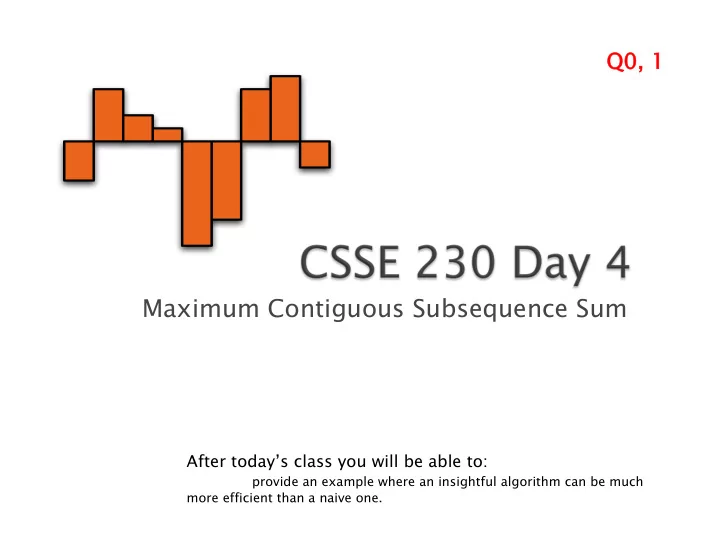
Maximum Contiguous Subsequence Sum
Q0, Q0, 1 1
After today’s class you will be able to: provide an example where an insightful algorithm can be much
more efficient than a naive one.
SLIDE 2
SLIDE 3
Q1 Q1
SLIDE 4
SLIDE 5 } Is MCSS θ(n2)?
- Showing that a problem is Ω (g(n)) is much tougher. How do
you prove that it is impossible to solve a problem more quickly than you already can?
- Can we find a yet faster algorithm?
SLIDE 6
A linear algorithm.
{-3, 4, 2, 1, -8, -6, 4, 5, -2}
SLIDE 7 } Consider {-3, 4, 2, 1, -8, -6, 4, 5, -2} } Any subsequences you can safely ignore?
- Discuss with another student (2 minutes)
Q2 Q2
SLIDE 8 } We noted that a max-sum sequence Ai,j
cannot begin with a negative number.
} Generalizing this, it cannot begin with a
prefix Ai,k with k<j whose sum is negative.
tradicti
- tion. Suppose that Ai,j is a max-
sum sequence and that Si,k is negative. In that case, a larger max-sum sequence can be created by removing Ai,k However, this violates our assumption that Ai,j is the largest max-sum sequence.
Q3 Q3
SLIDE 9 } All contiguous subsequences that border the
maximum contiguous subsequence must have negative or zero sums.
tradicti
- tion. Consider a contiguous
subsequence that borders a maximum contiguous
- subsequence. Suppose it has a positive sum. We can
then create a larger max-sum sequence by combining both sequences. This contradicts our assumption of having found a max-sum sequence.
Q4 Q4
SLIDE 10
} No max-sum sequence can start from inside a
subsequences that has a negative sum and extend beyond it.
} In other words, if we find that Si,j is negative, we
can skip all sums that begin with any of Ai, Ai+1, …, Aj.
} We can “skip i ahead” to be j+1.
SLIDE 11
SLIDE 12
SLIDE 13
becomes < 0 i j
SLIDE 14
becomes < 0 i j q p p-1
SLIDE 15
becomes < 0 i j q p p-1
SLIDE 16
Si,j is negative. So, skip ahead per Observation 3 Running time is is O (?) How do we know? Q5, Q5, Q6 Q6
SLIDE 17 } MCSS is O(n)! } Is MCSS Ω(n) and thus θ(n)?
- Yes, intuitively: we must at least examine all n elements
SLIDE 18
} From SVN, checkout MCSSRaces } Study code in MCSS.main() } For each algorithm, how large a sequence can
you process on your machine in less than 1 second?
SLIDE 19
} The first algorithm we think of may be a lot
worse than the best one for a problem
} Sometimes we need clever ideas to improve it } Showing that the faster code is correct can
require some serious thinking
} Programming is more about careful
consideration than fast typing!
Q11-12 Q11-12
SLIDE 20 } If GM had kept up with technology like the
computer industry has, we would all be driving $25 cars that got 1000 miles to the gallon.
} If the automobile had followed the same
development cycle as the computer, a Rolls- Royce would today cost $100, get a million miles per gallon, and explode once a year, killing everyone inside.
SLIDE 21
A preview of Abstract Data Types and Java Collections This week’s major program
SLIDE 22 An exercise in implementing your own growable circular Queue:
- 1. Grow it as needed (like day 1 exercise)
- 2. Wrap-around the array indices for more
efficient dequeuing Discuss Stacks as a warmup (push, pop), then ideas for Queues (enqueue, dequeue) Analyze implementation choices for Queues – much more interesting than stacks!
Q7-8 Q7-8
SLIDE 23
An exercise in writing cool algorithms that evaluate mathematical expressions: Infix: 6 + 7 * 8 Postfix: 6 7 8 * + Both using sta tacks.
Q9 Q9
SLIDE 24
} Plan when you'll be working } Review the pair programming video as
needed
} Check out the code and read the specification
together