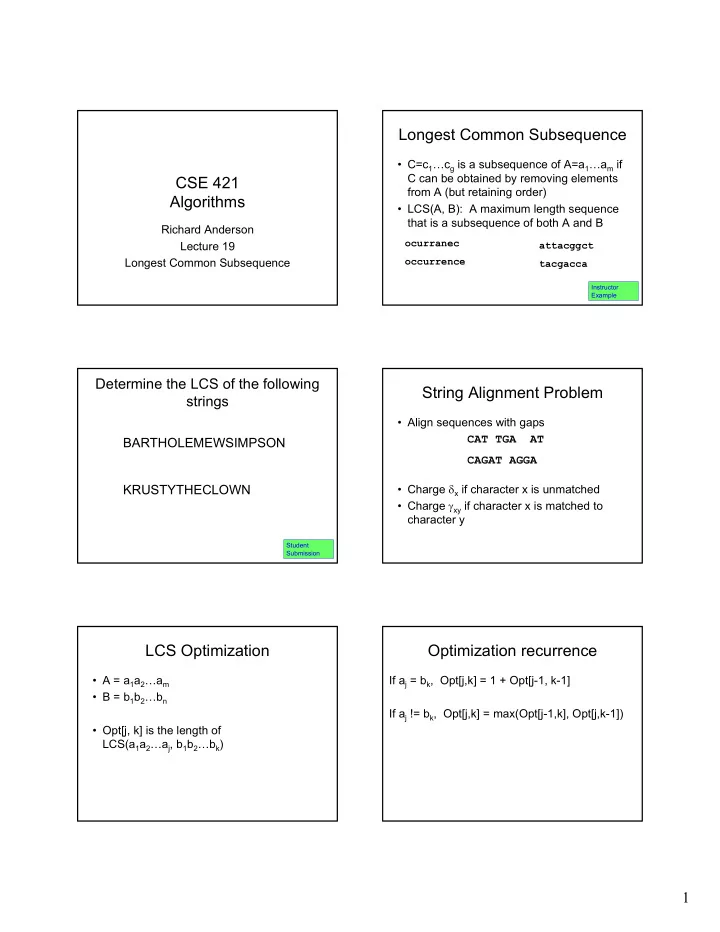
Longest Common Subsequence C=c 1 c g is a subsequence of A=a 1 a m - - PDF document

longest common subsequence
SMART_READER_LITE
LIVE PREVIEW

Longest Common Subsequence C=c 1 c g is a subsequence of A=a 1 a m - - PDF document

Longest Common Subsequence C=c 1 c g is a subsequence of A=a 1 a m if C can be obtained by removing elements CSE 421 from A (but retaining order) Algorithms LCS(A, B): A maximum length sequence that is a subsequence of both A


slide-1
SLIDE 1

1

CSE 421 Algorithms

Richard Anderson Lecture 19 Longest Common Subsequence

Longest Common Subsequence

  • C=c1…cg is a subsequence of A=a1…am if

C can be obtained by removing elements from A (but retaining order)

  • LCS(A, B): A maximum length sequence

that is a subsequence of both A and B

  • curranec
  • ccurrence

attacggct tacgacca

Instructor Example

Determine the LCS of the following strings

Student Submission

BARTHOLEMEWSIMPSON KRUSTYTHECLOWN

String Alignment Problem

  • Align sequences with gaps
  • Charge δx if character x is unmatched
  • Charge γxy if character x is matched to

character y CAT TGA AT CAGAT AGGA

LCS Optimization

  • A = a1a2…am
  • B = b1b2…bn
  • Opt[j, k] is the length of

LCS(a1a2…aj, b1b2…bk)

Optimization recurrence

If aj = bk, Opt[j,k] = 1 + Opt[j-1, k-1] If aj != bk, Opt[j,k] = max(Opt[j-1,k], Opt[j,k-1])

slide-2
SLIDE 2

2

Give the Optimization Recurrence for the String Alignment Problem

  • Charge δx if character x is unmatched
  • Charge γxy if character x is matched to

character y

Student Submission

Dynamic Programming Computation Write the code to compute Opt[j,k]

Student Submission

Storing the path information

A[1..m], B[1..n] for i := 1 to m Opt[i, 0] := 0; for j := 1 to n Opt[0,j] := 0; Opt[0,0] := 0; for i := 1 to m for j := 1 to n if A[i] = B[j] { Opt[i,j] := 1 + Opt[i-1,j-1]; Best[i,j] := Diag; } else if Opt[i-1, j] >= Opt[i, j-1] { Opt[i, j] := Opt[i-1, j], Best[i,j] := Left; } else { Opt[i, j] := Opt[i, j-1], Best[i,j] := Down; } a1…am b1…bn

How good is this algorithm?

  • Is it feasible to compute the LCS of two

strings of length 100,000 on a standard desktop PC? Why or why not.

Student Submission

Observations about the Algorithm

  • The computation can be done in O(m+n)

space if we only need one column of the Opt values or Best Values

  • The algorithm can be run from either end
  • f the strings
slide-3
SLIDE 3

3

Divide and Conquer Algorithm

  • Where does the best path cross the

middle column?

  • For a fixed i, and for each j, compute the

LCS that has ai matched with bj

Constrained LCS

  • LCSi,j(A,B): The LCS such that

– a1,…,ai paired with elements of b1,…,bj – ai+1,…am paired with elements of bj+1,…,bn

  • LCS4,3(abbacbb, cbbaa)

A = RRSSRTTRTS B=RTSRRSTST

Compute LCS5,1(A,B), LCS5,2(A,B),…,LCS5,9(A,B)

Student Submission

A = RRSSRTTRTS B=RTSRRSTST

Compute LCS5,1(A,B), LCS5,2(A,B),…,LCS5,9(A,B)

Instructor Example 4 9 1 4 8 1 3 7 2 3 6 2 3 5 3 3 4 3 2 3 3 1 2 3 1 1 3 right left j

Computing the middle column

  • From the left, compute LCS(a1…am/2,b1…bj)
  • From the right, compute LCS(am/2+1…am,bj+1…bn)
  • Add values for corresponding j’s
  • Note – this is space efficient

Divide and Conquer

  • A = a1,…,am

B = b1,…,bn

  • Find j such that

– LCS(a1…am/2, b1…bj) and – LCS(am/2+1…am,bj+1…bn) yield optimal solution

  • Recurse
slide-4
SLIDE 4

4

Algorithm Analysis

  • T(m,n) = T(m/2, j) + T(m/2, n-j) + cnm

Prove by induction that T(m,n) <= 2cmn

Instructor Example