MAX IV RF Systems PPT-mall 2 Lars Malmgren On - - PowerPoint PPT Presentation

max iv rf systems ppt mall 2
SMART_READER_LITE
LIVE PREVIEW

MAX IV RF Systems PPT-mall 2 Lars Malmgren On - - PowerPoint PPT Presentation

MAX IV RF Systems PPT-mall 2 Lars Malmgren On Behalf of the MAX IV RF Group Med linje ke Andersson, Dionis Kumbaro, Per Lilja,


slide-1
SLIDE 1

PPT-­‑mall ¡2 ¡

Med ¡linje ¡

Lars ¡Malmgren, ¡ESS ¡Presenta7on, ¡22 ¡March ¡2013 ¡ 1 ¡

On ¡Behalf ¡of ¡the ¡MAX ¡IV ¡RF ¡Group ¡

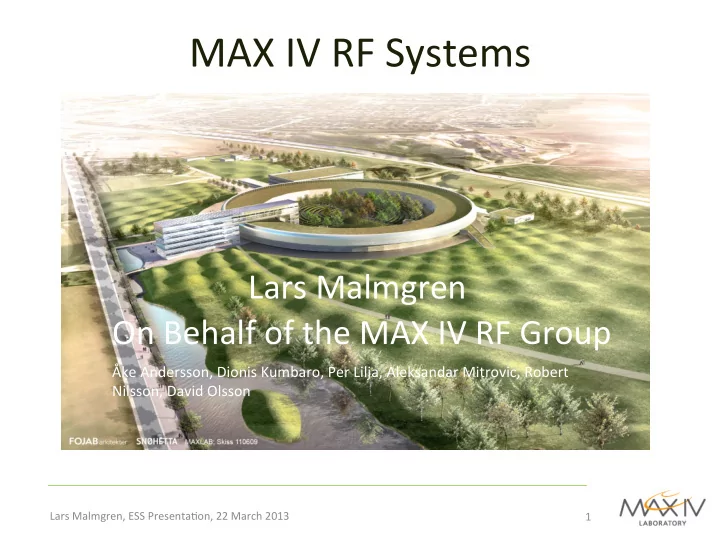
MAX ¡IV ¡RF ¡Systems ¡ ¡

Lars ¡Malmgren ¡

Åke ¡Andersson, ¡Dionis ¡Kumbaro, ¡Per ¡Lilja, ¡Aleksandar ¡Mitrovic, ¡Robert ¡ Nilsson, ¡David ¡Olsson ¡

slide-2
SLIDE 2

Outline ¡

  • MAX ¡IV ¡overview ¡
  • Linac ¡RF ¡
  • Linac ¡power ¡source, ¡power ¡control ¡and ¡knobs ¡
  • Linac ¡low ¡level ¡and ¡main ¡drive ¡line ¡(MDL) ¡
  • RF ¡guns ¡
  • Chopper ¡system ¡
  • MAX ¡IV ¡Storage ¡Rings ¡RF ¡
  • Digital ¡low ¡level ¡RF ¡system ¡

Lars ¡Malmgren, ¡ESS ¡Presenta7on, ¡22 ¡March ¡2013 ¡ 2 ¡

slide-3
SLIDE 3

Lars ¡Malmgren, ¡ESS ¡Presenta7on, ¡22 ¡March ¡2013 ¡ 3 ¡

MAX ¡IV ¡– overview

300m LINAC: Injects the rings & drives femtosecond X-ray source - 2014 1.5 GeV ring (96m) - 2016 3 GeV ring (528m) - 2015 World’s brigthest ring based light source

~30 beamlines when fully equipped

slide-4
SLIDE 4

Construc7on ¡site ¡

Lars ¡Malmgren, ¡ESS ¡Presenta7on, ¡22 ¡March ¡2013 ¡ 4 ¡

February ¡7, ¡2013 ¡

slide-5
SLIDE 5

Lars ¡Malmgren, ¡ESS ¡Presenta7on, ¡22 ¡March ¡2013 ¡ 5 ¡

The ¡linac ¡should ¡be ¡used ¡as ¡injector ¡for ¡both ¡the ¡1.5 ¡and ¡3 ¡GeV ¡storage ¡rings ¡ and ¡SPF ¡ ¡ 18 ¡klystrons ¡ 39 ¡linac ¡structures ¡ Two ¡electron ¡guns ¡(a ¡photo-­‑RF ¡gun ¡ and ¡a ¡thermionic ¡RF ¡gun) ¡ OperaIng ¡frequency ¡2998.5 ¡MHz ¡ Maximum ¡rep. ¡rate ¡100Hz ¡ Maximum ¡RF ¡power ¡35 ¡MW ¡ RF ¡pulse ¡length ¡4.5µs ¡ Linac ¡length ¡250 ¡m ¡ 1 ¡klystron ¡feeding ¡the ¡thermionic ¡gun (7.5MW) ¡

Operating beam energy 3 GeV

  • Max. on-crest beam energy 3.6 GeV

44% RF power redundancy

Max ¡IV ¡linac ¡RF ¡system ¡

slide-6
SLIDE 6

Max ¡IV ¡linac ¡design ¡strategies ¡

Lars ¡Malmgren, ¡ESS ¡Presenta7on, ¡22 ¡March ¡2013 ¡ 6 ¡

  • High ¡temperature ¡stability ¡
  • Modulators ¡with ¡low ¡voltage ¡pulse ¡to ¡

pulse ¡ji]er ¡ ¡

  • Minimize ¡output ¡power ¡varia7ons ¡by ¡

running ¡the ¡klystrons ¡saturated ¡

  • The ¡RF ¡phase ¡should ¡follow ¡the ¡linac ¡

tunnel ¡length ¡varia7ons ¡due ¡to ¡seasonal ¡ temperature ¡varia7ons ¡

slide-7
SLIDE 7

Lars ¡Malmgren, ¡ESS ¡Presenta7on, ¡22 ¡March ¡2013 ¡ 7 ¡ The linac consists of two parallel tunnels with 1.5 m concret in between. The wave velocity in an air-filled transmission lines is almost the same as the speed of the electrons in the linac. Length variations of the linac tunnel due to e.g. seasonal outside temperature variations will automatically be compensated for since the MDL, consisting of a rigid 1 5/8” coaxial transmission line with sliding joints, also will follow this length variations. Main Drive Line (MDL) feeding 15 klystrons

Klystron tunnel Concret

Max ¡IV ¡linac ¡RF ¡system ¡

Linac tunnel

Random voltage and phase variationstions are reduced by

  • ne over the square root of the

number of klystrons

slide-8
SLIDE 8

Lars ¡Malmgren, ¡ESS ¡Presenta7on, ¡22 ¡March ¡2013 ¡ 8 ¡

15 RF units feeding two accelerator Structures each 2 RF units feeding four accelerator Structures each 1 RF unit feeding gun and one accelerator structure RF unit including klystron and modulator(power supply) Waveguids are used for high power distribution

S-­‑band ¡(2998.5 ¡MHz) ¡constant ¡gadient ¡traveling ¡ wave ¡linac ¡sec7ons ¡(5.2m). ¡

slide-9
SLIDE 9

Linac ¡RF ¡unit ¡

Lars ¡Malmgren, ¡ESS ¡Presenta7on, ¡22 ¡March ¡2013 ¡ 9 ¡

v S-band RF Unit parameters

RF ¡Phase ¡change ¡3-­‑4° ¡/%Vk ¡

Measured ¡pulse ¡to ¡pulse ¡voltage ¡varia7on ¡ ¡< ¡10-­‑4 ¡rms ¡ <0.04 ¡° ¡RF ¡phase ¡pulse ¡to ¡pulse ¡ji]er ¡

slide-10
SLIDE 10

Pulse ¡compression ¡(SLED) ¡

Lars ¡Malmgren, ¡ESS ¡Presenta7on, ¡22 ¡March ¡2013 ¡ 10 ¡

EL ¡ EK ¡

Cavity ¡2 ¡ Cavity ¡1 ¡ 3 ¡dB ¡Coupler ¡ 180o ¡phase ¡ shif ¡ ¡ ¡ Klystron ¡

  • Accel. ¡sec7ons ¡

The Stanford Linac Energy Doubling (SLED) is used to increase the peak power for a given total pulse

  • energy. This is obtained by charging an overcoupled

(β≈6) high-Q cavity by the RF generator.

The accelerating gradients integrated

  • ver a small portion of the klystron pulse

durtion is almost doubled.

Waveguide input (iris) coupler TE015, Q≈105

Δφ/ΔT ¡=8°/°C ¡ Coolingwater ¡temperatur ¡stability ¡± ¡0.02 ¡° ¡ RF ¡phase ¡stability ¡< ¡± ¡0.2° ¡ ¡

slide-11
SLIDE 11

Lars ¡Malmgren, ¡ESS ¡Presenta7on, ¡22 ¡March ¡2013 ¡ 11 ¡

The ¡klystrons ¡are ¡running ¡at ¡konstant ¡ voltage ¡to ¡maintain ¡a ¡constant ¡RF ¡phase ¡ at ¡the ¡output. ¡ In ¡order ¡to ¡reduce ¡klystron ¡output ¡power ¡ varia7ons ¡due ¡to ¡varia7ons ¡in ¡the ¡input ¡ power ¡they ¡are ¡run ¡in ¡stura7on ¡mode. ¡ The ¡output ¡power ¡from ¡SLED ¡is ¡adjusted ¡ by ¡varying ¡the ¡charging ¡7me. ¡

Charging ¡Ime ¡ 3.8 ¡µs ¡ 3.3 ¡µs ¡ 2.0 ¡µs ¡

SLED ¡data ¡ β=6 ¡ Q˳=105 ¡

Output ¡power ¡from ¡SLED ¡is ¡adjusted ¡ by ¡varying ¡the ¡charging ¡7me ¡

slide-12
SLIDE 12

Lars ¡Malmgren, ¡ESS ¡Presenta7on, ¡22 ¡March ¡2013 ¡ 12 ¡

First ¡bunch ¡compressor ¡ ¡

Availabe ¡adjustments, ¡the ¡first ¡four ¡RF ¡units ¡

  • 1. LINAC ¡input ¡power ¡(SLED ¡charging ¡7me) ¡
  • 2. LINAC ¡phase ¡

These ¡kobs ¡will ¡be ¡used ¡for ¡phase ¡and ¡energy ¡feedback ¡

Knobs ¡

slide-13
SLIDE 13

Lars ¡Malmgren, ¡ESS ¡Presenta7on, ¡22 ¡March ¡2013 ¡ 13 ¡

Energy ¡measurement ¡by ¡BPM ¡at ¡a ¡dispersive ¡region ¡ Bunch ¡length ¡measurement ¡by ¡electro-­‑op7cal ¡crystal ¡and ¡THz-­‑SR ¡ Feedback ¡of ¡the ¡first ¡two ¡accelera7on ¡sec7ons ¡

Bunch ¡compressor ¡1 ¡ Energy ¡measurement ¡by ¡BPM ¡ Bunch ¡length ¡by ¡a ¡electro-­‑op7cal ¡crystal ¡ ¡

Feedback ¡for ¡the ¡rest ¡of ¡the ¡linac ¡(MDL) ¡

Bunch ¡compressor ¡2 ¡ Energy ¡measurement ¡by ¡BPM ¡ Bunch ¡length ¡by ¡THz-­‑SR ¡gives ¡a ¡rela7ve ¡value. ¡Sufficient ¡to ¡stabilize ¡the ¡MDL ¡ Alterna7vely, ¡use ¡some ¡of ¡the ¡bunches ¡as ¡a ¡probe ¡to ¡check ¡the ¡phase/chirp ¡

Feedback ¡

Δ ¡Ε ¡ Δφ ¡ E ¡ t ¡

slide-14
SLIDE 14

MDL ¡

Lars ¡Malmgren, ¡ESS ¡Presenta7on, ¡22 ¡March ¡2013 ¡ 14 ¡

Adjustable ¡direc7onal ¡couplers ¡ Fixed ¡to ¡the ¡linac ¡tunnel ¡wall ¡at ¡each ¡accelera7ng ¡sec7on ¡ Sliding ¡joints ¡ Connected ¡together ¡with ¡pressure ¡regulated ¡1 ¡5/8” ¡EIA ¡rigid ¡line ¡

The ¡MDL ¡input ¡RF ¡power ¡taken ¡from ¡the ¡fourth ¡klystron ¡is ¡ ¡90 ¡kW ¡ MDL ¡feeding ¡15 ¡klystrons ¡ ¡ The ¡transmission ¡line ¡pressure(nitrogen) ¡is ¡regulated ¡to ¡ compensate ¡for ¡ ¡propaga7on ¡varia7ons ¡due ¡to ¡pressure ¡ change ¡

slide-15
SLIDE 15

Photocathode ¡and ¡Therimionic ¡RF ¡guns ¡

Lars ¡Malmgren, ¡ESS ¡Presenta7on, ¡22 ¡March ¡2013 ¡ 15 ¡ RF ¡and ¡mechanical ¡ design ¡made ¡by ¡E. ¡Elafifi ¡

The ¡linac ¡consists ¡of ¡two ¡electron ¡guns. ¡A ¡photo-­‑ RF ¡gun ¡for ¡short ¡pulse ¡facility ¡(SPF) ¡pulses ¡and ¡a ¡ thermionic ¡RF ¡gun ¡for ¡storage ¡ring ¡injec7on ¡

slide-16
SLIDE 16

Kicker ¡system ¡ ¡

Lars ¡Malmgren, ¡ESS ¡Presenta7on, ¡22 ¡March ¡2013 ¡ 16 ¡

¡

  • The ¡thermionic ¡gun ¡will ¡only ¡be ¡used ¡for ¡ring ¡injec7ons. ¡
  • The ¡bunches ¡are ¡leaving ¡the ¡gun ¡with ¡a ¡period ¡of ¡333 ¡ps ¡(3 ¡GHz). ¡
  • Storage ¡ring ¡are ¡opera7ng ¡at ¡100 ¡MHz. ¡

Injec7on ¡bunch ¡train ¡structure ¡

  • A ¡bunch ¡train ¡should ¡consist ¡of ¡3 ¡bunches, ¡appearing ¡with ¡a ¡period ¡of ¡10 ¡ns ¡

(100 ¡MHz). ¡

  • 10 ¡bunch ¡trains ¡during ¡one ¡LINAC ¡shot. ¡ ¡

333 ¡ps ¡ 10 ¡ns ¡

slide-17
SLIDE 17

Thermionic ¡injector ¡setup ¡ ¡

Lars ¡Malmgren, ¡ESS ¡Presenta7on, ¡22 ¡March ¡2013 ¡ 17 ¡

  • Has ¡two ¡iden7cal ¡ver7cal ¡kickers. ¡
  • The ¡kickers ¡consist ¡of ¡a ¡15 ¡cm ¡long ¡stripline ¡pair ¡with ¡a ¡characteris7c ¡

impedance ¡of ¡50 ¡Ω ¡for ¡odd ¡TEM ¡modes. ¡

  • Both ¡electrodes ¡are ¡fed ¡by ¡RF ¡
  • An ¡aperture ¡is ¡located ¡downstream. ¡The ¡unwanted ¡bunches ¡will ¡be ¡dumped ¡
  • here. ¡ ¡
  • The ¡aperture ¡can ¡be ¡adjusted ¡so ¡the ¡wanted ¡bunches ¡pass ¡a ¡1 ¡mm ¡hole, ¡a ¡2 ¡

mm ¡hole, ¡or ¡over ¡an ¡edge. ¡

slide-18
SLIDE 18

Kicker ¡set-­‑up ¡A ¡

Lars ¡Malmgren, ¡ESS ¡Presenta7on, ¡22 ¡March ¡2013 ¡ 18 ¡

q Both ¡kickers ¡will ¡be ¡used. ¡ q The ¡first ¡one ¡will ¡be ¡fed ¡by ¡300 ¡MHz, ¡and ¡the ¡second ¡

  • ne ¡by ¡100 ¡MHz ¡

50 ¡Ω ¡ 300 ¡MHz ¡ ~400 ¡W ¡ 50 ¡Ω ¡ 100 ¡MHz ¡ ~1 ¡kW ¡

slide-19
SLIDE 19

Kicker ¡set-­‑up ¡A ¡

Lars ¡Malmgren, ¡ESS ¡Presenta7on, ¡22 ¡March ¡2013 ¡ 19 ¡

Advantages ¡set-­‑up ¡A ¡

  • Simple. ¡
  • Larger ¡aperture ¡diameter ¡(2 ¡mm) ¡can ¡be ¡used. ¡
slide-20
SLIDE 20

Kicker ¡set-­‑up ¡B ¡

Lars ¡Malmgren, ¡ESS ¡Presenta7on, ¡22 ¡March ¡2013 ¡ 20 ¡ 50 ¡Ω ¡ 300 ¡MHz ¡ ~1 ¡kW ¡ 100 ¡MHz ¡ ~400 ¡W ¡

Combining ¡network ¡

700 ¡MHz ¡ ~300 ¡W ¡

slide-21
SLIDE 21

Kicker ¡set-­‑up ¡B ¡

Lars ¡Malmgren, ¡ESS ¡Presenta7on, ¡22 ¡March ¡2013 ¡ 21 ¡

Advantages ¡set-­‑up ¡B ¡

  • Lower ¡emi]ance. ¡
slide-22
SLIDE 22

Summary ¡Linac ¡

Lars ¡Malmgren, ¡ESS ¡Presenta7on, ¡22 ¡March ¡2013 ¡ 22 ¡

Short ¡term ¡phase ¡stability ¡depends ¡on ¡the ¡modulator ¡pulse ¡to ¡pulse ¡voltage ¡ stability ¡(10-­‑4 ¡rms). ¡The ¡pulse ¡to ¡pulse ¡phase ¡stability ¡will ¡be ¡around ¡0.1° ¡rms. ¡ ¡ ¡ The ¡long ¡term ¡phase ¡stability ¡is ¡determined ¡by ¡the ¡stability ¡of ¡the ¡cooling ¡water ¡ temperature ¡(± ¡0.02 ¡°) ¡and ¡the ¡MDL ¡dielectric ¡pressure ¡and ¡temperature. ¡ ¡RF ¡ phase ¡stability ¡< ¡± ¡0.2°. ¡ ¡ ¡ Feedback ¡using ¡energy ¡and ¡bunch ¡length ¡measurements ¡will ¡be ¡used ¡to ¡ compensate ¡for ¡long ¡term ¡varia7ons. ¡ ¡ A ¡kicker ¡system ¡has ¡been ¡developed ¡that ¡kicks ¡out ¡three ¡3 ¡GHz ¡bunches ¡from ¡the ¡ thermionic ¡gun ¡with ¡a ¡7me ¡interval ¡of ¡10 ¡ns ¡(100MHz). ¡Ten ¡such ¡pulses ¡will ¡be ¡ injected ¡into ¡the ¡rings ¡at ¡each ¡shot ¡having ¡a ¡large ¡500 ¡MHz ¡component ¡that ¡can ¡be ¡ detected ¡by ¡the ¡BPM ¡system. ¡ ¡

slide-23
SLIDE 23

Lars ¡Malmgren, ¡ESS ¡Presenta7on, ¡22 ¡March ¡2013 ¡ 23 ¡

Max IV Water coold

Energy 1.5 GeV 3.0 GeV RF 99.931 MHz 99.931 MHz Circumference 96 m 528 m Harmonic number 32 176 Current 500 mA 500 mA No of cavities 2 6 RF station power 60kW 120kW Cavity voltage 280kV 300kV Cavity Rsh (=V2/P) 3.2 Mohm 3.2 Mohm Cu losses 24.5 kW 28 kW Coupling (beta) 2.3 4.0

2 ¡combined ¡ 60 ¡kW ¡ transmi]ers ¡

The operation frequency makes it possible to use standard FM transmitters

Storage Rings Parameters

Tetrode ¡100 ¡MHz ¡CW ¡power ¡source ¡ for ¡Max ¡IV ¡storage ¡rings ¡

1 ¡single ¡60 ¡ kW ¡ transmi]ers ¡

Evaluation of bids is currently underway.

slide-24
SLIDE 24

Lars ¡Malmgren, ¡ESS ¡Presenta7on, ¡22 ¡March ¡2013 ¡ 24 ¡

  • Main ¡Cavi7es ¡(100 ¡MHz ¡Capacity ¡loaded, ¡

Max-­‑lab ¡design) ¡

Tuning ¡Mechanism ¡ Tuning ¡plate ¡

Thermal ¡ RF ¡

RF ¡Systems ¡3 ¡and ¡1.5 ¡GeV ¡Rings ¡

  • Tuning ¡by ¡a ¡small ¡deforma7on ¡of ¡

the ¡lef ¡endplate ¡

  • A ¡deforma7on ¡of ¡±1.0 ¡mm ¡is ¡

equivalent ¡to ¡±540 ¡kHz ¡

  • The ¡profile ¡of ¡the ¡endplate ¡is ¡
  • p7mized ¡to ¡minimize ¡the ¡imposed ¡

stress ¡(max. ¡<100 ¡MPa) ¡

  • Endplates ¡are ¡electron ¡beam ¡welded ¡
  • nto ¡the ¡cavity ¡body ¡
  • Tuning ¡can ¡be ¡kept ¡in ¡the ¡elas7c ¡

range ¡

  • The ¡manufacturing ¡of ¡the ¡8 ¡main ¡

cavi7es ¡has ¡been ¡contracted ¡to ¡ Research ¡Instruments ¡GmbH ¡(RI) ¡ ¡ ¡

slide-25
SLIDE 25

Lars ¡Malmgren, ¡ESS ¡Presenta7on, ¡22 ¡March ¡2013 ¡ 25 ¡

Pre-­‑series ¡Cavity ¡

Pre-­‑series ¡RF ¡cavity ¡delivered ¡May ¡29th. ¡ ¡ Pre-­‑series ¡High ¡Power ¡Coupler ¡delivered ¡in ¡June. ¡ Cavity ¡Condi7oning ¡stand ¡ready ¡in ¡November: ¡300 ¡kV ¡was ¡reached ¡in ¡December. ¡ Remaining ¡cavi7es ¡will ¡be ¡delivered ¡this ¡summer. ¡ A ¡digital ¡low ¡level ¡RF ¡system ¡is ¡used ¡for ¡tuning ¡and ¡controlling ¡the ¡fields ¡in ¡the ¡cavity. ¡ ¡

slide-26
SLIDE 26

RF ¡System ¡– ¡Harmonic ¡Cavity ¡

Passive ¡Landau ¡caviIes ¡for ¡elongaIon ¡of ¡ bunches: ¡

  • Increase ¡Touschek ¡lifeIme ¡
  • Decrease ¡transverse ¡emiaance ¡growth ¡from ¡

Intra ¡Beam ¡Scaaering ¡

  • Increase ¡synchrotron ¡tune ¡spread ¡(Landau ¡

damping) ¡

Lars ¡Malmgren, ¡ESS ¡Presenta7on, ¡22 ¡March ¡2013 ¡ 26 ¡

slide-27
SLIDE 27

Lars ¡Malmgren, ¡ESS ¡Presenta7on, ¡22 ¡March ¡2013 ¡ 27 ¡

  • The ¡third ¡harmonic ¡Landau ¡

cavi7es ¡are ¡also ¡of ¡capacity-­‑ loaded ¡type, ¡in ¡order ¡to ¡push ¡up ¡ the ¡frequency ¡spectrum ¡of ¡the ¡ HOMs ¡

  • Tuning ¡by ¡a ¡small ¡deforma7on ¡of ¡

both ¡endplates ¡

  • A ¡deforma7on ¡of ¡±0.25 ¡mm ¡per ¡

end ¡plate ¡is ¡equivalent ¡to ¡±550 ¡ kHz ¡(max. ¡stress ¡< ¡60MPa) ¡

  • Both ¡endplates ¡will ¡be ¡electron ¡

beam ¡welded ¡onto ¡the ¡cavity ¡ shell ¡and ¡centre ¡rods ¡

  • RI ¡will ¡manufacture ¡five ¡300 ¡MHz ¡

Landau ¡cavi7es ¡from ¡drawings ¡ supplied ¡by ¡MAX-­‑lab. ¡

f = 300 MHz Practice: Rsh = 5.6 Mohm Q = 21000

RF ¡System ¡– ¡Harmonic ¡Cavity ¡

300 ¡MHz ¡capacity ¡loaded, ¡Max-­‑lab ¡design ¡ ¡

slide-28
SLIDE 28

RF ¡cavity ¡in ¡the ¡3 ¡and ¡1.5 ¡GeV ¡rings ¡

Lars ¡Malmgren, ¡ESS ¡Presenta7on, ¡22 ¡March ¡2013 ¡ 28 ¡

The ¡3 ¡GeV ¡ring ¡ ¡ The ¡1.5 ¡GeV ¡ring ¡ ¡

The ¡sex ¡main ¡cavi7es ¡are ¡placed ¡in ¡the ¡last ¡

  • f ¡two ¡short ¡straight ¡sec7ons ¡in ¡successive ¡
  • achromats. ¡There ¡are ¡a ¡total ¡of ¡20 ¡
  • achromats. ¡RF ¡power ¡from ¡the ¡

transmi]ers ¡is ¡feeding ¡one ¡cavity ¡each ¡via ¡ rigid ¡coaxial ¡transmission ¡lines ¡(Rigidline ¡ EIA ¡6 ¡1/8). ¡The ¡three ¡harmonic ¡cavi7es ¡are ¡ placed ¡in ¡successive ¡achromats ¡short ¡ stright ¡sec7ons ¡afer ¡the ¡main ¡cavi7es. ¡ Both ¡main ¡and ¡harmonics ¡cavi7es ¡are ¡ placed ¡in ¡the ¡same ¡straight ¡sec7on. ¡ ¡

slide-29
SLIDE 29

Lars ¡Malmgren, ¡ESS ¡Presenta7on, ¡22 ¡March ¡2013 ¡ 29 ¡

Analog Front End Up Conversion

Tetrode

MO 100MHz 80MHz 80MHz

Tuning Control Loop

Motor Controller

10 RF Diagnostic Signals

IQ Ctrl DC

8 ADCs 80MHz 16 ADCs 80MHz FPGA - Digital IQ

Demodulation and Control Loops

Control Inputs Diagnostics Inputs

RF Cavity Voltage RF Cavity Forward Power 10 RF Diagnostic Signals 8DACs 80MHz FPGA

Digital IQ Demodulation

RF Cavity Voltage RF Cavity Forward Power CAVITY CAVITY

Tetrode Tetrode Tetrode

100MHz

Host PC Windows cPCI Bus Digital I/O

Pin Switch Vacuum & Arcs Interlocks

VCXO PLL Clock

Digital Boards

  • Control ¡Loops ¡

Amplitude ¡and ¡Phase ¡ loops ¡ ¡ Tuning ¡Loop ¡

  • RF ¡Diagnos7cs ¡
  • Extra ¡U7li7es ¡

Fast ¡Interlock ¡ Automa7c ¡Condi7oning ¡ Automa7c ¡Startup ¡

  • Prototype ¡Assembled ¡

and ¡Tested ¡at ¡MAX-­‑lab ¡

  • First ¡Successful ¡tests ¡

with ¡Beam ¡at ¡MAX-­‑III ¡ in ¡September ¡2011. ¡ 200 ¡mA ¡ramped ¡with ¡ voltage ¡and ¡frequency ¡ loops ¡engaged. ¡

Design ¡by ¡A.Solom ¡

Digital ¡Low ¡Level ¡RF ¡
slide-30
SLIDE 30

Thanks ¡for ¡your ¡a]en7on ¡

Lars ¡Malmgren, ¡ESS ¡Presenta7on, ¡22 ¡March ¡2013 ¡ 30 ¡

slide-31
SLIDE 31

Lars ¡Malmgren, ¡ESS ¡Presenta7on, ¡22 ¡March ¡2013 ¡ 31 ¡

2D ¡Design ¡

  • Consist ¡of ¡a ¡15 ¡cm ¡long ¡stripline ¡pair ¡with ¡a ¡characteris7c ¡impedance ¡of ¡50 ¡Ω ¡

for ¡odd ¡TEM ¡modes. ¡

  • Both ¡electrodes ¡will ¡be ¡fed ¡by ¡RF ¡

Kicker ¡design ¡