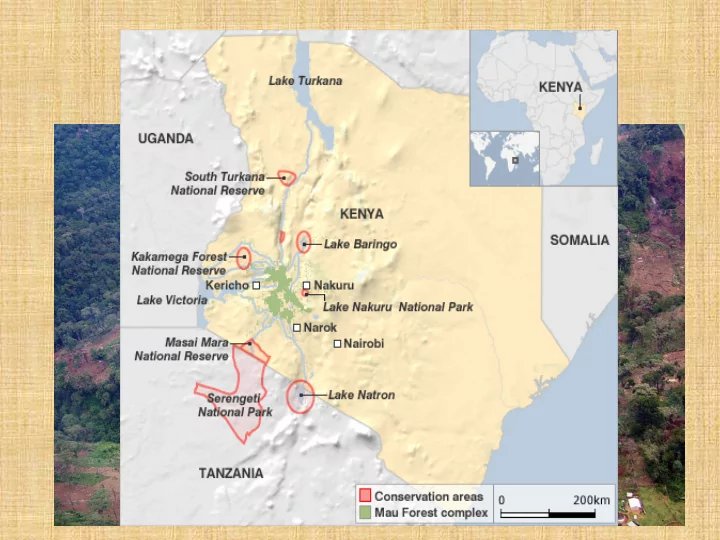
Mau Forest Overview What is the Mau forest? Largest remaining block - - PowerPoint PPT Presentation
Mau Forest Overview What is the Mau forest? Largest remaining block of montane forest in Eastern Africaan area > 400,000 ha. 21 Forests, 1 of which (Maasai Mau) is managed by local government (Narok County Council) One
What is the Mau forest?
- Largest remaining block of montane
forest in Eastern Africa—an area > 400,000 ha.
- 21 Forests, 1 of which (Maasai Mau) is
managed by local government (Narok County Council)
- One of 5 ‘water towers’ of Kenya; covers
upper catchments of the Nzoia, Yala, Nyando, Sondu, Mara and Ewaso Ng’iro riversE. Africa lakes and wetlands; i.e., Victoria, Baringo, Natron, Turkana, Nakuru and Naivasha
I mportance of the Mau
- The Mau complex nourishes Kenya’s two
key foreign exchange earners—tea & tourism—in addition to smallholder livelihoods (subsistence agriculture, retail trading) & commercial interests (dairy, irrigated agriculture, forest products)
- Source of Mara river & tributaries which
are dry season water sources for the transboundary Mara-Serengeti ecosystem
- A USAID focal area of bi-lateral & regional
significance to national development and multi-lateral relations – Lk. Victoria Commission and Nile Basin riparian agreements & treaties
The Mara-Mau: Socio-ecological context for management
- Forest excisions, settlement schemes, private land
sales, tree plantations of exotic spp, illegal encroachment and ‘irregular’ alienation of land
- Loss of large areas of indigenous forest and water
catchments in degraded condition – loss of function
- Major changes in land use and land cover – densely
settled peri-urban infrastructure and agricultural landscapes
- Politically motivated ethnic clashes during elections
driven by inequitable land allocation
Biodiversity values
- Contribution to priority wildlife
conservation areas
- Freshwater biodiversity
- Indigenous forest
- Important Bird Areas (#5)
- Farms & agrobiodiversity
LTPR dynamics
- Reserve forests (GoK/CC
- wned)
- Customary tenure zones
(Maasai)
- Ogiek claims
- Titles
– Legitimate – Irregular – Illegal
- Refugee camps
LTPR dynamics
Indigenous people
Direct conflict drivers
- Excisions
- Removals
- Unsustainable and
inequitable forest management
Underlying dynamics: demand for land and water
- Population pressure and immigration
- Uncontrolled water use
Underlying dynamics: power struggles and patronage
- Corruption and ethnically-
manipulated land concessions combined with drought led to violence and population displacement
- Lack of opportunity for youth
- Proliferation of management
units, no coherence; struggling
- ver jurisdiction and benefit
- Marginalization and
“developmental distance”
PROMARA: “For the Mara”
- GOAL: Help recover the
integrity of the Mara-Mau ecosystem for & by stakeholders
- Conflict management and
mitigation is the foundation on which this larger program is
- built. If the program is not able
to provide political stability by reducing conflict, it will be unable to achieve its longer term objectives
PROMARA: Integrated design
1. Strategy, vision, goal – ‘Road map’ & Results Framework
- Property rights and obligations of key stakeholders in the
Upper Mara River Basin strengthened, clarified and communicated
- Markets for commodities and services that enhance
conservation and sustainable NRM improved
- Equitable management of land and forests for environmental
goods and services (biodiversity, water, soil fertility, mitigation and adaptation to climate change) of the Mara-Mau ecosystem fostered.
- 2. The benefits of long-term observation & assessment;
knowledge acquisition & management
- 3. Clear leadership and political ‘will’ on the part of host
government – get in on ground floor of supporting ‘their’ plan, establish trust & follow through on commitments
PROMARA: Integrated design, con’t
- 4. Pre-obligation checks – gender, environmental
review/ESD
- 5. Reduce the ‘stovepipes’ but observe the criteria &
guidelines for programming $$ - CMM, BioD, Sustainable L/scapes
- 6. Set appropriate indicators & performance measures; e.g.,
- # men/women with secure property rights in target areas;
- # local NRM-based enterprises with significant youth involvement;
- # Ha in areas of biological significance showing improved
biophysical conditions;
- Quantity of GhG emissions, measured in metric tonnes CO2
equivalent, reduced or sequestered in NRM, agriculture &/or biodiversity sectors
- 7. Synergy/complementarity w/other initiatives; e.g., USAID dairy &
horticulture development; USAID Women’s Advocacy for Forest Resource Rights; AFD (French) ‘sister’ project in adjacent catchment
PROMARA: Integrated design, con’t
- 8. USAID Forward principles (anything ‘new’ here?)
- 9. Use/develop efficient procurement mechanisms
- 10. Test hypotheses, ‘phase’ implementation, re-plan & re-
validate w/stakeholders
PROMARA-Component 1: Improvement
- f land & resource tenure
- Support strategic communication
- f a forest rehabilitation program
- Clarify land rights outside the area
where illegal, irrregular or legal titles will be revoked
- Assess potential for conservation
easements w/in critical catchment areas & biodiversity ‘hot spots’
- Assess laws & practices
governing compulsory acquisition
- Support resettlement of
landowners whose titles have been revoked
- Assess evictees’/IDPs’ status,
investments & plans for relocation
PROMARA-Component 2: Restoration/protection of critical catchment, forests & biodiversity
- Mau Conservancy establishes a
legitimate role in governance of forest resources
- Analysis of formal & informal
institutions, projects & programs
- perational in Mara-Mau
- Selection of sub-catchments for
intensive field-based operations
- Assist Community Forest Assn’s
establish democratic operational norms in conjunction w/WRUAs
- Develop NRM co-management
models applicable to Mara-Mau & acceptable to GoK agencies
- Participatory biodiversity & natural
resources threats analysis
PROMARA-Component 3: Improvement
- f livelihood for catchment residents
- Integrated management of
rural highland economies that promote conservation and livelihoods
- Analysis of water resource
issues in the upper Mara catchment
PROMARA-Component 4: Mara-Mau Outreach & Resource Center
- Locate & establish the
MOC
- Support MOC operations
– Public information & awareness
- Analysis of Kenya’s new
constitution re: PROMARA program
- Establish PROMARA
institutional framework
- Gender & Youth-sensitive