
SLIDE 1
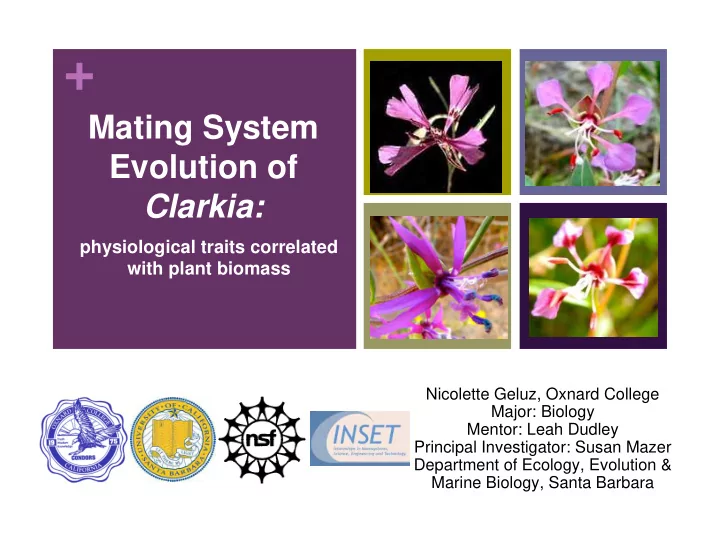
+ Mating System Evolution of Clarkia: physiological traits - - PowerPoint PPT Presentation
+ Mating System Evolution of Clarkia: physiological traits correlated with plant biomass Nicolette Geluz, Oxnard College Major: Biology Mentor: Leah Dudley Principal Investigator: Susan Mazer Department of Ecology, Evolution & Marine
Out-cross pollination (outcrossers) Vector driven Genetic variation More chances to be able
Self-fertilization (selfers) Synchronicity Smaller distance between
Ensures reproductivity Reduced genetic diversity Inbreeding depression
As pollinator population decreases or is absent, selection
When there is low amounts of water available, selection for
Driven by climate change Occurrence of drought Outcross phenotype
Outcrosser population will
Accumulate deleterious
Lower genetic diversity
Extinction
Drought Avoiders: plants that avoid drying-out Possible Strategy to avoid drying out:
Complete lifecycle when water is plentiful Early flowering Grow faster Start reproducing at a smaller size (smaller above-ground biomass) Greater carbon gain in shorter amount of time Lower water use efficiency Prevent water from escaping Smaller leaves, overall above ground biomass, petals Decrease water loss Increase water use efficiency
Main questions
Do outcrossers at dryer climates show drought
Are carbon gain and water loss negatively correlated
Physiological process Estimate plant biomass
ssp xantiana (outcrosser)
Lake Isabella 42 miles from Bakersfield Seasonal temperatures 3000 ft above sea level
Sawmill (in sympatry with
plants from Clarkia xantiana
(umol CO2 m-2 s-1)
(mol H2O m-2s-1)
Leaf areas
Outline leaves and scan
Measure leaf area Accounts for surface area
Separate above/below ground
Weigh above stem
y = ‐0.501837 + 0.0915018*T Photo RSquare 0.002802 Pvalue 0.641
y = ‐0.499794 ‐ 0.0632324*T Trans RSquare 0.002549 Pvalue 0.6565
y = 0.0352862 + 0.191668*T Wue RSquare 0.013959 Pvalue 0.2966
Physiology does not correlate with above-ground plant
Current change in the environment is at a slow rate Or does not exist Location is cooler
More data from different outcross populations Measures different examples plant fitness