Mathematics text The Mathematics tests have undergone the biggest - - PowerPoint PPT Presentation

mathematics
SMART_READER_LITE
LIVE PREVIEW

Mathematics text The Mathematics tests have undergone the biggest - - PowerPoint PPT Presentation

click to see all Mathematics text The Mathematics tests have undergone the biggest change this year. The Mathematics tests have undergone the biggest change this year. The Mathematics tests have undergone the biggest change this year.


slide-1
SLIDE 1
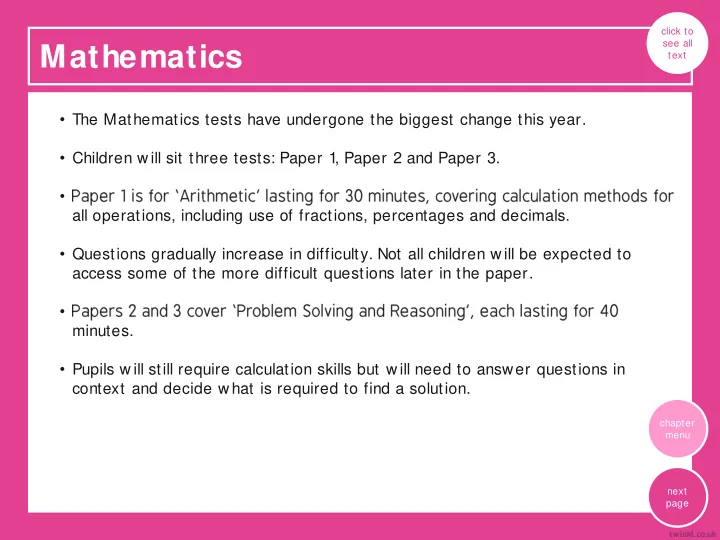
  • The Mathematics tests have undergone the biggest change this year.
  • Children w ill sit three tests: Paper 1

, Paper 2 and Paper 3.

  • all operations, including use of fractions, percentages and decimals.
  • Questions gradually increase in difficulty. Not all children w ill be expected to

access some of the more difficult questions later in the paper.

  • minutes.
  • Pupils w ill still require calculation skills but w ill need to answer questions in

context and decide w hat is required to find a solution.

Mathematics

click to see all text

  • The Mathematics tests have undergone the biggest change this year.
  • Children w ill sit three tests: Paper 1

, Paper 2 and Paper 3.

  • all operations, including use of fractions, percentages and decimals.
  • Questions gradually increase in difficulty. Not all children w ill be expected to

access some of the more difficult questions later in the paper.

  • minutes.
  • Pupils w ill still require calculation skills but w ill need to answer questions in

context and decide w hat is required to find a solution.

  • The Mathematics tests have undergone the biggest change this year.
  • Children w ill sit three tests: Paper 1

, Paper 2 and Paper 3.

  • all operations, including use of fractions, percentages and decimals.
  • Questions gradually increase in difficulty. Not all children w ill be expected to

access some of the more difficult questions later in the paper.

  • minutes.
  • Pupils w ill still require calculation skills but w ill need to answer questions in

context and decide w hat is required to find a solution.

next page chapter menu

slide-2
SLIDE 2

Sample Questions

Maths Paper 1 : Arithmetic

next page chapter menu

slide-3
SLIDE 3

Sample Questions

Maths Paper 2 / Paper 3 : Reasoning

next page chapter menu

slide-4
SLIDE 4

Sample Questions

Maths Paper 2 / Paper 3 : Reasoning

next page chapter menu

slide-5
SLIDE 5
  • F

irst and foremost, support and reassure your child that there is nothing to worry about and they should always just try their best. Praise and encourage!

  • E

nsure your child has the best possible attendance at school

  • Support your child w ith any homework tasks.
  • Reading, spelling and arithmetic (e.g. times tables) are always good to practise.
  • T

alk to your child about w hat they have learnt at school and w hat book(s) they are reading (the character, the plot, their opinion).

  • Make sure your child has a good sleep and healthy breakfast every morning!

How to Help Your Child

click to see all text

  • F

irst and foremost, support and reassure your child that there is nothing to worry about and they should always just try their best. Praise and encourage!

  • E

nsure your child has the best possible attendance at school.

  • Support your child w ith any homework tasks.
  • Reading, spelling and arithmetic (e.g. times tables) are always good to practise.
  • T

alk to your child about w hat they have learnt at school and w hat book(s) they are reading (the character, the plot, their opinion).

  • Make sure your child has a good sleep and healthy breakfast every morning!

next page chapter menu

slide-6
SLIDE 6
  • Listening to your child read can take many forms.
  • F

irst and foremost, focus developing an enjoyment and love of reading.

  • E

njoy stories together reading stories to your child at KS1 and KS2 is equally as important as listening to your child read.

  • Read a little at a time but often, rather than rarely but for long periods of time!
  • T

alk about the story before, during and afterwards discuss the plot, the characters, their feelings and actions, how it makes you feel, predict w hat w ill happen and encourage your child to have their ow n opinions.

  • Look up definitions of words together you could use a dictionary, the internet or

an app on a phone or tablet.

  • All reading is valuable

anything from fiction and non-fiction, poetry, newspapers, magazines, football programmes, TV guides.

  • Visit the local library -

How to Help Your Child with Reading

click to see all text

  • Listening to your child read can take many forms.
  • F

irst and foremost, focus developing an enjoyment and love of reading.

  • E

njoy stories together reading stories to your child at KS1 and KS2 is equally as important as listening to your child read.

  • Read a little at a time but often, rather than rarely but for long periods of time!
  • T

alk about the story before, during and afterwards discuss the plot, the characters, their feelings and actions, how it makes you feel, predict w hat w ill happen and encourage your child to have their ow n opinions.

  • Look up definitions of words together you could use a dictionary, the internet or

an app on a phone or tablet.

  • All reading is valuable

anything from fiction and non-fiction, poetry, newspapers, magazines, football programmes, TV guides.

  • Visit the local library -

next page chapter menu

slide-7
SLIDE 7
  • Practise and learn weekly spelling lists make it fun!
  • E

ncourage opportunities for w riting such as letters to family or friends, shopping lists, notes or reminders, stories or poems.

  • Write together be a good role model for w riting.
  • E

ncourage use of a dictionary to check spelling and a thesaurus to find synonyms and expand vocabulary

  • Allow your child to use a computer for word processing, w hich w ill allow for

editing and correcting of errors w ithout lots of crossing out.

  • Remember that good readers become good w riters! Identify good w riting

features w hen reading (e.g. vocabulary, sentence structure, punctuation).

  • Show your appreciation: praise and encourage, even for small successes!

How to Help Your Child with Writing

click to see all text

  • Practise and learn weekly spelling lists make it fun!
  • E

ncourage opportunities for w riting such as letters to family or friends, shopping lists, notes or reminders, stories or poems.

  • Write together be a good role model for w riting.
  • E

ncourage use of a dictionary to check spelling and a thesaurus to find synonyms and expand vocabulary

  • Allow your child to use a computer for word processing, w hich w ill allow for

editing and correcting of errors w ithout lots of crossing out.

  • Remember that good readers become good w riters! Identify good w riting

features w hen reading (e.g. vocabulary, sentence structure, punctuation).

  • Show your appreciation: praise and encourage, even for small successes!

next page chapter menu

slide-8
SLIDE 8
  • Play times tables games
  • Play mental maths games including counting in different amounts, forwards and

backwards

  • E

ncourage opportunities for telling the time

  • E

ncourage opportunities for counting coins and money; finding amounts or calculating change w hen shopping

  • Look for numbers on street signs, car registrations and anyw here else!
  • Look for examples of 2D and 3D shapes around the home
  • Identify, weigh or measure quantities and amounts in the kitchen or in recipes
  • Play games involving numbers or logic, such as dominoes, card games, darts,

draughts or chess

How to Help Your Child with Maths

click to see all text

  • Play times tables games
  • Play mental maths games including counting in different amounts, forwards and

backwards

  • E

ncourage opportunities for telling the time

  • E

ncourage opportunities for counting coins and money; finding amounts or calculating change w hen shopping

  • Look for numbers on street signs, car registrations and anyw here else!
  • Look for examples of 2D and 3D shapes around the home
  • Identify, weigh or measure quantities and amounts in the kitchen or in recipes
  • Play games involving numbers or logic, such as dominoes, card games, darts,

draughts or chess

next page chapter menu