Math 211 Math 211 Lecture #41 Limit Cycles and the Pendulum - - PDF document

math 211 math 211
SMART_READER_LITE
LIVE PREVIEW

Math 211 Math 211 Lecture #41 Limit Cycles and the Pendulum - - PDF document

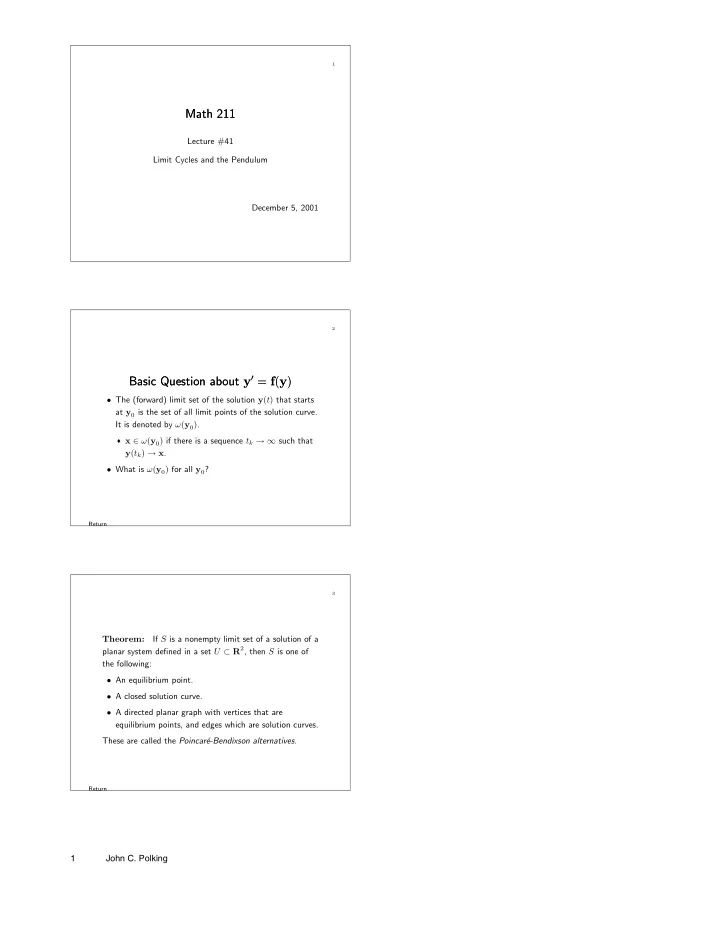
1 Math 211 Math 211 Lecture #41 Limit Cycles and the Pendulum December 5, 2001 2 Basic Question about y = f ( y ) Basic Question about y = f ( y ) The (forward) limit set of the solution y ( t ) that starts at y 0 is the set of all


slide-1
SLIDE 1

1

Math 211 Math 211

Lecture #41 Limit Cycles and the Pendulum December 5, 2001

Return

2

Basic Question about y′ = f(y) Basic Question about y′ = f(y)

  • The (forward) limit set of the solution y(t) that starts

at y0 is the set of all limit points of the solution curve. It is denoted by ω(y0).

x ∈ ω(y0) if there is a sequence tk → ∞ such that

y(tk) → x.

  • What is ω(y0) for all y0?

Return

3

Theorem: If S is a nonempty limit set of a solution of a planar system defined in a set U ⊂ R2, then S is one of the following:

  • An equilibrium point.
  • A closed solution curve.
  • A directed planar graph with vertices that are

equilibrium points, and edges which are solution curves. These are called the Poincar´ e-Bendixson alternatives. 1 John C. Polking

slide-2
SLIDE 2

Return Poincar´ e-Bendixson alternatives

4

Poincar´ e-Bendixson Theorem Poincar´ e-Bendixson Theorem

Theorem: Suppose that R is a closed and bounded planar region that is positively invariant for a planar

  • system. If R contains no equilibrium points, then there is a

closed solution curve in R.

  • The theorem is true if the set R is negatively invariant.

5

Examples Examples

  • # 1.

x′ = x + y − x(x2 + 3y2) y′ = −x + y − 2y3

The set {(x, y) | 0.5 ≤ x2 + y2 ≤ 1} is positively

invariant.

  • # 2. Rayleigh’s example: z′′ + µz′[(z′)2 − 1] + z = 0.

There is a limit cycle.

Return

6

The Pendulum The Pendulum

  • The angle θ satisfies the nonlinear differential equation

mLθ′′ = −mg sin θ − D θ′,

  • r

θ′′ + D mLθ′ + g L sin θ = 0.

We will write this as

θ′′ + d θ + b sin θ = 0. 2 John C. Polking

slide-3
SLIDE 3

Return Pendulum

7

The Pendulum System The Pendulum System

  • Introduce ω = θ′ to get the system

θ′ = ω ω′ = −b sin θ − d ω

  • The equilibrium points are (k π, 0)T where k is any

integer.

If k is odd the equilibrium point is a saddle. If k is even the equilibrium point is a center if d = 0

  • r a sink if d > 0.

Return Pendulum

8

The Inverted Pendulum The Inverted Pendulum

  • The angle θ measured from straight up satisfies the

nonlinear differential equation mLθ′′ = mg sin θ − D θ′,

  • r

θ′′ + D mLθ′ − g L sin θ = 0.

We will write this as

θ′′ + d θ − b sin θ = 0.

Return Inverted pendulum Pendulum system

9

The Inverted Pendulum System The Inverted Pendulum System

  • Introduce ω = θ′ to get the system

θ′ = ω ω′ = b sin θ − d ω

  • The equilibrium point at (0, 0)T is a saddle point and

unstable.

  • Can we find an automatic way of sensing the departure
  • f the system from (0, 0)T and moving the pivot to

bring the system back to the unstable point at (0, 0)T ?

Experimentally the answer is yes.

3 John C. Polking

slide-4
SLIDE 4

Return Inverted pendulum Inverted pendulum system

10

The Control System The Control System

  • If we apply a force v moving the pivot to the right or

left, then θ satisfies mLθ′′ = mg sin θ − D θ′ − v cos θ,

  • The system becomes

θ′ = ω ω′ = b sin θ − d ω − u cos θ, where u = v/mL.

  • The force is a linear response to the detected values of

θ and ω, so u = c1θ + c2ω, where c1 and c2 are constants.

Return Inverted pendulum Inverted pendulum system Controls

11

The Controlled System The Controlled System

  • The Jacobian at the origin is

J =

  • 1

b − c1 −d − c2

  • The origin is asymptotically stable if T = −(d+c2) < 0

and D = c1 − b > 0. Therefore require c1 > b = g L and c2 > −d = − D mL. 4 John C. Polking