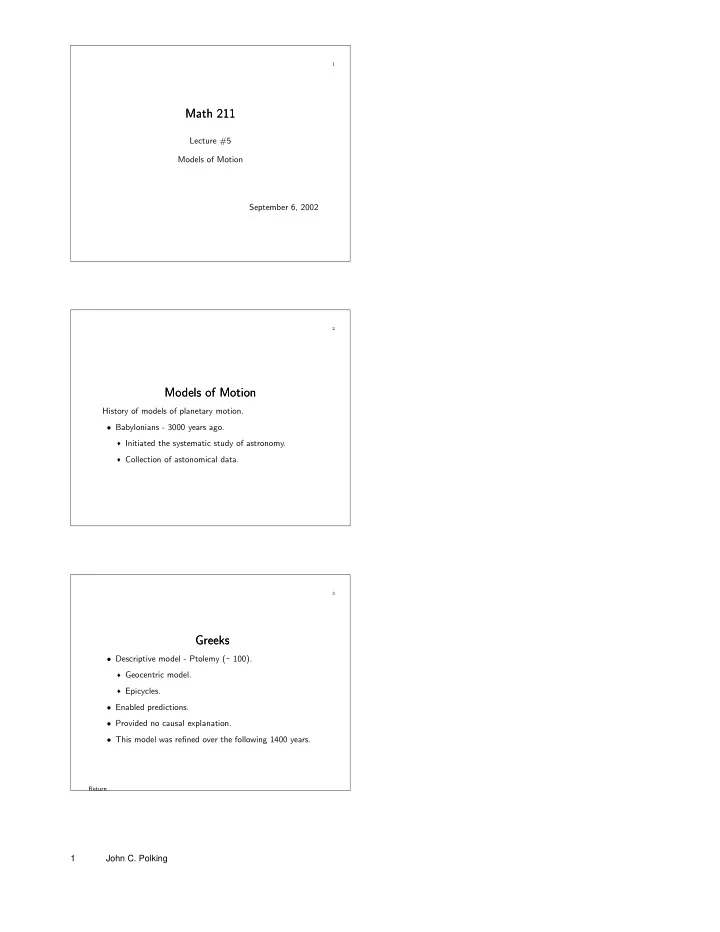
Math 211 Math 211 Lecture #5 Models of Motion September 6, 2002 - - PDF document

math 211 math 211
SMART_READER_LITE
LIVE PREVIEW

Math 211 Math 211 Lecture #5 Models of Motion September 6, 2002 - - PDF document

1 Math 211 Math 211 Lecture #5 Models of Motion September 6, 2002 2 Models of Motion Models of Motion History of models of planetary motion. Babylonians - 3000 years ago. Initiated the systematic study of astronomy. Collection


slide-1
SLIDE 1

1

Math 211 Math 211

Lecture #5 Models of Motion September 6, 2002

2

Models of Motion Models of Motion

History of models of planetary motion.

  • Babylonians - 3000 years ago.

Initiated the systematic study of astronomy. Collection of astonomical data.

Return

3

Greeks Greeks

  • Descriptive model - Ptolemy (˜ 100).

Geocentric model. Epicycles.

  • Enabled predictions.
  • Provided no causal explanation.
  • This model was refined over the following 1400 years.

1 John C. Polking

slide-2
SLIDE 2

Return Greeks

4

Nicholas Copernicus (1543) Nicholas Copernicus (1543)

  • Shifted the center of the universe to the sun.
  • Fewer epicycles required.
  • Still descriptive and provided no causal explanation.
  • The shift to a sun centered universe was a major

change in human understanding of their place in the universe.

Return Greeks Copernicus

5

Johann Kepler (1609) Johann Kepler (1609)

  • Based on experimental work of Tycho Brahe (1400).
  • Three laws of planetary motion.

1. Each planet moves in an ellipse with the sun at

  • ne focus.

2. The line between the sun and a planet sweeps out equal areas in equal times. 3. The ratio of the cube of the semi-major axis to the square of the period is the same for each planet.

  • This model was still descriptive and not causal.

Return

6

Isaac Newton Isaac Newton

  • Three major contributions.

Laws of mechanics. ◮ Second law — F = ma. Universal law of gravity. Fundamental theorem of calculus. ◮ f ′ = g ⇔

  • g(x) dx = f(x) + C.

◮ Invention of calculus. Principia Mathematica 1687

2 John C. Polking

slide-3
SLIDE 3

Return Greeks Copernicus Kepler Newton 1

7

Isaac Newton (cont.) Isaac Newton (cont.)

  • Laws of mechanics and gravitation were based on his
  • wn experiments and his understanding of the

experiments of others.

  • Derived Kepler’s three laws of planetary motion.
  • This was a causal explanation.

For any mechanical motion. Still used today.

Return Newton 1 Newton 2

8

Isaac Newton (cont.) Isaac Newton (cont.)

  • The Life of Isaac Newton by Richard Westfall,

Cambridge University Press 1993.

  • Problems with Newton’s theory.

The force of gravity was action at a distance. Physical anomalies. ◮ The Michelson-Morley experiment (1881-87).

Return Newton Problems

9

Albert Einstein Albert Einstein

  • Special theory of relativity – 1905.
  • General theory of relativity – 1916.

Gravity is due to curvature of space-time. Curvature of space-time is caused by mass. Gravity is no longer action at a distance.

  • All known anomalies explained.

3 John C. Polking

slide-4
SLIDE 4

Return

10

Unified Theories Unified Theories

  • Four fundamental forces.

Gravity, electromagnetism, strong nuclear, and weak

nuclear.

  • Last three can be unified by quantum mechanics. —

Quantum chromodynamics.

  • Currently there are attempts to include gravity.

String theory. The Elegant Universe : Superstrings, hidden

dimensions, and the quest for the ultimate theory by Brian Greene, W.W.Norton, New York 1999.

11

The Modeling Process The Modeling Process

  • It is based on experiment and/or observation.
  • It is iterative.

For motion we have ≥ 6 iterations. After each change in the model it must be checked

by further experimentation and observation.

  • It is rare that a model captures all aspects of the

phenomenon.

Return

12

Linear Motion Linear Motion

  • Motion in one dimension — x(t) is the distance from a

reference position.

  • Example: motion of a ball in the earth’s gravity — x(t)

is the height of the ball above the surface of the earth.

  • Velocity: v = x′
  • Acceleration: a = v′ = x′′.

4 John C. Polking

slide-5
SLIDE 5

Return Definitions

13

  • Acceleration due to gravity is (approximately) constant

near the surface of the earth F = −mg, where g = 9.8m/s2

  • Newton’s second law: F = ma
  • Equation of motion: ma = −mg,

which becomes x′′ = −g

  • r

x′ = v, v′ = −g.

Return

14

  • Solving the system

x′ = v, v′ = −g

  • Integrate the second equation:

v(t) = −gt + c1

  • Substitute into the first equation and integate:

x(t) = −1 2gt2 + c1t + c2.

Return

15

Air Resistance Air Resistance

Acts in the direction opposite to the velocity. Therefore R(x, v) = −r(x, v)v where r(x, v) ≥ 0. There are many models. We will look at two different cases. 1. The resistance is proportional to velocity. 2. The magnitude of the resistance is proportional to the square of the velocity. 5 John C. Polking

slide-6
SLIDE 6

Return Resistance

16

Resistance Proportional to Velocity Resistance Proportional to Velocity

  • R(x, v) = −rv, r a positive constant.
  • Total force: F = −mg − rv
  • Newton’s second law: F = ma
  • Equation of motion:

mx′′ = −mg − rv

  • r

x′ = v, v′ = −mg + rv m .

  • The equation v′ = −mg + rv

m is separable.

Return R = 0

17

  • Solution is v(t) = Ce−rt/m − mg

r .

  • Notice

lim

t→∞ v(t) = −mg

r .

  • The terminal velocity is vterm = −mg

r .

Return Resistance

18

Magnitude of Resistance Proportional to the Square of the Velocity Magnitude of Resistance Proportional to the Square of the Velocity

  • R(x, v) = −k|v|v, k a positive constant.
  • Total force: F = −mg − k|v|v.
  • Equation of motion:

mx′′ = −mg − k|v|v

  • r

x′ = v, v′ = −mg + k|v|v m .

  • The equation for v is separable.

6 John C. Polking

slide-7
SLIDE 7

Return

19

  • Suppose a ball is dropped from a high point. Then

v < 0.

  • The equation is v′ = −mg + kv2

m .

  • The solution is

v(t) = mg k Ae−2t√

kg/m − 1

Ae−2t√

kg/m + 1

.

  • The terminal velocity is

vterm = −

  • mg/k.

Return R = 0 R = −rv R = −k|v|v

20

Solving for x(t) Solving for x(t)

  • Integrating x′ = v(t) is sometimes hard.
  • Use the trick (see Exercise 2.3.7):

a = dv dt = dv dx · dx dt = dv dx · v

  • The equation

v dv dx = a is usually separable.

Return

21

Problem Problem

A ball is projected from the surface of the earth with velocity v0. How high does it go?

  • At t = 0, we have x(0) = 0 and v(0) = v0.
  • At the top we have t = T, x(T) = xmax, and

v(T) = 0. 7 John C. Polking

slide-8
SLIDE 8

Problem

22

R = 0 R = 0

The acceleration is a = −g. The equation v dv dx = a becomes v dv = −g dx

v0

v dv = − xmax g dx −v2 2 = −gxmax xmax = v2 2g .

Problem

23

R = −rv R = −rv

The acceleration is a = −(mg + rv)/m. The equation v dv dx = a becomes

v0

v dv rv + mg = − xmax dx m . Solving, we get xmax = m r

  • v0 − mg

r ln

  • 1 + rv0

mg

  • .

Problem

24

R = −k|v|v R = −k|v|v

Since v > 0, the acceleration is a = −mg + kv2 m . The equation v dv dx = a becomes

v0

v dv kv2 + mg = − xmax dx m . Solving, we get xmax = m 2k ln

  • 1 + kv2

mg

  • .

8 John C. Polking