Materials Purity: Ultra-Low-Background Copper, ICP-MS Assay, and - - PowerPoint PPT Presentation

materials purity ultra low background copper icp ms assay
SMART_READER_LITE
LIVE PREVIEW

Materials Purity: Ultra-Low-Background Copper, ICP-MS Assay, and - - PowerPoint PPT Presentation

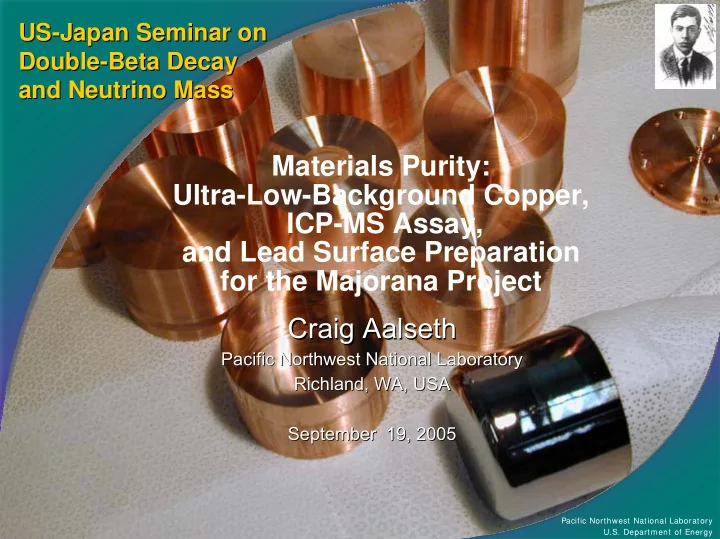
US- -Japan Seminar on Japan Seminar on US Double- -Beta Decay Beta Decay Double and Neutrino Mass and Neutrino Mass Materials Purity: Ultra-Low-Background Copper, ICP-MS Assay, and Lead Surface Preparation for the Majorana Project


slide-1
SLIDE 1

Pacific Northwest National Laboratory U.S. Department of Energy

US US-

  • Japan Seminar on

Japan Seminar on Double Double-

  • Beta Decay

Beta Decay and Neutrino Mass and Neutrino Mass

Materials Purity: Ultra-Low-Background Copper, ICP-MS Assay, and Lead Surface Preparation for the Majorana Project Craig Aalseth Craig Aalseth

Pacific Northwest National Laboratory Pacific Northwest National Laboratory Richland, WA, USA Richland, WA, USA September 19, 2005 September 19, 2005

slide-2
SLIDE 2

2

2005/9/26

Outline

Motivation Electroformed Copper ICP-MS Copper Assay Lead Surface Preparation Summary

slide-3
SLIDE 3

3

2005/9/26

Materials are Critical

Depth is only part of the equation Must also have

Pure materials Environmental

gamma shielding

Environmental

neutron shielding

Residual muon

shielding

Muon-induced secondary neutrons can dominate under good conditions

slide-4
SLIDE 4

4

2005/9/26

See talk by

  • T. Hossbach
slide-5
SLIDE 5

5

2005/9/26

Copper Motivation

Commercial high-purity copper is an attractive material for constructing ultra-low-background spectrometers. Thermal, mechanical, electrical, and vacuum properties enable vacuum cryostats, crystal mounts, heat conductors, electrical interconnects, etc. When even higher purity is required, additional electrolytic and chemical purification can be combined with the final fabrication step, resulting in “electroformed” copper parts of extreme purity. This process can be done underground, providing a potential way to eliminate cosmogenic activation products seen in copper with above-ground exposure. Additional purity improvements seem possible with modest additional chemistry.

slide-6
SLIDE 6

6

2005/9/26

Ultra-Low-Background Ultra Electroformed Copper Ultra-

  • Low

Low-

  • Background

Background Electroformed Copper Electroformed Copper

Strength equal to OFHC Technology has small physical footprint for production Can be easily formed into thin, low-mass parts Purity established with IGEX* experience, development continues

*(International Germanium EXperiment)

Electroformed cups shown have wall thickness of only 250 µm!

slide-7
SLIDE 7

7

2005/9/26

Low-Background Electroformed Copper Low Key Elements Low-

  • Background Electroformed Copper

Background Electroformed Copper Key Elements Key Elements

Semiconductor-grade acids Glassware-free handling Copper sulfate purified by recrystallization Baths circulated with continuous microfiltration to remove oxides and precipitates Continuous barium scavenge removes radium Cover gas in plating tanks reduces

  • xide formation

Periodic surface machining during production minimizes dendritic growth Low-background detector and electroformed cryostat during assembly

slide-8
SLIDE 8

8

2005/9/26

Electroforming Overview Electroforming Overview Electroforming Overview

N2 cover gas

H2SO4 CuSO4

+

  • F

I L T E R

BaSO4

PUMP Secondary Tank

C

O I L

Chiller/ Heater

230Th tracer

study shows >8,000 rejection

230 230Th tracer

Th tracer study shows study shows >8,000 rejection >8,000 rejection

slide-9
SLIDE 9

9

2005/9/26

Plating Bath Process Parameters Plating Bath Process Parameters Plating Bath Process Parameters

3 mg/l Thiourea ~1 mg/l BaSo4 1 mg/l CoSO4 30 mg/l HCl 75 g/l H2SO4 188 g/l CuSO4 Concentration Constituent

Plating is done onto polished, cleaned, stainless steel mandrels in the shape of the desired parts Current density is ~40 mA/cm2 Plating rate is ~0.05 mm/h BaSO4 collects in the micro- filtration stage and acts as radium scavenge CoSO4 was added as a holdback carrier for the cosmogenic

56,57,58,60Co present in the

starting copper HCl and Thiourea affect copper crystal nucleation and grain size

slide-10
SLIDE 10

10

2005/9/26

Chemistry & Cosmogenics Chemistry & Cosmogenics Chemistry & Cosmogenics

Further improvements were made in the chemistry for electroformed Cu production U, Th progeny reduced substantially (100x, 10x) over early work [Bro95] Underground production would totally eliminate cosmogenic 60Co, other less- important cosmogenics Current chemistry development continues (tracer studies, mass balance, etc.)

NIM A292 (1990) 337-342.

E ar ly data showing c osmoge nic s

Ge Cu Both

Re-analysis (in progress) suggests greater purity… ~1995 to pr e se nt E le c tr

  • for

me d c oppe r

r adioc he mistr y gains:

  • H2SO 4 Pur

ity

  • R

e c rystalize d CuSO 4

  • Bar

ium sc ave nge R e sults:

226R

a <25 µBq/ kg

228T

h 9 µBq/ kg

(Br

  • dzinski e t al, Jour

nal of R adioanalytic al and Nuc le ar Che mistry, 193 (1) 1995 pp. 61-70)

~1995 to pr e se nt E le c tr

  • for

me d c oppe r

r adioc he mistr y gains:

  • H2SO 4 Pur

ity

  • R

e c rystalize d CuSO 4

  • Bar

ium sc ave nge R e sults:

226R

a <25 µBq/ kg

228T

h 9 µBq/ kg

(Br

  • dzinski e t al, Jour

nal of R adioanalytic al and Nuc le ar Che mistry, 193 (1) 1995 pp. 61-70)

L NGS NOSV High-Pur ity Cu:

226R

a <18 µBq/ kg

228T

h <12 µBq/ kg

(M. L aube nste in e t al, Applie d R adiation and Isotope s, 61 (2004) 167- 172)

L NGS NOSV High-Pur ity Cu:

226R

a <18 µBq/ kg

228T

h <12 µBq/ kg

(M. L aube nste in e t al, Applie d R adiation and Isotope s, 61 (2004) 167- 172)

slide-11
SLIDE 11

11

2005/9/26

Electroformed Copper Surface Cleaning & Passivation Electroformed Copper Electroformed Copper Surface Cleaning & Passivation Surface Cleaning & Passivation

Goal was to find copper cleaning process to replace destructive nitric acid etch Surface passivation was also desired Experiments inspired by CUORE conversations Tested several oxide removal methods Tested ~30 passivation chemistries H2O2-based cleaning & citric acid passivation were final result

slide-12
SLIDE 12

12

2005/9/26

Examples from MEGA Detector Examples Examples from from MEGA MEGA Detector Detector

slide-13
SLIDE 13

13

2005/9/26

Examples from MEGA Detector Examples Examples from from MEGA MEGA Detector Detector

slide-14
SLIDE 14

14

2005/9/26

Electroforming R&D is Ongoing Electroforming R&D is Ongoing Electroforming R&D is Ongoing

slide-15
SLIDE 15

15

2005/9/26

LANL-PNNL LANL Underground Cu Experiment LANL-

  • PNNL

PNNL Underground Cu Experiment Underground Cu Experiment

Equipment underground at WIPP LANL, Majorana team will

  • perate

Will demonstrate cosmogenic suppression

slide-16
SLIDE 16

ICPMS Copper Purity Assay ICPMS Copper Purity Assay ICPMS Copper Purity Assay

slide-17
SLIDE 17

17

2005/9/26

Motivation Motivation Motivation

Direct radiometric methods require large sample mass (~10 kg), long count time (~3 months), have reached limit Producing material for next-generation detector (Majorana) will require careful QA of even small parts Inductively-Coupled Plasma – Mass Spectrometry (ICP-MS) has good potential for reaching radiopurity goals

slide-18
SLIDE 18

18

2005/9/26

Basic ICP/MS

PLASMA

mass spectrometer Quadrupole sample & aerosols: liquid gases solids ion detection EM FC Daly ASAT

slide-19
SLIDE 19

19

2005/9/26

PNNL ICP/MS Equipment PNNL ICP/MS Equipment PNNL ICP/MS Equipment

slide-20
SLIDE 20

20

2005/9/26

Sample Introduction Methodologies Sample Introduction Methodologies Sample Introduction Methodologies

slide-21
SLIDE 21

21

2005/9/26

DETECTION IMPROVEMENT IN ICP/MS DETECTION IMPROVEMENT IN ICP/MS

1E5 1E6 1E7 1E8 1E9 1E10 1986 1990 1993 1996 1996+USN YEAR 17000 fg/mL 4500 fg/mL 450 fg/mL 45 fg/mL 4 fg/mL ACPS

slide-22
SLIDE 22

22

2005/9/26

ICP-MS DETECTION RANGES ICP

Aqueous Standards

ICP-

  • MS DETECTION RANGES

MS DETECTION RANGES

Aqueous Standards Aqueous Standards

WEIGHT PREFIX 238U ATOMS/ml 10-3 (ppt) Milli 2.53x10¹⁸ 10-6 (ppm) Micro 2.53x10¹⁵ 10-9 (ppb) Nano 2.53x10¹² 10-12 (ppt) Pico 2.53x10⁹ 10-15 (ppq) Femto 2.53x10⁶ 10-18 (pp?) Atto 2530 10-21 (pp??) Zepto 2.53

10-24 (pp???) Guaca 0.00253 NORMAL ICP-MS RANGE THIS WORK

slide-23
SLIDE 23

23

2005/9/26

Direct Atto-gram/mL Detection Direct Direct Atto Atto-

  • gram/mL

gram/mL Detection Detection

1E-2 1E-1 1E0 1E1 1E2 1E3 1E4 230 232 234 236 238 240 242 244

2.0E+02 1.2E+04 1.0E+02 4.0E+01 1.2E+03 4.6E+01 2.5E+02 1.8E+05 2.2E+01 2.9E+01 1.9E+01 7.2E+01 5.6E+01 2.7E+01

Response (cps) 250 ag/mL Np-237 25000 MHz/ppm amu

slide-24
SLIDE 24

24

2005/9/26

Copper Sample Preparation Copper Sample Preparation Copper Sample Preparation

Nominal 1g copper sample is placed in 75ml clear Teflon bottle 20ml 7.5M HNO3 (<0.05pg/ml) is added Tracer (229Th or 230Th) is added at about 10% of expected

232Th value

Gentle heat is applied until dissolution is complete Copper goes to +2 state

slide-25
SLIDE 25

25

2005/9/26

Thorium Separation Thorium Separation Thorium Separation

Column is 200-400 mesh anion resin Column is first washed with H2O Column is conditioned with 7.5M HNO3 Sample is loaded (20 ml 7.5M HNO3) Wash copper from column void volume (7.5M HNO3) Elute (strip) thorium with 0.5M HNO3

Elute in 3 ml directly to MS

chemist explains to me how this works

  • n my whiteboard…
slide-26
SLIDE 26

26

2005/9/26

ICP-MS Instrument ICP ICP-

  • MS Instrument

MS Instrument

Condition instrument with 0.5M HNO3 until stable background is achieved Switch in eluent (also 0.5M HNO3) and wait for signal to stabilize Measure (integrate) mass response during eluent ionization

Typically ~6 integration periods of 30 seconds each Provides 10 seconds on each of three mass peaks

(230.0, 230.5, 232.0) for each integration period

slide-27
SLIDE 27

27

2005/9/26

Data Reduction Data Reduction Data Reduction

Subtract instrument background from eluent signal

This is from 0.5M HNO3 reagent and is small

Subtract process blank from eluent signal

This is from an eluent blank prepared without copper

and is larger

Quote result (pg/g) based on tracer Convert to µBq/kg equivalent 232Th (4x multiplier)

slide-28
SLIDE 28

28

2005/9/26

First Copper Result First Copper Result First Copper Result

Two 1-g samples of MEGA inner-can copper were analyzed Sample #1 (0.882 g)

The process blank was 6.0±0.3 pg/g The sample yielded a value of

7.3±0.7 pg/g (gross)

  • r 1.2±0.8 pg/g (net)

This is a net 232Th activity of 4.9±2.9 µBq/kg

Sample #1 (0.936 g)

The process blank was 5.7±0.3 pg/g The sample yielded a value of

7.0±0.6 pg/g (gross)

  • r 1.3±0.7 pg/g (net)

This is a net 232Th activity of 5.2±2.8 µBq/kg

slide-29
SLIDE 29

29

2005/9/26

Cu ICP-MS Next Steps Cu ICP Cu ICP-

  • MS Next Steps

MS Next Steps

Sensitivity

Preliminary result appears to be first positive indication of Th in Cu Anion column cleanup of 7.5M HNO3 planned Sub-boiling distillation to further clean HNO3 if necessary Instrument background now 6x lower

Documentation

Process will eventually transition into “service center” activity Will benefit from QA, standardized reporting

Priority

Repeat process blanks Repeat and extend copper measurements (starting stock, other Cu) Test reagent cleanup chemistry

slide-30
SLIDE 30

30

2005/9/26

Pb Cleaning Pb Cleaning Pb Cleaning

Ancient lead is desired to avoid 210Pb backgrounds, present in all modern lead Materials are usually recovered needing extensive surface cleaning Even new lead may need oxide removal for safety reasons “Spanish” Lead~1542 “New” Lead ~1950 to ~1980

slide-31
SLIDE 31

HNO3 (1%) H2O2 (3%)

H2O

Rinse

H2O

Rinse

H2O

Rinse

H2O

Rinse

C2H4O2

Acetic Acid

#1

Unclean lead inserted in the cycle.

#3

When lead is clean, remove from cycle; execute final rinse.

H2O Rinse

#2

Repeat Cycle as necessary

#4

Package lead in clean protective box for transport

Lead Brick Cleaning Process Ethyl Alcohol

Final Rinse

slide-32
SLIDE 32

32

2005/9/26

Starting Material Starting Starting Material Material

slide-33
SLIDE 33

Acetate Formation Acetate Acetate Formation Formation

slide-34
SLIDE 34

34

2005/9/26

Acetate Removal Acetate Acetate Removal Removal

slide-35
SLIDE 35

35

2005/9/26

Final Result Final Final Result Result

slide-36
SLIDE 36

36

2005/9/26

Summary Summary Summary

Ultra-Low-Background Electroformed copper is an established technology, improvements continue R&D to reach Majorana assay targets underway

ICP-MS expected to reach Majorana target sensitivity for

232Th in copper

Surface α, β assay for Pb and Cu are planned

Underground electroforming R&D in progress in two underground locations

Soudan (SBIR partner Jim Reeves) WIPP (LANL Majorana team, Steve Elliott, et al.)

Surface preparation chemistry being developed for lead

slide-37
SLIDE 37

37

2005/9/26

Acknowledgements Acknowledgements Acknowledgements

Kate Antolick, Tom Farmer, Erin Fuller, Eric Hoppe, Todd Hossbach, Jeremy Kephart, Tashi Parsons- Moss, John Orrell, John Smart